Theater Review: Pain Is Silent in 'Spring Awakening'
In this Sandbox Collective production, director Andrei Nikolai Pamintuan leans into the shadows.

Published on Mar 1, 2026
In the second scene of Act II, Moritz (alternately played by Nic Chien and Omar Uddin) stands under the spotlight that disperses as if moonshine peeks through layers of dark clouds. He mutters, "So dark, so dark, so dark," then sets the gun in his mouth. But instead of a loud bang, the stage blacks out. We don’t need to hear it. The silence already echoes a hundred-fold within the walls of the brand-new Proscenium Theater's Black Box.
It is this kind of silence that makes Spring Awakening, with music by Duncan Sheik and book and lyrics by Steven Sater, resonate even two decades after it premiered Off-Broadway. This version, which is staged by The Sandbox Collective, is directed by Andrei Nikolai Pamintuan, with musical direction by Ejay Yatco. It runs until March 22.
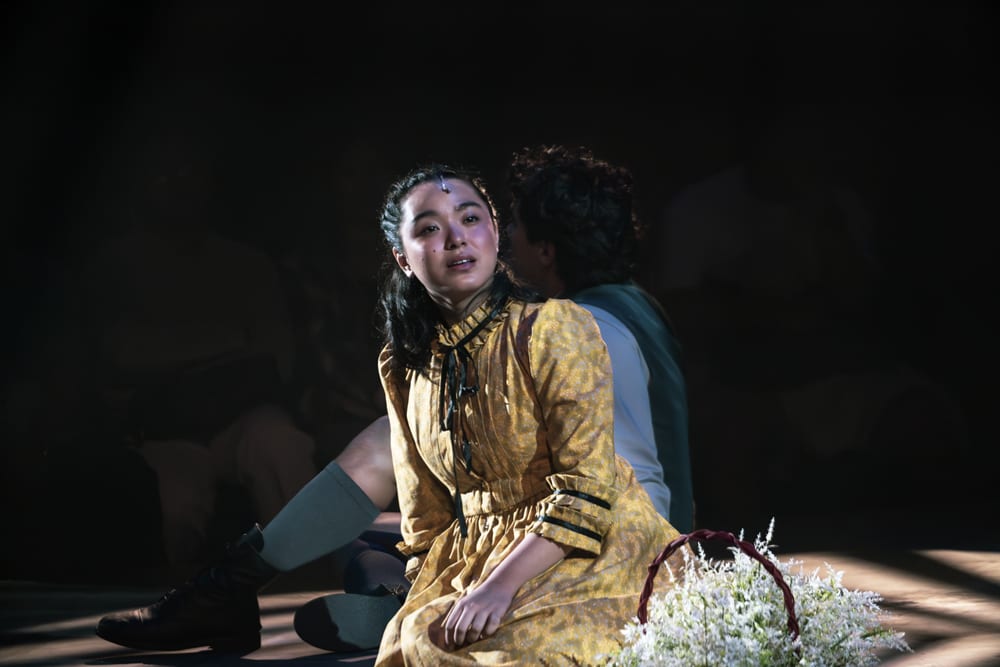
The Atmosphere of Silence
The set (designed by Wika Nadera) immediately conveys this silence and darkness. Gray limewash-like texture extends from the stage floor to the backdrop, where an alcove of beams marked by asymmetric lines and sharp corners is built. There in the recesses and under dim light, the live band plays—making music and creating a statement in an oppressive atmosphere.
Spring Awakening is billed as a rock musical, but the score feels more alternative rock or even folk if we're strict about genres. Here and there, Ejay Yatco (musical director) adds a few bars to the arrangement, reinforcing the punch in the music and, again, emphasizing the heaviness where it is needed in a largely vulnerable production that’s handled with tenderness. There are more stomps in "All That's Known," "I Believe," and "Totally Fucked", at least when compared to the Original Broadway Cast Recording on Spotify. But there’s also softness in “Mama Who Bore Me.” It helps (a lot) that this brand-new Black Box has almost perfect acoustics. It turns out the secret to crisp and balanced sound in a black box isn't a miracle—it’s just a new building.
Onstage, a tree, or at least what's part of it, hangs from the ceiling, standing in for Melchior's favorite oak tree. "When you lean back against this oak, and stare up at the clouds, you start to think hypnotic things," he tells Wendla (Sheena Belarmino). Only here, the oak is as high as the clouds—because for the children in this dark milieu of late 19th-century Germany, dreams and aspirations can only be imagined, never fulfilled.
For most of the show, this physical space is enveloped in a faint glow, with the spotlight either dispersed into thin lightrays as in the aforementioned Moritz scene or perfectly configured to make silhouettes onstage (light design by D Cortezano). This play in shadow and light blends well in Spring Awakening’s atmosphere of silence.
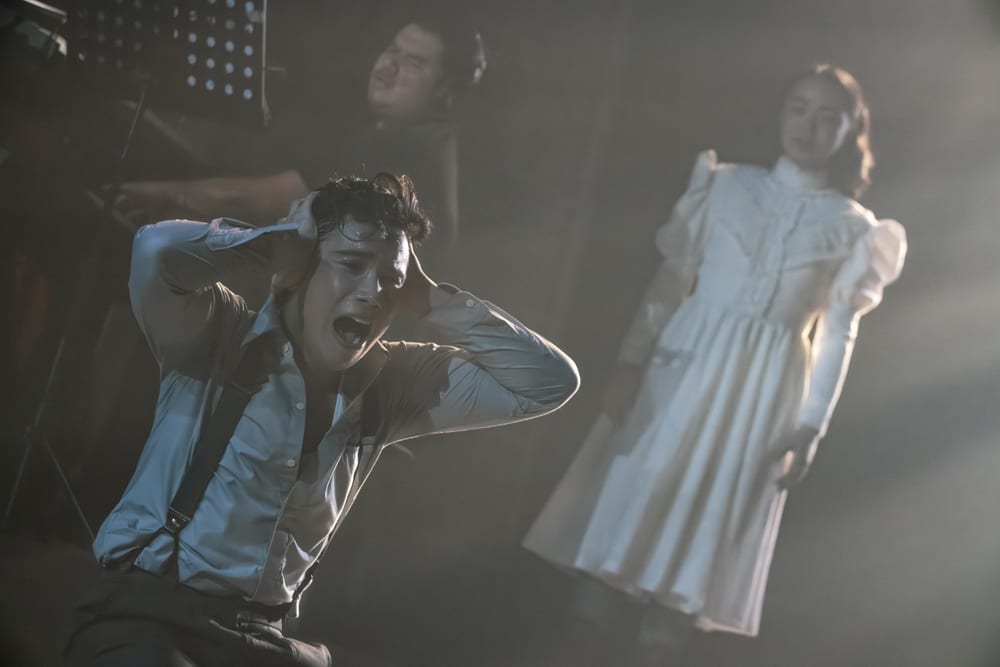
The Spotlight on Actors
While the technical elements establish a cohesive atmosphere, this Sandbox Collective production ultimately finds its pulse in the cast. The actors carry the heavy burden of the play’s silence and darkness, transforming Victorian repression into something haunting.
Wendla is immediately established as a doe-eyed teen who’s ultimately failed by society, and Belarmino succeeds in conveying this arc, all while holding the audience close through a gripping performance. But this isn't a solo act, as her energy tends to be dependent on who is sharing the stage. On preview night, for example, the innocence of Belarmino’s Wendla is emphasized with the strong presence of Nacho Tambunting’s Melchior. On the other hand, her character is at its most vulnerable with the weakness of Alex Diaz’s Melchior—for better or worse.
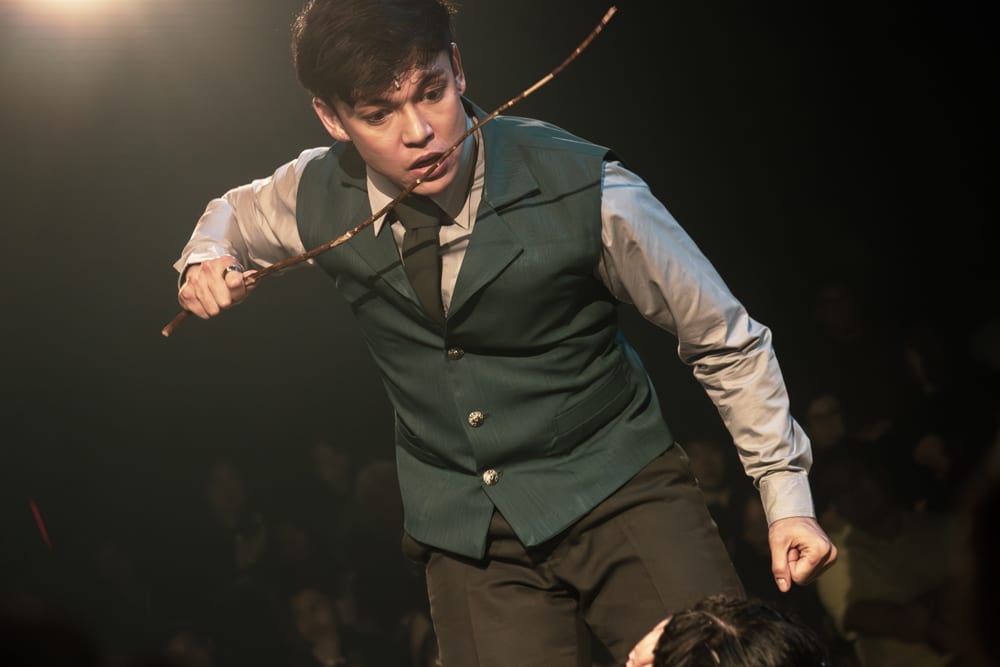
Tambunting tends to take command of the room, both with his gestures and voice. Diaz goes for an opposite treatment, which makes for a sensible choice for this tragedy, but at times is amiss in scenes where we need to see his anger (like in the beating scene). D Cortezano’s flashes of red light match every whipping motion rooted in the pent-up rage in Tambunting’s Melchior.
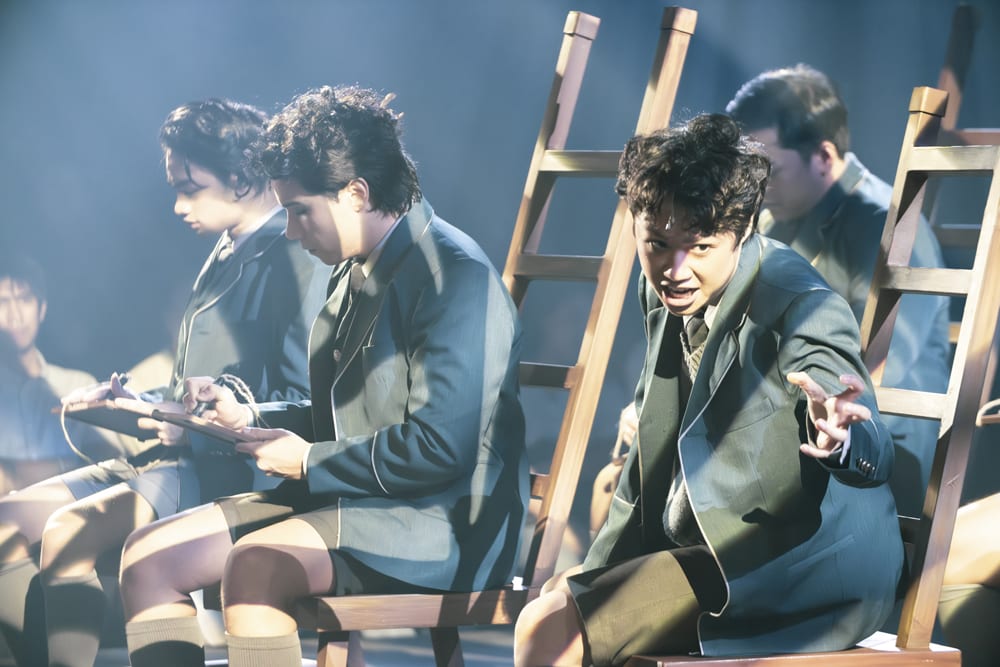
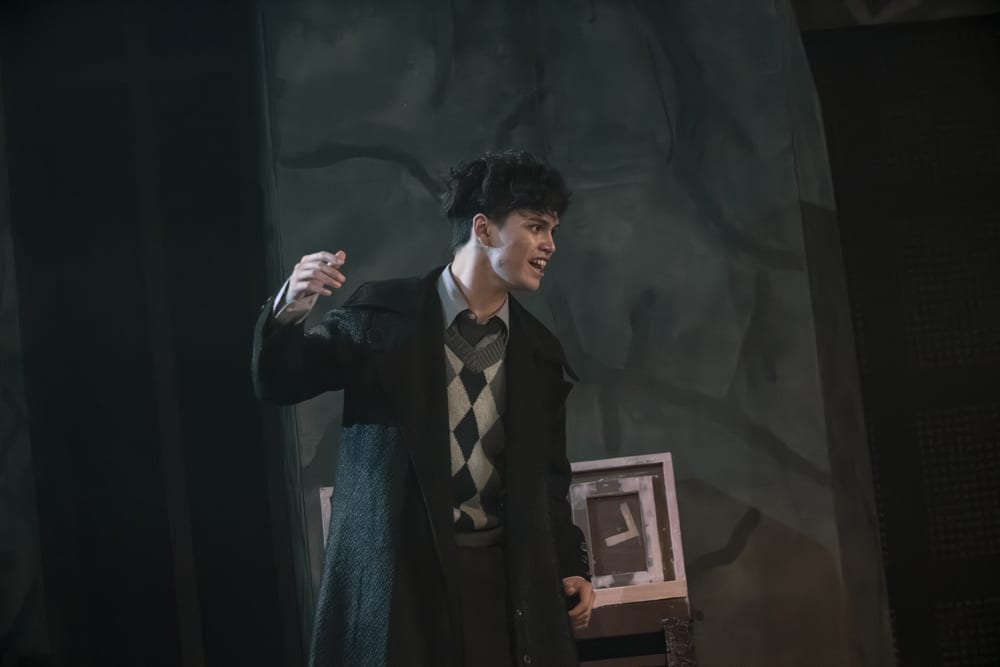
Tambunting's alpha energy also provides a sharp foil to Chien’s fractured Moritz. Chien's performance is a study in physicalized trauma: characterized by certain pauses in his songs, a descent into derangement that bleeds through his every line, and hands that seem to perpetually claw at the air. The latter seems to spring forth from many of the ensemble’s choreography (by Nunoy Van Den Burgh), almost signaling his solo struggle that’s as heavy as the collective’s.
Omar Uddin, on the other hand, seems to have mastered the art of the troubled character, especially after his Bitoy in Quomodo Desolata Es? Isang Dalamhati and his Josh in Bar Boys. While his performance is rooted in authenticity, it is also expected.
As the individual arcs of these students collide, the production shifts from a collection of performances into a singular experience: the tragedy of Spring Awakening isn’t in the bellows of Melchior after finding out about the death of Wendla, but in the spaces where the voices fail. The technical precision of the production’s design, from the lights to the sound, highlights the quiet chaos in the material. While rock music and feverish choreography provide the heartbeat, it is the heavy and suffocating silence that ultimately breaks the heart.

This is a review of the press preview on February 12, with Nacho Tambunting as Melchior, Nic Chien as Moritz, and Ana Abad Santos as Adult Woman; and the 8 p.m. performance on February 14, with Alex Diaz as Melchior, Omar Uddin as Moritz, Menchu Lauchengo-Yulo as Adult Woman, and Gabo Tiongson (swing) as Hanschen. The show opened on February 13.
Spring Awakening is presented through special arrangement with Music Theatre International (MTI), New York, NY, USA. It runs until March 22 at The Black Box, The Proscenium Theater, Rockwell, Makati. Tickets are available through Ticket2Me, with prices ranging from P2,900 to P3,900.
ALSO READ:
More Shows, New Audiences: How Philippine Theater Is Experiencing a Renaissance
Theater Review: Les Misérables: World Tour Spectacular Is Anything But 'Just a Concert'
Theater Review: Form Follows Content in 'Children of the Algo'
Christa I. De La Cruz is a Palanca Award-winning writer with over 15 years of experience in feature writing for print and digital media. She earned her Sertipiko sa Malikhaing Pagsulat sa Filipino from the University of the Philippines Diliman and holds an MFA in Creative Writing from De La Salle University.
View More Articles About: