Paraiso, Where Fiction Meets Non-Fiction
This book by Christoph Dehn is full of personal stories of people’s lives in the Party.
Published on Nov 4, 2026
Paraiso, a book written by Christoph Dehn (2025), is about two love stories: the one between Jan Grosz (Jan) and Diwata de los Santos (Diwa), and the other between CPP (Communist Party of the Philippines) kasamas and the Party (movement).
The story starts with a recently retired Jan arriving in the Philippines. He looks for answers, which he could only find from Diwa. But first he has to find her. Ironically, she is the one who finds him: she writes him a letter via snail mail to his address in Germany. His daughter Jules scans and sends him the letter, and he answers to a Postbus in Manila.
Jan and Diwa are somehow connected to two deaths – of Bishop Merten Gonzales and Maria Manoto. The Bishop was chairman of the Board of CDC (Coastal Development Center) in San Fernando, La Union, and Maria was its Director (in the 1990s). CDC is the main NGO beneficiary of Weltverantwortung (WeFe), a German Funding Agency based in Bonn, Germany.
Bishop Gonzales was implicated in an investigation of missing funds (which were donated by WeFe). He had given the money to his mistress.
Jan gets an invitation from the Bishop’s daughter to visit his grave, as was arranged by the CDC director. Abigail, or Abi, greeted Jan at her house, denying that her father was killed. She said that her father was extremely troubled in his last days. She remembered being called the “robber’s daughter” by her classmates at school. She believed her father’s conscience was what caused a heart attack in the end. Jan, although he had indirectly caused his death, was not responsible for it.
Diwa instructs Jan to meet Kaloy, an ex-comrade, in Negros. He was one of the victims of a ‘purge’ on the island after the Party suspected him of being a Deep Penetration Agent (DPA) for the military. After two days of torture, one of his torturers, Bernie, realizing that he had invented his confession and that he was innocent, escaped from the NPA (New People's Army) camp with him. But just as they reached a provincial road, he collapsed, and his legs were run over by a speeding provincial bus.
Maria Manoto. As the head of the CDC, Maria handled its financial affairs, and this included centralization – the diversion of NGO funds to the Party. She had been efficient at it – until she herself was suspected as a military DPA. She was arrested and rehabilitated, but so were her torturers. After this, she decided no longer to be a good soldier – that she would make the most of her position to enrich herself. Her assistant, Pascal, and Diwa were asked to look into the CDC finances, and they came out with a report of the total amount of money as ‘centralized’, and this was glaringly much less than the amount the Party had received.
The Party subsequently arrests Maria, tortures her, and puts her on trial (Hukumang Bayan), where Diwa was asked to testify. Diwa realized that Maria was going to be executed and sent letters to the Party’s high officials, but to no avail. She then resigned from the Party.
In the ‘70s, Diwa, Maria, and many young activists had high hopes for the Party and its revolution. They noticed that the NPAs were positively accepted by the poor people, and this more than offset the hardships that they faced in fighting the dictatorship. The NPAs had a sort of Robin Hood image. The purges and the financial scandals changed this. Then came the Party’s failure to lead the revolution that overthrew Marcos. There came a time of great discussions.
This period was cut short when the Party leader (Jose Maria Sison) issued Reaffirm Our Basic Principles and Rectify Errors in mid-1992. Then comrades left the Party in droves. Diwa remained, thinking, “This is the price we have to pay for justice to finally take place”.
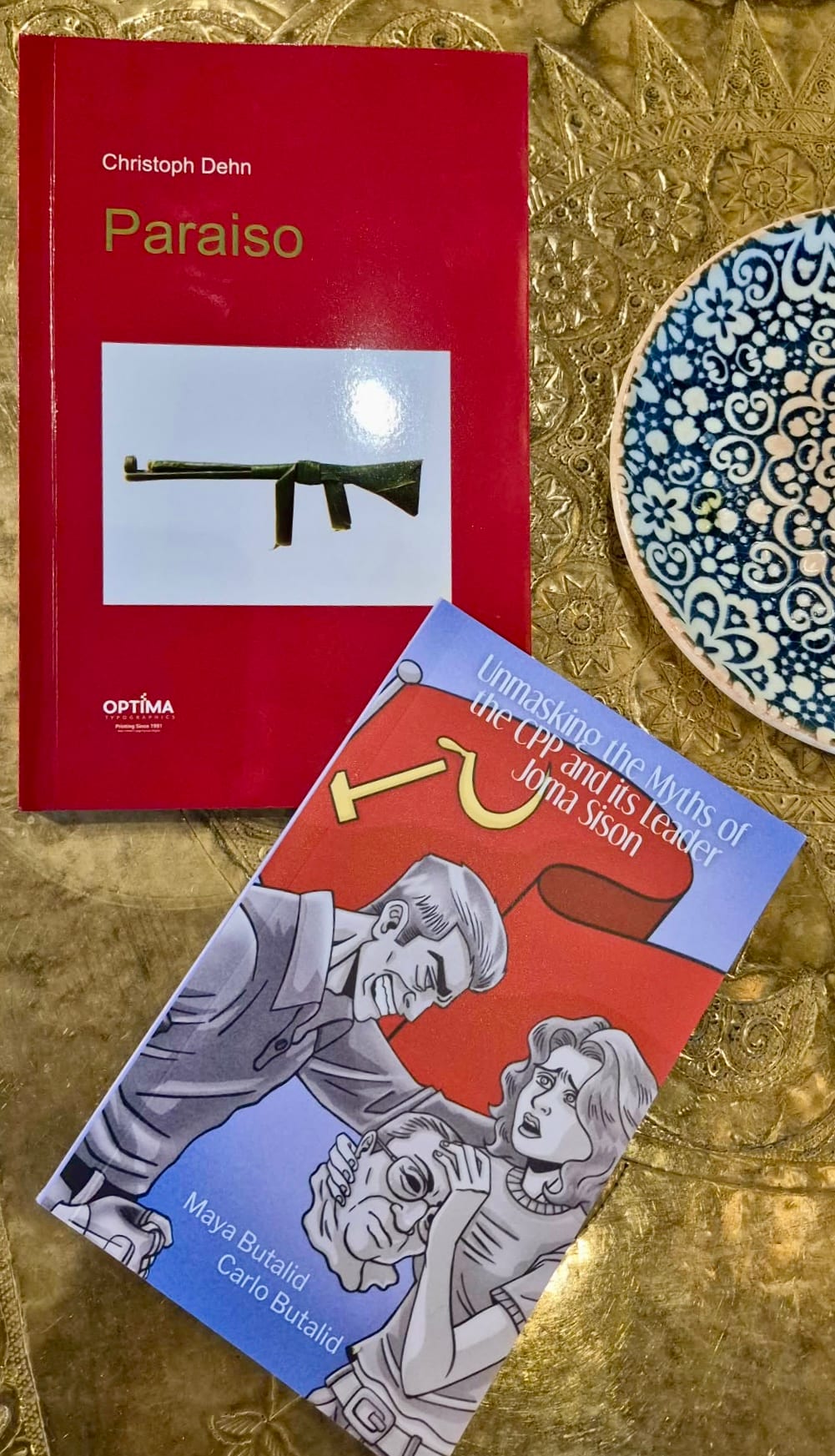
Paraiso is full of personal stories of people’s lives, their experiences with the Party, etc. What stands out are two things: the Party’s purges and system of justice; and the system for diverting money from NGOs to the Party. Anecdotal accounts abound, but hardly any are documented formally. As far as I know, nothing had been written about the phenomenon of ‘centralization’. When we wrote Unmasking the Myths, we couldn’t deal with it, because there were no quotable sources. Now, with Paraiso, Christoph Dehn has come out with a detailed account in the form of a fictional story. This, in a sense, complements the other. It is my hope that future writers could also shed light (even if only as fiction) on the CPP’s corrupt financing schemes.
Defenders of the CPP would tend to minimize or trivialize the acts of purges and money transfers, but they are not. They are widespread phenomena. And illegal fund transfers provide a significant amount of the Party’s operational funds. This is important. And this is corruption: the CPP has a widespread system for siphoning all kinds of funds (especially government funds into their coffers). They are indeed fully participating in the country’s corrupt system.
The corruption by the CPP is particularly blatant given today’s uproar against corruption. The Party cynically uses the issue of government corruption while it greatly benefits from corruption itself. The Party merely uses the issue in order to get more new recruits for the movement. But there is no way that they themselves will really address corruption.
Paraiso is available at Popular Bookstore, 305 Tomas Morato Ave. in Quezon City, Metro Manila; and at PGX (People’s Global Exchange), 112 Anonas Extension, Sikatuna Village in Quezon City, Metro Manila.
ALSO READ: A Former Member of the Communist Party of the Philippines Speaks Her Truth
Carlo Butalid is the co-author of "Unmasking the Myths of the CPP and its Leader Joma Sison" (8Letters Bookstore and Publishing, 2025).
View More Articles About: