In ‘9 Temples to Heaven’, Struggling Against Time Becomes a Tender Dissension Between Faith and Death
The Thai film finally reaches the Philippines via the 2026 QCinema International Film Festival, which runs until November 22.
Published on Nov 17, 2026
After making the rounds at festivals such as the Busan International Film Festival, BFI London Film Festival, and premiering at the 2026 Cannes Directors' Fortnight, Thailand’s Academy Award entry for Best International Feature, 9 Temples to Heaven, directed by auteur Sompot Chidgasornpongse, finally reaches the Philippines via the 2026 QCinema International Film Festival, competing in the Asian Next Wave program. Also competing in the same program is Phuttipong Aroonpheng’s The Burning Giants, which was previously selected for the QCinema Project Market in 2023. This year, the QCinema International Film Festival uses genre and the auteur as its overarching framework. Through the concept of "genre-teurs," the festival explores this intersection across different program sections, showcasing films that examine defining personal voices and visions. Moreover, it bridges the gap between conventional storytelling and personal artistry by highlighting works that utilize familiar genre conventions.
Tracing Sompot’s narrative fiction debut means delving into his earlier career as a filmmaker. Initially, Sompot wanted to be an animator, but a scarcity of resources for animation during his undergraduate studies led him to pursue architecture—the same field studied by his long-time collaborator, Apichatpong Weerasethakul (who also serves as one of the producers of 9 Temples to Heaven; the other producer is Kissada Kamyoung).
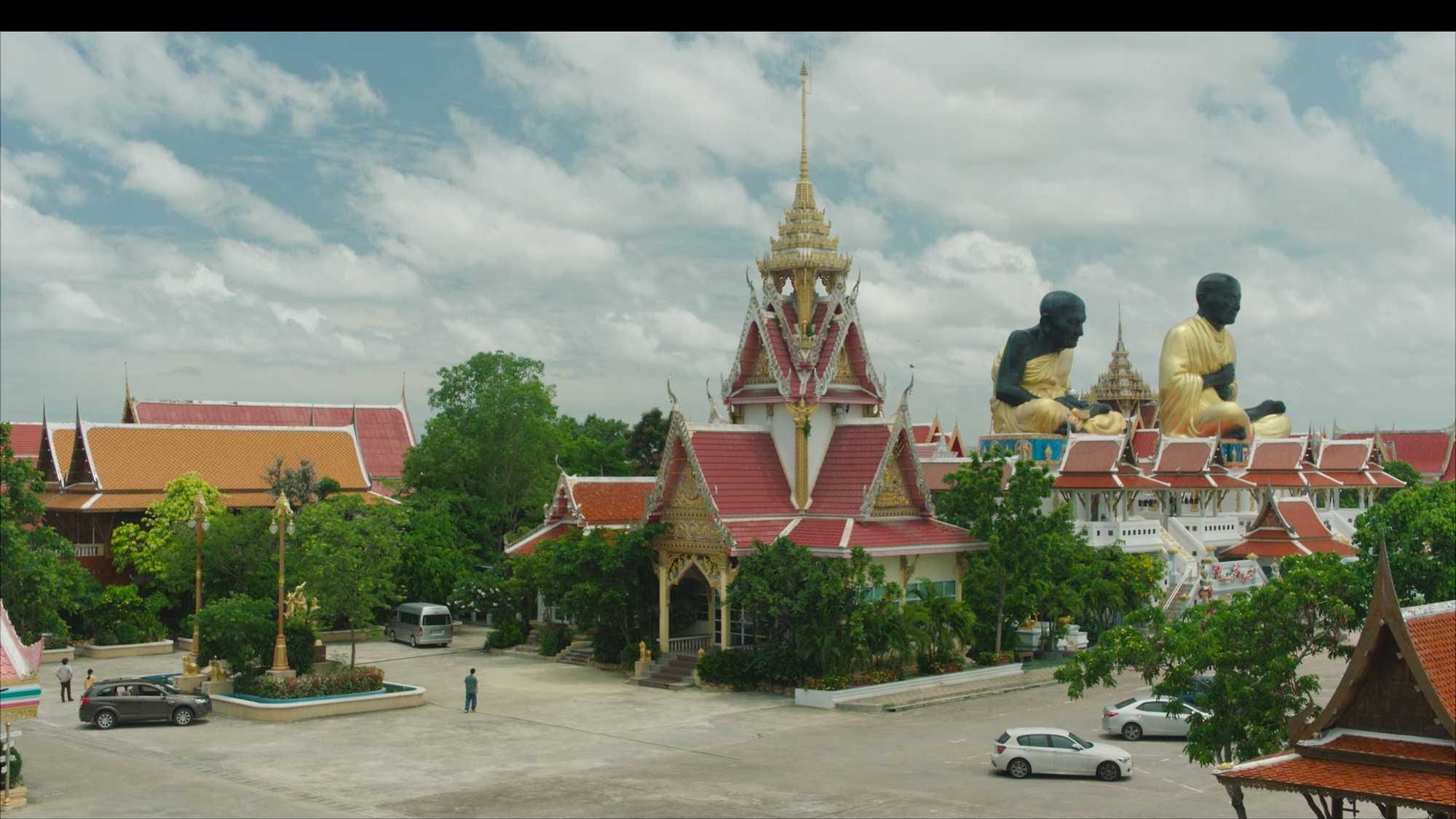
Some of his films are informed by his background in architecture. For example, several of his earlier works emphasize his knowledge of shaping space and constructing form as a driving force, as seen in short films like To Infinity and Beyond and Bangkok in the Evening. However, some of his other works cut against this grain, relying instead on personal memory, performance, and repurposed footage—such as in Diseases and a Hundred Year Period, Auad Dee, and Yesterday. Overall, most of his early works examine everyday lives confined or controlled by societal structures, presenting the nation both inside and outside the frame while experimenting with personal narrative through the medium's form.
Through these early visual and thematic experiments, his first feature—the documentary Railway Sleepers (with Apichatpong also credited as a producer while Kissada is a production manager whom Sompot knew for 14 years)—acts as a synthesis of his filmmaking practices over the years. By depicting the train as a microcosm of Thai life during a period of transformation and capturing the intimate bond between the Thai people and their railways, the film bridges his short works with his current project. In his new feature, as he ventures fully into narrative fiction, he dissects yet another aspect of Thai culture that shapes everyday life.
With Apichatpong credited as one of its producers, and Sompot having worked alongside him for two decades—starting as an intern on Apichatpong’s genre-bending The Adventure of Iron Pussy, before becoming an assistant director on many of his films such as Tropical Malady and Syndromes and a Century—a comparison is inevitable. This is perhaps also due to a shared aesthetic approach: 9 Temples to Heaven, like Sompot’s earlier documentary, uses contemplative cinema to tell the story of a family embarking on a pilgrimage to avert the impending death of Grandma Saluay (portrayed by Amara Ramnarong), led by the eldest child, Sakol (played by Surachai Ningsanond).
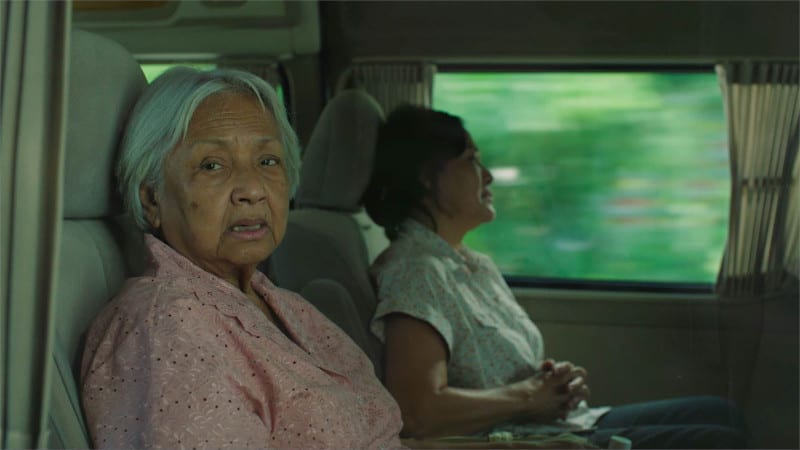
But I argue that the film is nothing quite like Apichatpong, no matter how long the picture lingers, and is more of Sompot’s artistic engagement with James Benning from his time studying for his MFA in Film/Video at the California Institute of the Arts, which also birthed half of his earlier works. And this is not to say that Apichatpong doesn’t have an apparent influence on Sompot’s artistic vision, but because across the film’s contemplative nature, only two sequences will remind audiences of something Apichatpong would do: first is when the sky devours the sun and the scene takes on a magical realist premonition of death; and the last is when the camera moves upward inside the second temple, lingering on the temple’s spiritual and architectural design paired with the monk’s lecture on meditation, which regulates the mind and body in relation to their surroundings and the world. Both of these are reminiscent of Uncle Boonmee Who Can Recall His Past Lives and Cemetery of Splendour, respectively. (Both of these films have been discussed too in relation to Sompot’s documentary in his interview with MUBI Notebook.)
Moreover, Apichatpong’s films use the forest as a site for national history and collective memory. Such deployment of the forest is frequently seen across Apichatpong’s cinema as the foundation for his narrative flow, subverting linear storytelling to emphasize a freer progression of scenes. Furthermore, the forest becomes a vehicle for Apichatpong to unlock a magical realism borne by the images in every frame. The image serves as the bedrock of Apichatpong’s films because his cinema relies on sensory immersion, guiding thought and, ultimately, provoking reflection—whether understood or not—in how cinema's effect on the viewer is to captivate their desire to enter the film's world.
Meanwhile, Sompot’s earlier work shows how he emphasizes human connection through everyday, mundane occurrences outside the forest. Contrary to mundanity in Apichatpong’s films, where the everyday is observed as part of a drive toward the unfolding narrative, Sompot uses landscape as a foundation for looking and listening. This brings to life how individuals shape one another while revealing a person's unique observations of their surroundings. This subversion stems from Sompot’s studies and artistic engagement with Benning, an influence that is powerfully evident in his film 9 Temples to Heaven (and equally apparent in his documentary, whose philosophical driving force continues as he ventures into narrative fiction).
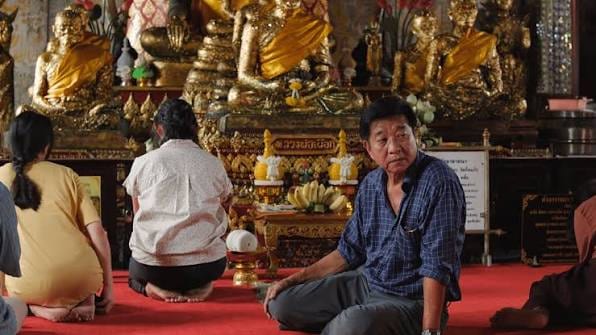
One observes that the narrative flow of 9 Temples to Heaven is linear (contrary to how Apichatpong’s films construct narrative progression non-linearly in relation to time), following the trajectory of a single full day. In this regard, the film’s contemplative nature serves as its foundation to support this day-long duration. Through this, the film subverts its inherent sense of urgency (since the conflict seeking resolution is the impending death of Grandma Saluay) and instead highlights a reliance on a calm, firm perseverance toward achieving its goal. This functions as a form of self-reconciliation aligned with the spiritual nature of Buddhism, which values being focused without excluding anything within human experience, including difficult thoughts and emotions.
Through the course of this day-long pilgrimage, Sompot establishes a central contradiction early on through both his cinematic approach and the family's internal dynamics. As they hit the road, these contradictions become more apparent through Tor, Sakol's son (impressively portrayed by Sompop Songkamol), who challenges their superstitious beliefs and refuses to follow the merit-making rituals. Although the film highlights his defiance at times as disrespectful, this friction only reinforces the story's critique of personal and religious dogma. Moreover, one can infer that Tor acts as a foil: he detaches himself from the family and their perception of merit-making because he lacks a firm personal dogma regarding how to avert his grandmother's death. Instead, he is driven purely by the affective impulse to end Grandma Saluay’s suffering as they embark on visiting the nine temples.
Further, as the family dynamics are slowly revealed over the course of the journey, what is particularly compelling is how French cinematographer Jonathan Ricquebourg’s camera moves deliberately from the family to the surrounding landscape. This spatial turn allows the soundscape to subvert what the images present to the audience. What the image withholds as the camera tilts toward the landscape, the audio supplements, rendering the scene both complete and restricted while defying the camera’s voyeuristic tendencies. Here, the camera functions both as a synthesis of time—presenting a passive contraction of time wherein the family attempts to forge a predictable outcome from their reality—and as a tender modality for observing shifting family dynamics as the narrative unfolds before our eyes. When the frame lingers, such as when Grandma Saluay feeds the fish and recalls growing flowers in her past, it unearths an intricate personal history, revealing who she once was and how she came to be.
It is also worth examining the repetition that Sompot constructs and shapes throughout the film’s runtime, as this repetition extracts the similarities and differences in the characters' connections to Grandma Saluay, as well as to the progression of the merit-making rituals. At the first temple, adherence to the ritual process is heavily emphasized to highlight the need to elevate Grandma Saluay’s accumulation of merit. However, as the film progresses, this mechanism forces the family to confront their own beliefs regarding death. In one scene, everyone's patience seems to wear thin with the repetitive merit-making and the grueling task of completing all nine temples. Through their exchanges, Sakol’s authority becomes apparent; yet, this desire to save Grandma Saluay from her premonition or fated death begins to dilute. Even though Sakol’s authority is contested, the power he holds as the eldest child—and as an individual with an intense drive and a plan to prevent her impending death—still prevails. In fact, this can also be read as Sakol’s attempt to reclaim his mother to make up for lost time and absences (death poses a dilemma for Sakol because he has yet to mend his connection with a mother who is slowly forgetting).
Moreover, this repetition serves as a mode of transformation wherein the film’s restraint becomes its edge, as Sompot allows the contradictions and their critiques to reveal themselves (even if they lack a punchy impact). Through this, the rigorous merit-making rituals, performed even in Grandma Saluay’s absence, generate a tension among three elements: the sacred grandeur of the temples slowly giving way to commercialization, the rituals' efficacy in defying the premonition, and the profound weight of confronting death and grief. At this juncture, the intergenerational beliefs of Theravada Buddhism are put to the test through a violent intercession, wherein the “eternal return” is not Grandma Saluay miraculously recovering her health, but rather the family being forced to confront and accept the impossibility of defying death.
Ultimately, the film’s intricate dissection of this belief revels in a time that collapses and reclaims agency. From the number 9 in its title, which serves a cultural purpose in Thai society regarding fortune and moving forward, to its solid opening that ties to its ending, framing the film with Suthep Wongkamhaeng’s song Phiang Kham Diao (Just One Word), which the film uses to enact the unsaid between family members, 9 Temples to Heaven tenderly navigates death, grief, and the beliefs—both personal and cultural—that accompany them. It gradually demonstrates that death does not signal being forgotten; rather, it is a phase wherein memories are immortalized through photographs or the recordings on Koon’s phone as he dreams of Grandma Saluay’s passing.
Because I saw Grandma Saluay: she is still there in her former home, which has become a glass recycling factory; at her old home in Nonthaburi; at the factory where she once worked; she is still planting flowers in her garden; and she still sings the same protective chant for her grandchildren and child as she remembers all that has passed.
QCinema International Film Festival runs until November 22.
ALSO READ:
Review: '2 Valid IDs' Falls Short of The Reprieve It Built
Puregold CinePanalo’s 'Mono No Aware' is this Year’s Best Filipino Film Yet
Lorence Lozano is a film critic and cultural worker from the Philippines. Their interests lie at the intersection of gender, politics, and space within Southeast Asian cinema.
View More Articles About: