Grief, Terror, and a Whale of a Time
This Nat Geo adventure gone wrong, based on Daniel Kraus’ novel, Whalefall, is about confronting grief inside the literal belly of the beast.

by Zach Yonzon
Published on Oct 21, 2026
Austin Abrams is having one hell of a year. After spending all of last month’s Resident Evil trying to survive all manner of mutated zombies, Hollywood’s newly-crowned scream king spends all 94 minutes of Whalefall trying to survive the figurative crushing weight of grief and the literal crushing weight of being ingested by a sperm whale. Based on a 2023 novel by Daniel Kraus, who co-authored the Netflix-adapted Trollhunters with Guillermo del Toro, Whalefall follows the story of college student Jay Gardiner (Abrams), who is grappling with the recent passing of his father, Mitt (Josh Brolin). Jay and Mitt’s contentious relationship had a wedge driven into it by Jay’s desire for distance and Mitt’s desire to sink to the bottom of the ocean with the help of weights tied to his body. Trigger warning: Whalefall is about a complicated father’s suicide and his only son’s struggle to come to terms with loss and the guilt of never having lived up to his father’s expectations.
Mitt’s family — his wife, two daughters, and Jay — never quite get the closure they need despite each of them receiving letters because the family never finds the expert scuba diver's body. Jay gets the well-intentioned but poorly thought-out idea of searching for his father’s remains just for his grieving family to have something, anything, physical to lay to rest. When Jay, who learned all that he knows about scuba diving from his local diving legend of a father, goes deep into the water, he encounters a giant squid being pursued by a sperm whale and promptly gets snatched by the former and swallowed by the latter. What follows is a terrifying, almost real-time depiction of Jay’s struggle to survive inside a whale while battling a giant squid and the lingering ghost of his dad.
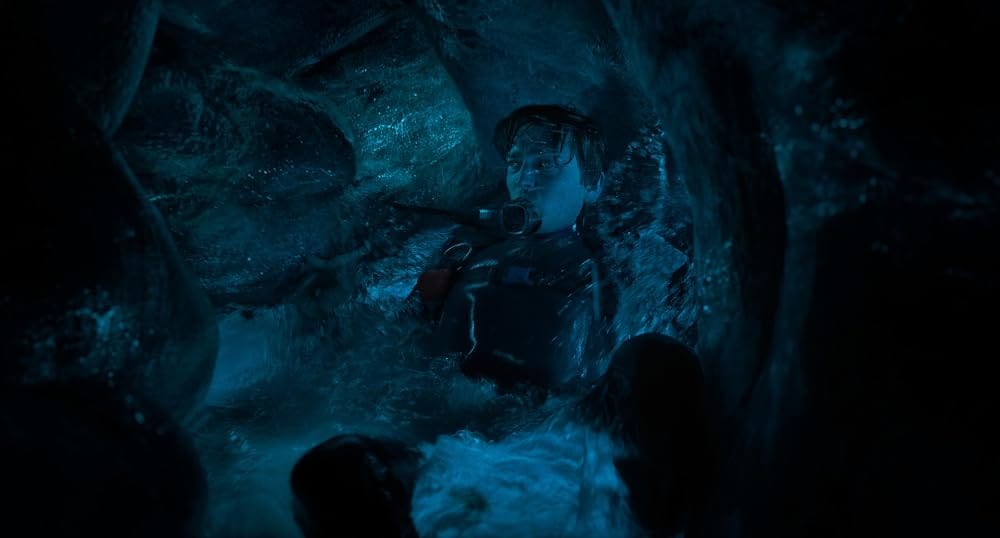
If you suffer from thalassophobia, or worse, the unusual and corner case of vorarephobia, or fear of being eaten alive or swallowed whole, you might want to steer clear of Whalefall because the scenes in the deep ocean are as terrifying as they are beautiful. The sound of whale song reverberating through the vastness of a dark, powerful ocean is heart-crushing and poetic, and it contrasts with the sheer horror of slowly being consumed in the claustrophobic, fleshy confines of a whale’s gullet. Much of what happens in Whalefall happens to be scientifically accurate, which adds to the horror. Aside from one scene involving scientifically tenuous ‘vocal folds’ which also happens to be one of the most soul-crushing, hope-extinguishing parts of the film, much of what happens in Whalefall is actually, physically possible.
It also involves a whole lot of luck, or bad luck, as it were, and most people will avoid ending up as whale fodder because that sort of thing just doesn’t happen. It can, scientifically. It just doesn’t, realistically. So the stories of Jonah and Pinocchio, and yes, Jay Gardiner, fall well within the realm of fancy. What isn’t fictional and poses a real, more familiar terror, on the other hand, is the enormity of grief and how it can swallow you whole. Whalefall’s 24-meter behemoth, the largest animal on earth next to a baleen whale, is merely a metaphor for the all-consuming power of sorrow. The film strikes a wonderful balance between Jay’s efforts to escape the inside of a literal whale and his struggle to overcome asphyxiating melancholy.
Jay’s battle inside the whale is punctuated by flashbacks to his relationship with his dad, allowing audiences to understand and empathize with his grief. Mitt was a flawed and complicated man who struggled to raise a son ready for a world far harsher than the ocean depths, an emotionally and verbally abusive father who came from the school of tough love. The very mission Jay undertook that led to his predicament was precisely to make a long-gone father proud, an undertaking to prove that he’d grown into the man his father had always hoped he’d become. The belly of the whale is deadly, sure, but it pales in comparison to the depths of dolor.
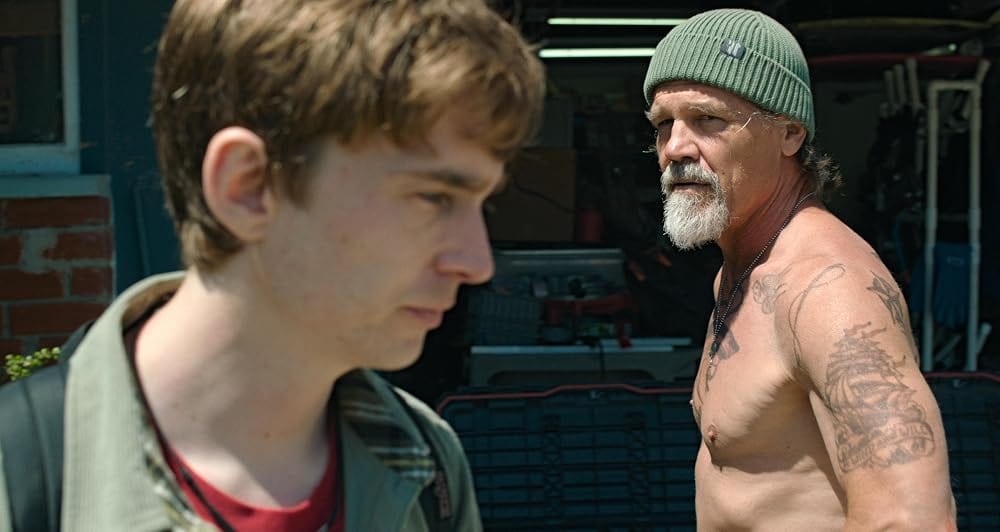
Whalefall is an outsized drama about surpassing sorrow packaged as a survival thriller, and both angles work. The flashbacks are interwoven perfectly with Jay’s torturous journey inside one of the world’s biggest predators, and as he peels away the layers of his complex relationship with his late father, he slowly uncovers an uncommon will to survive. Abrams delivers a performance rivaling his role on Resident Evil, an endearing everyman with personal struggles like the rest of us who’ve got complicated, tangled relationships and who’ve experienced grief. Brolin is perfectly cast as Mitt, a specter of a memory that Jay must exorcise in order to move on and live. In scientific terms, whale fall refers to the carcass of a dead whale that sinks to the bottom of the ocean, a detritus of gargantuan flesh and bone that nourishes entire ecosystems. From death comes life, a neat little ribbon of a metaphor that ties the entire film together.
The only way to truly experience the visceral, constricting fear of Whalefall is to see it on a massive screen or, if you’re up to it, in a 4DX cinema that takes the entire experience to another level. Some cinematic epics deserve a big screen to be truly appreciated for their grandeur and scale, such as The Odyssey or the upcoming finale to Denis Villeneuve’s Dune, but Whalefall must necessarily be seen on the big screen because piddly TV screens or handheld devices are a disservice to the oceanic expanse and the majesty of a sperm whale. It is a sorrowful yet cathartic drama nested deep in the belly of a survival horror, a fine addition to a year filled with some of the best scary movies we’ve seen in a good, long while.
ALSO READ:
The Odyssey is a Sharp Rebuke of War and a Lament for the Disjointedness of Humanity
Dune Is an Operatic and Grandiose Film That Demands to Be Seen on the Big Screen
Zach really, really, really loves films.
View More Articles About: