Love, Sex, and Death: 'Wuthering Heights' Is an Exultation of Cinema’s Singular Language
Emerald Fennell’s fast and loose adaptation of Emily Brontë’s one novel is a masterful demonstration of film’s transformative nature.

by Zach Yonzon
Published on Feb 12, 2026
The French call an orgasm, or the fleeting, spasmic moment right after la petite mort, or ‘the little death.’ It doesn’t exclusively apply to the sexual experience but sometimes also to moments that impact a person in such powerful, consciousness-sapping ways that it could be imagined as death. It’s a perfect term. Emerald Fennell, who wrote and directed “Wuthering Heights” (stylized with quotation marks), also penned and helmed 2020’s Promising Young Woman and 2023’s Saltburn, which should already prepare viewers for an intense and perhaps, at times, harrowing cinematic experience. Fennell conflates love and desire with death and suffering, conveying as much with a clever opening sequence that deceives viewers into confusing sex with death and the resulting embarrassment from realizing it is very much part of the agenda. There is a phenomenon called ‘angel lust’ or ‘rigor erectus,’ observed in the corpses of men who have been executed, where the penis is engorged, a perennial hard-on that persists after death. Even in some women, the labia and clitoris become swollen, a postmortem indicator of a violent execution. It is a metaphor that threads the entirety of Fennell’s “Wuthering Heights.”
Fennell does away with the superfluous, removing Emily Brontë’s narrative structure and consequently one of its narrators, Mr. Lockwood. The quotation marks on the film’s title are purposeful, as Fennell changes much from the book, removing key characters such as Catherine’s older brother Hindley, merging his role and characteristics into her father, Mr. Earnshaw (Martin Clunes). She also dispenses with an entire generation, depriving Brontë’s story of whatever modicum of closure it delivered, but also cutting off its generational trauma. The book has been dissected endlessly and adapted so many times into film that Fennell owed it to her younger self, doubtlessly changed by her introduction to one of the greatest novels in the English language, to deliver a version that only she could.
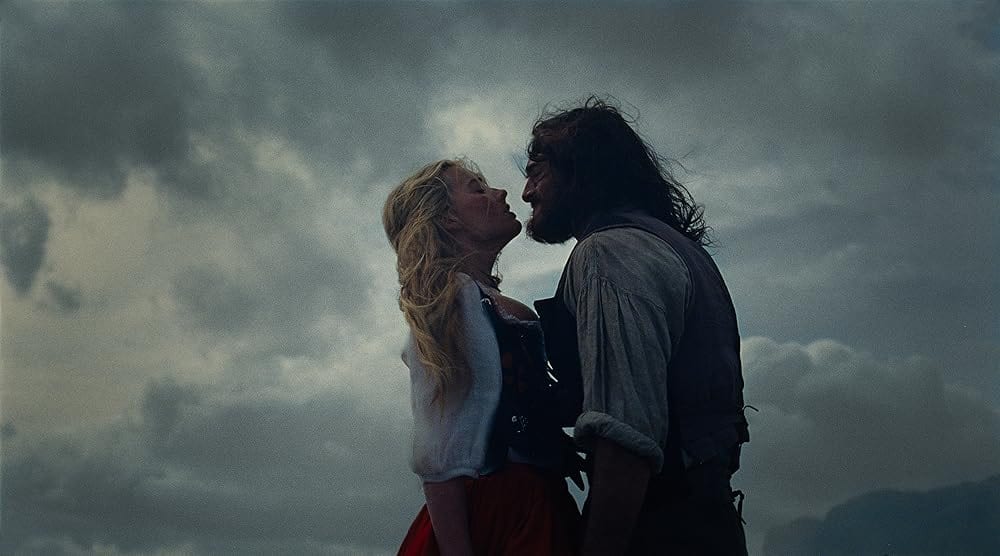
“It cracked me open,” Fennell said while speaking as a guest at the Brontë Women's Writing Festival in 2025. “I wanted to make a movie that felt like I felt when I read it,” and Fennell read the book at the hormonally-charged age of 14, which explains much of the almost ribald insertion of erotica in what many—including the film’s marketing material—describe as ‘the greatest love story of all time’. It’s a debatable claim, but love is nothing if not complex and, as much of human history proves, can be full of pain. “Wuthering Heights” is raw and hungry, suffused with primal lust that sees Heathcliff (Jacob Elordi) and Catherine (Margot Robbie) engaging in some of the most intense, finger-bitingly suggestive sex ever shown on screen. It’s certain to offend many fans of the book, which is not—in fact—an erotica. But you wouldn’t know it from Fennell’s version, which is as horny as horny gets but manages to convey sensuality without once showing nudity. A shirtless Elordi is the most the film ever shows, and it’s not even the sexiest part of the film. It’s both an homage and a middle finger to Victorian morality, the hypocrisy of religious conservative thought that indulges in carnality behind closed doors but rebukes it outside of them.
Much can be said about the casting of Elordi as Heathcliff, described as a “dark-skinned gipsy” foundling of mysterious origins in the book. But Elordi’s stunning turn as the monster in Guillermo del Toro’s Frankenstein proved that the man has range, and his take on Brontë’s anti-hero is even more monstrous than the monster stitched from discarded human remains. Fennell has also taken much care to at the very least contrast Elordi’s skin against Robbie’s much fairer complexion, itself a visual metaphor that’s used literally to encase Catherine in a protective cocoon. When her husband Edgar Linton (Shazad Latif) has her bedroom walls painted in the color and pattern of her skin, it’s a disquieting show of love and obsession, once again two things that often intertwine and become indistinguishable from one another.
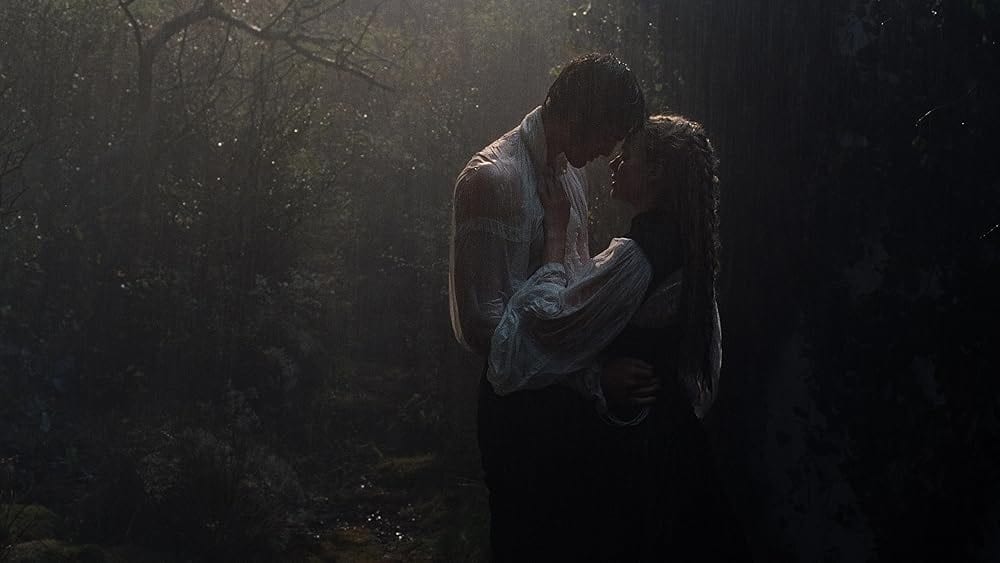
Wuthering Heights is not a tender love story. It is driven and cruel, a destructive game played by two players who keep upping the ante of their cruelty and leave others broken in their wake. When Fennell transforms Brontë’s story into an unbridled erotica, it’s with the full awareness that the overindulgence of lust and desire is what drives man into degradation. Heathcliff’s innocent, protective love (d)evolves into something monstrous, a desire for possession and control that has no place in a healthy relationship. That’s the point. There’s nothing healthy in the web of relationships in “Wuthering Heights”, culminating in Heathcliff’s seduction of Isabella (Alison Oliver), a wild and uncomfortably titillating rendition of BDSM.
Heathcliff and Isabella’s dynamic alone merits deep reflection, which truly begins when he breaks into her bedroom and tells her he will use her as a pawn in his game of revenge and asks her, “Do you want me to stop?” As with the book, where she views him as some romantic hero of chivalrous devotion, Isabella consents, paving the way for her own degradation. He asks her again and again for her consent, never committing the sin of unwanted abuse, and in this way, Fennell somewhat sanitizes Heathcliff’s monstrosity. It’s a feminist understanding, perhaps the only acceptable way to fall into debasement and submission—where it is an act of will. In this way, Isabella is not a victim but an accomplice, an active hand in dealing cruelty. Of course, Heathcliff could have and should have stopped at any time, which makes him a terrible man, whether or not Isabella actively participated in his infernal machinations.
It’s easy to dismiss “Wuthering Heights” as a failed adaptation of a book that’s arguably impossible to adapt into film. Many have tried, and none have truly been satisfactory. But Fennell’s “Wuthering Heights” isn’t so much about translating Brontë’s literature into film, but rather transposing much of the author’s themes into a story that only film can tell. This is where “Wuthering Heights” truly shines; because film has a multi-sensory language that’s unique in all of art and when Fennell and cinematographer Linus Sandgren, who won an Oscar for La La Land, deliver frame after frame of beautifully composed shots over a bed of violins and cellos from composer Anthony Willis or songs from Charlie XCX, it is a paragon of cinema. “Wuthering Heights” is a haunting, stunning elevation of film’s singular language, the most sublime confluence of sight and sound where scenes are burned indelibly into your mind.
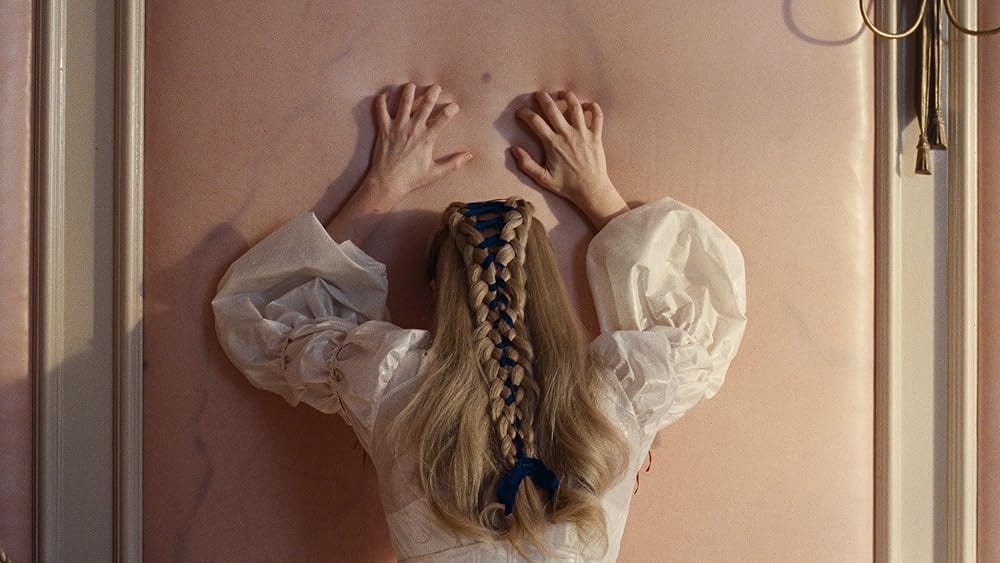
Yes, this is cinema for the MTV generation, where frame composition is key, an age where Wes Anderson has become iconic for visual symmetry. But Fennell has crammed so many things into “Wuthering Heights” that giving it a cursory review or assigning it an X number of stars would do injustice to its brilliance. Little things matter, such as the mention of the Lintons’ wealth coming from textiles, and the film’s extensive use of cloth as a visual metaphor for barriers. From the opening scene where the dying struggles with his last breath through cloth; to Catherine’s bridal veil echoing her mourning veil, which is then lifted by Heathcliff in order to kiss her; to a silken funeral shroud as a bookend to the rough sackcloth of a hanged man. Cloth, which represents Linton or Catherine’s marriage, is always a barrier between the lovers, so even the fully clothed sex is essential to the storytelling.
Even the origin of Heathcliff’s name in the film, a throwaway line that also serves to explain the absence of Hindley, is a nod to the book’s incestuous love affair between Cathy Linton and Hareton Earnshaw, who happen to be cousins. The gothic opulence and brightness of Thrushcross Grange contrasts with the oppressive darkness and cold of Wuthering Heights, a sterling example of thoughtful production design that also includes a wonderful installation sculpture consisting of hundreds of hands crawling up a wall. Every design choice is deliberate, and every detail is meant to contribute to Fennell’s themes.
One poster for the film is reminiscent of Gone With the Wind, which is no accident, given that Catherine and Heathcliff are just as toxic and loathsome as Scarlett O’Hara and Rhett Butler, and both classic love stories tread similar waters. Perhaps love is a truly wretched endeavor if our most iconic stories just have lovers vacillating between cruelty and affection. “Wuthering Heights” will impact viewers in a similar way, as its departure from source material and focus on certain themes at the expense of others is certain to upset some. But the same divergence from the book, which includes Fennell’s masterful depiction of various manner of sensual things, will delight just as many. Love it or hate it, apropos for a story that amalgamates both love and hate into one grotesque, yet irresistible whole, “Wuthering Heights” stands as a triumph of cinematic storytelling.
ALSO READ:
15 More Mainstream Movies with Unsimulated Sex Scenes
12 Mainstream Movies Where the Actors Have Real Sex Onscreen
Zach really, really, really loves films.
View More Articles About: