Steven Spielberg Directed Two of the Greatest Alien Films of All Time. ‘Disclosure Day’ Isn’t One of Them.
The legendary director’s fascination with aliens continues in a summer blockbuster that rehashes old tropes, offers no new ideas, and raises questions it never bothers to answer.

by Zach Yonzon
Published on Jun 10, 2026
Steven Spielberg has been trying to tell the perfect alien story for decades. In 1977, he wrote and directed Close Encounters of the Third Kind and five years later brought us E.T. the Extra-Terrestrial, two films enshrined in the National Film Registry for their cultural, historical, or aesthetic significance. Close Encounters and E.T. are two of the best films about aliens ever made, and with this year’s Disclosure Day, Spielberg takes another swing at the genre. It’s a miss.
Let’s get this out of the way: Emily Blunt is phenomenal. It is, perhaps, to her credit that her portrayal of Margaret Fairchild, a weatherman from a small Kansas City television station who begins to exhibit extraordinary abilities, is so good, so compelling, that it’s enough to convince less critical viewers that Disclosure Day is anything but an overwrought, pretentious, laborious two and a half hour cinematic slog. It’s not entirely Spielberg’s fault. Some of the best parts of the film are actually clearly his directorial choices and Janusz Kaminski’s cinematography. But Disclosure Day is a narrative mess, and it’s because of David Koepp’s ambitious screenplay that is crammed with superfluous characters and details, as well as plot threads that seem to go nowhere. It’s a shame because Koepp is responsible for the original Jurassic Park and penned Brian de Palma’s Mission: Impossible. Then again, he also co-wrote the last two Indiana Jones films and last year’s Jurassic World: Rebirth, so Koepp is clearly capable of churning out clunkers.
In the simplest terms, Disclosure Day features the attempt of some people to expose the truth about how aliens have existed among us for decades with the help of a pair of individuals who have been granted extraordinary abilities by said aliens. It’s not a bad plot. It’s also not terribly original. The X-Files tread the same territory and did it considerably better. The Men in Black series was more entertaining. Disclosure Day capitalizes on existing alien mythology, such as the incident in Roswell, New Mexico, crop circles, and an alien design that’s based on the stereotypical little green men with oversized heads and large, black eyes. Disclosure Day attempts to ground its story in reality by tying it closely to familiar tropes and iconography, but makes no effort at all to tie them together in a cohesive fashion. The film’s antagonist, Noah Scanlon (Colin Firth), heads a mysterious corporation called Wardex that has kept the existence of aliens a secret and even used the aliens’ technology to patent some of humanity’s greatest inventions. You know, just like in Men in Black.
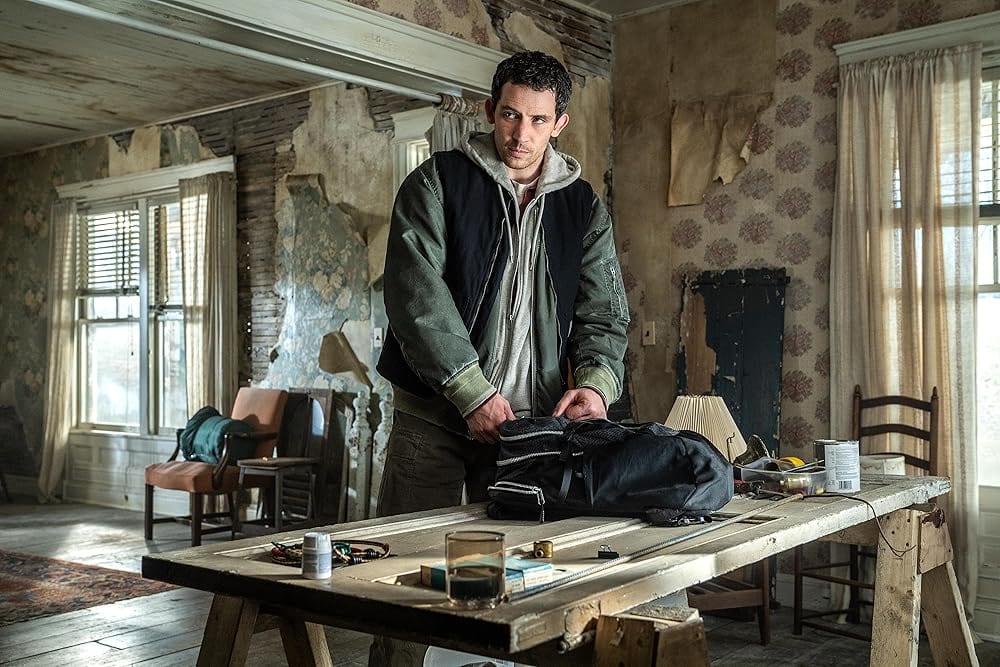
There are some genuinely cool moments in the film, and the train scene where Josh O’Connor’s Daniel Kellner and Margaret are fleeing from an unhinged Wardex enforcer is as exciting as any Mission: Impossible sequence. But these moments are few and far between and don’t merit sitting through 145 minutes of tedious and self-important storytelling. There are spoilers ahead, but it’s necessary to dissect exactly why Disclosure Day is such a failure of cinema and a waste of the medium. Daniel and Margaret are a pair of ‘chosen ones’ who gained latent extraordinary abilities after being abducted by the aliens, but it’s never quite explained what makes them so special and why. Maybe it’s because they’re a pair of straight, white people. Over eight billion people on the planet, and the aliens picked the most vanilla pair of individuals for reasons that Disclosure Day will never explain.
Disclosure Day also doesn’t explain why there are two when Daniel does absolutely nothing of note aside from stealing some archival footage and a mysterious alien artifact that has special powers that, again, the film doesn’t bother to expound on or explain. Absolutely nothing special happens when Daniel and Margaret, strangers who at the start of the film have nothing to do with one another, finally meet. They don’t get additional abilities, they don’t join hands and make things happen, there’s absolutely no reason at all why Daniel exists other than to have a girlfriend (Eve Hewson), who’s a former novitiate, reconcile the ideas of a supreme being and alien life. Hewson’s Jane Blankenship is one of the best parts of the film, an audience surrogate who helps address the inevitable doubt and existential line of questioning when faced with the reality that we are not alone in the universe, a character who helps show science and faith as two parts of a beautiful whole. A theme that was far better and more elegantly explored in Robert Zemeckis’ Contact in 1997.
Daniel is a narrative albatross who brings absolutely nothing to the table other than to run from Wardex, meet Margaret, and be useless. We learn that he has the uncanny ability to understand math, the language of the aliens, but it never actually comes into play, and he never uses it or demonstrates it in a way that moves the story along. Margaret has the ability to speak any language natively as well as gain empathic insight into people’s lives, which she uses to stun and disarm them. Daniel’s mathematical genius is just referred to in conversation but never amounts to anything. In fact, so many of Disclosure Day’s plot contrivances are told, rather than shown. Colman Domingo plays Wardex defector Hugo Wakefield, who inexplicably knows things and literally explains the film’s overarching message in a short exposition. Hugo talks about how ‘empathy’ is our entire reason for existence, which is a beautiful and admittedly timely message, but one that’s blunted by having to be explained in dialogue rather than shown in application. This is exactly Margaret’s power, a preternatural empathy that helps people be kinder to each other, but for some reason, she never uses it against Wardex head of security Casper Boyd (Henry Lloyd-Hughes), who’s a meanie all the way ’til the end.
That’s another problem with Disclosure Day: the folks at Wardex are just meanies and little else. Aside from Casper trying to kill Daniel and Margaret during the train scene and Scanlon possessing Eve using the alien artifact to try to kill Daniel, Wardex doesn’t present a real threat. In the end, when Margaret finally makes it to the TV station, Casper just runs away in disgust instead of pulling out a gun and shooting her, which makes no sense at all when he was trying to kill Daniel and Margaret just hours earlier. For a company that wields so much power that’s deeply entrenched in government and employs many armed enforcers, they’re largely ineffective and inutile. There’s a part where Daniel walks around in broad daylight and sneaks past over two dozen agents. This kind of ineptitude is acceptable in E.T., which is a family movie, but not in Disclosure Day, which takes itself seriously and demands that audiences give it the same consideration.
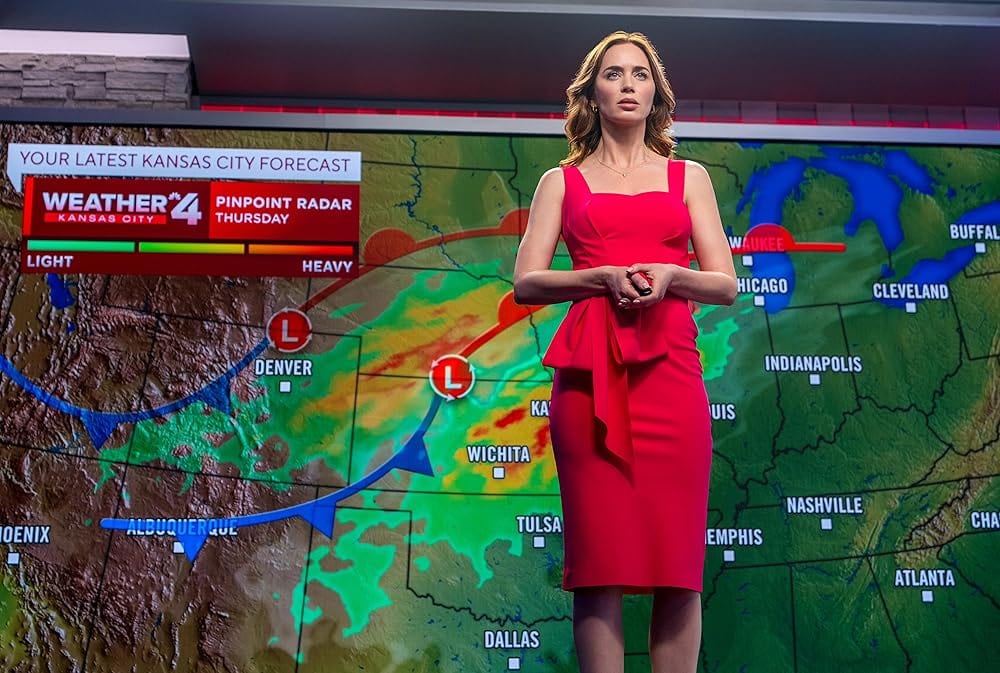
The pitfall with Disclosure Day’s self-importance is that it crumbles under the very scrutiny it invites. Daniel has a very, very cool moment where a crop circle forms around him while he’s on the phone with Margaret, but it’s the first and last time the film references crop circles. It’s never explained and has absolutely no bearing on the story other than for cool visuals, which is insulting for a film that purports to be significant and deep. Disclosure Day fails to answer the simplest questions, like why the aliens chose Daniel or Margaret, or why there has to be two people when the entire film’s key moment only needs Margaret. Spielberg already delivered a storytelling masterpiece that details alien abduction in 2002 with the miniseries Taken, a multigenerational tale that better utilizes the concept of aliens working through humans to achieve our mutual salvation. Disclosure Day feels like a discarded earlier draft of Taken, which features a precocious 12-year-old Dakota Fanning.
What is the point of Disclosure Day? It might have been an impressive directorial debut for anyone else, but not from the person who made Close Encounters of the Third Kind. It’s certainly a disappointment coming from the person who made the world cry and believe in magic in E.T.. It’s a distilled and far less potent story than Taken, which Spielberg produced. If Disclosure Day had stuck with one idea, such as challenging our faith in God in the face of alien existence, it might have worked. If it had tried to give meaning to crop circles, maybe that could’ve been something, too.
If it wanted to deliver the message of empathy, it certainly could’ve done it without having to supersede the news of an imminent third world war. It's contrary to your message of empathy when the world stops talking about the ravages of war and focuses on aliens instead. Disclosure Day comes at a time when the world is so inured to callousness and inhumanity that daily exposure to ongoing genocide doesn’t move the needle. The United States government has literally declassified its encounters with Unidentified Aerial Phenomena (UAP) and Unidentified Flying Objects (UFO), and no one batted an eyelash. Yet Disclosure Day wants us to believe that the world will stop in its tracks and be shocked at the revelation of aliens through archival footage that looks less realistic than AI brain rot.
The world doesn’t care: the President of the United States is mentioned in documents that detail the rape of children, and yet not a single person in what appears to be a pedophilic billionaire cabal has been arrested or charged. Disclosure Day is infuriating because the entire film feels like just another distraction from real, more important issues. The failure of human empathy is a problem, and if Disclosure Day had dedicated its entire two and a half hour runtime to that, it would be more meaningful. But the film busies itself with too many other good ideas and gets lost in the process. Disclosure Day is unoriginal, uninspired, and a stain on the resume of a man who has already shown us how to do alien encounters right.
ALSO READ:
The Radical Traditionalism of Steven Spielberg
Steven Spielberg Has Finally Been Convinced to Make A Superhero Movie
Zach really, really, really loves films.
View More Articles About: