The Sensual Cinema of Isabel Sandoval
The Filipino auteur discusses her latest film Moonglow and the secret poetics of her sensual cinema.
by Lé Baltar
Published on Apr 17, 2026
This piece is a comprehensive profile on Isabel Sandoval's body of work based on film critic Lé Baltar's interview with the director conducted in March.
Isabel Sandoval is glowing, even on a humid late Saturday afternoon. Her toned-down getup, a black tank top and beige pants, suits the way she speaks—sweetly and softly, always wearing a smile on her face. Like the women she plays in her films, she evokes an elusive, inexplicable allure, a kind of ambivalence too slippery to fully decipher but that nevertheless draws you towards her. There are no signs of stress or fatigue, though lately she has been "living out of a suitcase," splitting her time between New York and Madrid.
She’s been adding a few more stops to her itinerary since arriving in Manila in early February. After a two-day trip to her hometown in Cebu, which included a visit to her mother, she worked on an undisclosed project in the Philippine countryside. A few weeks later, she spent some quiet time in a Jesuit retreat house in Baguio, her first in almost 20 years, to work on a script for a new film about covert CIA operations in 1960s rural Philippines. Now, she stays in Quezon City to edit behind-the-scenes footage and promo assets for her latest film, Moonglow, including a two-minute trailer she asked me to go over an hour before we met for the first time and spent the afternoon together at a casual Korean diner in Cubao, the city’s commercial and commuter center.
The Education of a Filmmaker
Isabel Sandoval directs and stars in her new film Moonglow.
.jpg)
Growing up an only child in Central Visayas in the post-Marcos era, Sandoval’s interest in the arts began with two important women in her life. Her maternal grandmother, Teofila Canoy, was a well-known theater and film actress in Cebu in the ’60s and ’70s. Under the screen name Aurora Villa, she appeared in a couple of films, namely Leroy Salvador’s Badlis sa Kinabuhi (1969), starring Gloria Sevilla, and Pablo Santiago’s Iniibig Kita, Father Salvador (1976), starring Vic Vargas and Helen Gamboa. Her mother, Mila Fernandez, who raised her independently, starred as Shiela Villa in the now-lost Cebuano indie film Ang Diary ni Mercedes, though she never really developed a penchant for performance, seduced as she was by the allure of the silver screen.
Moving images were essentially Sandoval’s film school—she had no formal film education. She remembers watching comedies starring Canuto Francia, known onscreen as Canuplin, the Filipino Charlie Chaplin, at a pre-war movie palace with her mom, or walking in on some adults in their living room playing bomba films of the late ’80s, starring Vida Verde. In the afternoons, she’d watch both the studio and independent films by the likes of Lino Brocka, Mike de Leon, and Ishmael Bernal. Her favorite Bernal film is the underseen Broken Marriage (1983), led by Vilma Santos and Christopher de Leon, which she considers to be as feminist and ahead of its time as Marilou Diaz-Abaya’s Moral (1982).
At five years old, young Isabel was beside herself, daydreaming and memorizing a lot of Sharon Cuneta movies, including Dapat Ka Bang Mahalin? (1984) and Babangon Ako’t Dudurugin Kita (1989), and Maricel Soriano comedies, such as Inday Bote (1985) and Inday Inday sa Balitaw (1986), which were part of the comic-serial-to-screen pipeline heavily practiced by big Filipino studios then. In her teens, at a time when physical media and printed ephemera were all the rage, scanning local street stalls for pirated films made for a good afternoon. Years later, while working a corporate job in Manila after completing her bachelor’s degree in psychology at the University of San Carlos, she recalls regularly paying a visit to Titus Brandsma Center in New Manila, which screened François Ozon films she would then buy bootleg DVDs of in Quiapo, the country’s piracy mecca. Foreign filmmakers, from Wong Kar-wai to Ingmar Bergman to Pedro Almodóvar, soon elevated her taste, which would only heighten after moving to New York City for graduate business school in her early twenties.
Chantal Akerman pictures like Jeanne Dielman, 23 quai du Commerce, 1080 Bruxelles (1975), and News from Home (1976) would actively shape Sandoval’s philosophy as an indie filmmaker, setting the foundation for her acclaimed international breakout Lingua Franca, an impressionistic social issue drama set and shot in New York, which premiered at the 2019 Venice Film Festival. In the story, the protagonist Olivia practically stands in for Jeanne. The former works and lives in a Brooklyn apartment just as the latter does in a Brussels flat. “That was really mind-blowing because it made me realize that it’s really the filmmaker that decides what is cinema,” she says of Jeanne Dielman, which she saw for the first time at the Film Forum in 2007.
“It really felt like a cinema that was truly free and that you were inventing it as you were making it because you were putting the camera in front of this woman and doing possibly what could be considered the most mundane, boring thing and have it feel so riveting and alive and revelatory,” she continues. “And that was really instructive for me in that as a filmmaker, especially as an independent filmmaker, I should live up to that signifier of being independent. And that I should make a movie the way that I imagined it and with as much autonomy as I can, if possible, or to create conditions where I can be creatively free.”
Cinematographer Isaac Banks and director Isabel Sandoval behind the scenes of Moonglow
.JPG)
Lingua Franca and the Long Game
The filmmaker stars as Dahlia, a deeply wily detective who pulls off a heist against her corrupt police chief
.jpg)
Following the Venice premiere, Lingua Franca was acquired by Ava DuVernay’s ARRAY for North American distribution and went on to stream on Netflix, Tubi, The Criterion Channel, and Kanopy. This April, the film returns to The Criterion Channel for the 11-film program “Tramps, Troublemakers, and Trailblazers: Trans Filmmakers," curated by critics Caden Mark Gardner and Willow Catelyn Maclay, authors of the book Corpses, Fools, and Monsters: The History and Future of Transness in Cinema, which featured Lingua Franca. The Filipino title is streaming alongside the likes of Jane Schoenbrun’s We’re All Going to the World’s Fair (2021) and Louise Weard’s Castration Movie Anthology I. Traps (2024).
Sandoval last saw Lingua Franca at the Museum of the Moving Image (MoMI) in New York two years ago, following the release of Gardner and Maclay’s book. About the response to the film at Venice, the director says it was less an instant success than a sleeper hit. Before the official premiere, her team arranged an advance press screening in London knowing that most critics would be busy during the festival run. “But in London I know that the sound must be extremely loud, which I’m sure [will] ruin or compromise the experience of the film,” she remembers. Another factor was the typical expectations of what a social issue movie should be, particularly for a story that is centered on an undocumented Filipino trans woman. The director even recalls a review demanding that the film appear akin to a Brillante Mendoza movie.
At the time, Sandoval made history as the first out trans woman of color to direct and star in a Venice film. It was her response to trans movies that were primarily concerned with presenting trans lives through a medico-surgical perspective, which was rather passé and predictable. It offered a lived language through which the trans experience could be reframed and reimagined. Time, which can be at once tender and cruel, has only exalted the film’s place in the canon of trans cinema and even outside of it, confirming that a work so thoughtfully and lyrically made as Lingua Franca will always find its audience, however long and slow it takes.
Before Lingua Franca, the actor-writer-director already made two features: Señorita, a pulpy noir based on the 2009 short film of the same name, which premiered in competition at the 2011 Locarno Film Festival, and Aparisyon, the cloistered martial law drama that played at the 2012 Cinemalaya Philippine Independent Film Festival. Asked about the Cinemalaya scene then, Sandoval remembers it with fondness, mentioning the works of her contemporaries, such as Eduardo Roy Jr. and Francis Xavier Pasion, who are both gone now, and veterans like Loy Arcenas and Jun Lana, who at the time had just made REquieme! and Bwakaw, respectively. “The scene was very electric at that time,” she shares, noting that it was also around the time when she realized she was a woman of trans experience, deciding to finally transition after the release of Aparisyon.
Over a decade since this modest start, Sandoval has gotten big enough to build a steady cine-literate following. Already a revered name in arthouse cinema, a reputation that at the same time helped push her into the mainstream, becoming a member of the Academy of Motion Picture Arts and Sciences in 2022, she is still refining her craft and still plotting the bifurcated lives of her elusive heroines.
Moonglow is Isabel Sandoval’s first film shot in Manila since 2012’s Aparisyon.
.JPG)
Moonglow and the Art of Withholding
Her fourth feature, Moonglow, just world premiered at the 2026 International Film Festival Rotterdam in February. This month, it is set to make its Italian premiere in competition at the Asian Film Festival in Rome, and then return to the Netherlands for its Amsterdam premiere at the CinemAsia Amsterdam. Then in May, it is making its North American premiere as the closing night film at MoMI’s First Look Festival, which will also screen the likes of James N. Kienitz Wilkins’s The Misconceived, also fresh off Rotterdam, and Ildéko Enyédi’s Venice hit Silent Friend, starring Tony Leung Chiu-wai and Léa Seydoux.
A stylized and subterranean story of police corruption and rekindled romance set in late 1970s Manila, Moonglow offers Sandoval’s most vivid and oeuvre-defining film yet, a stunning stylistic reach that invokes the trappings of film noir and classic Hollywood romance only to flout and elude them. Sandoval stars, as she has done so in her previous films, as Dahlia, a conflicted cop who plays Robin Hood by orchestrating a theft against her corrupt police chief and funneling the money to the poor. Tasked to crack her own crime, she comes to terms with her eroded soul by reigniting a love she once thought possible in a city steeped in martial rule, in smoky, sweat-stained summer nights. Teasingly hazy and sensuous, this period piece is a glowing addition to the repertoire of a filmmaker whose primary draw is her enigma, and who has always seen cinema as “a gesture of empathetic imagination.”
Like the women that have come before her, Dahlia is a deeply wily protagonist that embodies “a public self and a secret life.” “I balk at writing dialogue because my kind of character is not the most vocal and transparent,” the filmmaker admits in an interview with Impulse Magazine. “I’m into revealing who they are by what they don’t actually say, what they withhold.” This slippery virtue, which threads through her oeuvre and here rides the rhythm of jazz (Sandoval played Miles Davis’s soundtrack to Louis Malle’s 1958 thriller Elevator to the Gallows on loop while writing Moonglow), can in part be explained by her background in psychology.
“That probably says a lot about my subconscious obsessions,” she says. “It’s like a projected technique in that I’m projecting perhaps issues that I’m not able to resolve, and I do it through art and through cinema. So there is in the process both something that is deliberate and intentional but also something that feels like you’re at the whim of in that you are simply following where your subconscious takes you in terms of the characters and situations they found themselves in.”
Arjo Atayde plays Charlie, the heroine's former lover
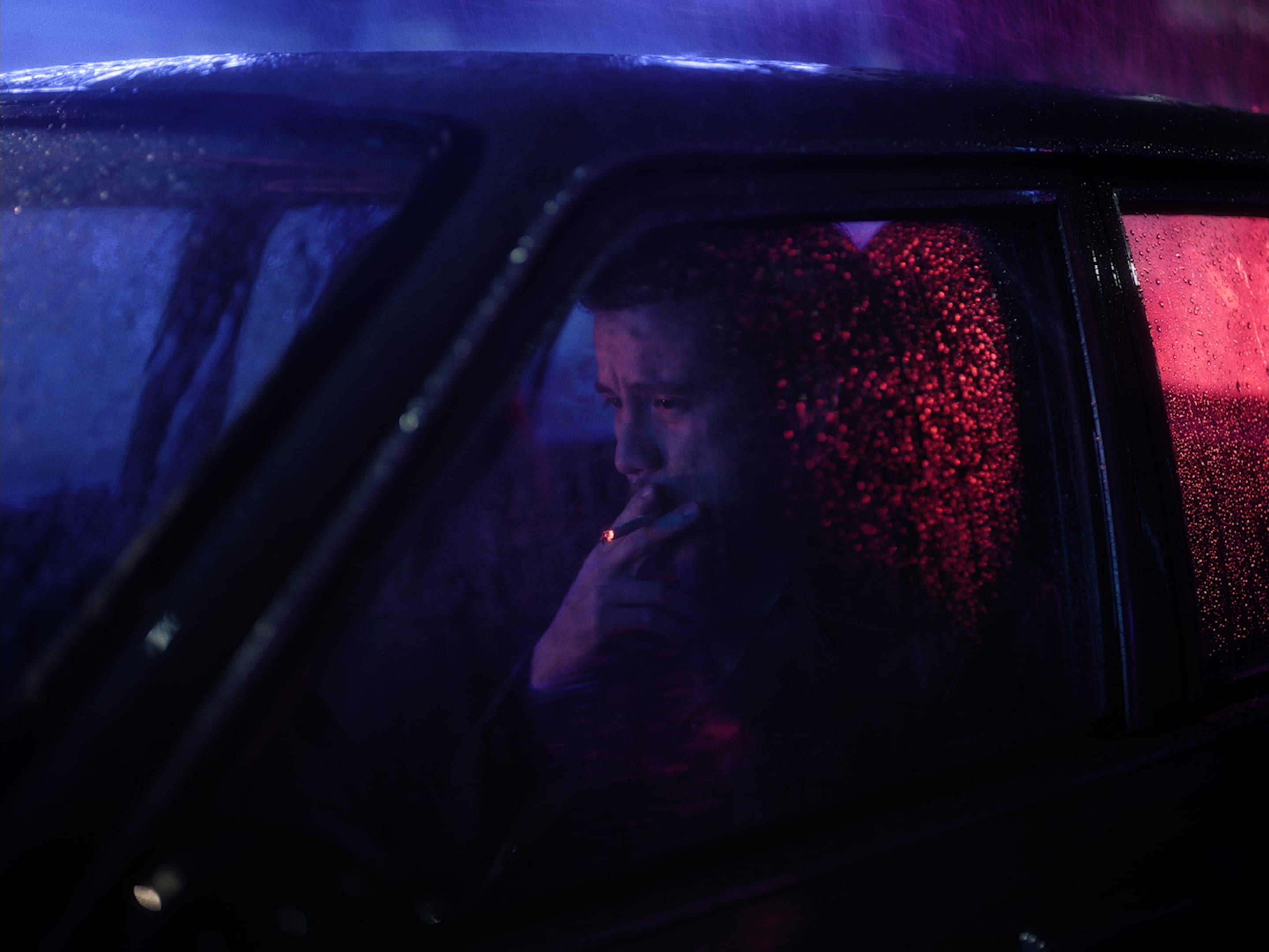
The film has received mixed reviews from audiences and critics alike. Trade publications in the U.S. generally remark upon how it doesn’t deliver in rigid neo-noir or thriller terms. “It’s unlikely to win her many new admirers, while those converted by Lingua Franca may wait for a new work a little closer to that film’s quiet humanism,” claims Guy Lodge at Variety. But for Sandoval, it’s a matter of how the film is framed, like how Michael Koresky, senior curator of film at MoMI, contends with Moonglow as another entry in her auteurial body of work and not necessarily as a genre piece. “I was aware that making a film in the Philippines within a genre that’s ostensibly like Southeast Asian crime noir, it sets certain expectations in terms of aesthetic, in terms of pace, in terms of the kind of violence that is there,” she explains. “But I can only really make the film the way that I made it, you know. And I think I would bristle at having to be told to make it a certain way.”
What spoke to Sandoval while putting the film together was the noirs and melodramas of the ’40s and ’50s, which she both loosely subverts and pays homage to. In Moonglow, she embraces cinema as a medium of artifice, departing from the social realism that defined her first three features and therefore making a work that feels more like the movies. “I think, and I don’t know if subtextually is the right word, I wanted to entice the audience to engage with the images more critically and not just at face value in that what might be more truthful and revelatory is what might just be outside the edges of the frame or what is heard and not seen.”
“They shaped my sense of what a protagonist was. They made me feel like cinema was truly larger than life, and I wanted to infiltrate the pantheon of these archetypes: noir, the femme fatale, the star persona. I was trying to really approach it [that way], and I thought it was a very perceptive read in that I wasn’t just trying to play a character, but I was trying to embody a star persona in the film like Barbara Stanwyck or something like that.”
She finds a direct correlation between this mindset and seeing that period as the pinnacle of America’s soft power and cultural hegemony, visible not just across its former colonies, like the Philippines, but the whole world. “They did it through Hollywood and how it was able to sweep under the rug and conceal its imperialistic interests and pursuits through beauty and glamour and seduction,” she says. “During the ’70s, during the Marcos regime, I think our former First Lady had the same thought.”
Whereas Sandoval already crafted a martial law movie in the monastery-set Aparisyon, starring Jodi Sta. Maria and Mylene Dizon, she wittingly toys with the idea of a martial law movie and the form in which it is often told in Moonglow, as though pulling off a heist, to add an idiosyncratic yet still worthwhile work to a canon that has become synonymous with Brocka and Bernal. It’s also her way of reorienting how Hollywood saw and sort of pigeonholed her. “I wanted to make a film that I knew I hadn’t made but that no one else would expect me to come up with and hopefully pull off.”
Co-starring with Arjo Atayde, Agot Isidro, and Dennis Marasigan, Moonglow is the multihyphenate’s most ambitious film production to date. But instead of filming in New York, she insists on returning to the Philippines, where she feels most artistically free and where she can leverage her growing international profile. “It felt a lot easier,” she tells me, before noticing a copy of Chantal Akerman’s memoir My Mother Laughs, which I brought with me. “I love this book. I love that you have this book.”
Principal photography stretched on for over 20 days in April and May 2024 under sweltering Manila heat, which forced Sandoval to rewrite some scenes to be shot at night indoors. But at the time she had yet to shoot the scene of Charlie (played by Atayde) and Dahlia in bed together, which would become the film’s ending. Asked why that intimate moment lacks any sex scene, Sandoval reveals it was never part of the script.
“Because I feel like I would dissipate the tension, whatever tension there is between them, erotically or sexually, if I consummate that,” she says. “So in a way the one moment of actual physical contact between them is when she touches his face in the motel room. Even the final image of the film of them very close to each other, you know, our faces don’t actually touch, but I can literally feel Arjo’s breath on me when we shot that.”
By December in Taipei she was already working on the sound design with Tu Duu-chih, who previously worked with Asian auteurs like Edward Yang, Hou Hsiao-Hsien, and Wong Kar-wai. Sandoval credits her producer Alemberg Ang for making the Philippine shoot happen. Her only request then was to team up with Isaac Banks, who shot Lingua Franca (though at first they were supposed to hire a Filipino cinematographer), and composer Keegan DeWitt, who also scored her short film Shangri-La (2021) and is attached to Tropical Gothic, another period piece partly based on the Nick Joaquin short story collection The Woman Who Had Two Navels and Tales of the Tropical Gothic.
Tropical Gothic is also Sandoval’s riff on Alfred Hitchcock’s Vertigo (1958) and will be produced by Big Beach of Little Miss Sunshine (2006). It tells the story of a Babaylan pretending to be possessed by the spirit of her Spanish master’s dead wife to take back the land taken by the colonial powers from her community. The project has been in the pipeline as early as 2019, and initially Sandoval was set to star as the pre-colonial shaman, but she’s now pivoting towards hiring a Filipino actress to play the part, perhaps Nadine Lustre. “I don’t want to play two Babaylans in a row,” she argues. “And I also don’t want to be known as a director who only directs herself, you know.”
Though the material won a development prize at the 2021 Berlinale Talent Project Market, which prompted the plan to pursue the European international co-production route, filming stalled as the producers remained dogged in attaching some A-list actors to take on the role of the colonizers, most of whom either found the project a little too obscure or esoteric to take on at the time or found issue in only playing a supporting character to the Babaylan. Sandoval doesn’t really sweat it and tries to remain pragmatic. “I mean, Hollywood is Hollywood,” she says.
But what would be non-negotiable moving forward is her creative autonomy. “I feel like the more financing I [I] get, especially in Hollywood, the higher the likelihood that I might have to compromise my vision for the film.” Like the CIA drama she’s working on, Tropical Gothic is her exploration of the country’s ambivalent relationship with colonialism and imperialism and her own ambivalent relationship with America. “And now that I moved part-time to Madrid, I’m kind of in bed with two of our former colonizers,” she humors me.
While filming Moonglow and developing Tropical Gothic, Sandoval has scored some crucial television work, directing episodes of the likes of Jenny Han’s Prime Video hit The Summer I Turned Pretty and the FX/Hulu spiritual crime series Under the Banner of Heaven, starring Andrew Garfield and Daisy Edgar-Jones. She’s also attached to the FX mystery thriller series Vespertine, reportedly still in the works. “Thinking about it now, I was really feeling quite a bit of pressure to step up and make sure that I fit into this Hollywood crowd,” she says.
“Revelation,” the penultimate episode Sandoval directed for Banner, which was submitted by FX for Emmy consideration and whose script she read while premiering Shangri-La at Venice, was “both remarkable and especially rewarding” to her as it found her working on her first TV set and telling a story decidedly different from her own, noting that “the flip side of sensuality is spirituality.” As in Aparisyon, it allowed her to contend with the deep dislocation of faith she went through as someone who had a neurotically Catholic education from kindergarten to college and who was a devout mass server at the Sacred Heart School for Boys (now Ateneo de Cebu). On Garfield’s Latter-day Saint character, Sandoval wrote in Variety: “I ‘got’ Pyre and understood him deep in my bones, as his ambivalence towards his faith mounts the more intimately he learns about its history, more fraught and unsettling than he was taught to believe.”
Working on television, according to the filmmaker, is a great palette cleanser. “Especially when I’m immersed in my own world for such a long time,” she explains. “Being an independent filmmaker, the stakes are so high, I feel. You’re not only the architect of your vision, but also, and particularly in my case, because I also take on multiple roles, both in front of and behind the camera, sometimes the film can live or die based on how well I execute those different roles that I jump on in film. It reinforces her sensibility as an auteur, specifically as a “director-editor who writes and not as a writer-director.” “It clarifies to me who I am and who I’m not.” The paycheck has also given her some financial freedom, hence the privilege to lead a new life between three continents while working on new projects.
The Road Ahead for the Filipina Auteur
Depending on whether she books a new job, Sandoval aims to spend most of the summer in Europe. But in between stops in what she considers an insane lifestyle lately, she always makes it a point to find “pockets of alone time to decompress and recover.” In every new city she visits, she tries to walk for hours to allow herself some necessary introspection, a real-life trait that somehow speaks to her onscreen persona, to the virtues of Dahlia and the rest of the complicated women in her sensual cinema.
Going to places of worship, which she has not done in forever, similarly soothes her. Her stay in Baguio, where she had dinner with film producer Moira Lang, who then suggested the Jesuit retreat house, has given her that respite, having been the only guest at the sanctuary nestled atop the rolling hills of the cold City of Pines. “I had really lovely views of the city,” she recalls. A self-confessed introvert and a Pisces with a penchant for secrets, Sandoval prefers to keep to herself. Even at film festivals, she rarely leaves her hotel room, unless absolutely necessary. She’s also cut back on her screen time over the years, using social media mostly to promote movies and update on works in progress.
Speaking of which, she’s developing a new psychological film, on top of Tropical Gothic, the undisclosed project she just shot, and the forthcoming CIA drama. “It’s more intimate and more raw, kind of like an adult psychological relationship drama set in either New York or London,” she reveals. “I might act in that one. We’ll see.”
Then there is the plan to adapt an Edith Wharton or Henry James novel into film or TV in the future. A few years ago, she was attached to a TV adaptation of Wharton’s The House of Mirth. “That was one novel that I read early on in New York that really made me bawl my eyes out,” she says. “That was so heartbreaking and depressing, but I also related to it at that time because I just graduated from my master’s and I was looking for a job, and so this heroine met a very tragic end. That’s me! She's drawn to the “subterranean drama” in both authors’ works. “I feel like they’re striking because of how much their novels are about female interiority more than anything else in that they’re kind of astute psychological dramas [in which] a lot of the action takes place under the surface.”
"Subtle" and "subterranean" have always been the markers of the Sandoval ethos. Hers is a cinema of double lives, of characters trying to outrun their own image. But not Sandoval the filmmaker. And so, despite many detours, literal or otherwise, she still somehow ends up embracing that sensual, slippery sensibility, like a true auteur. Like Brocka, like Akerman. In an interview, she describes it as “shuffling the cards of [her] obsessions.” “It’s never conscious when I come up with these stories,” she says. "Somehow they just end up that way.”
Outside, Cubao is already stretching its shadows, the skyline of buildings no longer self-effacing. Over two hours of talk later, Sandoval says goodbye and walks to her hotel, whereas the city’s chaos takes me to another city thousands of miles away, to New York, to an apartment in Brooklyn, and then to another flat in Brussels. Places so far and foreign, places I’ve only lived through Olivia, through Jeanne, through Isabel, and through Chantal. I think of these women. I thank these women. I am these women.
Lé Baltar, an independent culture journalist and film critic based in Manila, and a member of GALECA: The Society of LGBTQ Entertainment Critics, the International Film Society Critics Association, and the Online Association of Female Film Critics.
View More Articles About: