'Toy Story 5' Teaches Us That Tech Is Not the Enemy
Despite the deliberately misleading marketing, the fifth installment of this 31-year franchise shows us the place of tech in a world where we feel more disconnected from each other than ever.

by Zach Yonzon
Published on Jun 18, 2026
How many stories can you really tell about toys that come to life before everything starts to become more of the same thing? It turns out, quite a lot. Pixar’s Toy Story has a simple premise: children’s toys have a life of their own when people aren’t looking. But Pixar at its absolute best always told stories that were much, much more than its basic premise, and Toy Story in 1995 was a deep and existential examination of identity and purpose told through the eyes of a self-aware piece of plastic. Toy Stories 2 through 4 were variations of a theme, asking the same question about purpose and existence, but each time layering the answers because existence is profoundly complex. Toy Story 5 brings in the new element of tech with the character of Lilypad (Greta Lee) or “Lily”, because toys have come a long way from cowboy dolls and plastic dinosaurs.
Lily is a tablet aimed specifically at kids, complete with kid-friendly versions of messaging and social media apps. It’s something of a full circle for Pixar to address the impact of smart devices, now an ubiquitous presence in our lives and the lives of our children, when its invention and popularity was ushered in by the late, great Steve Jobs through the iPhone in 2007, one year after he sold Pixar to Disney. Smartphones and tablets are the toys of today, integral to the lives of many children and often a lifesaver for many parents and caretakers who take advantage of how devices keep children’s attention spans. Jobs once famously said, “You go to your TV to turn your brain off. You go to your computer to turn your brain on.” Smart devices, technically tiny computers, have blurred the line between TVs and computers since then, and our brains have never been the same. Toy Story 5 examines and satirizes the impact of smart devices on children (and tangentially, adults), kicking the story off with Bonnie (Scarlett Spears) having a difficult time finding playmates in her neighborhood. We later learn that children are spending more and more time with their own personal Lilypads, where online games and messaging apps have taken the place of real-world interaction.
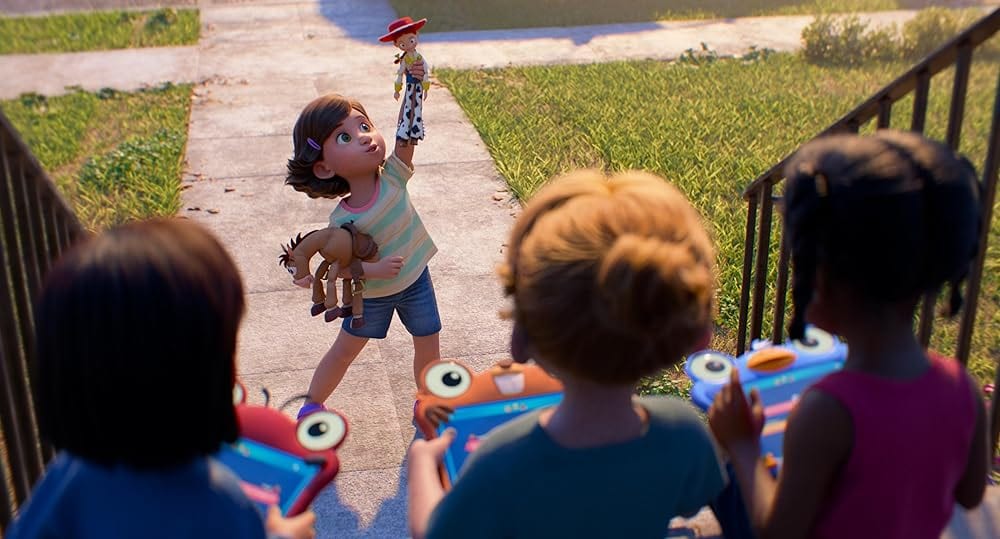
Bonnie’s toys take it upon themselves to help Bonnie find playmates, real-world friends with whom she can play toys and fuel her imagination. Her favorite toy, Jessie (Joan Cusack), sneaks out of the house to engineer a playdate and is faced with the brutal reality of the changing landscape of toys in a world ruled by technology. A series of mishaps and coincidences finds Jessie back in her first home, a narrative convenience in a film that’s strung together by a confluence of events that happen in the right place at the right time. This is the film’s weakest point — more than its predecessors, Toy Story 5 relies heavily on inexplicable events that lead to each other, beginning with a stray shipment of new generation, high tech Buzz Lightyear (Tim Allen) toys that come alive and find their way to Bonnie’s neighborhood at the same time as Jessie getting lost and being found in her old owner, Emily’s childhood home. Its Rube Goldberg machine of a narrative aside, Toy Story 5 carries some real emotional heft and is the culmination of Bonnie and Jessie moving to the center of the story after Andy’s exit in Toy Story 3 and Woody (Tom Hanks) going rogue in Toy Story 4.
Toy Story 5 shows Emily for the first time, giving longtime fans a look at one of the franchise’s most important figures in its mythology. Jessie’s existential crisis was the core of Toy Story 2, and Sarah McLachlan singing Randy Newman’s “When She Loved Me” will forever be one of Pixar’s most heartbreaking moments, right alongside the opening sequence of Up. Jessie’s backstory is a reward for fans, and its emotional impact is directly proportional to how invested you are in the franchise, but even viewers who have never seen any of the films or specials should be able to relate to the universal conundrums of abandonment and grief. Every film in the series has made it clear that the purpose of toys is to love and make their children happy, and very, very often the toys love their children more than the children — who inevitably outgrow their toys — love them back. This inequitable, imbalanced relationship forms the crux of every Toy Story, which only works because toys are at peace with their purpose and give everything of themselves to the children who play with them. The toys of Toy Story are the embodiment of love.
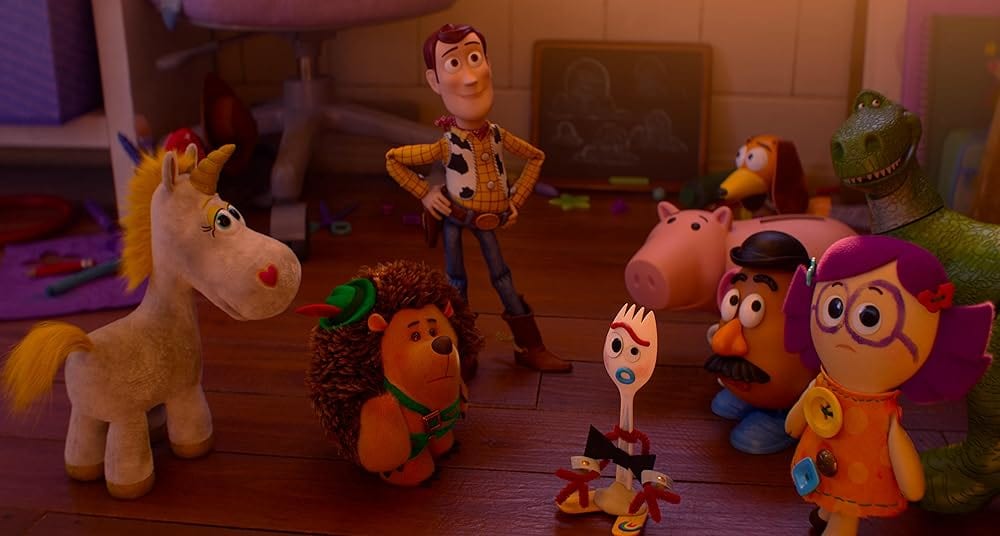
But love and grief go hand in hand, and one’s grief is always as big as one’s love, so when Jessie is reminded of Emily and the threat of experiencing the same abandonment by Bonnie, her fear and grief are overwhelming. Toys are transient companions who play brief roles in children’s lives, and acceptance and understanding of this temporary relationship is a recurring theme in the franchise. It’s always painful and sad to see toys that don’t understand that their children have outgrown them and that their time for play is over and will never come back. In essence, we ourselves are toys, and our lives’ truest, most noble purpose is to bring joy to the ones we love, even for the briefest moment.
One of the film’s best characters is Smarty Pants (Conan O’Brien), an electronic potty-training toy once used by Blaze (Mykal-Michelle Harris), an eight-year-old who now resides in Emily’s old home. Smarty Pants and his toddler toy companions were only with Blaze for mere months, shocking Jessie, who tells them that a few months isn’t enough time spent with their kid. It’s a reminder that our time with the people we love will always be more brief than we’d like, and we don’t control how long we can be part of their lives, but those moments we share are what matter. One of the film’s emotional climaxes is when Jessie learns how much she impacted Emily’s life, providing her — and consequently the audience — closure we never thought we needed.
Lily is framed as the main antagonist, but she’s no Lotso from Toy Story 3. Lilypad is more of a metaphor for how we’ve allowed technology to replace genuine connections, how we mistake online messaging for real conversations, and how we measure relationships and social acceptance through numbered metrics. Our interactions have been gamified, and despite being connected through technology, we’re more isolated from each other than ever. But Toy Story 5 makes it clear that this isn’t anyone else’s fault but our own, because Lilypad is merely a toy, a conduit that enables isolation as much as it empowers connection and finding like-minded people whose company we genuinely enjoy. Toy Story 5 also shows us that toys, quite simply, aren’t for everyone. For the first time in the franchise, Toy Story 5 acknowledges that not all kids play with toys using their imagination, and the ones who do must find others like themselves in order to create true magic. In a world that increasingly dulls imagination and creativity, where people turn to technology such as AI to generate art and ideas, Toy Story 5 reminds us that toys are among the last bastions of warmth and humanity.
ALSO READ:
Toy Stories: How the Subversion of Playthings Makes for Terrific Scares
Toy Story 4 Elegantly Captures the Existential Terror of Being Alive
Zach really, really, really loves films.
View More Articles About: