Today I Learned: Jose Rizal's Original Manuscripts Were Stolen in the 1960s
Back in the 60s, the Philippine government almost lost Rizal's greatest works.

by JV Ordoñez
Published on Dec 30, 2025
Sitting through a lecture on the greatest works of national hero, ladies' man, polyglot, fencer, and renaissance man Jose P. Rizal is a rite of passage for every Filipino. Enjoyment of Rizal's writing usually depended on the luck of the draw—on what type of Filipino, Literature, or History teacher you had.
Regardless of what you think of him, we usually only develop a true appreciation for works such as Noli Me Tangere, El Filibusterismo, and Mi Ultimo Adios as we get older and build our own sense of nationhood and nationalism at varying stages of adulthood and frontal lobe formation.
But did you ever hear about the tale of the stolen Rizal manuscripts of these exact three seminal works and priceless pieces of a nation?
It was circa 1961, a time when the Philippine government was celebrating Rizal's centennial birth anniversary and a subsequent International Congress on Rizal.
More than a decade ago, historian Ambeth Ocampo wrote about phantom thieves who slipped through the flimsy glass cases that housed the original manuscripts of Noli Me Tangere, El Filibusterismo, and Mi Ultimo Adios. The only thing left at the scene of the crime was a right rubber glove as the perps entered through an unlocked window via an electric wire. The crime was believed to be an inside job, according to the historian.
The crime then evolved into a ransom situation involving a note fashioned out of cut-out newspaper letters arriving at the Manila Times office demanding P1.4 million, or risk having the manuscripts burnt to a crisp—something straight out of a noir crime movie.
This wasn't the first time precious works were nabbed. Directly after World War II, 122 major manuscripts were stolen from Manila City Hall vaults, forced open with an acetylene torch. In 1946, 106 of them were returned while 16 remained missing.
Ocampo says then-Education Secretary and prolific author Alejandro "Anding" Roces recovered the prized Rizal manuscripts a year later.
Patay na si Rizal
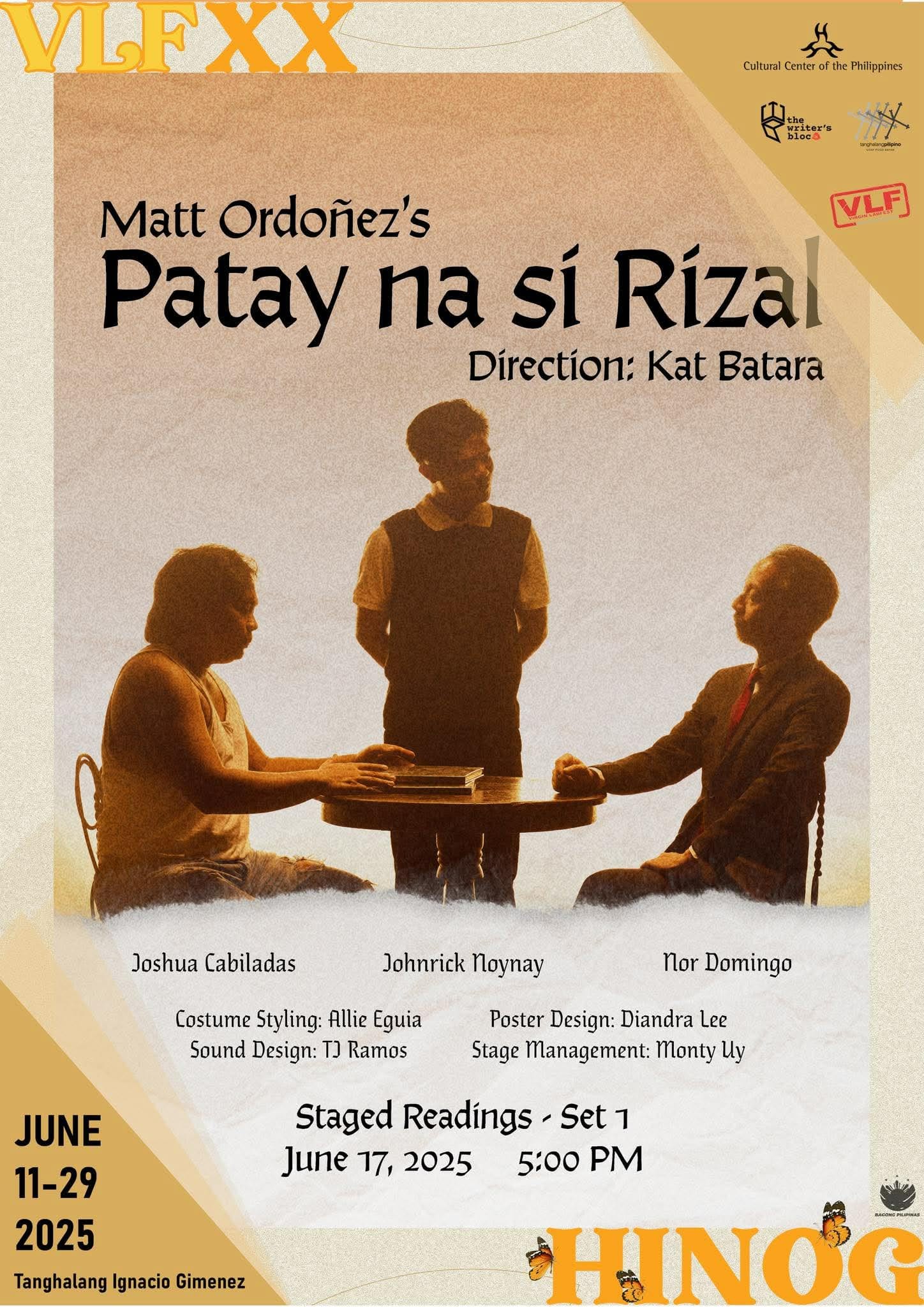
Earlier in June this year, an intriguing one-act play staged at the Cultural Center of the Philippines during Virgin LabFest (VLF) called Patay na si Rizal, written by Matt Ordoñez, my older brother, and directed by Kat Batara, fictionalized and dramatized this often-forgotten filler episode of Philippine history.
Ordoñez crafts this tale involving Roces' reimagined meeting and ransom negotiation with the supposed thief who stole Rizal's greatest works.
The former Education Secretary, played by veteran stage and television actor Nor Domingo, eventually engages in a more critical debate with the thief, played by Joshua Cabiladas, about national identity and literary legacy. The spectacle is witnessed by a waiter played by John Rick Noynay, who embodies the common Filipino. The overarching question is simply this: What good is a dead man's musings to a people that isn't keen on reading or remembering in general?
View More Articles About: