Jessica Soho: ‘The Journalist is Not the Star’
Jessica Soho, arguably the country’s most awarded journalist, reflects on her career spanning more than four decades, and confronts the challenges facing the industry today.
Published on Nov 18, 2026
Every year, Esquire Philippines presents Man at His Best, the local iteration of a global signature event, where we celebrate extraordinary Filipinos reshaping society as we know it. These are the dreamers and doers who are making a profound impact on our way of life, and who are using their talents and skills to make something of themselves and inspire the rest of us to become better versions of ourselves.
This year, in celebration of Esquire Philippines’ 15th anniversary, we’re honoring 10 heroes and mavericks in entertainment, journalism, culture, business, and advocacy, as well as five iconoclasts who exemplify what it means to be a Man at His Best.
Meet Esquire Philippines’ Journalist of the Year, Jessica Soho
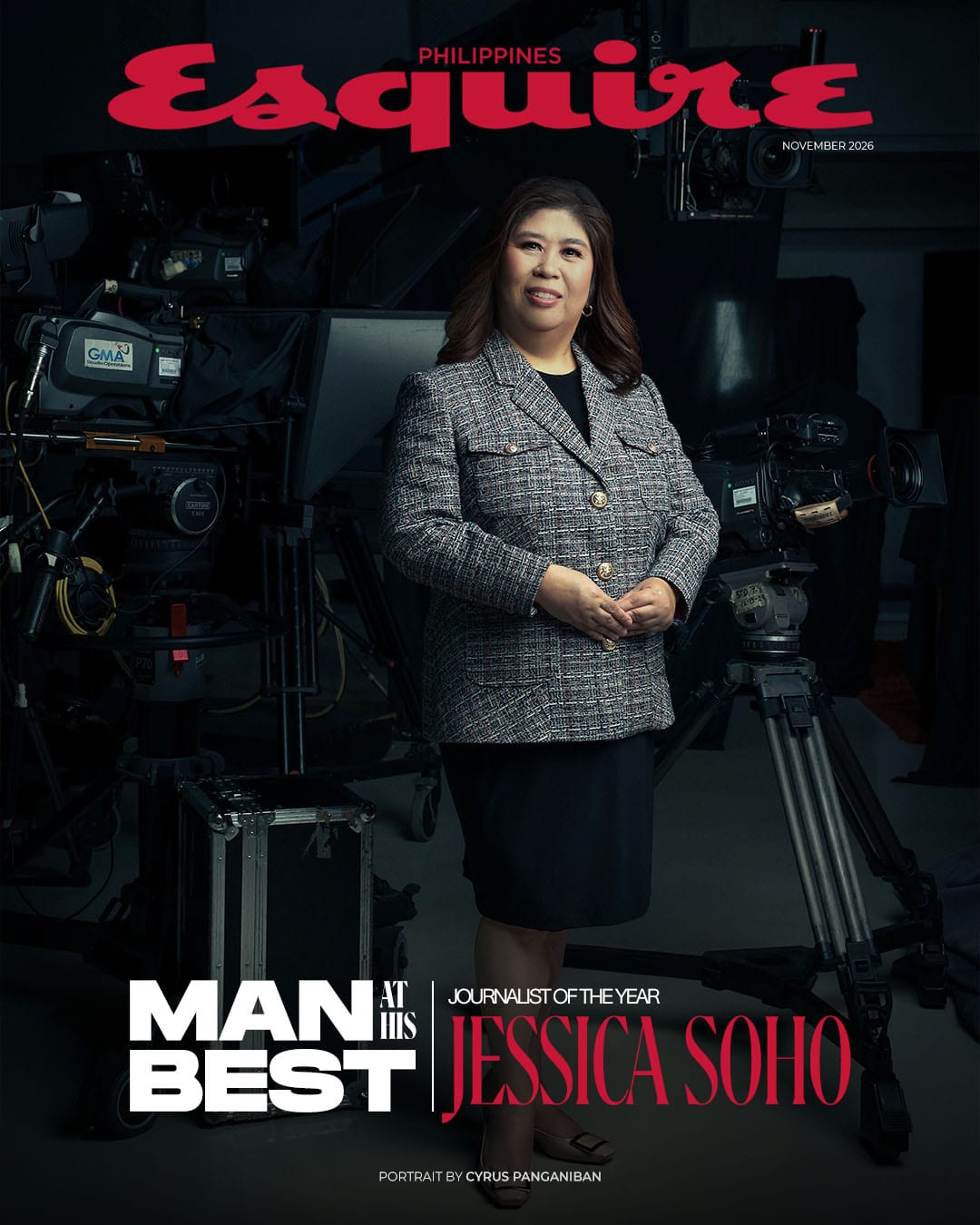
Jessica Soho has a secret.
Newsroom legend has it that she keeps a shadow social media account to monitor what people say online (much to the consternation of her producers), including posts by GMA-7 reporters back when she was news manager.
She now confirms that.
“I only have three friends in that secret account,” she chuckles.
She admits she gets hurt when she encounters bashing.
“I’m human. I’m not a bot. My staff in Kapuso Mo, Jessica Soho (KMJS) tells me it also affects them,” she says.
But she can’t help it. Naturally curious, she uses that account to gauge public sentiment.
She arrives at this interview with her own notes—a list of the things she wanted to say but afraid she’d forget.
“I’d discuss a timeline, my background, my career, where I came from,” she rattles off the list from her phone, perhaps unable to escape her default of being the interviewer, not the interviewee.
But it seems fitting on the occasion of her being awarded Esquire’s Journalist of the Year. The distinction is a chance for retrospection as much as introspection, from her being a reporter in the ‘80s to becoming a pop culture icon with a drag queen impersonating her.
“Maybe I should be cool and say okay. It’s fun, I should watch it,” she says of the drag impersonation.
A story well-told
Soho’s illustrious career as a journalist is well told. What I wanted to know was how she sees her place within today’s media landscape amidst the advent of social media and artificial intelligence (AI); and given her wealth of experience both as a journalist and a news manager, how she would advise a younger generation of journalists to navigate it.
Because what is out there now is very different from when she started as a reporter in 1984, right at the cusp of the EDSA Revolution of 1986, and thereafter bearing witness to the country's tumultuous history. Today’s upheaval is different: social media and AI chip away at, and some say threaten, the very value of journalism itself.
But Soho, who has been in the front seat of history if not part of it, is unfazed by changing tides. She has covered the presidential campaigns of Cory Aquino and Ferdinand Marcos, Sr. during the snap elections of 1986, the Marcoses’ exile in Hawaii and the Philippines’ return to democracy.
“I was the one who got the call from (then Defense Secretary Juan Ponce) Enrile’s camp when they broke away. The caller just said this was the big news we were all waiting for. Send your team to (Camp) Aguinaldo ASAP,” she recalls.
In Hawaii, she, along with another reporter, Danny Buenafe, were given access to the hospital to see Marcos, Sr. who was then rumored to be sick.
“As proof that he was really sick. (Former President Aquino) Cory did not believe that he was dying,” she says. “He glowered at us when he saw us but we were not allowed to interview him. I just vividly remember that his skin was gray.”
Soho also found herself in the headlines in 1989 when she and her team went missing on an assignment to the Spratlys, long before it had entered the Filipinos’ consciousness.
“We were looking for the Spratlys at the time na hindi pa alam kung saan ‘yung Spratlys. But we never reached Pag-asa Island. But we saw islands claimed by other countries,” she says.

The team was running out of fuel and had to turn back. But there was not enough fuel to return to Puerto Princesa in Palawan. To make matters worse there, were no islands in sight.
“We really thought we were just going to crash into the sea. I was prepared to just swim if we did,” she says.
Miraculously, they found an island—with a landing strip. They landed safely, with barely enough fuel to spare—just enough, she jokes, for a bonfire that night. That island she would later know is called Ramos Island and the airstrip belonged to missionaries who were translating the bible into local dialects.
Then Western Command Chief Brig. Gen. Napoleon Angeles decided to take a boat in an attempt to reach Balabac Island where there was a Navy outpost with communication facilities. But the boat broke down.
Meanwhile, the newsroom in Manila was already mourning.
“They were already praying for our souls. Manila had declared us missing and they had called my Dad to come to the old newsroom. Tina (Monzon-Palma, then Senior Vice President for News) was inconsolable, and Tina doesn’t cry,” she said.
It was only later that night that the newsroom found out where they were. They were rescued the following day and Soho has since become a household name.
“Jessica back from the dead,” one newspaper headline announced.
If she’s not the headline herself, the headline finds her. In 1998, she spotted a missing Cebu Pacific aircraft that crashed on Mt. Sumagaya in Misamis Oriental. Soho was with her team on board one of the search helicopters that had circled the mountains in a hopeless search. When they were about to turn back to the base, she asked for one last turn. And banking on knowledge from a previous coverage of another plane crash which was found near the peak of a mountain, she trained her sights on the summit.
“I was murmuring, magpakita kayo, magpakita kayo, para mahanap kayo.”
Moments later, her prayers seemed to have been answered. “And then I saw white bits on the side of the mountain, like someone had thrown an egg.” She promptly pointed it out to the military. That could’ve been it.
They turned back for the day. But that night she could not sleep. “What if I was wrong? What if it was just some wreck?” she worriedly asked herself. That same midnight she went back to the army commander who told her she was correct and they had, indeed, found the wreckage. All 104 crew and passengers were confirmed killed and immediately a retrieval operation was organized.
Journalists are not the stars
Soho is a boots-on-the ground journalist so I ask: “What has changed and remained the same in journalism?”Despite being undoubtedly one of the country’s journalism stars, she would be the first to tell you that the journalist is not the star.
“The story is. It’s so hard to say that now in this age of self-promotion, but the story is the story. You’re not,” she emphasizes. Give a face to the story, she always advised.
“In one of my speeches to a young audience, I think it was the Global Youth Summit, I told them, ‘Kayo kaya, sabihin kaya natin sa kanila (politicians), kayo kaya ang lumusong sa baha! And the kids went wild, they were cheering. Kasi nga, they’re the ones who go to school, they wade in the floods. Those people who go to work, na ilang oras sila pumipila sa MRT, and LRT. Galit ang mga tao!”
Point of view is also important. “I’m not very opinionated. I don’t like being opinionated, but I get that the generation now, they want you to be opinionated. You have to have a stand. Hindi pwedeng fence-sitter when it comes to corruption, when it comes to issues like human rights, or the environment. Then you can express your opinion, then you can pursue those types of stories depending on your motivation.”
Soho said that was why she pushed for the Kurakot (corruption) series (a series of stories on the multi-million flood control projects controversy) on KMJS which is a magazine type of a program more known for human interest stories than incisive pieces.
Soho had received online criticism that her caliber and instincts as a journalist is wasted on light stories. Thankfully, journalists rarely escape their nature. “Because for the life of me, I could not go on producing content na light, na puro profile interviews when I knew there was this serious issue that was eating at our society – that our legislature has become ground zero for corruption.”
“Is that how you would do journalism in the age of social media?” I ask, to take what’s important and to go placidly and steadfastly against the noise.
“There’s no other way. The fundamentals are the same. Accuracy is non-negotiable, fairness, too. Being responsible and accountable for your content - those are non-negotiables for me. Those values should still be there. You should still breathe those values, live by them,” she answered.
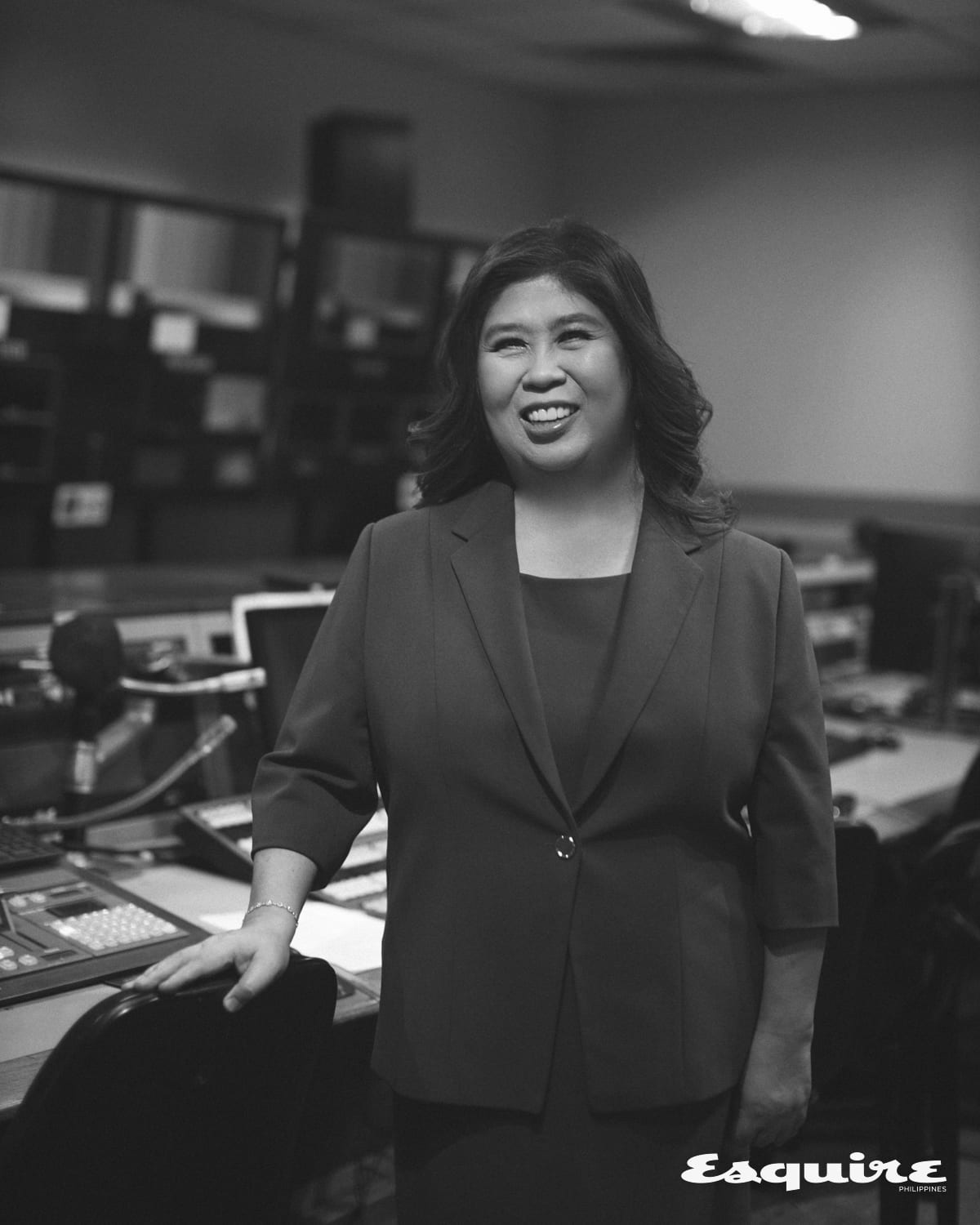
This intuition is what characterizes Soho, something she might have acquired early on as a child when she used to go with her paternal grandmother, Concepcion, to the market in San Fernando, La Union and had a stepmother who owned a parlor.
She spent the weekends with her maternal grandmother, Sixta, a retired public school teacher in Agoo, La Union.
“I would be with her on weekends, and I would play with playmates who were the children of the farmers, because she had some land,” she recalled. “All day there would be people in her house and then at around 10 or 11 a.m., mag-uwian na sila, mangungutang na sila ng bigas para mayroon silang pang-saing. I had a stepmother who ran a beauty parlor, mahilig din akong tumambay sa beauty parlor. I listened to all sorts of stories and gossip. I think even at an early age, I was really a very keen observer of all these realities before me.”
“Maybe it’s a gift?” I asked rhetorically.
Soho also recalled watching documentaries shown to them by Belgian nuns in their Catholic school.
“One of the nuns showed us a documentary on banana plantation farmers in Davao,” she recounted. “This was a big case that I encountered when I was already working as a journalist. But when we were in high school, the nuns said that because of the insecticides that were sprayed on the banana plantation, the men became infertile, they could not bear children. And then in senior high, we were immersed with farming communities, and we helped the farmers harvest rice and vegetables.”
If the path to journalism was opening at that time, she would not know until much later.
The Accidental Journalist
In fact, Soho calls herself “an accidental journalist” after shifting from a political science course at the University of the Philippines in Diliman to journalism because that was the first course she saw with only three units of math. She had intended to go to law school and needed an undergraduate degree, but couldn’t hack math, she said.
That choice proved to be fortuitous and led to her having veteran journalist Louie Beltran as one of her teachers and a mentor who would soon plant an idea in her head. “(He) made journalism sound so cool with all his exploits, the investigative stories, the Martial Law stories. That was the time I started entertaining the thought.”
At a printing class, the final requirement was to design their own business cards. There she wrote the path she would later take.
“I wrote, ‘Jessica Soho, War Correspondent.’”
The budding journalist said she chose to enter GMA because of its convenient location. “Nung nakita ko, ‘uy GMA, nasa Quezon City lang, isang jeepney ride lang.”
Palma hired her in 1984 and by 1985 she was a full-fledged reporter. “Ang swerte ko na malas ko because the guy covering the defense, the military beat, Pert Franco, the father of Mao de la Cruz of DZBB, died of cancer. And again, there was no one to fill in. So ako na yon.”
A lot of her pivotal choices in life seem providential, like a path had already opened before she has even recognized it.
“Do you think it’s destiny?” I asked.
“Maybe,” she said, almost introspectively.
The journalist as manager
Now, more than 40 years later, Soho has won 36 international awards, including two George Foster Peabody awards, 200 local awards for her shows and 201 personality awards at the time of this interview.
But one achievement she said she was proud of was being a news manager of GMA-7 in the early 2000s during which GMA-7 successfully dislodged competition at the top of the ratings after decades of dominance. Appointed Acting News Director in 2004 and then Vice President for News two years later, she went on to become First Vice President for News programs in 2013 until her retirement in 2014.
“My marching order was to beat competition. How the hell was I going to do that?” she said.
It was back to the drawing board, and her instincts, for Soho. To tackle the competition, she did what she has always done with every new assignment that came her way—study it. “We were out of touch. We were not connecting. They were dominant because their newscasts were in Tagalog. They had changed the paradigm. And then, GMA had nothing. We didn’t have marketing research. I had to learn things all over again.”
Soho said she studied minute per minute ratings, called in her Public Affairs producers, and took a long hard look at the difference between the flagship programs of GMA-7 and the competition.
“And then I would ask Lirio (Dayao, production coordinator) to plot the stories. What they had and what we didn’t. They had longer commercials and I took advantage of those gaps. ‘Dun ko pinasok ‘yung magagandang content. I studied the audience and the demographics. The bottom line there was that the content was really king or queen. You build it and they will watch it.
“From the late ‘80s to the ‘90s, we were clobbered, not just in ratings but in equipment,” she added. “We had nothing, we had old cars, old cameras.”
Once, she even asked the network owners to buy a helicopter, which was an advantage the competition had in terms of providing a bird’s eye view of things like protest rallies, and deployment. “One day there was an open forum with the owners of the company, and I went, ‘Pwede ba ibili n’yo rin kami ng helicopter?’ I will go down in history as having so bravely and brazenly asked the owners of the GMA for a helicopter.”
And then there were the reporters. And the headaches they (we) bring. But Soho understood, admitting she was also stubborn.
“That’s how we trained them, to stand their ground because you interact with people in power,” she said. “I can live with that. The desk would complain, matigas ang ulo. Tigas-ulo is good.”
It was the same stubbornness (or steadfastness) she applied as GMA-7 tackled the competition and what the network lacked in resources at the time, it made up for in ambition. Prior to her appointment, GMA had already produced trailblazing shows like the Public Affairs show Brigada Siete in 1993, which Soho helped conceptualize. She pushed the envelope further by introducing the documentary format as a regular program in GMA via the show I-Witness in 1999, in part due to criticism that television was shallow. For its debut, I-Witness had Philippine journalism’s who’s who: Mike Enriquez, Luchi Cruz-Valdes, Vicky Morales, Cheche Lazaro, and Soho herself.
“I even dubbed it as ‘Philippine television’s finest hour’,” she said.
GMA-7 would soon launch the Kapuso branding in 2002 and establish itself as the leading news organization in the country.
Then came her own show, Jessica Soho Reports, the precursor to KMJS, which was made more popular by one of its recurring lines, “Lumipad ang aming team ….”
Under her stewardship, GMA News sent teams to the far ends of the world, to places like Mt. Everest, Iraq, Afghanistan, Haiti, Japan, Israel and Gaza, helping establishing it as a world class news organization.
Her tenure as News chief also had its share of challenges: a GMA team was kidnapped by the Abu Sayyaf, who also tried to keep reporter Susan Enriquez behind until then Vice President Noli de Castro stepped in.
But despite these setbacks, things started turning around for GMA. “Of course, with management support,” she said when asked how she was able to do it. “We started getting better equipment, we had microwave vans. There was money coming in to replace our decrepit equipment. I remember attending trade shows in the States where we were shown equipment, and we could shop for those.”
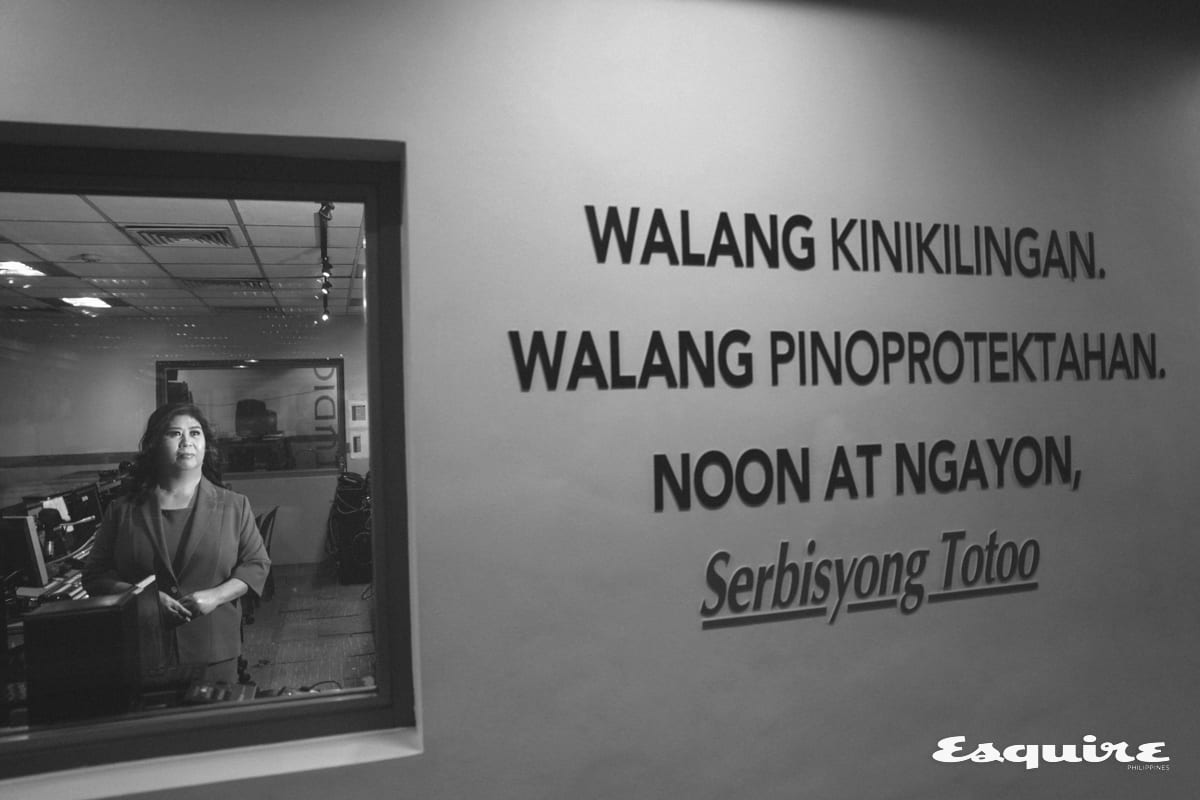
She helped conceptualized the tagline, “Walang Kinikilingan, Walang Pinoprotektahan, Serbisyong Totoo Lang,” which has since become GMA-7’s motto and guiding principle.
Journalism, social media, and AI
Studying the audience is what turned things around for GMA, but that audience is constantly changing. The combined threat of social media and AI also looms on the horizon, if not a reality already.
A 2026 Digital News Report by the Reuters Institute, notes that in the Philippines, which has an internet penetration rate of 67 percent, social media is the dominant source of news while “television (down 42 percent in 2026 from 66 percent in 2020) and print (10 percent in 2026, down from 22 percent in 2020) continue their long-term decline, and online news use has plateaued.”
When the audience is moving away from traditional media for news, where are they getting it instead?
The same report by Reuters says that “27 percent of respondents globally get some news from news-focused individual creators or influencers, and almost half (46 percent) get some news from creators of any type” who are “more entertaining, easier to understand, and more relatable than traditional news outlets.”
Then there is AI, which in some parts of the world, has been incorporated in production if not totally replaced journalists.
Jindex.ai a database built by Ukranian journalist Katya Gorchinskaya that tracks AI adoption in newsrooms around the world, has so far documented that at least 18 news organizations have replaced journalist functions with AI as of this writing.
“It’s a threat,” Soho said of AI, but one that can be harnessed. “I simply cannot imagine a world without journalists. Sa totoo lang, some of the data AI now has, came from journalists themselves, which is why publications are suing AI companies for stealing their work. AI may be trained to cover news conferences, transcribe, and make a summary about it, but it cannot replace how the journalist can relate the words to the human experience.”
Another Reuters Institute article posits an intersection or a ‘hybridization” between human-driven journalism and AI: AI can handle parts of the job like gathering and summarizing information while retaining the judgment call by the journalist.
“AI does not know the pulse, or what makes things click, of our readers and our followers. That is our own. That is irreplaceable. Hindi kaya ng AI ang pinagdaanan ko: the storytelling, appreciating and understanding the facts and events that we report on,” she said, which is to say that what makes journalism human, cannot be automated.
Journalism as mission and curse
In her speech before the UP College of Mass Communication she emphasized journalism’s value.“Hindi ko pa rin nalilimutan ‘yung sinabi ng isa kong kaibigan noong kapapasok ko sa trabahong ito. Sabi niya ‘Jessica, imagine the power that you have: to report the news which helps people form their opinion about what’s going on.’”
“Do you think we still have that role?” I asked.
“I think so. I refuse to believe that we don’t have that anymore because as I was telling you, it’s good to be stubborn. I would like to quote journalist Malou Mangahas (one of the founders of the Philippine Center for Investigative Journalism) that journalism is a far bigger cause than any of us, which is true. Why are we here? It’s because we have a mission, but I also know this job is a curse.”
A curse?
“This job is not something you can just switch off. What kind of people would chase stories day in and day out like we do? And most of the stories are bad and negative but why do we keep doing it? Because people need to know.”
“Do they listen, the public?” I probed.
“It doesn’t matter. We have a job to do. We can’t just give up, ‘di ba? Sino magbabalita?”
When Soho calls journalism a curse, consider it a warning.
To young journalists she advises: “It’s really chasing the story constantly. Journalism has changed. So, if you still want to get into this kind of profession, you need to evolve.”
She says she is now in her mentorship era, passing on the lessons from her own mentors to the next generation of journalists.
Ever humble, Soho said she stands on the shoulders of giants before her: Tony Seva (former Senior Vice President for Operations), Tina Monzon-Palma, reporters Rey Vidal and Jun Bautista, editor and visual manager Steve Serna, and cameraman Ric Villegas, among others. The legend learning from the greats.
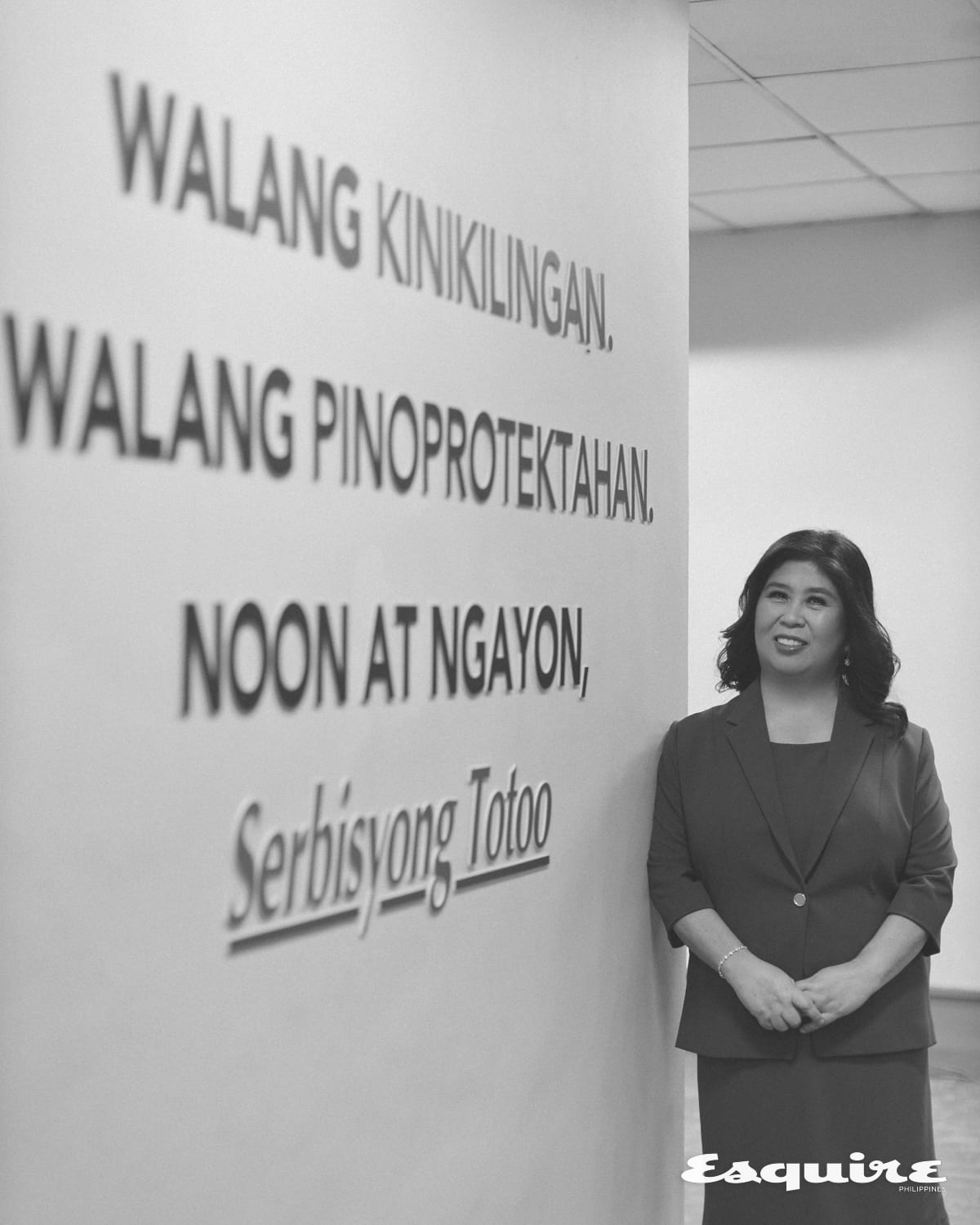
“I'm paying it forward because if there’s one thing that I’m most proud of, it’s the fact that I trained and mentored a whole generation of journalists, the same reporters you probably see now on television, and videographers, we used to call them cameramen, producers in Public Affairs,” she says.
Yet for all the changes in journalism, some things remain stubbornly the same, particularly the problems she has spent her career covering.
“More than four decades later bakit ito pa rin ang kino-cover ko? Why haven’t we moved? Our politicians are stealing more,” she sighed.
“And the answer is?” I inquired.
“Dapat hindi ganun. That’s why we need more journalists, now more than ever kasi the same injustices, the same issues I covered, 42 years ago, are still the same things confronting us now. Why? That is the big question,” she said almost exasperatedly.
“The truth is even more valuable now.”
For as long as there are questions, there will be journalists.
Story: Joseph Morong
Editor-in-Chief: Paul John Caña
Creative Direction: Igi Talao
Photography: Cyrus Panganiban
Videography: Jino del Mundo
Hair and Make-up by Yari Balaguer
Styling by AJ Alberto
View More Articles About: