The Lopez Moat: Built to Survive Everyone But Each Other
As tycoon Ramon Ang reportedly buys Gabby Lopez’s stake in Lopez Inc., it helps to understand the company’s ownership structure and the strategies it employed to ward off threats over the years.
by Lala Rimando
Published on Aug 10, 2026
In April 1986, Oscar Lopez walked into the First Philippine Holdings building in Makati carrying a letter of appointment signed by then Executive Secretary Joker Arroyo. What he found was a company with more than P1 billion in debt, P3 million in the till, and 20 employees left to run it. The outgoing president, Eddie Regala, greeted him at the door with a question that was really a warning: why would you want anything to do with this big headache. Oscar's reply, recorded years later in Phoenix: The Saga of the Lopez Family, the family's own two-volume history published in 2000, was almost sheepish. "Yes, well, sometimes I wonder myself why."
He was not exaggerating, and he was not the only Lopez walking into a wreck that year. Fourteen years earlier, Ferdinand Marcos Sr. had taken the family's empire apart piece by piece. Meralco was extracted through a forced sale of shares, priced, as Piki Lopez recalled in an earlier interview, at a down payment of P10,000. ABS-CBN was shuttered overnight. First Philippine Holdings, once one of the country's most important companies, shrank to almost nothing.
Eugenio "Eñing" Lopez Sr., then the family patriarch and who jumpstarted the family pivot from sugar business to an influential media and energy empire, died in American exile in 1975, still fighting to get it all back. His eldest son Eugenio “Geny” Lopez Jr spent five years as a political prisoner before escaping to the United States. When the family returned to their companies after the 1986 revolution, they were not returning to an inheritance but to a debt.
What the first and second generation did next was not one comeback. It was three decades of constant motion: rebuild a company, then sell off a piece of it that no longer made sense; expand into a new sector, then retreat when a crisis hit; take on debt to grow, then pay it down hard when the economy turned. Meralco, ABS-CBN, and First Holdings were rescued in the late 1980s. First Gen was carved out and built up between 1998 and 2006. Geothermal powerhouse Energy Development Corp (EDC) was bought, taken private, then partly sold down again to new partners in 2017. Every one of those moves also did something else, almost as a byproduct: it added another wall to a structure meant to keep the next Marcos, the next crony, the next hostile government agency from ever again taking the whole business in one stroke. The people who lived through 1972 built that discipline into the architecture itself.
The third generation inherited the architecture, but it did not inherit the same instinct for handling a threat from inside the family. Until 2026, that was not a problem this structure had ever needed to solve.
A structure built to survive an attack
The lesson of 1972 was not really about Marcos as a person. It was about concentration. A family that owns a company entirely and privately, with every share sitting in one name, owns something a dictator, a crony, or a hostile creditor can seize as a whole, and cleanly, with a single decree or a single forced transaction. There is nothing standing between the asset and the raider except whatever goodwill the raider chooses to extend, and in 1972, that turned out to be none.
A public company is harder to steal outright. It has thousands of shareholders whose claims cannot be waved away. It has a board that owes a fiduciary duty enforceable in court. It has disclosure rules, creditors, and a listing that requires an actual, defensible transaction rather than a signature taken under duress. So when the second generation Lopez brothers rebuilt Meralco, they did not simply take it back and hold it tightly. In November 1991, First Holdings and its affiliated foundation sold 21 million Meralco shares, 23 percent of the company, in an initial public offering so oversubscribed that a second block, another 25 percent, went to market two years later. By 1996, Meralco was the most widely held company in the country. As Oscar Lopez put it in the foreword to The Audacity DNA, First Philippine Holdings' own institutional history published in 2014, the company by then had nearly 90,000 stockholders, a fact he offered less as a boast but as proof that FPH had rebuilt itself into something stable enough to build on again.
The same instinct had already been tested once, at PCIBank. Philippine law at the time capped any single family's ownership of a bank at 30 percent, so when Geny Lopez tried in 1987 to buy back his father's old bank from the Development Bank of the Philippines, the legal ceiling forced him into partnership. He allied with Filipino-Chinese tycoon John Gokongwei, an outsider to the Lopez circle. The two men split the bank's leadership: Geny as chairman, Gokongwei as head of the executive committee. And by 1990 the PCIBank they ran together was the country's most profitable bank. A regulatory limit that looked like a constraint had instead proven something useful early: bringing in outside shareholders did not have to mean losing the company. It could actually mean gaining a shield.
The tallest structure in Philippine business
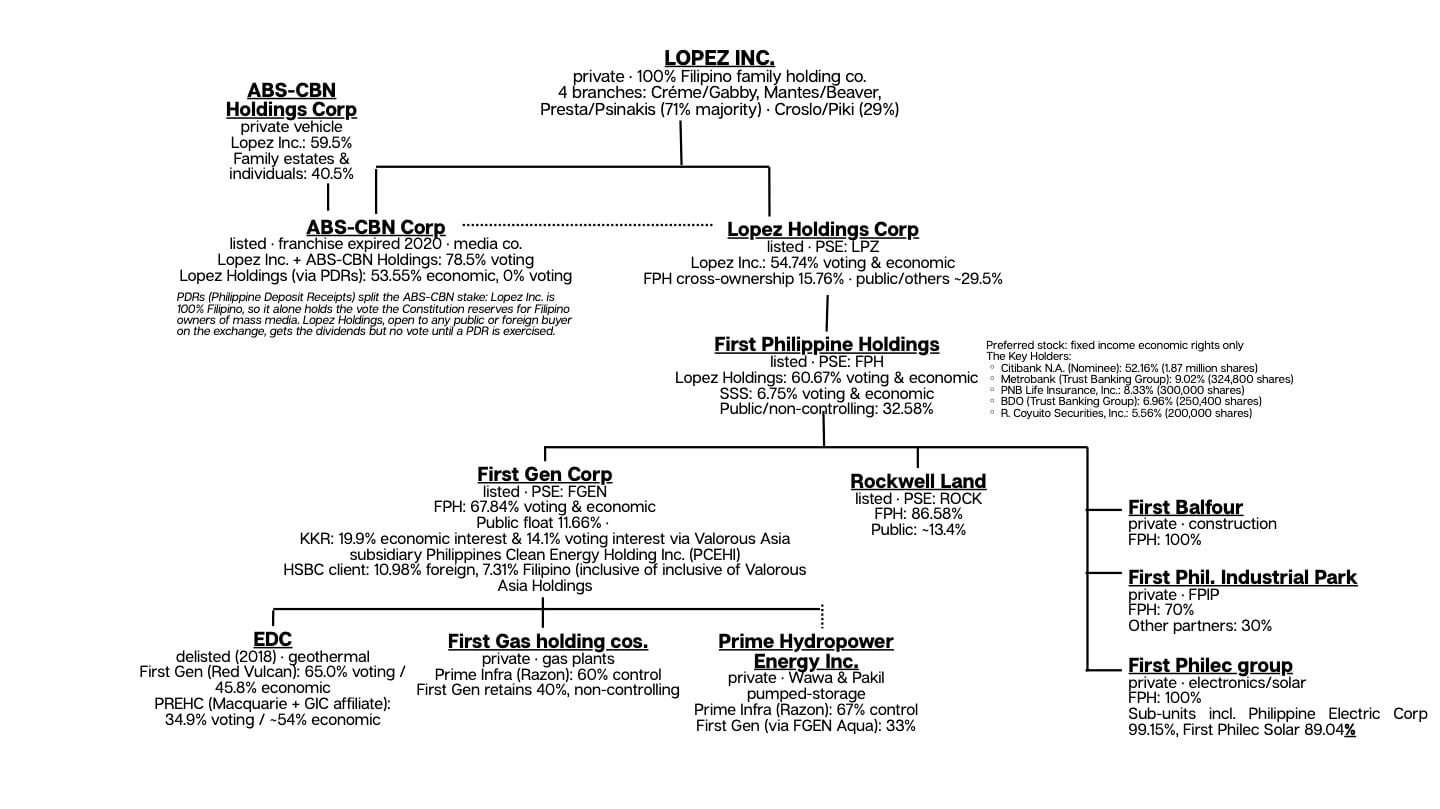
By the time the third generation took their seats at the table, this instinct had hardened into an actual corporate architecture, and an unusual one even by the standards of Philippine family capitalism. At the very top sits Lopez Inc..
Privately held, Lopez Inc. is a company with no ticker, no prospectus, and no public shareholder. Its entire ownership is four private vehicles, one for each branch of the second generation:
- Croslo Holdings for Oscar Lopez's branch
- Mantes Corp. for Manolo's
- Créme Investment Corp. for Geny's
- Presta Holdings for Presy's.
This was deliberate. If a hostile buyer, a hostile creditor, or a hostile government went after any single company in the group, the rest of the group would still be anchored upstream, safe inside a private holding company nobody outside the family could ever buy into.
From that private top, control cascades down through a chain of majority stakes, each one just large enough to carry a shareholders' vote. Lopez Inc. holds roughly 55 percent of Lopez Holdings Corporation, the first public rung. Lopez Holdings holds just over 60 percent of First Philippine Holdings. FPH holds close to 68 percent of First Gen Corporation. First Gen holds 65 percent of the voting stock of Energy Development Corporation, the geothermal arm. Multiply the percentages straight through, and the family's actual economic claim on EDC's earnings, five layers down, is a fraction of what the vote at each layer suggests. That gap is not an accident. It is the point. Majority of the vote at each rung is what lets Lopez Inc. elect the directors and pass the resolutions all the way down the chain, while the money that funds each company's growth can come from almost anywhere else.
And it has come from almost everywhere else. Nowhere is this clearer than in the creation of First Gen. When First Generation Holdings was incorporated at the end of 1998, it was meant to be a passive vehicle, nothing more than a way to pass earnings up from the gas plants to FPH. A 1999 study by McKinsey and Co. recommended that First Holdings sharpen its focus on power and energy. Oscar Lopez's team took that recommendation further than McKinsey proposed, folding the group's scattered power assets under one roof. "OML decided to put our power generation assets under one roof," First Gen's early vice chair Peter Garrucho recalled in The Audacity DNA, using the family's shorthand for Oscar M. Lopez and crediting him with both the reorganization and the name.
But instead of funding the new platform by borrowing more or diluting the family's private ownership without limit, the team chose a staged route: sell small strategic stakes first, then go public. In 2001, Singapore's AIDEC and Japan's Sumitomo together bought 11.6 percent of First Gen. A P5-billion retail bond followed in 2005, upsized twice after investors oversubscribed it. Then, on February 10, 2006, First Gen listed on the Philippine Stock Exchange, selling 24 percent of its shares at P47 apiece and raising roughly P9 billion, an amount that combined with the bond proceeds to leave the company with a year-end war chest of $459.2 million. The strategy had been sketched out years earlier, in almost those exact words, by financial analyst Erwin Avante, who told the board, according to The Audacity DNA, that the plan would let the family “raise funds” while it stayed, in his words, “in the driver's seat.” Finance officer Noel Singson called the same move arming themselves, telling the book's author the team went public specifically “to further arm ourselves.”
First Gen has repeated the maneuver at nearly every layer since. A 2010 rights offering brought in P15 billion without moving the board majority, because FPH simply exercised its own pro-rata rights. Preferred share issuances in 2011 and 2012 raised another P20 billion combined without touching a single common vote. A 2015 placement, subscribed to pro-rata by FPH, diluted nobody's percentage even as it brought in fresh cash. When EDC needed a bigger infusion in 2017, First Gen brought in Macquarie Infrastructure and Real Assets and Singapore's GIC as co-investors, structuring the deal through common and preferred shares so precisely that today First Gen holds 65 percent of EDC's votes while claiming less than 46 percent of its economic interest. The difference was sold off on purpose, to fund a business the family alone could not have financed.
ABS-CBN runs the same split for a related but different reason. Lopez Inc. holds just over 78 percent of the network's votes directly, while Lopez Holdings holds roughly 54 percent of the economic interest through Philippine Depositary Receipts rather than the underlying shares themselves. That structure exists partly because the Philippine Constitution requires mass media to be wholly owned and managed by Filipino citizens. The instrument that lets outside or institutional capital claim a piece of ABS-CBN's cash flow without ever touching a ballot is not just a Lopez preference. It is close to the only legal way a nationality-restricted industry can raise capital at all.
Every company its own fortress
None of this works if Lopez Inc. can simply reach down through the layers and dictate outcomes at will, and the family's own structure prevents exactly that. Once a company lists, or brings in an institutional partner even without listing, its board owes a fiduciary duty to every shareholder on the register, not only the family that controls the vote.
First Gen counts KKR among roughly a fifth of its shareholders. EDC counts Macquarie and GIC as owners of more than a third of its votes. FPH counts the Social Security System among its institutional investors. None of them signed on to be governed by a family council. They signed on to be governed by a board answerable to the Securities and Exchange Commission (SEC) and the Philippine Stock Exchange (PSE). Philippine corporate law does not carve out an exception for a director who also happens to be someone's cousin.
Each subsidiary's separate board is not bureaucratic padding. It is a second wall inside the first, protecting public shareholders from being treated as an afterthought to family politics, the same way the pyramid above it protects the family from being treated as an afterthought to a raider's ambitions.
How other families did it
Other family conglomerates that needed outside capital while keeping control have converged, again and again, on the same two tools: a private holding company at the apex, and a split between voting rights and economic rights somewhere below it.
Sweden's Wallenberg family runs the purest version, its foundation-controlled Investor AB holding stakes in Ericsson, ABB, and Atlas Copco through shares that carry 10 votes apiece against a public float that carries one. Italy's Agnelli family uses loyalty voting shares through its holding company, Exor, to control Stellantis, Ferrari, and Juventus, while public investors own most of the economic float.
Ford Motor Company has run a dual-class structure since 1956 for a version of the Lopez family's own logic: the Ford family's shares carry 40 percent of the vote on roughly 2 percent of the economic stake. India's Tata Sons goes further still, majority owned not by any branch of the Tata family directly but by a set of philanthropic trusts, which insulates control from any single generation's succession fight.
A former banker, Lala Rimando wrote about Philippine business and managed newsrooms for over 25 years. She’s now based in La Union, working on the biography of the late John Gokongwei.
View More Articles About: