Congress Just Ratified the 2026 National Budget; Here's What You Need to Know
At P6.793 trillion, this is the biggest national budget in history. Should we worry about more phantom infrastructure projects next year?

by JV Ordoñez
Published on Dec 29, 2025
Here we are at the end of the year and Philippine lawmakers have finally consolidated both their respective versions of next year's national spending plan. This comes at a heightened climate of scrutiny amid the discovery of egregious phantom ghost projects which were used to fatten their own pockets—well, allegedly.
The ₱6.793-trillion national budget for 2026 also underwent the first-ever bicameral conference committee deliberations that were open to the public via livestream, prompted by the outrage over the multi-billion peso flood control debacle and the wasted state funds that stemmed from billions inserted in this year's budget used for dubious reasons.
Before we get started: Senators Robin Padilla and Rodante Marcoleta voted against the budget's ratification due to "concrete audit findings, fiscal patterns, and policy distortions," and "unclear allocation of funds for financial assistance programs."
Senators Imee Marcos, Bong Go, and Bato dela Rosa did not sign the Bicameral Conference Committee report on next year's spending plan.
Senators Risa Hontiveros, Loren Legarda, Kiko Pangilinan, and JV Ejercito had reservations that included those on the farm-to-market roads program; unprogrammed funds; and the Medical Assistance to Indigent and Financially Incapacitated Patients program.
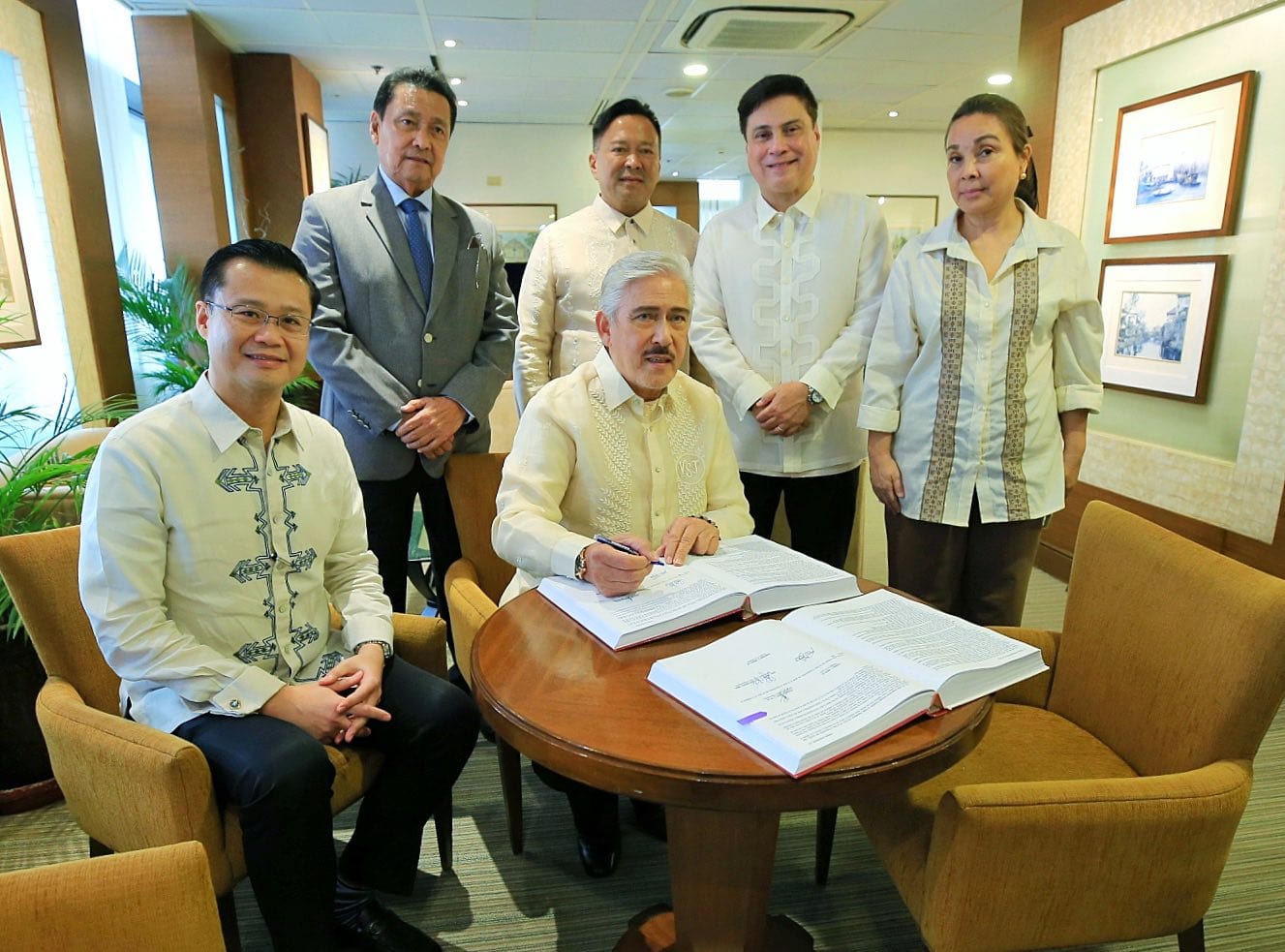
Senators signing the ratified Bicameral Conference Committee report of next the P6.793 trillion 2026 national budget
Education and Health get big time funding; Lawmakers give Agriculture 15-year high budgetary allocation
The spending plan awaits the signature of President Ferdinand "Bongbong" Marcos Jr. by the start of the new year. So this begs the question: Are there any eyebrow-raising components to the budget? We quickly dissected the ratified version of the spending plan for you to be the judge.
The final ratified and reconciled version of the 2026 General Appropriations Act is the biggest budget in the country's entire history at ₱6.793 trillion, up from the ₱6.326 trillion budget this year. Doing the math, this is ₱467 billion higher or a 7.4 percent increase from the current spending plan. Take note that President Marcos vetoed about ₱194 billion in budgetary items in this year's spending plan due to these "not being consistent with the administration's priorities to ensure that government targets would respond more directly to the needs of Filipinos."
As mandated by the 1987 Constitution, the education sector received the largest allocation at a whopping ₱1.35 trillion budget next year, intended for classroom shortages, school-based feeding programs, and textbooks, among other issues plaguing the public learning system.
Let's hope something comes out of this lofty funding as Filipino students still fare poorly among their global counterparts in major subjects. They were ranked among the world's weakest in mathematics, reading, and science, with the Philippines ranking 77th out of 81 countries in all categories, performing worse than the global average. This was based on the Organization for Economic Cooperation and Development's (OECD) 2022 Programme for International Student Assessment (PISA), published last year. The Philippines also ranked 63rd out of 64 countries in the OECD's global assessment that ranked 15-year-old students worldwide in producing and evaluating original ideas that would translate into effective solutions.
"While education is a good in itself there should be greater appreciation of how greater education spending becomes substantially more developmental when it integrated with an employment and Filipino industrialization strategy," Sonny Africa, executive director of the think tank IBON Foundation, said in a Viber message.
"Without this, higher education allocations will be socially beneficial but also become economically underleveraged."
Another major winner was the health sector, which has ₱447.6 billion in funding next year, with ₱129.78 billion for the Philippine Health Insurance Corp. Remember that PhilHealth had its subsidy completely cut this year due to the agency failing to make use of its over ₱200 billion in spare funds to cover benefits and operations. Marcos had ordered the Department of Health to ensure services continue despite doing away with the subsidy. So simply put, PhilHealth survived on its over ₱200 billion corporate budget from its reserves.
Senator Win Gatchalian, who heads the chamber's Finance Committee, noted before the Senate plenary that lawmakers decided to realign ₱16.5 billion from the Department of Public Works and Highways budget, which itself has recently become mired in controversy and scandal.
Agriculture, which is a key sector and area of development for the country, will get ₱214.39 billion in funding next year, from ₱200.19 billion a year earlier. This is the biggest budget for the sector since 2010. The Philippines is hard-pressed to modernize its agricultural infrastructure to boost its food security efforts and irrigation needs.
As expected, DPWH is our biggest loser
In case you've been living under a rock, the DPWH has been at the center of large-scale corruption-laden issues, with even a former high-level DPWH bureaucrat dying under suspicious circumstances recently before anyone has actually been jailed for the supposed kickback scheme.
President Marcos himself earlier said that there isn't a need for new funding allocations for flood-control projects next year, citing unused funds from this year amounting to about ₱350 billion in unused flood control money.
In the ratified report, lawmakers agreed on a ₱529.6 billion budget for next year, a ₱477 billion decrease from the ₱1.007 trillion this year. President Marcos had vetoed ₱26 billion earlier this year. This translates to a nearly 50 percent decrease. The agency also lost ₱351 billion from what they originally requested for in 2026, which was ₱881 billion.
Philippine legislators have also realigned more than ₱255 billion of the DPWH's budget, including ₱16.5 billion to PhilHealth and ₱4.2 billion to the disaster fund, with others going to social services.
"On face value, reallocations towards health and agriculture are a massive response to priority concerns by the public," Hansley Juliano, who teaches political science at the Ateneo de Manila University, said in a Facebook Messenger chat.
"However, we cannot forget that there are also structural flaws in these sectors: they are also not immune to corrupt contractors and middlemen that damage goods and services."
Next year's budget not without controversy
Here we are at the sections of the budgetary discourse which are, without fail, marred with controversy and criticism.
Unprogrammed appropriations, or discretionary funds, will be at ₱243.4 billion next year, which understandably causes concern since these can be tapped throughout the year. This pork barrel-type of funds can be released if additional state revenue comes in. Critics have panned high allocations to this area of the budget since it gives too much flexibility to the executive branch to take out funds without stringent oversight.
The Office of the President, strangely enough, got a pretty high ₱28.02 billion budget next year amid calls for transparency and as other agencies try to make do with what is given to them.
The Office of the Vice President of the embattled Vice President Sara Duterte had its budget restored to ₱889 million after the House version of the budget initially cut it to ₱733 million amid a political squabble between both the Marcos and Duterte clans. This is also a ₱156 million increase from this year's budget for the OVP.
"As has been demanded by the public, more politicos' heads need to roll metaphorically. Otherwise the narrative of him protecting allies will persist," Juliano said.
View More Articles About: