Chele González is Mercedes-Benz Philippines Newest Ambassador
The Michelin-awarded chef and part-time DJ picked Mercedes-Benz for the GLE because the GLE actually works as a family car.

by Alvin Uy
Published on Sep 26, 2026
Chef José Luis "Chele" González was introduced as Mercedes-Benz Philippines' newest brand ambassador on the night of September 24, at a dinner the brand called "Welcome Home: A Culinary Journey Through 140 Years of Innovation," held for select lifestyle and motoring media at its Greenhills showroom.
Six classics lined the façade of the showroom: a 1967 W108 250 SE, a 1968 W113 280SL Pagoda, a 1981 W123 200, a 1982 380SL, a rare 300CE Cabriolet, and a 2009 G550. It was difficult to imagine a better visual timeline of Mercedes-Benz in the Philippines.
The W108 and Pagoda represented the era when a Mercedes was still something almost exotic on Philippine roads. The W123, meanwhile, was perhaps the most important of them all locally. It was the car that cemented the three-pointed star's association with success during the 1970s and '80s, when the Mercedes-Benz name carried an almost mythical weight. And then there was the G-Wagen, a reminder that the Mercedes idea of luxury eventually expanded beyond sedans and into one of the world's most recognizable SUVs.
The Mercedes-Benz story itself begins in 1886, when Carl Benz patented what is widely regarded as the world's first automobile. Gottlieb Daimler developed his own motorized vehicle around the same period. Four decades later, Daimler and Benz merged their companies, and the Mercedes-Benz brand as we know it was born in 1926. One hundred forty years later, the company is still building cars around the same basic idea: engineering should not simply move people from one place to another but make the journey itself meaningful.
That philosophy took hold in the Philippines almost immediately. Mercedes-Benz arrived here remarkably early. Universal Motors Corporation was one of the country's first importers and assemblers of Mercedes-Benz vehicles, producing models such as the Ponton and Fintail locally from the 1950s through 1970. Commercial Motors Corporation subsequently continued the relationship, assembling Mercedes-Benz models including the W114/W115 and, most famously, the W123 in its Pasig facility.
Chef Chele at the announcement ceremony of him being the luxury car brand's new ambassador.
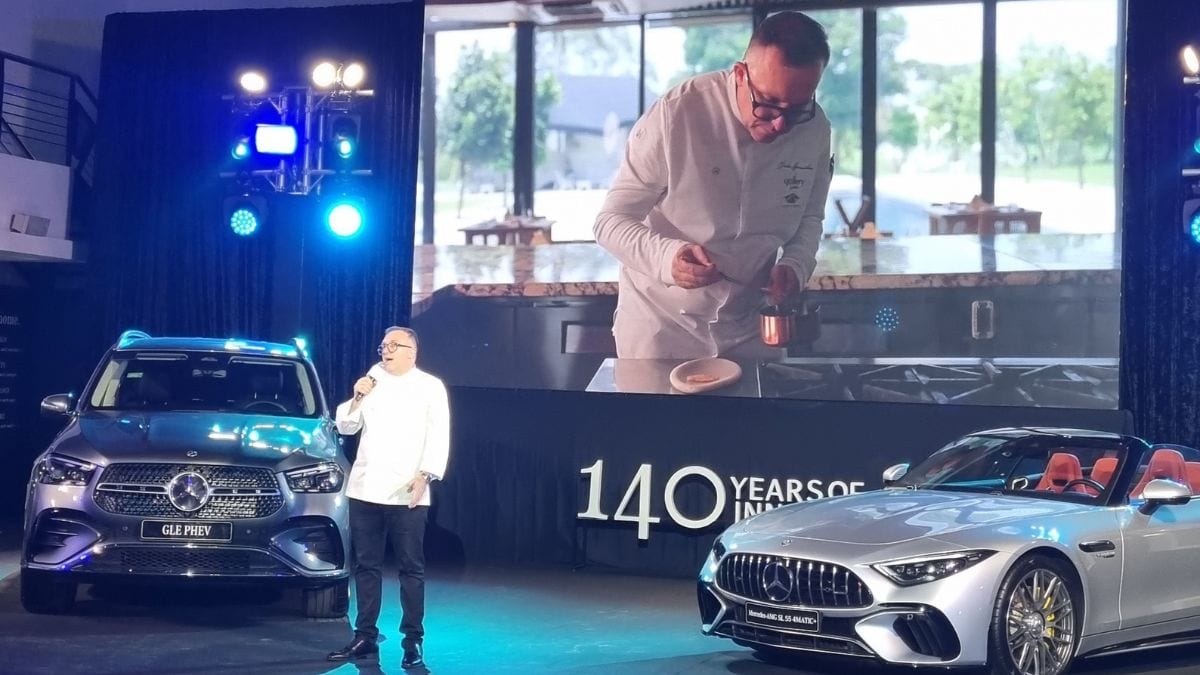
That history is worth remembering because it makes Mercedes-Benz more than a foreign luxury brand that happened to be sold here. For decades, it was actually part of the country's emerging automotive industry. By the 1970s, Mercedes-Benz had become so culturally embedded that Filipinos had given it a name of its own: Chedeng.
Filipinos have been calling Mercedes-Benz "Chedeng" since the 1970s, a nickname so familiar that it has almost transcended the brand itself. Mercedes-Benz's own 140th-anniversary campaign now embraces the word, describing Chedeng as a symbol of "hard-earned milestones, family successes," and the journeys shared with loved ones. There was a reason the word carried so much weight.
In the Philippines of the '70s, '80s, and '90s, owning a Mercedes-Benz was not simply about transportation. It was a visible sign that you had arrived. Businessmen, executives, professionals, and the country's rising middle and upper classes aspired to the three-pointed star, and the W123 in particular became a familiar symbol of achievement. Contemporary accounts of Philippine motoring describe how the W123's reputation and local assembly helped make it the car of choice for aspiring executives, bankers, and young professionals.
The nickname "Chedeng" therefore became more than automotive slang. It became shorthand for a certain idea of success.
That made the theme of Thursday night's dinner particularly appropriate. "Welcome Home" was deliberately layered: it welcomed González into the Mercedes-Benz family as its newest brand ambassador, but it also marked the return of another familiar figure to the Inchcape fold, Jun Cajayon, now Business Unit Head of Mercedes-Benz Philippines.
.jpg)
.jpg)
González, the Spanish-born chef behind Gallery by Chele and Asador Alfonso, has established himself as one of the country's most interesting culinary figures. Trained in Spain and having worked in kitchens including El Bulli, Arzak, Mugaritz, Nerua, and El Celler de Can Roca, he has since earned Michelin recognition for both of his Manila restaurants.
His connection to Mercedes-Benz is more than a celebrity endorsement. González owns a GLE 400e Plug-In Hybrid, and the evening's film officially introduced him as the brand's newest ambassador, built around shared ideas of innovation, precision, craftsmanship, and excellence. The GLE also captured where Mercedes-Benz is headed: a company defining luxury less through large engines and leather interiors these days and more through electrification, intelligent technology, and efficiency.
Then there was Cajayon. For many in the Philippine automotive media, Jun is a familiar face. He has spent close to three decades moving through the automotive industry, with experience across sales, marketing, and dealer-network development. But there is another side to Cajayon that makes his return to Mercedes-Benz especially fitting.
Gonzalez' take on Pigeon
.jpg)
.jpg)
Away from boardrooms and product launches, he is known among enthusiasts for his appreciation of mechanical watches. Online, his name goes back more than a decade in Philippine watch circles, where he was identified as a member and moderator of the PhilippineWatchClub with a particular interest in Omega's Speedmaster Mark series. One of his watches, a rare Speedmaster Mark 4.5, was even featured by Fratello Watches in 2013. That appreciation for mechanical things, whether a complicated timepiece or an old automobile, is perhaps what makes Cajayon particularly suited to a brand whose history is built around engineering.
The night's centerpiece brought those worlds together in a rather unusual way. Chef Chele created a five-course culinary interpretation of Mercedes-Benz history, pairing iconic cars with dishes inspired by their personalities. The Patent Motorwagen became "Ignition," the AMG SL became "Adrenaline," the G-Class became "The Icon," the Mercedes-Maybach S-Class became "The Sovereign," and the GLE 400e PHEV and EQE Sedan became "Evolution." It was not meant to be literal. Rather, González was attempting to translate what makes each automobile distinctive into ingredients, technique, and flavor, much in the same way that Mercedes-Benz has spent 140 years translating engineering into an emotional experience.
It was an unusually clever way to celebrate a car company, since Mercedes-Benz's history has always been less about the cars themselves than about what they represented to the people who owned them. For one generation, it was the W108 parked outside the family home. For another, it was the unmistakable shape of a W123 arriving at a business meeting. Later came the W124, S-Class, SL, and G-Class. Today, it might be a GLE PHEV gliding through Manila traffic on electric power alone. The technology changes. The cars change. Even the meaning of luxury changes. But the emotional shorthand remains.
Ask González what actually sold him on the GLE, though, and the badge has little to do with it. He talks about its range as a family vehicle, its electric-driving capability, and its sustainability credentials, and, somewhat delightfully, a Burmester surround sound system built for a chef who moonlights as a DJ.
View More Articles About: