The Porsche Cayenne Electric Makes Its Case for the Future of the Luxury SUV
Porsche electrifies its iconic Cayenne SUV

by Alvin Uy
Published on Oct 11, 2026
When Porsche Philippines unveiled the all-electric Cayenne at its media premiere last Thursday, October 8, it introduced more than a new powertrain for its flagship SUV. The Cayenne Electric represents a different interpretation of a vehicle that has helped redefine Porsche since 2002, retaining its sporting DNA and everyday versatility while using electrification to improve performance, comfort, and practicality.
Unlike a conventional Cayenne fitted with a combustion engine, the Cayenne Electric is built on an evolved version of the Premium Platform Electric architecture, designed specifically around an electric drivetrain. It will be sold alongside the internal-combustion-engine and hybrid variants, giving buyers the freedom to choose how they want their Porsche to perform. The more powerful Cayenne Turbo Electric is also expected to join the Philippine lineup in the near future.
This strategy reflects Porsche's belief that electrification need not mean abandoning traditional engines. The company intends to continue developing combustion-powered and hybrid Cayennes well into the next decade, allowing the different powertrains to coexist rather than forcing customers into a single direction.
Still unmistakably Porsche, but electrified
The standard Cayenne Electric delivers 408 PS in normal operation, with output rising to 442 PS when Launch Control is activated. Its dual-motor, all-wheel-drive configuration produces up to 835 Nm of torque, enabling it to accelerate from zero to 100 km/h in 4.8 seconds before reaching a top speed of 230 km/h.
Electric motors deliver torque almost instantaneously, making acceleration smooth and immediate. This is particularly useful when overtaking or merging onto expressways, while the absence of a conventional combustion engine brings quieter operation and a more refined driving experience.
Power comes from a 113-kWh high-voltage battery integrated into the chassis. Although the Cayenne Electric has a substantial kerb weight of approximately 2,525 kilograms, the battery's low position helps lower the center of gravity, contributing to stability and handling. Porsche Traction Management coordinates the front and rear motors through an electronically controlled all-wheel-drive system designed to respond rapidly to changing road conditions.
Porsche quotes a maximum WLTP driving range of 642 kilometers. Its 800-volt electrical architecture supports DC fast charging at up to 390 kW under suitable conditions, with a 10-to-80-percent charge possible in less than 16 minutes when the battery and charging infrastructure meet the required conditions.
For Philippine buyers, home charging will likely remain the most convenient way to live with the Cayenne Electric, particularly for those with dedicated parking and predictable daily driving routines. Porsche has also developed an optional wireless charging system rated at up to 11 kW, allowing the vehicle to charge through a floor-mounted plate without manually connecting a cable, but local availability will need confirmation if this would be available soon.
A rear shot of the new Porsche Cayenne
.jpg)
Bigger dimensions, more room for everything
The electric Cayenne is not simply a traditional SUV with its engine removed. Measuring 4,985 mm long, 1,980 mm wide, and 1,674 mm high, it is 55 mm longer than its combustion-powered counterpart. More importantly, its 3,023-mm wheelbase is approximately 130 mm longer, creating additional space for rear passengers.
The longer wheelbase is particularly beneficial for a luxury SUV expected to serve as both a driver's car and a family vehicle. Electrically adjustable rear seats come as standard, allowing occupants to prioritize comfort or create more room for cargo.
What you get inside the Cayenne, modern creature comforts and all
Luggage capacity ranges from 781 to 1,588 liters, depending on seat configuration, while a 90-liter front luggage compartment, or frunk as it is usually called, provides additional storage. It is a practical advantage for smaller bags, charging cables, or items owners would rather keep separate from their main luggage.
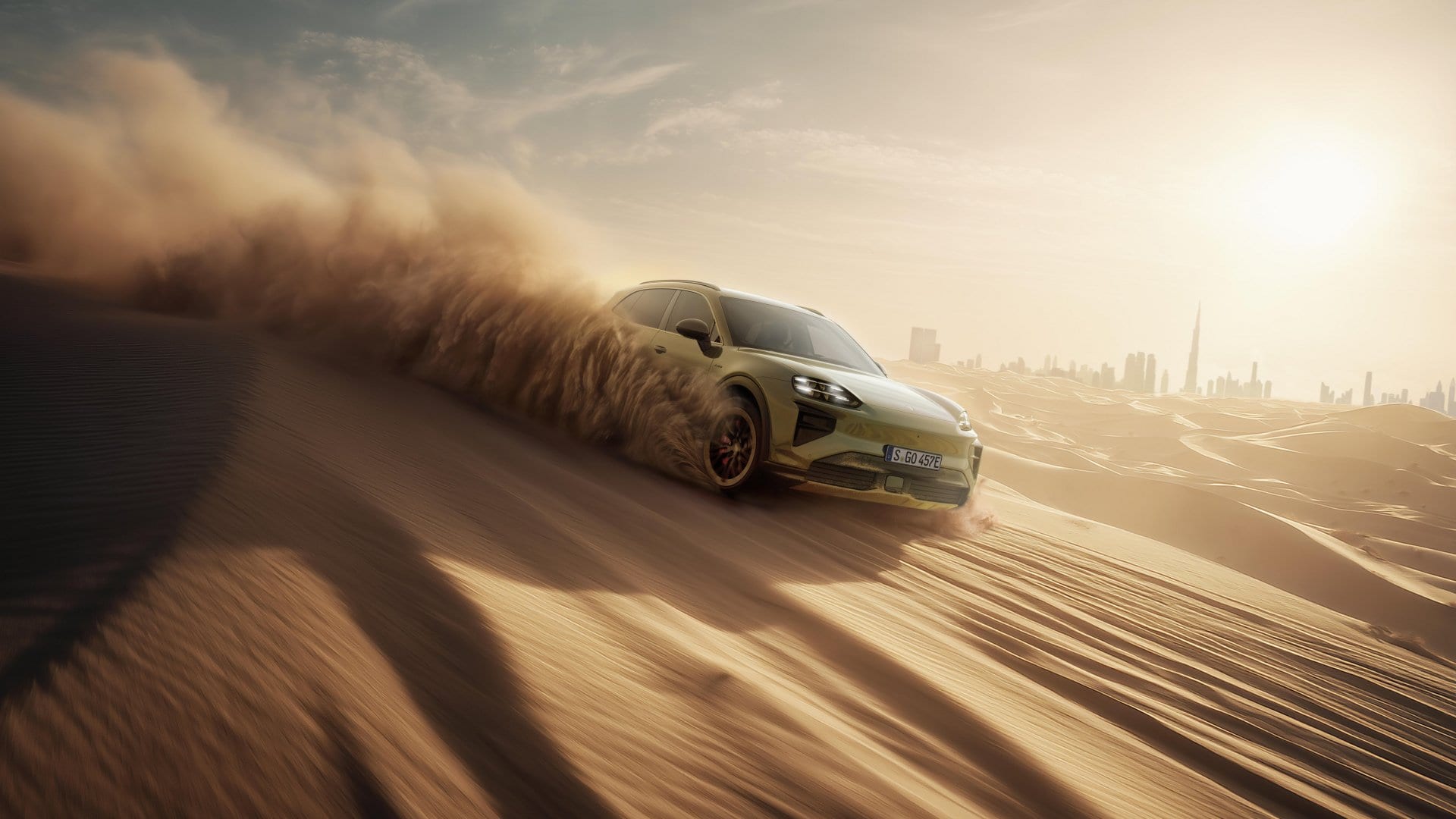
Porsche has also retained the Cayenne's utilitarian credentials. Depending on equipment, the electric SUV can tow up to 3.5 tons and features dedicated off-road driving modes for sand, gravel, mud, and rocks. Testing in the Arabian Desert demonstrated its ability to negotiate loose sand and steep gradients, showing that the transition to electric power has not diminished the model's intended versatility.
A digital-first cabin
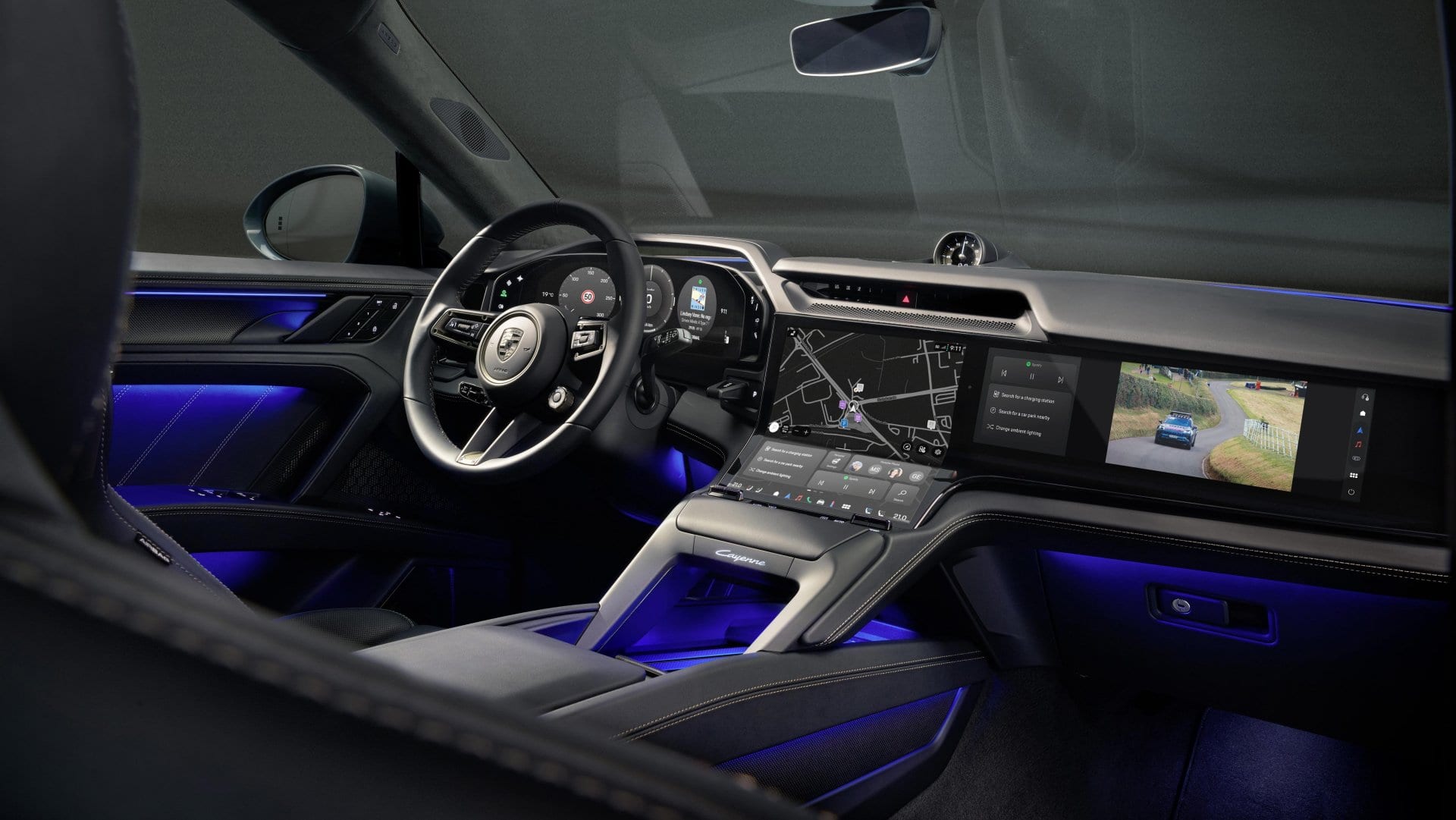
Inside, the Cayenne Electric introduces Porsche Digital Interaction, a new operating concept built around a curved OLED flow display that blends into the center console. Together with the other screens, it forms the largest continuous digital display area ever fitted to a Porsche.
The 14.25-inch OLED instrument cluster presents driving information, navigation, and vehicle settings. An optional 14.9-inch passenger display provides access to entertainment, applications, and video streaming, while an available augmented-reality head-up display projects navigation guidance into the driver's field of vision.
An AI-supported voice assistant can understand natural-language instructions and control functions such as climate settings, seat heating, and ambient lighting. The Porsche Digital Key also allows compatible smartphones and smartwatches to lock and unlock the vehicle, with access shareable among additional users.
Comfort receives similar attention. The panoramic roof uses electrically controlled liquid-crystal technology to adjust its transparency, while surface heating warms not only the seats but also selected armrests and door-panel areas. Mood Modes coordinate lighting, climate, sound, and seating functions to create different cabin atmospheres.
Buyers can further personalize the interior through a broad selection of colors, trims, and upholstery materials, including leather-free alternatives such as Race-Tex with a Pepita-pattern textile.
In the Philippines, the Cayenne Electric will likely appeal to established Porsche owners and affluent professionals who want to embrace electrification without sacrificing the performance, prestige, and practicality of a full-size luxury SUV. Technology-minded entrepreneurs and executives with home-charging facilities may also appreciate its instantaneous acceleration, quieter operation, and sophisticated digital features.
For existing Cayenne owners, the choice will depend on priorities. Those who value the sound and mechanical character of a combustion engine may prefer the traditional model, while buyers who favor instant torque, increased rear-seat space, and the convenience of charging at home have a compelling alternative in the electric version.
The realities of Philippine charging infrastructure, driving patterns, and final local specifications will remain important considerations. Nevertheless, the Cayenne Electric makes a persuasive case for an SUV that combines performance, comfort, and everyday usability without tailpipe emissions.
Rather than replacing the traditional Cayenne outright, Porsche has created another way to experience its flagship SUV. With combustion-powered, hybrid, and fully electric versions sharing the same nameplate, customers can choose the powertrain that best suits their lifestyle. The Cayenne Electric simply makes the future of Porsche performance a little more tangible.
View More Articles About: