Xpeng Is Selling Manila a Vision of Cars Straight Out of Back to the Future and the Jetsons
This isn't just cartoons and sci-fi anymore.

by Alvin Uy
Published on Aug 18, 2026
The Philippine automotive market is undergoing one of its most significant transformations in decades. Chinese automotive brands are arriving in increasing numbers, bringing with them electric vehicles, hybrids, sophisticated technology, and levels of equipment that have challenged the established order of the industry. But as more Chinese manufacturers enter the market, simply being another EV brand is no longer enough to stand out. The next battle is likely to be fought over technology, and more specifically, artificial intelligence.
When Xpeng officially arrives in the Philippines this September, it will bring more than a new generation of electric vehicles. The young Chinese technology company is bringing an entirely different vision of mobility, one built around artificial intelligence, autonomous driving, robotics, and even flying cars.
The company officially launches in Manila on the 25th of September, and it will introduce Filipinos to a brand that was conceived from the beginning around new-energy vehicles and intelligent technology. Founded in 2014, Xpeng is remarkably young compared with the traditional automotive giants, but that relative youth is also one of its greatest advantages. It did not have to spend decades transitioning an internal-combustion vehicle business into an electric one. It was born into the electric era and from the outset treated software, connectivity, and artificial intelligence as fundamental parts of the automobile rather than features added after the fact.
.jpg)
Beyond EVs
Electrification is already familiar to Filipino motorists. What's newer is the idea that the computer running the car, more than the motor or the battery, could end up being the more defining technology of this next generation.
Xpeng has invested heavily in artificial intelligence and intelligent driving, developing its own software and hardware architecture rather than relying entirely on external technology suppliers. Its vision-language-action, or VLA, technology is designed to allow the vehicle to interpret its surroundings, understand complex situations, and make driving decisions in a way that's closer to human reasoning than rule-based automation.
Conventional advanced driver-assistance systems are built around a collection of functions designed to respond to specific situations. Xpeng's approach is different: a more general AI system capable of understanding a much wider variety of real-world circumstances. Its VLA 2.0 architecture is part of the company's longer-term development toward higher levels of autonomous driving, including Level 4 capability.
The technology becomes much more convincing when experienced outside a controlled demonstration area. During a recent media technology tour in China, Xpeng Philippines invited members of the local media to experience its autonomous-driving technology firsthand. The demonstration involved vehicles equipped with its VLA technology navigating open public roads instead of running through predetermined maneuvers inside a closed test facility.
For journalists accustomed to seeing driver-assistance systems demonstrated through automatic braking, lane keeping, or parking functions, the experience offered a different perspective. The vehicle was required to interpret an environment that was constantly changing and make decisions accordingly. It showed less what the software could do under ideal circumstances than how far Xpeng wants AI to go in handling the real world's mess.
Filipino motorists won't be handing over full control to their cars anytime soon. Xpeng's current systems still fall within the regulatory framework governing advanced driver assistance, even as the company keeps developing the technology toward higher levels of autonomy. But the point stands: the technology required for that driverless future is already being built and tested in real-world environments.
Xpeng has also begun moving autonomous driving beyond the realm of private passenger cars. The company has introduced a robotaxi program based around Level 4 autonomous-driving technology, illustrating that Xpeng wants AI to be a commercially deployable transportation technology, not just a selling point on a premium vehicle.
The Xpeng X9
.jpg)
A Different Kind of Chinese Automotive Company
China's automotive industry has become extraordinarily competitive. Manufacturers can now produce EVs with impressive range, attractive design, sophisticated interiors, and extensive standard equipment at prices that have forced established global brands to rethink their strategies. The Philippine market is consequently no longer asking whether Chinese vehicles can compete with Japanese, Korean, European, or American products. The question now is which Chinese brands can establish a meaningful identity of their own.
That's where Xpeng separates itself. It sees itself as much an AI company as an automobile manufacturer, and that distinction influences the way it approaches everything from product development to manufacturing. The vehicle is only one component of a much larger ecosystem that includes autonomous driving, robotics, and aerial mobility.
That ecosystem is most apparent when you see its facilities in China.
The company has developed an unusually open approach to its manufacturing and technology infrastructure, turning parts of its headquarters and factories into public attractions through its Xpeng AI Manufacturing Tour. Most factories keep cars behind security gates until they're finished. Xpeng does the opposite, presenting its manufacturing facilities as destinations where visitors can watch artificial intelligence and automation turn into physical products.
Its global headquarters in Guangzhou combines research, development, testing, and corporate functions with a public-facing brand experience center. Visitors can learn about the company's evolution, its AI-assisted driving technology, core technologies, flying-car development, and global expansion. The facility also includes demonstrations involving AI robots, vehicle technologies, and Xpeng's intelligent manufacturing systems.
The Traveller T1 single-man aircraft
.jpg)
The Traveler T1 single-man aircraft fitting inside a land carrier
.jpg)
The company's Guangzhou intelligent manufacturing base takes the idea further, combining production facilities with exhibition spaces, research and learning workshops, and visitor experiences. The facility covers approximately 512,000 square meters, includes five major workshops, and represents an investment of more than RMB4.5 billion.
Xpeng calls it an Industry 4.0 intelligent manufacturing system, one built to produce vehicles efficiently and to show visitors exactly how technology runs through every step of the process.
In Zhaoqing, it operates its first self-built vehicle production base. Covering approximately 1 million square meters, the facility incorporates 389 ABB robots and highly automated assembly processes, where a vehicle can roll off the line in minutes. The plant is also central to Xpeng's manufacturing-scale story: it produced the P7, reportedly the first model from a Chinese pure-electric NEV startup to cross 100,000 units in mass production.
For a car company, opening factories to tourists may seem unconventional. For a technology company, it makes perfect sense.
The Rise of Tech Tourism
China has become one of the world's most important technology and manufacturing centers, but much of that technological transformation has traditionally been experienced from a distance. Xpeng is attempting to turn it into something visitors can see, touch, and experience.
The company's AI Manufacturing Tour is positioned as a new landmark for AI technology and cultural tourism in the Greater Bay Area, combining physical AI, intelligent manufacturing, and multi-modal future mobility. The program is intended for families, technology enthusiasts, industry professionals, and tourists, creating an experience that sits somewhere between a science museum, an industrial tour, and a glimpse into the future.
It turns industrial tourism into something far more immersive: visitors encounter AI-powered cars, robots, and flying vehicles alongside manufacturing tech like automated visual inspection, smart logistics, and integrated megacasting.
At the Xpeng Headquarters, four core experience zones are designed to tell this story, including an AI robot showcase, interactive vehicle and manufacturing displays, a simulated manufacturing environment, and installations devoted to the company's AI technology and Turing chip.
The A868 hybrid flying car and the eVOTOL concept flying car
.jpg)
Xpeng's Intelligent Manufacturing Academy adds an educational layer, offering courses and interactive experiences for younger students that push them toward science, engineering, and technology. The factory becomes something more than a place where products are made. It becomes a classroom.
This could become an important form of tourism over the next decade. Just as travelers visit museums to understand the past, a new generation may start traveling to technology centers to see the future. A trip to Guangzhou could mean food, architecture, and culture, plus watching robots build cars, riding in an AI-driven vehicle, and seeing how flying vehicles get made.
Call it tech tourism.
If Xpeng's autonomous-driving ambitions demonstrate how the company wants to change transportation on the ground, its flying-car subsidiary Aridge illustrates what it believes could happen above it.
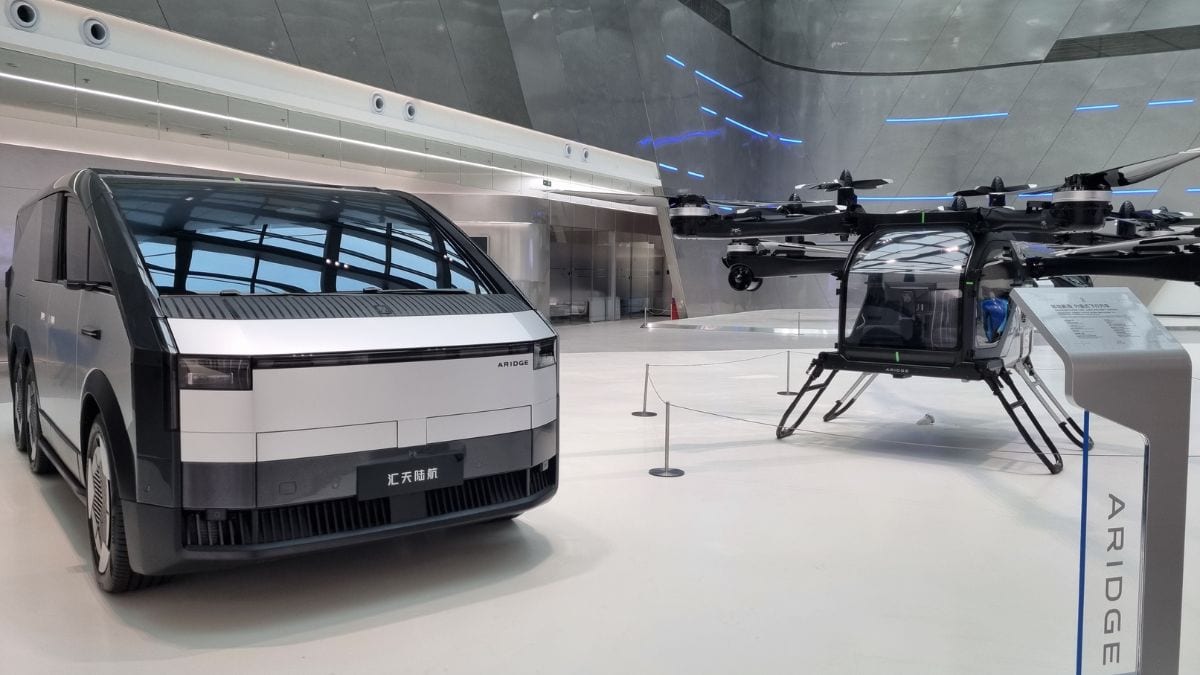
Most flying car concepts try to combine an airplane and an automobile into a single machine. The Land Aircraft Carrier, perhaps Xpeng's most ambitious idea yet, goes modular instead. The system consists of a large road-going vehicle that carries a detachable flying module. On the ground, it operates as a vehicle; when required, the aircraft can be deployed separately for low-altitude flight. The concept is unusual, but its significance lies in the fact that Xpeng is attempting to take it beyond the prototype stage.
The company has reported approximately 7,000 pre-orders for the Land Aircraft Carrier and is targeting commercial production by the end of 2026. That does not mean flying cars are about to become as common as SUVs. Aviation certification, airspace management, infrastructure, pilot requirements, safety, and public acceptance remain formidable challenges, especially across global markets.
But moving toward production matters. It suggests low-altitude mobility is inching from science fiction toward an actual transportation industry.
Urban transportation has always been constrained by the two-dimensional nature of roads. Even the smartest autonomous vehicle still has to operate within that network. Low-altitude mobility adds another dimension entirely, one with real implications for urban congestion, emergency response, logistics, and eventually personal travel.
The next decade may see the automobile industry competing not just to move people more efficiently along roads, but to determine how people move between road, air and an eventually integrated multi-modal network.
Xpeng's arrival in Manila deserves to be seen as more than another entry into a crowded Chinese automotive field.
The L03 and X9 will ultimately have to prove themselves in the traditional ways. Filipino customers will judge them on design, performance, range, comfort, pricing, reliability, after-sales service and, perhaps most importantly, the company's ability to establish long-term confidence in the Philippine market.
But the larger story is the technology behind them.
The Land Aircraft Carrier mothership and its modular flying car
The automotive industry is gradually moving toward a world in which the mechanical attributes of a vehicle are only part of its identity. Electric powertrains have already changed how cars are propelled. Artificial intelligence is beginning to change how they perceive and operate. Robotics is changing how they are built. And flying vehicles could eventually change where they can go.
Xpeng happens to be developing all four, which makes its arrival relevant in the Philippines beyond just another badge on the lot. As more Chinese brands enter the market, the competitive landscape will be defined less by price and equipment than by the technological ecosystems these companies bring with them. For Xpeng, the automobile is the most visible part of that ecosystem, just not the most important one.
The company's broader ambition is to create a future in which intelligent machines interact seamlessly with the physical world: cars that understand their surroundings, robots that work alongside humans, factories that operate through physical AI, and aircraft that push mobility beyond the limits of the road.
That is a much bigger proposition than simply selling electric cars.
That's what makes Xpeng worth watching when it arrives in Manila this September: less a pitch to buy an electric vehicle, more an invitation to imagine what happens when the technology behind that vehicle turns intelligent, autonomous, and capable of moving through more than one dimension. Xpeng Philippines marketing manager Fritz De Ocampo also confirmed the two-seat X2 flying car will be on display at the September launch.
For a country just entering its own electric era, Xpeng is offering something more: a preview of what comes after the EV, and it might not be as far off as it looks.
View More Articles About: