Why the Filipino Struggle Is Written in the Score of 'Les Misérables'
Red Concepcion talks about relating to the theme of "righteous revolution" in the musical.

Published on Jan 22, 2026
Sometime in 2017, the song "Di Niyo Ba Naririnig?" circulated online. It is, obviously, the Filipino translation (by Filipino composer and librettist Vincent A. De Jesus with additional lyrics by writer Rody Vera and theater artist Joel Saracho) of "Do You Hear the People Sing?," which is one of the most popular tracks from the musical Les Misérables.
"Di niyo ba naririnig? Tinig ng bayan na galit, himig ito ng Pilipinong di muli palulupig. Dudurugin ang dilim, ang araw ay mag-aalab, at mga pusong nagtimpi ay magliliyab. Ikaw ba’y makikibaka at hindi maduduwag na gisingin ang mga panatikong bingi’t bulag, kasinungalingan labanan hanggang mabuwag," the first part of the song goes. It served as an anthem during the Martial Law protest at Luneta Park on September 21 that same year, about 10 months after former dictator Ferdinand Marcos Sr. was buried at the Libingan ng mga Bayani upon the approval of then-president Rodrigo Duterte.
Then in 2020, a day ahead of Duterte's SONA, local stars like Angel Locsin, Enchong Dee, and Noel Cabangon, performed the same song in a rousing black-and-white music video. At the time, amid the global pandemic that exposed the weakness in our health care (and, basically, the general system in place), the song called for change.
In Les Misérables, "Do You Hear the People Sing?" was sung by Enjolras, Marius, and the students in Act I as a call to rebellion to overthrow the government at a street barricade in Paris, and then again in the epilogue as a reprise by the whole company. This narrative was inspired by the real-life 1832 June Rebellion in the French capital, which was an attempt to overthrow the monarchy amid economic problems, food shortages, and general discontent.
So, really, it doesn't come as a surprise that the Alain Boublil-Claude-Michel Schönberg musical resonates so deeply with the Filipino psyche.
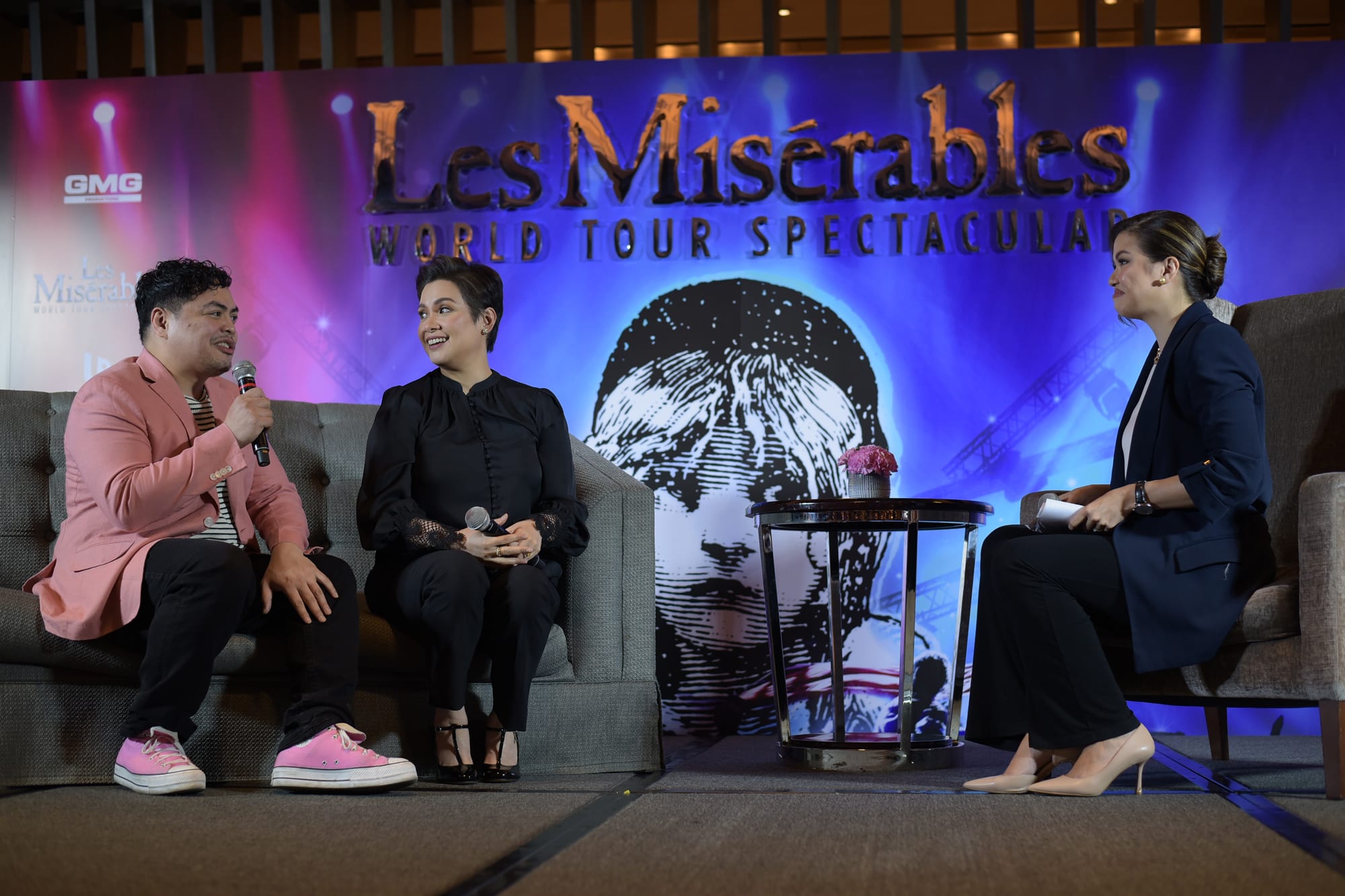
"We relate to the theme of what I call 'Righteous Revolution,'" Red Concecpion explained during a press conference on January 21. He plays the role of Thénardier in Les Misérables: World Tour Spectacular, which just opened at The Theatre at Solaire. "People standing up for what is right against oppression or against an injustice. I think that is just ingrained in us Filipinos, and I think we see ourselves out there with the students."
Lea Salonga (who plays Madame Thénardier) added that even the darker, more cynical characters like the Thénardiers reflect a local reality of survival that the audience instinctively understands.
"Survival is what we need to do," she noted. "We understand that in a country like this, that there are people who will do literally some of the most... they will debase themselves to make a buck. Red's character goes through the sewers of Paris just to pick-pocket the bodies of the dead. There's something about that, that I think we understand."
Concepcion and Salonga are joined by acclaimed Broadway and West End performers like Gerónimo Rauch (as Jean Valjean) and Jeremy Secomb (as Javert), as well as Filipino talents Rachelle Ann Go (as Fantine) and Emily Bautista (as Éponine). About half of the orchestra, which is conducted by Adrian Kirk, is composed of Filipinos as well, emphasizing what Concepcion said: "This show is just tied into our DNA for some reason."
"When you open the souvenir program [of Les Misérables: World Tour Spectacular], when you open the pages where we've all written something about our relationship with the show, it's me, Red, Rachel Ann, and Emily. So the four Filipinos who are in this production are all in one spread. When I looked at it yesterday or two days ago, I was like, 'Wow. That is so cool'," Salonga noted.
Filipinos in the Global Theater Scene
The presence of Filipinos in Les Misérables has evolved through the decades. Concepcion, returning home after eight years abroad, credits this evolution to the path paved by his co-star.
"Lea really has opened doors for us," Concepcion said, turning to Salonga. "Before her, it was not a possibility for us to even think of getting on Broadway. You put it in my head that I can do it, that it's possible."
Salonga originated the role of Kim in the West End production of Miss Saigon in 1989, then reprised the role on Broadway in 1991. For Les Misérables, she previously played the roles of Éponine (Broadway in 1993 and West End in 1996) and of Fantine (Broadway in 2007).
Concepcion, meanwhile, is best known for playing The Engineer in the Miss Saigon tours in the U.S., U.K., and Ireland. He was also Thénardier at The Muny in 2024.
Rachelle Ann Go's international breakthrough came in 2014 when she starred as Gigi Van Tranh in the West End revival of Miss Saigon. She was also part of West End's Les Misérables as Fantine from 2015 to 2016, which overlapped with her performance in the Manila leg of Les Mis' Asian tour that ran from March to May 2016, also at The Theatre at Solaire. She was again cast as Fantine during the 2020 run of Les Misérables and the 2021 run of Les Misérables: The All-Stars Concert, both at the Sondheim Theatre. She reprised her role in the United Kingdom and Ireland tour in 2022.
Now back in Manila, Go looked back at her first year in Les Misérables on the West End in 2015 with gratitude and a sense of transformation.
"I was crying before the show because I think the night before, I forgot my words, or I was messing up. I was mumbling, and I was just like, 'Oh my gosh. I think I'm gonna mess up tonight again.' That night, the guy who was playing Jean Valjean hugged me during the hospital scene, and then he said, 'You are amazing.'"
Describing herself as "very spiritual," that moment was an answer to a prayer. She recalled asking, "God, is this for me Cause I feel like I do not fit in." The affirmation from a co-actor freed her from the "Filipino mentality" where a performer feels their worth is tied solely to the volume of the audience's applause.
"That night changed my whole perspective," she explained. "I felt like I'm actually not performing for the people there. I have a purpose why I'm here on stage." Returning to Manila now and looking at a stage filled with diversity, she noted with pride: "It’s like, 'Wow. We made it.'"

For Emily Bautista, who was born in Massachusetts to Filipino parents, the journey to the barricade has been a profound homecoming.
"Never in my wildest dreams did I think I would get to do my dream role of doing Éponine," she shared. She first played the role in the 2018 U.S. tour. "Not only that, but to do it here in the Philippines. I'm a very proud Filipina."
The significance of this run in Manila was underscored by the presence of her parents in the audience. "Both of them are in the audience, my father and my mother. I have so much family here. So getting to do this show, that just means so much to me, to my family here, for the people that I love, and to reconnect with my roots."

The "Spectacular" Format
This homecoming is amplified by the scale of the 2026 production, which isn't the standard theatrical staging of Les Misérables nor exactly the previous Les Misérables anniversary concerts. It was designed to let the music—and the voices (and instruments) carrying it—take the spotlight.
"I believe that as a fan of Les Mis, not only as a performer, this Spectacular version brings a passionate way of telling this story. Also, it's the first time that we are in a concert version," Gerónimo Rauch (Jean Valjean) said, referring to himself and co-star Jeremy Secomb (Javert).
"And when it says 'Les Mis rocks,' it's that. It's definitely a rock concert because we deliver every night. It's all about the music. The music takes a step forward in this story, and we have a 30-piece orchestra with us every night. So as a fan and as a performer, this is a privilege."

Secomb noted, "Like Geronimo said, what the concert version does is it just brings the emotion of the music that you get in the stage show, but it just lifts the music and the storytelling. So we stand and just deliver this incredible score that we are all fans of. I think every single person who is involved backstage, we are all fans of this show. And I think it really shows when we go out and perform this show with that incredible orchestra behind us, the incredible sound team, the design of the show sound-wise, the lighting—everything. It literally just showcases this incredible score that Claude-Michel Schönberg, Alain Boublil, and Herbert Kretzmer put together 40 years ago now, and it still stands the test of time."
For Salonga, who was part of both the 10th anniversary concert at the Royal Albert Hall in 1995 as Éponine and the 25th anniversary concert at the O2 in 2010 as Fantine, Les Misérables just "absolutely works as a concert."
She added, "We know that the score by itself, without moving set pieces or an actual staging, it works. I think part of the reason it does work is how ingrained the score is with audiences."
This just makes us even more excited for that resounding number: 'Do you hear the people sing? Singing a song of angry men? It is the music of a people who will not be slaves again.' And maybe, just maybe, it will finally awaken those who need to hear it."
Les Misérables: World Tour Spectacular runs until March 1, at The Theatre at Solaire, 1 Asean Avenue, Entertainment City, Tambo, Paranaque. Tickets are exclusively available through Ticketworld.
Main image from GMG Productions.
ALSO READ:
Theater Review: Les Misérables: World Tour Spectacular Is Anything But 'Just a Concert'
More Shows, New Audiences: How Philippine Theater Is Experiencing a Renaissance
Christa I. De La Cruz is a Palanca Award-winning writer with over 15 years of experience in feature writing for print and digital media. She earned her Sertipiko sa Malikhaing Pagsulat sa Filipino from the University of the Philippines Diliman and holds an MFA in Creative Writing from De La Salle University.
View More Articles About: