Theater Review: DUP's 'Ang Kaliitan ng Kasalukuyan' and the Problem With Navel-Gazing
It is written and directed by Palanca awardee Arlo Deguzman, who's also the university-based company's newly-appointed Artistic Director.
Published on Mar 31, 2026
Heightened expectations surround the debut of Arlo Deguzman’s Ang Kaliitan ng Kasalukuyan, the closing piece for Dulaang UP’s 48th Season, “Paano umuwi nang may pagpapasya?” The production brings a homecoming of sorts: Deguzman is a multi-awarded playwright and a BA Theater Arts alumnus returning to the university after pursuing advanced theater studies abroad and broadening professional experience in Doha and Dubai. More significantly, his arrival as the newly appointed Artistic Director coincides with the revival of the UP Playwrights' Theatre—the entity established by DUP Founder Tony Mabesa in 1986 to champion original Filipino plays—and its renaming to DUP Playwrights. In this space, Barthes' "Death of the Author" is effectively suspended; the author is very much alive, celebrated, and positioned at the precarious crossroads of what's promoted to be a new movement in the university's storied theater scene.
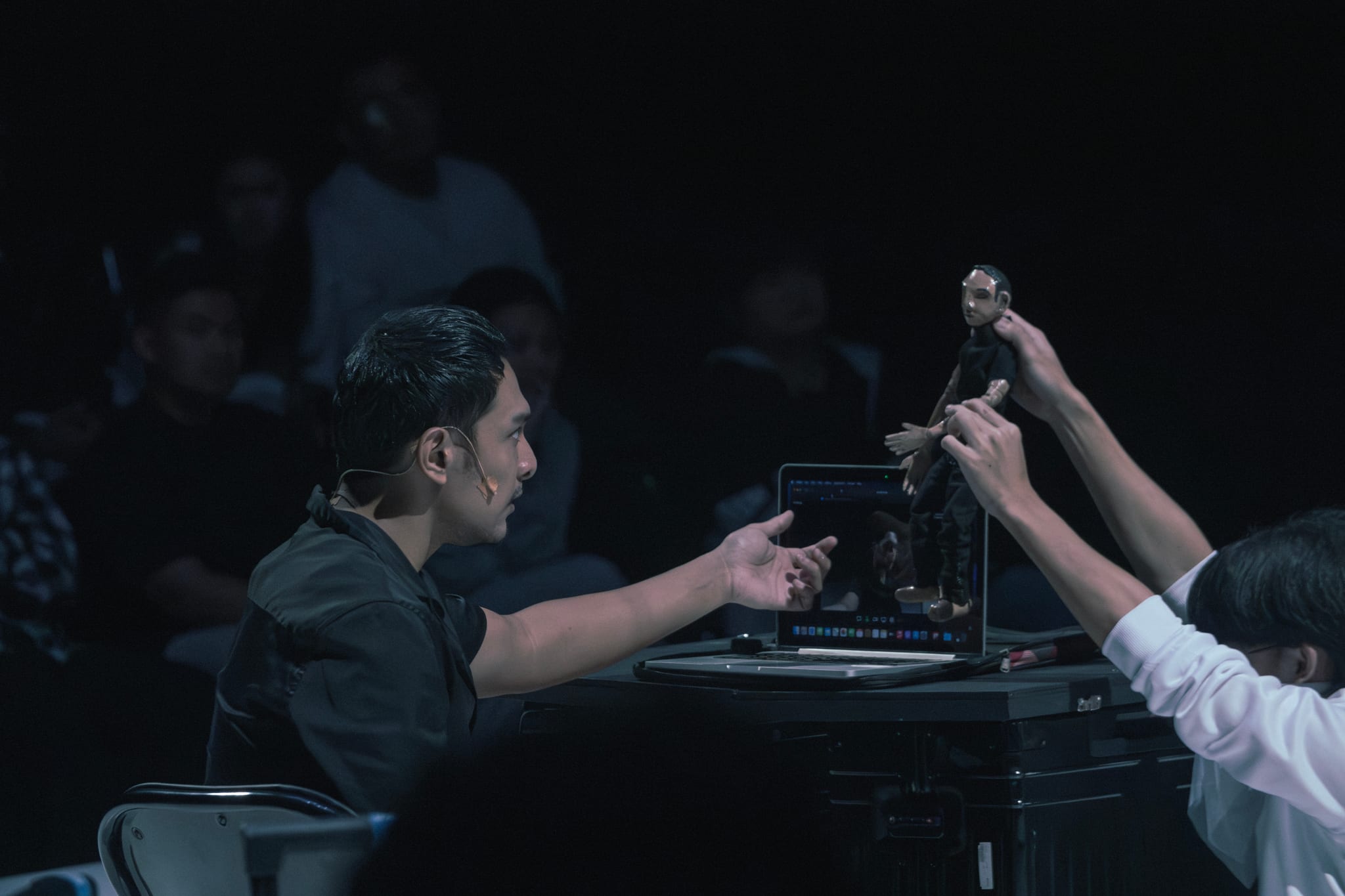
Ang Kaliitan ng Kasalukuyan follows the story of Bulan (played by Sandino Martin), an OFW in the Middle East for nearly two decades. A playwright, at least before working as a producer for promotional videos in Dubai, he longs to come home permanently and write his own plays. A quick Google / LinkedIn search—obviously a non-formalist approach to critiquing the material, as previously established, reveals that Deguzman has likewise worked for a decade as a production manager in Doha and Dubai, then for five years as both a production manager and theater arts instructor at NYU-Abu Dhabi. Ang Kaliitan ng Kasalukuyan, which is not only written but also directed by Deguzman, is also about him. He is Bulan; Bulan is him.
And while there is nothing wrong about writing the self, especially if you’re developing a piece for an undergraduate or a master’s thesis, where students are often advised to write about what they know, it is easy to fall into the pitfalls of navel-gazing. Ang Kaliitan ng Kasalukuyan, unfortunately, did so.
Writing About the Self and the Trap of Narrative Myopia
There are various ways to avoid navel-gazing (or the excessive, self-absorbed focus on a character's inner thoughts) when writing about the self. There are grounding the characters through external action and dialogue, using an object or situation to evoke a character's emotion, or playing with the language or tone. It could often work, even in first-person POVs.
Ang Kaliitan ng Kasalukuyan, however, remains trapped in its introspection—whether with Bulan as the narrator, Bulan talking to his inner duwende (a likely homage to Kidlat Tahimik's lore of a creative spirit within us), and other Bulan soliloquys. His internal monologues tend to be long and circular, rather than swift and relevant to land the goal of specific beats.
This lack of narrative distance manifests most clearly in the script's structure. For example, in a flashback sequence involving Bulan's grandmother (Lola Saling, played by Marichu Belarmino) and a butterfly, the dialogue feels caught in a loop, with about half a page of arguments repeated with a different set of words on another page.
The play is also burdened with its overabundance of sociopolitical baggage. It touches on numerous issues: the personal grief of Bulan for his lost youth, the Pinoy elderly parents' mindset of treating their children as their way out of poverty, urban decay, inheritance issues among extended family, diaspora, and so on. It’s true that the “personal is political,” and the things faced by Bulan could ultimately be rooted in societal and systemic problems. But with the material’s fixation on interiority, discussions of these “big” issues feel like surface-level sketches rather than a sustained interrogation of the current situation. Plus, to claw its way out, this particular material sticks to what can only be described as mentor archetypes to bridge the gaps instead of a natural arrival at insights.
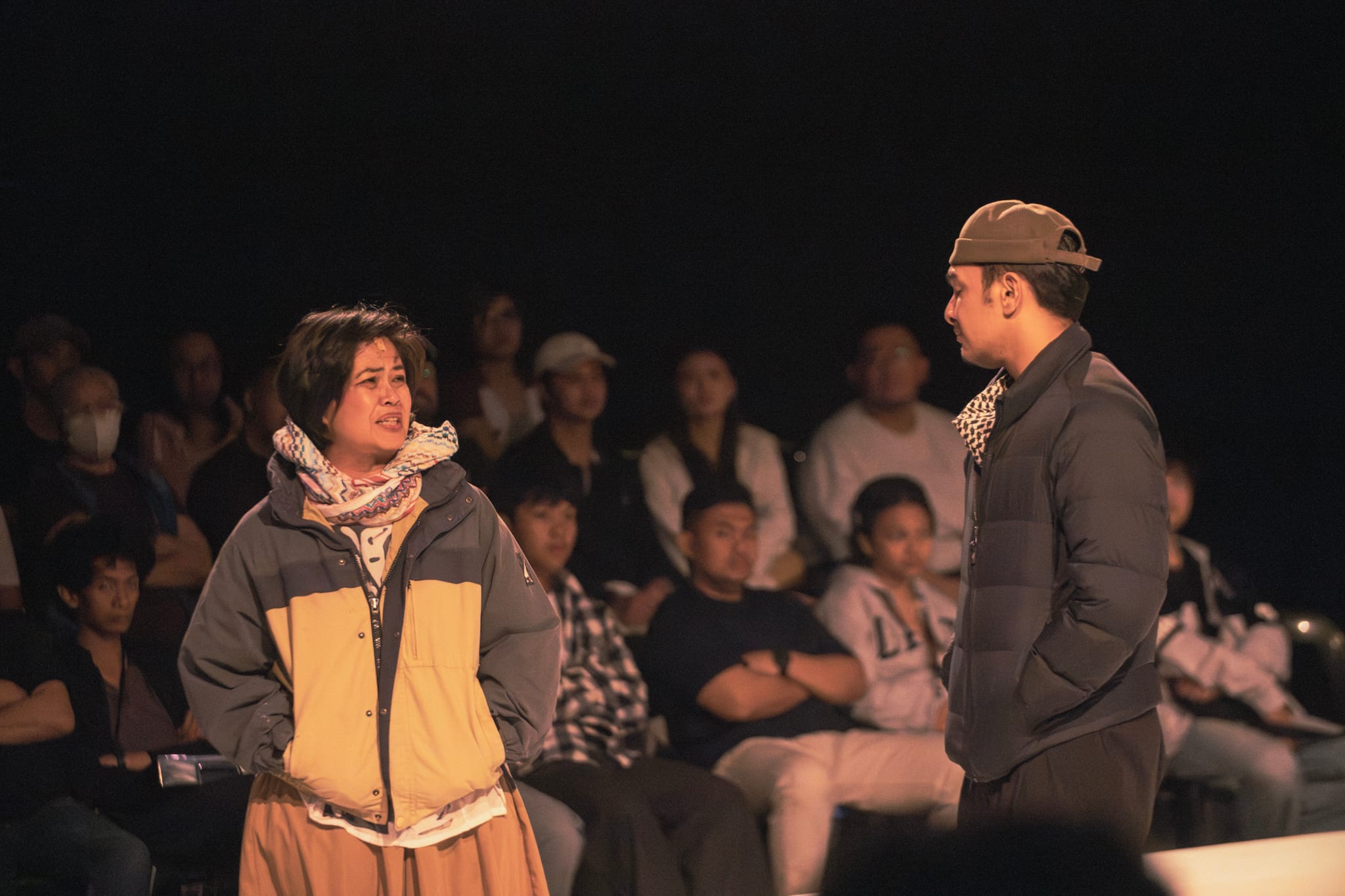
One of the characters who serves as a mouthpiece is Bulan's uncle (Jojo Cayabyab), a former activist who launches into a philosophy lesson with his nephew. Then there's Bulan's older sister (Tess Jamias), who—in a camping scene—rattles off a list of aphorisms as if reciting a litany. Almost poetic in tone, the structure of these sentences could be beautiful. But they rely heavily on repetitive rhetoric that eventually caves under its own weight, offering arguments that are at times fundamentally contradictory. Most notable is a line where she tells her younger brother to look out for himself and put up boundaries, but also says that nothing is more important than family.
Further complicating the experience of the material is a jarring linguistic dissonance. Bulan’s parents (Fermin Villegas and Sheryll Ceasico), originally from Nueva Vizcaya, have been in Manila for two decades, yet their Tagalog feels misplaced in this contemporary urban setting. Their dialogue seems to come from some heavy-handed writing, rather than being owned and organic to the characters that they play. At times, Villegas fumbled his lines, a struggle likely caused by the stiff phrasing.
Bulan’s diction, on the other hand, suddenly shifts from fluent and almost poetic Tagalog in Act I to a mix of English in Act II—granted, there’s also a shift in setting. Coming home to Nueva Vizcaya is more prominent in the first, while returning to Dubai makes up most of the second.
DUP’s Bag of Tricks
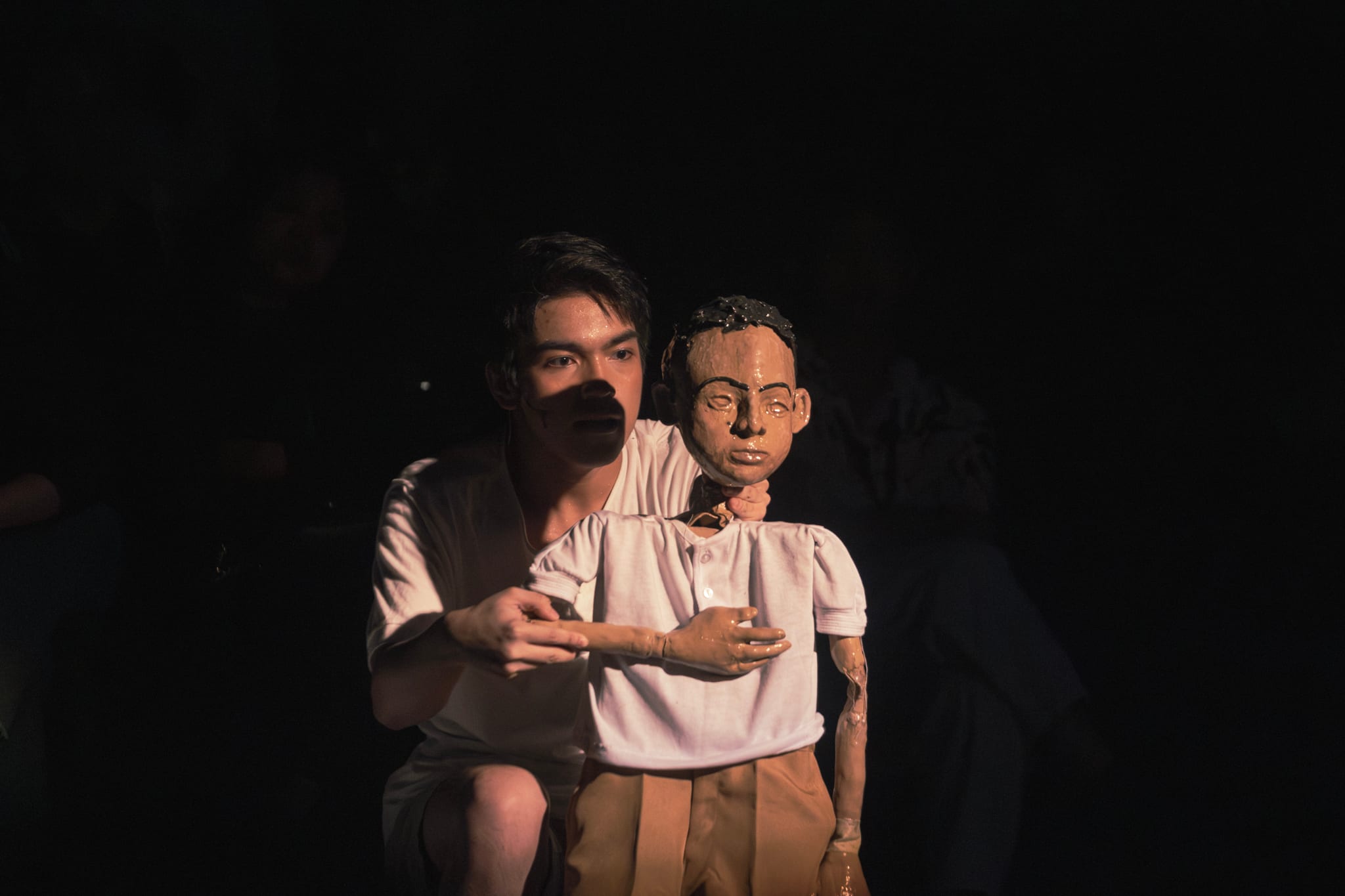
While the production doesn’t succeed at its material, we do have to hand it to Dulaang UP for its display of tricks: a showcase of every technical resource within the black box theater of IBG-KAL. There is puppetry (designed by siglo), which renders the most tender moments of Bulan's childhood flashbacks. Kerr Allen's handling of young Bulan gives an emotional anchor to the inanimate object.
The stage design features a swimming pool and functional waterfalls with actual water, which is undeniably visually arresting during the finale. But does the resolution warrant this symbolism, or is it more of an expensive flex? One has to wonder if the spectacle is meant to drown out the script's weakness.
As the closing piece for DUP’s 48th Season, Ang Kaliitan ng Kasalukuyan leaves us at a strange crossroads. Deguzman’s return to his alma mater is a testament to the university’s enduring creative spirit, while the revival of a platform dedicated to original Filipino plays is cause for celebration. However, for a movement to truly take root, it must move beyond the smallness of one.

This is a review of the 7 p.m. performance on March 14, two days after opening.
Ang Kaliitan ng Kasalukuyan ran from March 12 to 29 at the IBG-KAL Theater, UP Diliman, Quezon City.
ALSO READ:
Theater Review: 'A Chorus Line' Shines in the Dance Sequences
Theater Review: Form Follows Content in 'Children of the Algo'
Theater Review: Pain Is Silent in 'Spring Awakening'
Christa I. De La Cruz is a Palanca Award-winning writer with over 15 years of experience in feature writing for print and digital media. She earned her Sertipiko sa Malikhaing Pagsulat sa Filipino from the University of the Philippines Diliman and holds an MFA in Creative Writing from De La Salle University.
View More Articles About: