Theater Review: 'Si Faust' Forged a New World from an Old Text
The only flaw in this Nelsito Gomez-Basti Artadi collab? Its tragically short run.

Published on Dec 4, 2025
We know from literature that no story, in its purest sense, is ever original. Narratives are often built on existing fundamental patterns, archetypes, and tropes, as many theorists argue: from Campbell with his Hero's Journey to Bakhtin and his dialogism. And yet, it is in these limits where creativity flows, where artistry stands on the shoulders of giants, pushes the envelope, and kills the darlings—all cliches intended. Proof of this is a masterclass in intertextuality: Si Faust (After Goethe), billed as a rock opera by creators Nelsito Gomez (director) and Basti Artadi. It alludes to the "deal with the devil" motif we're familiar with, builds on German writer Johann Wolfgang von Goethe's two-part play, and puts together Filipino rock band Wolfgang's greatest hits into its own universe of a Filipino sung-through musical that's easily one of the best productions of 2025.
Si Faust's only flaw is its tragically short run. Staged at Arete's Doreen Blackbox Theater, it only had seven show days (November 14 to 16 and November 20 to 23), with a last-minute extension on November 28.
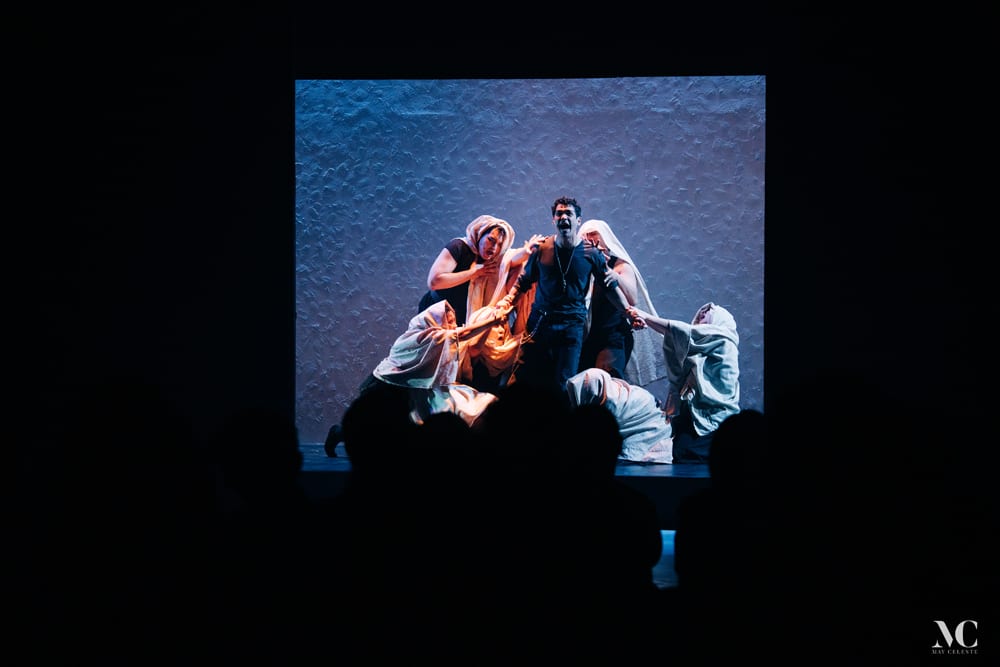
Goethe's Faust of the Old, Gomez-Artadi's Si Faust of the New
Johann Georg Faust was a 16th-century German itinerant alchemist, astrologer, and magician—also sometimes regarded as a conman and/or a heretic. Doubts surround his existence, but it is believed that he was the inspiration behind the German folk legend. Faust, as adapted in many pieces of literary, artistic, cinematic, and musical works, became an archetype for a protagonist who makes a deal with the devil, exchanging his soul for unlimited knowledge and worldly pleasures. The story was popularized by Christopher Marlowe through The Tragical History of Doctor Faustus (1592), where Doctor Faustus is a scholar of almost every discipline. Unsatiated, he wants to master necromancy, summons the devil, and makes a pact with Mephistopheles (who will serve him for 24 years). Faustus later begins to dread his impending death and damnation; he begs for mercy, but it is too late.
Johann Wolfgang von Goethe, about two centuries later, reworked the Faust legend into a two-part tragedy in mostly rhymed verse: Faust, Part One (1808) and Faust, Part Two (1832). Here, Mephistopheles (Satan) makes a bet with God, wagering that they can lead the Lord's striving scholar, Faust, astray. While Marlowe's Faust seeks limitless power, Goethe's Faust seeks a complete and holistic understanding of the universe. Goethe's Faust is also saved in the end, after his former love pleads for his soul.
It is this nuanced Faust that Gomez explores in Si Faust, and puts him in a local setting. The protagonist (Joseton Vergel de Dios) is a disillusioned and broken preacher amongst those perishing in a plague-stricken Philippine province (where plague can be read in both the medical and the socio-political sense). What makes this Faust much more complex is that he seems burdened and dissatisfied with the inability to heal the sick, urging him to make a desperate deal with Mephistopheles (Maita Ponce). As the moral question goes, does the end justify the means?
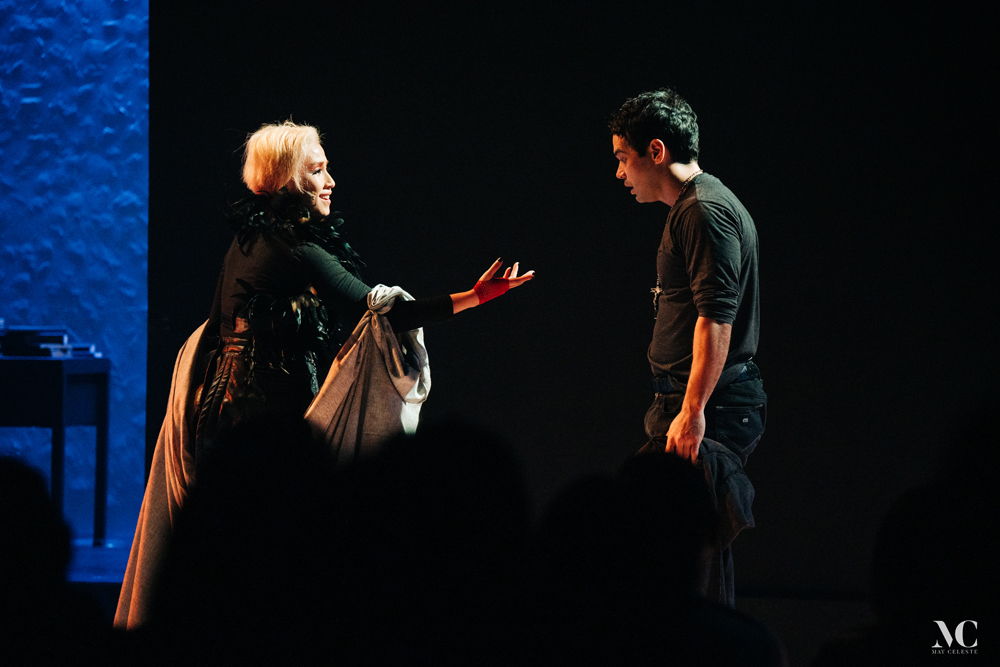
And then there's another layer of whether or not he is doing it for fame and power. The next scene, after all, portrays Faust basking in the glory of popularity after coming to the aid of his people ("Center of the Sun"), and especially after getting rid of his physical shortcomings. De Dios, in this part, does it doe-eyed, prompting yet another question of whether it was an innocent enjoyment and disbelief of the attention or a devious manipulation.
Together, these thought-provoking sequences early on in the 100-minute rock opera led me to believe that Gomez' Faust has the purest of intentions, maybe. I was rooting for the protagonist with his childlike wonder—especially as De Dios takes advantage of his calisthenics training in the rings scene ("Very Free")—mixed with wide-eyed complexities of fear and anguish, immersing myself in this universe of Si Faust.
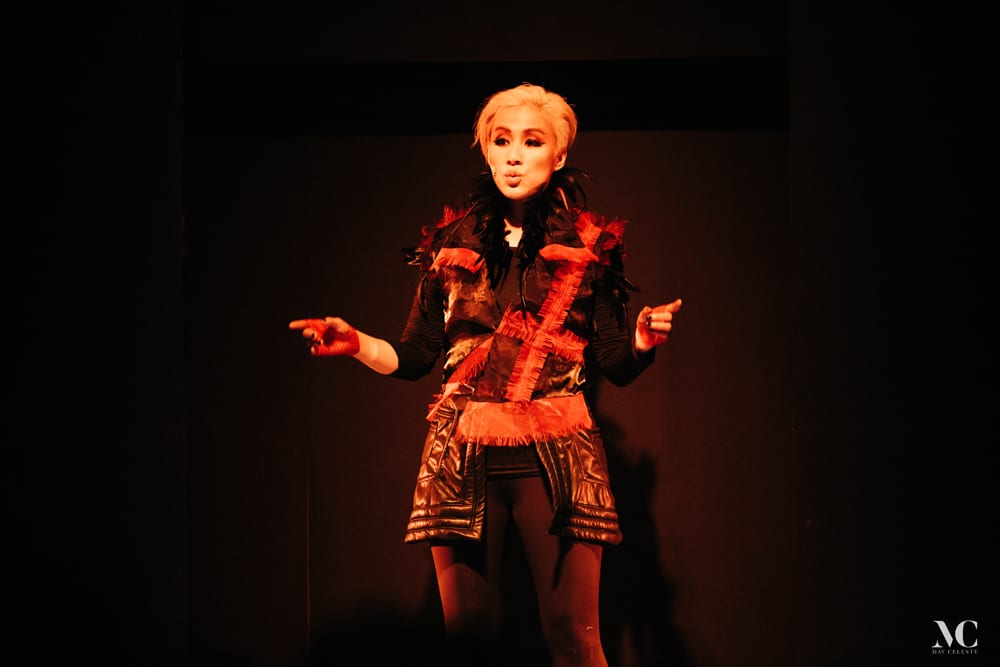
Ponce renders a sinister vibe on Mephistopheles, with her blonde hair and sleek outfit of black and red (costume by Carlo Pagunaling), projecting an air of authority, charm, and unapologetic badassery, rather than a traditional demon; and it is this command that makes it impossible to look away as she sings, moves, and manipulates.
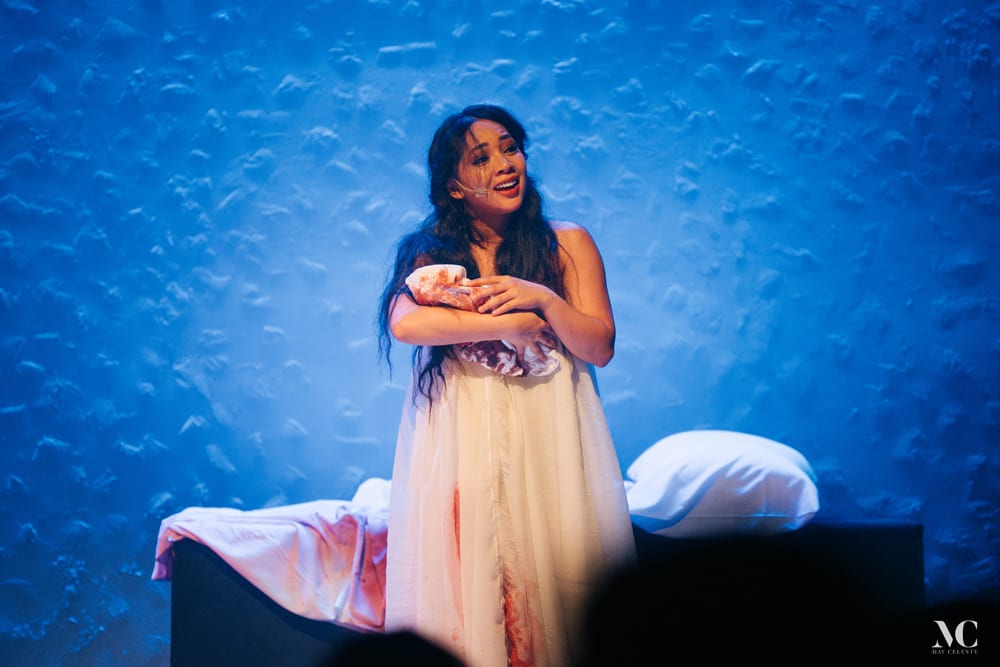
Shaira Opsimar, who plays the provincial girl Marga (Margarete or Gretchen in Goethe's Faust), never fails to capture with her gravitas (as she always does, as in her recent works like Walang Aray and Delia D). Her story ends with a tragedy, and Opsimar's voice renders every ounce of Marga's anguish and despair.
Finding the Narrative in the Soundscape
These complex characterizations are complemented by everything else happening in the production.
While most jukebox musicals struggle with finding the perfect blend of found music (especially popular songs of bands) and dialogue, Si Faust pulls it off with a sung-through of Wolfgang's biggest hits. As I was unfamiliar with the songs of the band (and that it's of the grunge and heavy metal genre), it was challenging to absorb the lyrics—which, in this case, is the backbone of the narrative as an alternative to a libretto. But when I just went with the flow: i.e., followed the movements onstage, relied on my sparse knowledge of the Faustian bargain, took note of the few words I could catch, and overall rocked to the music, the whole production unbelievably became clearer. In this world of Faust (and the songs of Wolfgang), there is an emotional turmoil in desperation ("NME," "Natutulog Kong Mundo," and "24"), but with anthems of aspiration and motivation ("She Is My Cain", "Hiwaga"), a contrast to Marlowe's foreboding tone of damnation and an extension of Goethe's struggle for ambition. Kabaitan Bautista's musical direction nails this soundscape, and even the sound design, that I initially thought there was a live band playing on stage right. (I later find out there's none.)
A full playlist of Wolfgang's tracks as played in order on Si Faust is made available by Gomez on Spotify. A proper listen to the lyrics makes it look like the songs were made for (or made from) the deal with the devil motif, "Halik ni Hudas" is right there after all, strengthening this chosen collaboration by the theater wunderkind and the music legend.
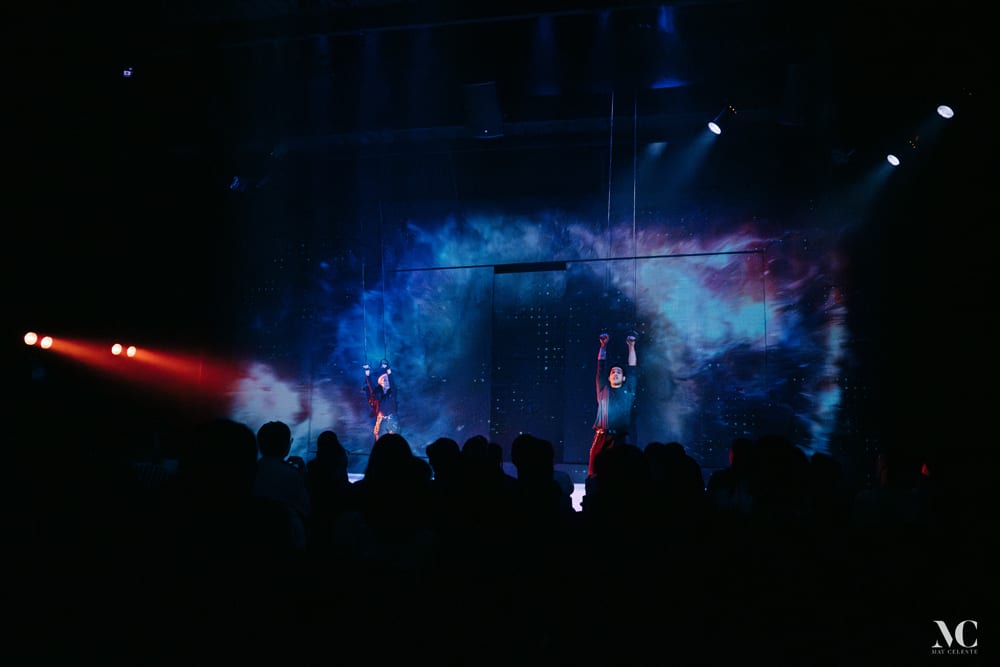
And while not every word of every song matches the scene, music continues to steer the ship even in the visuals, prompting viewers to get lost in the trance-like tone of the projections (Joyce Garcia). At times, even, it feels as if we're watching a music video, bringing with it the nostalgia of '90s MTV, just enough to match the early Wolfgang era. The chorus' choreography (by Jim Ferrer), likewise, embraces this rock-driven material, portraying the mayhem when necessary.
Sarah Facuri's bare stage serves as a canvas for all these; but more importantly, that hypnotic atmosphere is further translated with the moving backdrop. Physically, the movement of the two or three wooden panels—swiftly switching left-to-right, and vice versa, to create small and large window openings—is already a breathtaking feat of stagecraft. Figuratively, it allows the narrative to play with time, space, and the themes of choices and consequences.
Enriched by references to old texts and found music, Si Faust stands on its own, offering a profound commentary on modern aspiration. This piece about dissatisfaction satisfies all the senses and, ultimately, compels the audience to confront existential questions—as good art does.
Si Faust is produced by Areté.
Christa I. De La Cruz is a Palanca Award-winning writer with over 15 years of experience in feature writing for print and digital media. She earned her Sertipiko sa Malikhaing Pagsulat sa Filipino from the University of the Philippines Diliman and holds an MFA in Creative Writing from De La Salle University.
View More Articles About: