In Austin, Intel Lastierre’s Incisions on the Immigrant Skin
As the inaugural recipient of the DORF Fellowship in Professional Practice, her artworks are currently on exhibit in Texas until January 31.

Published on Dec 28, 2025
It all began in the church for Intel Lastierre.
In sugarland Negros, Alfonso Ossorio’s The Angry Christ towers over the altar of a modernist chapel built for the workers of the industry-shaping Victorias Milling Company. For the young Lastierre, it was an encounter that felt less like a Sunday ritual than a rite of passage for any child growing up in the island’s plantation economy. The image is imposing: spanning 60 square meters, Christ’s sinewy arms stretch outward, the face in an ambiguous register between revelation and restraint—a seething calm on the cusp of the Last Judgment.
“Its scale, energy, and intensity completely blew me away,” she recalls, “and inspired my love for creating large works.”
Lastierre was right to sense something oracular in the 1950 church mural: it endures not only as a pilgrimage site for the devout but also as a magnet for cultural production, spawning a Floy Quintos play in 2017 and a cascade of character sketches on the queer life of its Filipino-American painter.
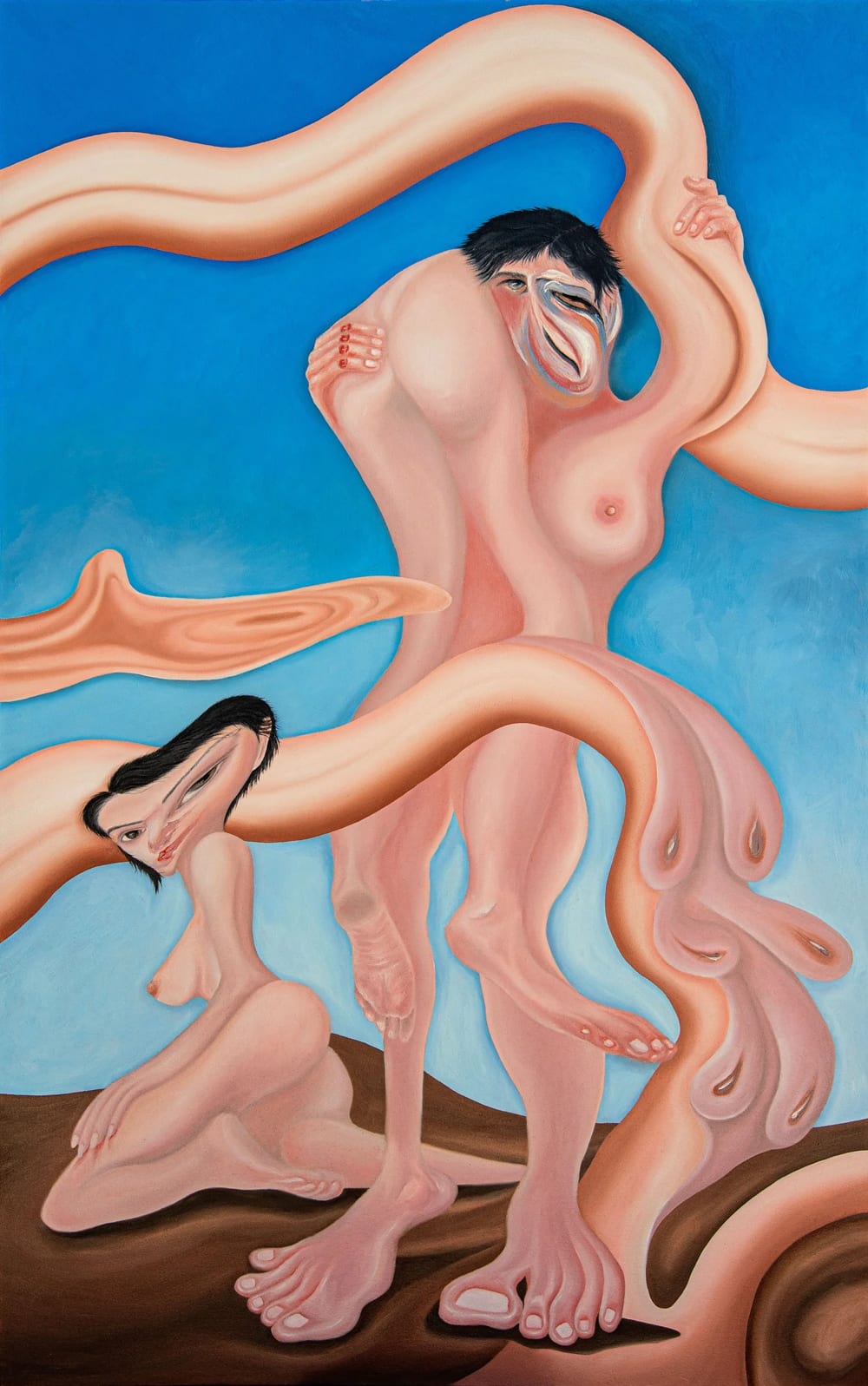
Today, Ossorio’s anatomical study drifts through Lastierre’s subconscious, emerging as peeled skin, spongy tissue, and skewed limbs unfurled layer by layer in her mixed-media show at DORF in Austin, Texas. On view through January 31, 2026, Infernal Rebirth into Hell: Illusions and Realities gathers her signature, flesh-warping language in painting and installation, casting the immigrant body as the corpus delicti of the American Dream.
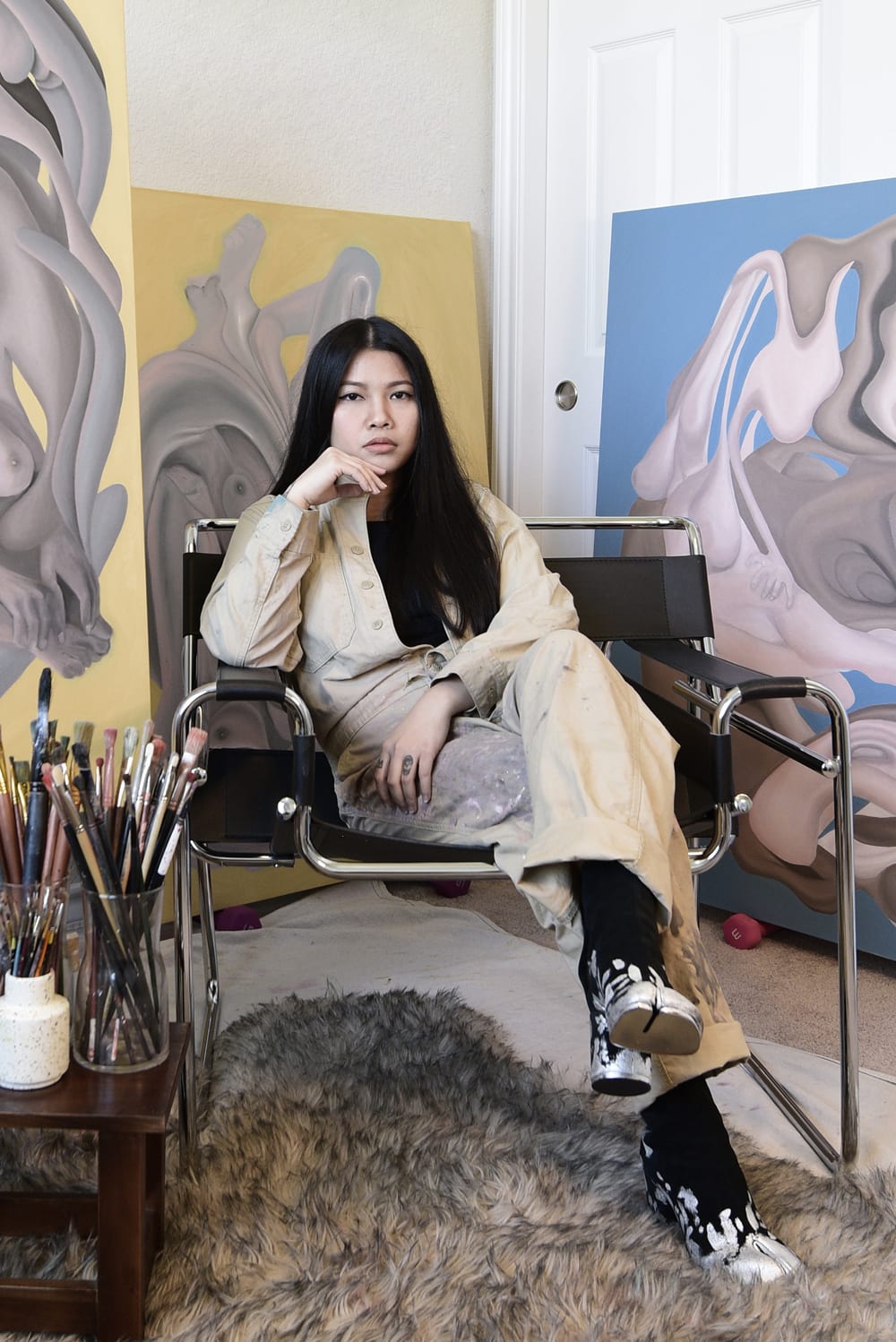
Lastierre, 36, is the inaugural recipient of the DORF Fellowship in Professional Practice in the United States, a grant structured around mentorship, financial support, and exhibition opportunity. Two things drew her to its landmark open call earlier this year: first, “I like their gallery space!” and second, the program is artist-run. Less hierarchical and more collaborative, the program pulled artists like her who want to break into the Texan art scene. Two things also stood in her way: she’s a self-taught female artist and a first-generation immigrant.
“The art world here is very exclusionary,” she tells me over Zoom. “Most institutions and curators are white, and access is often based on connections and privilege that immigrant artists usually do not have.”
Lastierre’s bluntness translates even in the show’s most compact work, "Devouring the Dream" (2025), where a sculpted mouth rests inside a clear acrylic suitcase, its teeth clamped down on a U.S. passport. The installation is at once seductive and unsettling: a wink to Pop Art’s obsession with the everyday and Surrealism’s body horror tactics. Drawn from the Filipino trickster monster tambaloslos, the piece becomes a stand-in for how immigration policies entrap and consume.
The Silay-born artist moved to the U.S. in 2017, just as travel bans began to signal an era of executive overreach. Little did she know, lawlessness was about to become the lingua franca of the Trump Administration. Immigrant artists braced for double impact: the physical danger of crackdowns and the invisible dread that artistic labor was always under surveillance.
“Networking and gaining recognition is not just about skill,” Lastierre says. “It’s also about navigating a system that wasn’t built for people like me. On top of that, being an immigrant means dealing with instability, visas, and the constant awareness that your place here is always conditional.”
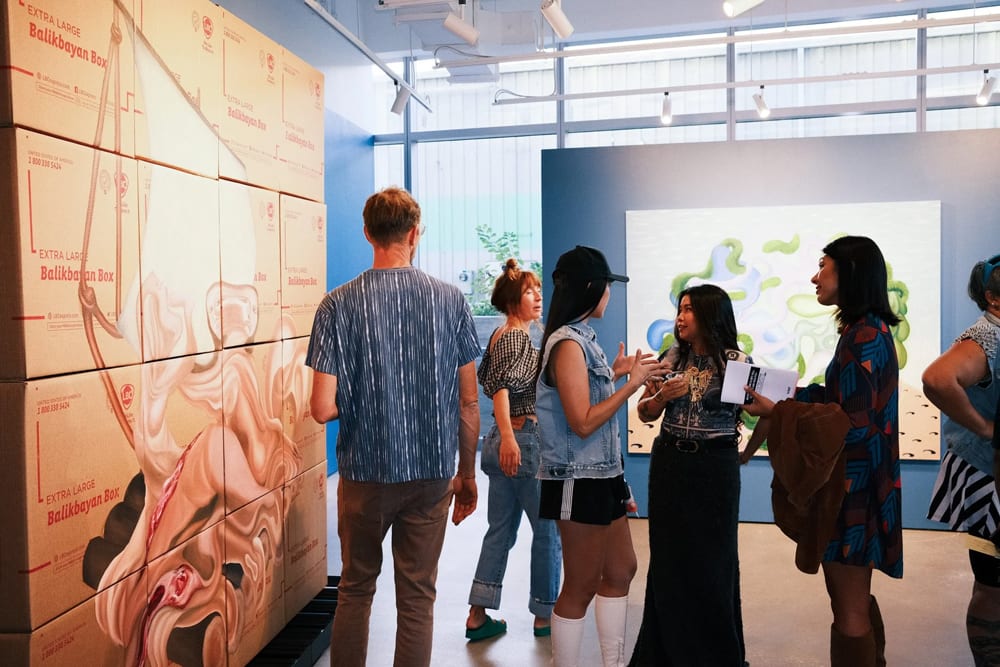
That sense of conditionality—of belonging as something perpetually deferred—takes sculptural form in "Balikbayan: Boxes of Longing." Lastierre stacks sixteen of these cardboard boxes into an edifice and paints on it an image that explicitly recalls the precarious choreography in Théodore Géricault’s "The Raft of the Medusa." Stripped of shipping labels and customs tags, the packages cease to be mere containers of goods and become artifacts instead. The product is part monument, part indictment.
Indeed, identity and the violence of its uprooting is a perennial theme in immigrant art. Lastierre doesn’t mind that it's often worn thin by repetition. In earlier work, she captured Austin’s art audience with her haunting tableaus of severed head-like forms fashioned from air-dry clay and synthetic hair. Pierced by wooden arrows, the mouths were caught mid-scream. Industrial elements—hooks, bolts, and chains—referenced the machinery of conquest and trade that accompanied colonial agony. In her present exhibition, that reckoning with the scars of empire gives way to the more contemporary urgencies of collective care. Here, she integrates Braille versions of her works, inviting blind and visually impaired visitors to experience art through touch. Access, for her, isn’t a consequence but a requisite—itself an extension of diasporic reality.
Is this an act of radical inclusion? Far from a solo flight, the curatorial development of Infernal Rebirth was led by two women, Manila-born Regine Malibiran, who also served as DORF’s pioneering Curatorial Fellow, and Sara Vanderbeek, the gallery’s executive director. For Lastierre, the project reaffirms what she seeks in artistic partnership, even in the less glamorous dimensions of the art world. “There are 50-50 arrangements that don’t make sense, and there are those that do,” she laughs, referring to the standard sales split between artist and gallery. “I’m happy to report that with DORF, it does.”
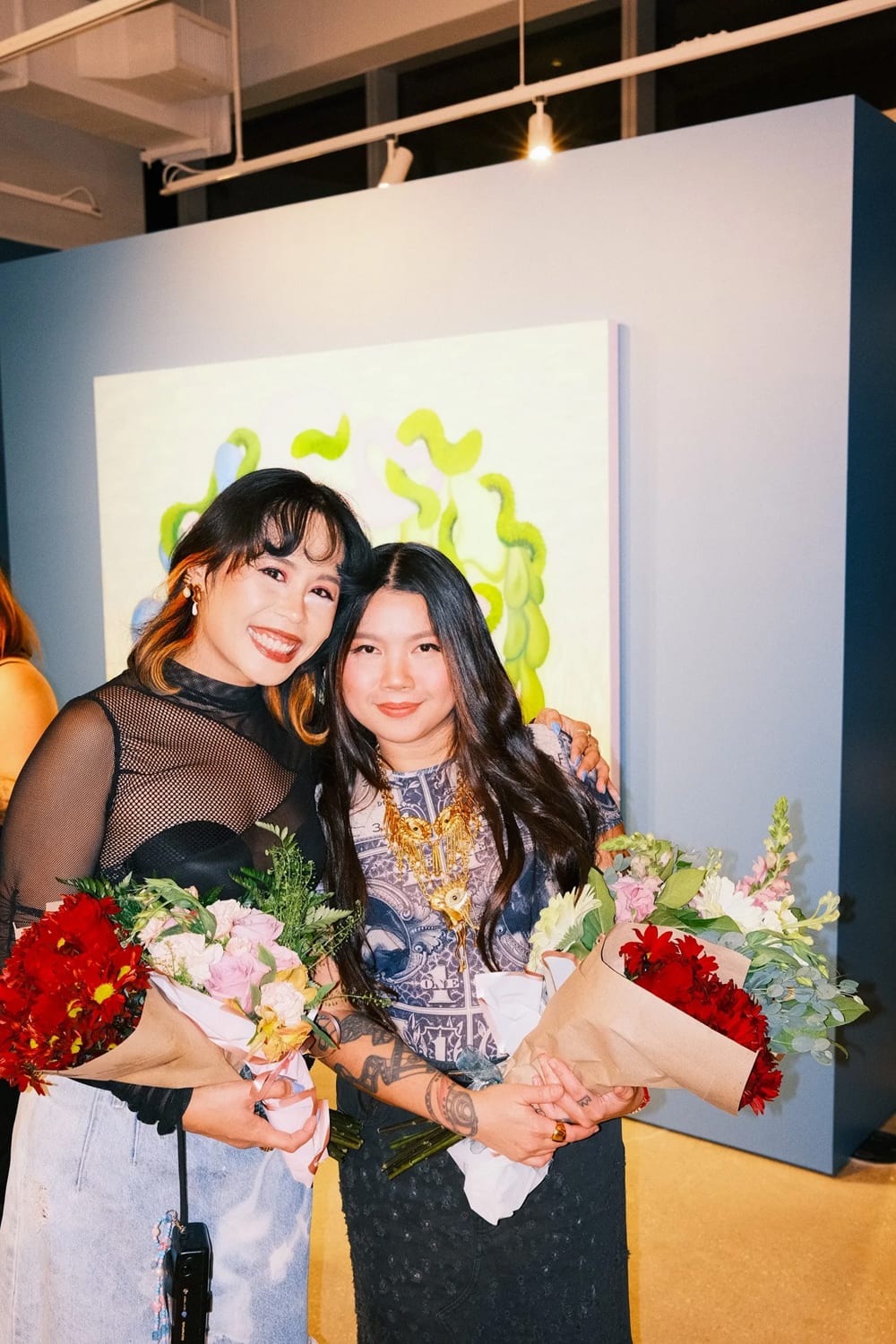
Extending the exhibition’s social reach, DORF hosted a program in November with the Filipino-led alliance Tanggol Migrante Movement, which offered practical discussions on law enforcement encounters and solidarity-building. “I think it is really important as an artist to choose the right gallery, “ Lastierre says, “not just for the space, but also for the intention and values behind it.”
Outside the studio, the artist is either walking her dogs or absorbed in inquiry. On Instagram, she posts snippets of what occupies her thought bubble, like the American feminist Linda Nochlin’s groundbreaking 1971 essay "Why Have There Been No Great Women Artists?"
“Nochlin did not just critique the exclusion of women from art history,” Lastierre explains. “She questioned how value, mastery, and legitimacy are defined in the first place. Her writing made me realize that reinterpreting history, reclaiming the female nude, and centering marginalized perspectives is not just personal. It is actively challenging the systems that shaped the canon.”
If women-driven projects were meant to open doors and redefine value, Lastierre took that to mean showing up, quite literally, in the civic spaces where art meets the public. In 2024, Lastierre served as a panel member for Austin’s Art in Public Places program, tasked to review proposals for and provide feedback on community-focused creative projects.
“Engaging with the community helps us understand diverse perspectives, respond to real experiences, and create work that resonates beyond the studio,” she says.
Bouts of burnout do come, she admits, pressed under the monolith of America’s ideals of success. Yet she rarely succumbs to the paralysis of an artist’s block. When it strikes, she leans into curiosity, tempered by a measure of self-restraint.
“The more I finish a piece, the more I learn about my work,” she reflects, before turning once more to mythology. “It feels a bit like Icarus reaching the sun, but I do not want to know everything, because if I did, it would lose its excitement.”
Infernal Rebirth into Hell: Illusions and Realities runs until January 31 at DORF, Zilker Point, 218 South Lamar Boulevard, Suite 140, Austin, Texas.
Denzel Yorong is an independent media producer and writer. He is a finalist for the 2025 Purita Kalaw-Ledesma Prizes in Art Criticism.
READ MORE:
The Making of an Artist: The Whys and Hows in Silke Lapina's Bakit Pa
In 'Quezon City Biennial: Ilalim/Ibabaw,' the City Is the Gallery
View More Articles About: