What We Owe a Confession: On Geloy Concepcion’s 'Things You Wanted to Say But Never Did'
The Ateneo Art Gallery has extended the exhibit's run through July 18.
Published on Jul 11, 2026
I find myself still sitting on the floor of Geloy Concepcion’s Things You Wanted to Say But Never Did. I have lost track of time reading through the confessions anonymously sent, projected onto a sheer curtain. Through the fabric, I can see silhouettes of guests moving around the exhibition space. They almost resemble the silhouettes cut out in some of the photographs on the wall. A floor fan gently stirs the curtain. I realize that I have been watching the curtain for longer than I intended.
The movement of the fabric reminds me of my childhood siestas. My mama would settle herself beside me on the living room couch and fall asleep almost instantly, while I remained awake, watching the curtain rise and fall because of the wind from the electric fan. Rise and fall. Rise and fall. Watching the curtain felt like watching time itself pass. Those afternoons were among the early instances I became aware that, even beside my mama, there were some experiences that only I, and I alone, could experience. Of course, I did not know how to articulate that feeling back then. I had almost forgotten that memory until I found myself sitting with Concepcion’s installation.
Somewhere among the projected words, the moving fabric, and the passing silhouettes, another chain of associations begins. Claire Bishop offers a way of understanding this experience. Drawing on Freud’s idea of dreams, she argues that installation art is experienced through free association. We move from one element to another, allowing personal memories and related emotions to surface until they become part of the work’s meaning.
Concepcion’s exhibition works through atmosphere as much as through text. There is a faint music lingering in the background. I can imagine hearing it in a film where a montage of the protagonist’s wistful memories unfolds. Its rhythm asks for attention—the intimate and gentle kind. It slows my mind down. And then my heart. And then it makes me stay in the exhibition longer. For an artwork that builds upon the vulnerability and trust of others, the exhibition invites us to sit with, to walk with, these strangers’ confessions.


“i find too much comfort in my own sadness,” one confession reads. It is written on a photograph of a seated figure cut out into a white silhouette. The confession no longer belongs to an identifiable individual. I cannot ask who this person is, what happened to them, or whether their life is actually like mine. What I am left with are their words, and their anonymity allows me to read the “I” as my “I.”
The photograph was taken in what appears to be an ordinary domestic interior. Although the background is blurred, I can still make out the silhouette of a sofa or a chair. Nothing dramatic is happening, but that mundanity in this photograph—and in the rest of the exhibition—is precisely what catches me. The photographs give the confessions a world, a room, in which they can breathe and become alive.
Above the figure’s head is a burst of white scribbles. I do not know what it means, to be honest. But it feels like there is something happening inside this person that cannot be photographed. Instead of depicting sadness, the image acknowledges its intangibility.
Sadness is often imagined as blue and dark and cold, yet the room in the photograph is washed in warm browns and soft pinks. It is softly lit like it is lived in. I once asked my therapist why sadness seemed to be my default emotion. By “default,” I meant that I felt I had built a home in it. The image makes me understand why we might find comfort in our sadness. Because it can become familiar, a place we learn to inhabit.


Another confession that catches me reads: “Being pregnant and sober has forced me to face the problems I was running from. It hurts, but I’m learning so much. I don’t want to drink again.” It is not an “I” that I can identify with, at least not directly. I have never wanted to become pregnant, nor have I struggled with alcohol, but something about it feels familiar.
The exhibition repeatedly performs this gesture. It occurs to me that the exhibition does not ask me to identify with these strangers. Their stories remain theirs, and I want them to stay that way. What I am recognizing are the human conditions the confessions disclose—avoidance, confrontation, suffering, growth, and eventually, resolution in this case. The anonymous confessions preserve the lived experience of another, while allowing me to encounter something recognizably human about it.
I walk toward the wall where we are invited to leave a confession of our own. I find myself unable to write one. It surprises me because I have spent the last hour lingering with strangers’ confessions only to realize that I hesitate when it is my turn to enter Concepcion’s project. There is another impulse that emerged while walking through the exhibition space. I catch myself wanting to pose for a photograph before the confessions on the wall. It is a common practice now in museums, after all. And then I realize I am turning them into a backdrop for a carefully composed image of myself, risking turning their vulnerability into another image for circulation. I do not want mine to become one.

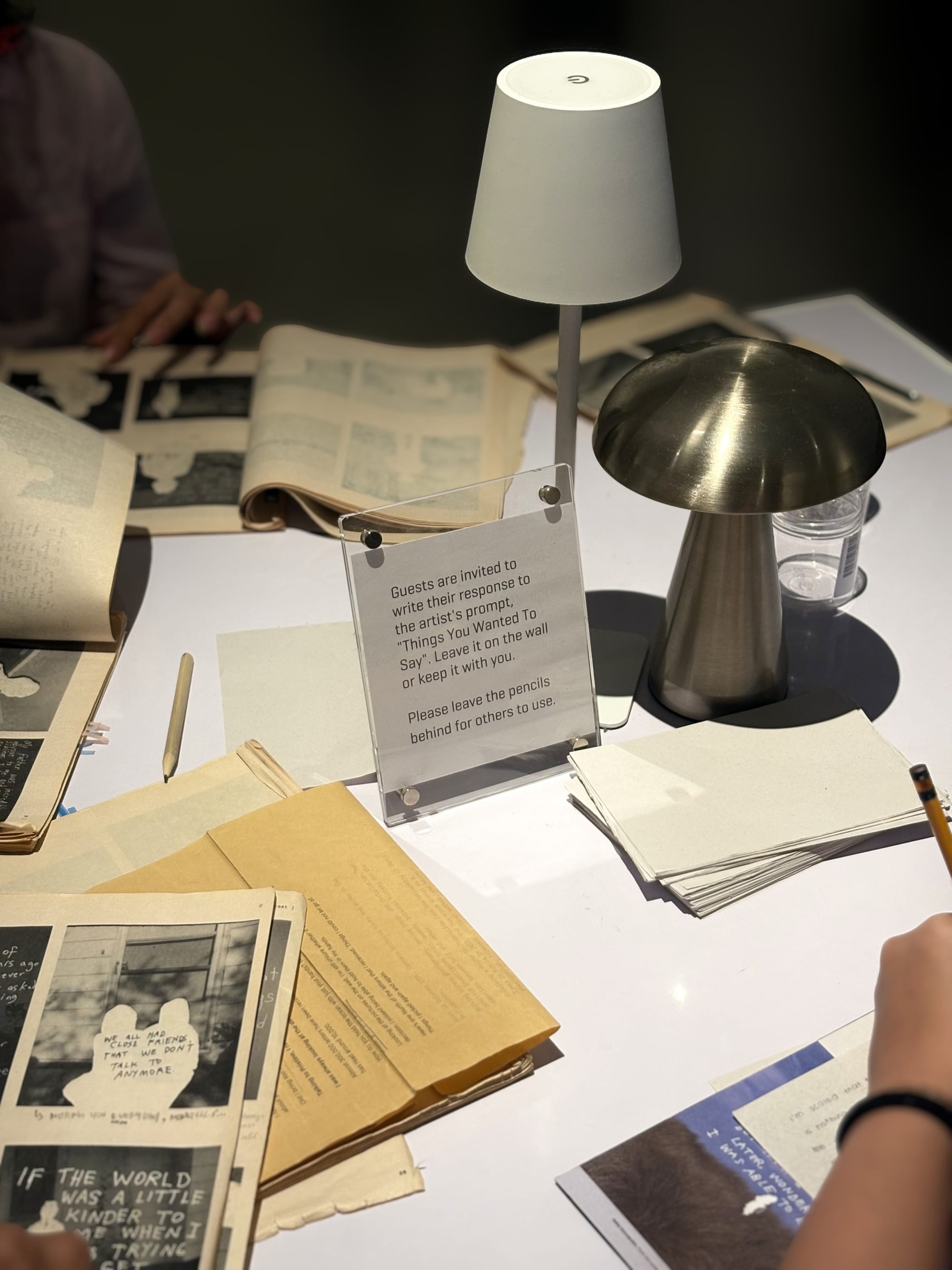
I first thought the anonymity was liberating. Something I wanted to say but never did could finally enter the world, released from myself, but devoid of anything that ties it back to me. I acknowledge that there is something freeing about it. But I imagine my confession—and I imagine it as its own being—entering the lives of strangers. It can be read, photographed, reposted. Aestheticized. Anonymity, I realize, does not necessarily protect my vulnerability from becoming just another image, just another backdrop.
I think instead of the people who hold my vulnerability with care. If I were to entrust someone with my vulnerability, I would want to know that my confession would be held with care. Concepcion’s exhibition asks us to sit with one another’s vulnerability. Perhaps Things You Wanted to Say But Never Did is also about how to receive another person’s confession.
Geloy Concepcion’s Things You Wanted to Say But Never Did runs until July 18 at the Wilson L Sy Prints & Drawings Gallery, 2F Ateneo Art Gallery.
ALSO READ:
Esquire Philippines' Best Visual Artists Awards 2026
The 100 Most Powerful People in the Philippines: Wielders of Soft Power
Amanda Juico Dela Cruz teaches in the Fine Arts Department of Ateneo de Manila University and the Literature Department of University of Santo Tomas. She was a fellow at the 20th Ateneo National Writers Workshop and the 8th Cordillera Creative Writing Workshop. She graduated with an MFA in Creative Writing and an AB in Philosophy from De La Salle University. She has published in Art+ Magazine, Beyond the Ghetto, Plural Art Mag, and Philosophia: International Journal of Philosophy. Her oeuvre of creative and scholarly works inquires from theories to write on and from the female body in the context of post-sexual revolution narratives.
View More Articles About: