'Kalikasan' Is the New Old Board Game You Need to Buy
Esquire Philippines sits down with Randy Flynn, the man who designed the popular board game Cascadia and its exclusive Philippine edition.

by Zach Yonzon
Published on Jun 4, 2026
Cascadia is a 2021 board game designed by Randy Flynn, who was recently in Manila for the biggest board game convention in Southeast Asia: All aBOARD Expo '26. It ran from May 28 to 31 at the Quezon City M.I.C.E. Center.
Its Philippine edition, Kalikasan, was also launched at the Expo, where board game enthusiasts played the familiar tile-laying and token-drafting game. But instead of having habitats and wildlife of the Pacific Northwest, the puzzle elements celebrate local biodiversity, including five Philippine animals: the Philippine Eagle, the tamaraw, the bangus, the binturong, and the tarsier.

ESQUIRE Philippines: Where did the idea of Cascadia come from?
RANDY FLYNN: So, my wife and I were on vacation in Hawaii, and it was the time that Tiny Towns was released by AEG and Peter McPherson, the designer. We bought it there at a game store in Hawaii, and we played it. I think we played it seven times while we were there. Just two players, the two of us. And we also played Orbis at the game shop there. The key thing about that was Tiny Towns had the variable scoring cards, and I was really impressed with how that worked. And it was a spatial puzzle game, which I like. And we really enjoyed it. And then Orbis, of course, had hexes, and it was kind of the hex tile way of going through things. So on the flight back, I was going through my design notes on my laptop and looking through them, and I found one that basically said, "A two-layer, two-level tile laying game where the tiles on the first level dictate what can be played on the second level." And that was most of the note. It said, well, it could be a city building theme, it could be a nature-based theme. Like, that was about it. And I've posted the note before. Somehow, that just clicked with those, like, all of those components together. And I furiously took notes like the rest of the plane trip, like pages of notes when I was done about possibilities. And within a week, I actually had a playable prototype, which also had a board that was similar to Calico from Flatout [Games’] first game. So yeah, it came together pretty, pretty quickly from that.
Calico is too punishing, which is why many actually enjoy Cascadia.
It's a game of regret.
Did you expect Cascadia to be as well-received as it is?
Oh, I had no expectations at all. I mean, I was like, I think it's a good game. It should do well. When I signed it with Flatout, they hadn't yet published Calico. Like, they had crowdfunded it. It wasn't even out there yet. Or maybe they were getting ready to crowdfund. Or I think they had just finished the crowdfunding, and so, you know, I didn't know how they were going to do, really, and all of that. So I didn't have a lot of expectations. But the Flatout folks are my friends, game design friends, and I worked really well with them, and I was like, "Yeah, I want to work with them." So I signed it with them. And so I really didn't know. Here's fresh publishing company people, you know, just friends of mine doing all of this, and I didn't know how it would go. It was interesting, though, as we went through the process of designing the game and working with AEG. Eventually, when they decided, yes, they'll co-publish [the game]. You know how they did Calico, like confidence in us kind of built, you know, and there was a point where when we got it towards done, and it was like, could this get on the list for Spiel [Essen, the biggest board game trade fair in the world]? Like, there's no reason it couldn't, you know? That was kind of what it was. Like, you know, I think we've done a pretty good job with this. And then Kosmos came on board as the German publisher, and I was like, okay, yes, this is a real possibility, you know? So yeah.
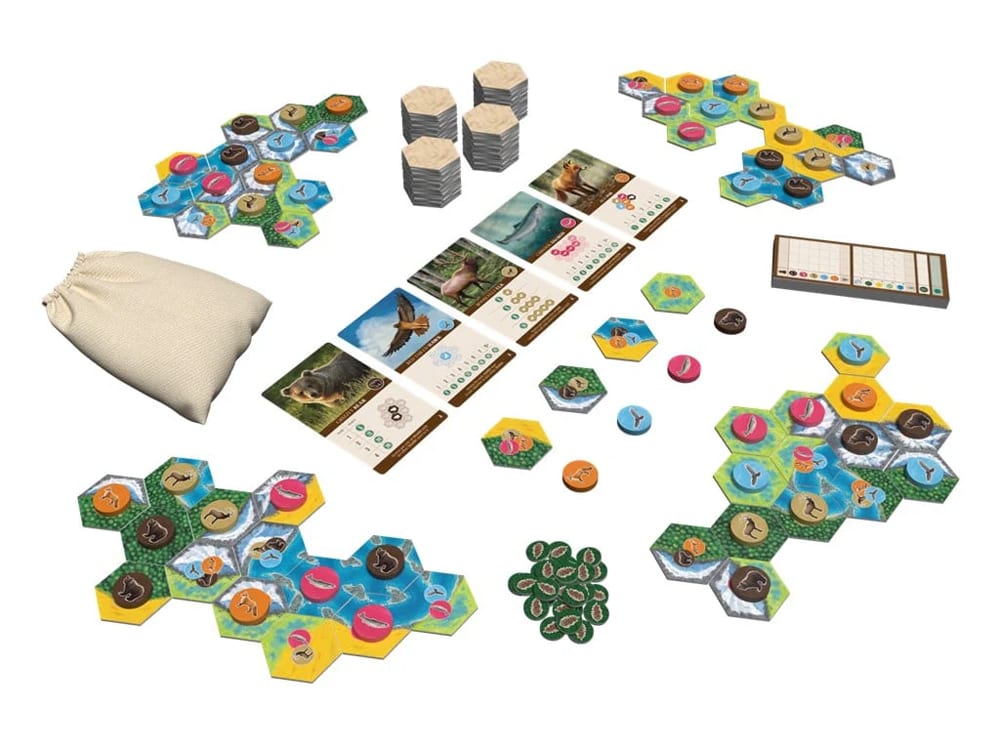
You’re coming out with a new game, Alpine Lakes. Can you tell us a little more about it?
Yeah. Uh, so Cascadia: Alpine Lakes is really the first true sequel to Cascadia. So, you know, we have the Rolling, we have the expansion, Landmarks, and we have the Junior, but this one's a true sequel. So it's just really like, what's the next generation of this? And what can we do? The key thing about Alpine Lakes is that it has you stack tiles. So yes, you're building out your landscape just like you are in Cascadia. You're using these double hex tiles instead of single [ones]. But you can, to some degree, you need to build up[wards] as well. So it adds kind of a third, you know, axis to what you're doing. There are a few other differences. Like the scoring cards are not per wildlife, they're per habitat, and they don't care what the wildlife is. They'll say things like this: "Each glacier corridor scores if it has an adjacent pair of the same animal." Doesn't matter if they're a pika or they're a cougar or whatever; it doesn't matter. And so all of the different habitat scoring conditions are that way. They don't care which animals; they just care that you meet them. But at the same time, we've kept some things exactly the same. So the Cascadia players already know at least half the game when they start. The draft is identical—four tiles, four tokens. You take a pair. Nature tokens work exactly the same. You play on something that's a keystone hex. You know, on a tile, you get a nature token. You can spend it to change the draft, you know? So those things stay the same. It's definitely a small step up in complexity because we're adding that third axis. But in the core game, I don't think that step is very much. I think a lot of players are looking for, like, oh, just like the next little level. I think this will work out really well for them, and maybe some of the players for whom Cascadia was a little too straightforward. Maybe this adds enough that they're like, oh, okay, now, now this, this is what I want.
How did the Philippine version of Cascadia come about?
So, I was not directly involved in that. AEG, you know, is a big sponsor of the convention here. [They’ve also] been interacting, uh, [they’re a] big sponsor of CMON Expo in Bangkok, as well, and talked with Hans [Kenner Fernandez of Gaming Library] and others about this. And they kind of had the idea of doing it, and they started talking, and then it was proposed to Flatout and myself to do this version. And we were pretty quick to agree to that. It seemed like a great, great idea because we've always thought it would translate well to other places, but it wasn't really what I think Flatout wanted to do themselves necessarily, because the Cascadia brand itself is very strong(ly), very Pacific Northwest-based. So Alpine Lakes is still a Pacific Northwest-theme and all of that. So yeah, in the end, they chose, you know, a Philippine artist, and they had people edit the text to make it [Filipino], and they put in a—I just, I only learned when I got here—that it has an English rulebook and a Filipino rulebook, which I thought was incredibly cool. I have one other game that's like that. My game Tabriz for the English version also comes with Iranian in it, which is really nice. So yeah, I didn't have a lot of involvement other than saying, "Okay, yes, do this please!"
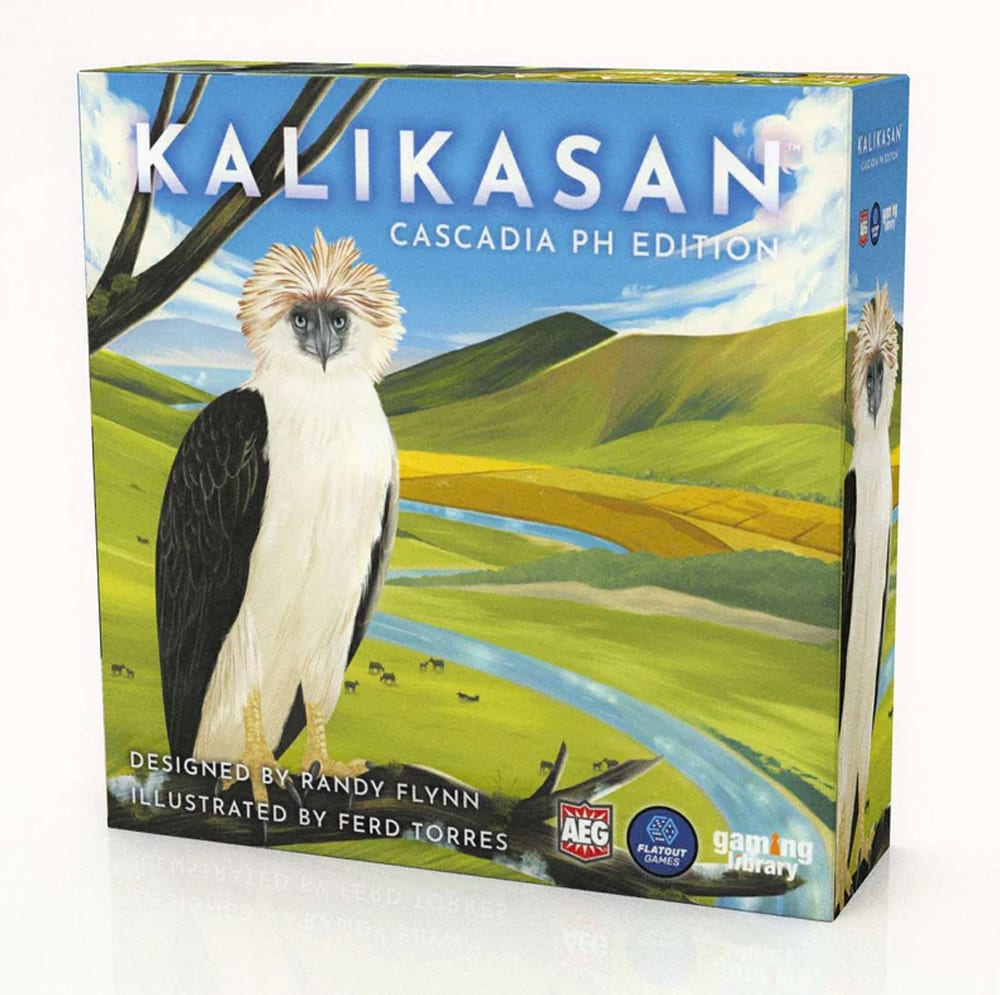
How excited are you to see all these games come out that are, you know, inspired by your game and basically your game design?
I mean, I think it's like seeing, you know, Kalikasan come out. It’s really cool. It's very validating to see that, you know, this design, you know, transfers well. And I think what they did with that was very similar. They looked at the patterns and said, "Okay, what animals, you know, that are iconic to the Philippines actually make sense with these patterns?" It's the same thing we did, you know, when we designed Cascadia. They did it, and did it really well. And so it's nice to see that translates really well. And I think it's been nice to see that we can take the ideas in Cascadia, create a junior version, and have it come out well. We translated one of my other designs. Rolling Up Roses became Cascadia: Rolling series of games. So that was a re-theme from [another game] into Cascadia, that happened to work really well. And it's just nice to see the bones of some of that, you know, really work well in different systems and come out. So yeah, it's really nice to see.
Speaking of game mechanics, can you give one or two of your favorite ones?
I love, you know, I basically love resource-collecting games, and I love engine-building games both a lot, and there are plenty of those versions that I don't like, games that use it. But when it's done, when those are done well, I really enjoy them. Which goes back to Concordia being my favorite game. It's like it really blends these two things very, very well. It's like perfect for me.
What games do you have on your table right now?
Oh, see, recently, you know, one of the things about being a game designer or publisher is that you often end up playing a lot more prototypes than you do published games. And it's definitely, definitely true for me. But let's see, what are some things that I've played recently? Um, uh, Skyjo, an older game that's become more popular in the U.S. in the last two years. Something we played a decent amount of, something we always play, is Skull King. I brought two games with me to the Philippines to fill baggage space with games, even though there are hundreds here, and that's Skull King and 6 Nimmt! or Take 5. In the U.S. market, you know, those are very portable games that are fantastic, and I play them quite often. I learned Mosaic, one of the games I had backed a while ago and hadn't had a chance to play. So that was fun. It's like, you know, a civilization-building game. Step up from Concordia for sure. My son actually really enjoyed it. Um, so that was fun as well.
Do you play with your family?
Yeah. It's actually one of the, actually, the reason I got into board games was to bring that into my family and, you know, so that's where it started.
In Cascadia, would you ever introduce a way to do stuff like change the tile instead of changing the animals or moving the position of your animal to another tile?
Yeah, all of those have been considered. Like changing a tile in the draft. There are sort of reasons we didn't do that. Um, it's kind of because with the tokens, it's easy. You take it, you put it aside, you pick a new one from the bag, and you throw it in. With the tiles, it’s not actually that easy because we do them in stacks, and we don't provide a bag. So now, when you remove one, you actually need to shuffle it back in. So there's just [these] kind of limitations that, on one hand, might work. On the other hand, it's interesting because it kind of became like a core that the game sits on that people have to deal with. So it's like the forcing function of, sorry, you're going to have to deal with these tiles one way or another. And it would almost feel wrong to remove that restriction in some ways. But the movement, let’s just say it could very well show up in a future Cascadia in a limited way, because we actually do have some designs around some possibilities for that. So yeah.
Do you have any experience with games that have come out from Asia as opposed to, say, in America or Europe?
A little bit, not a lot. But I was a guest judge for the Road to Essen in Vietnam. [The people who] put that together asked me to be a judge. I was kind of like the special judge at the end. I didn't judge like every entry, but I got to judge the finalists along with the other judges. That was really fascinating to see, you know, the things that they brought in from Vietnamese culture. And because that was part of the goal, it wasn't just a … oh, Vietnamese designers were like, they really wanted things that were thematic to Vietnam and all of that. It was really fascinating to see the things that they came up with that were like twists, or very much taking mechanics we're used to and just, you know, almost re-theming them versus [just] twists on things. It was really cool to see. It was a great learning experience too. So yeah.
Is there any observation that you can make about Asian game design or Asian players that you've gleaned so far?
You know, I think, not so much. And I think part of it is that, you know, even like when I was doing the judging and looking at some of the other ones from Vietnam, and then, you know, when I browsed [here], I'm seeing a very similar variety. It's like there's a bunch of different kinds of games that people like to enjoy. One of the games from Vietnam was like Catan-related, you know, but very different thematically, and some had a little more, um, like head-to-head, you know, conflict in it. So I really see a similar variety in things. I don't know that I have any observations on the differences.
ALSO READ:
The Man Who Has Played Over 9,500 Board Games
A Filipino Twentysomething Entrepreneur Created This Board Game About the Byzantine Empire
Zach really, really, really loves films.
View More Articles About: