58th is the Most Empathic Way to Commemorate the Maguindanao Massacre
The real-life tragedy, which saw the murder of 58 people, including at least 32 journalists, is recounted through chilling archive news footage.
Published on Oct 2, 2026
There’s poetry in the way 58th presents the Maguindanao Massacre. The real-life tragedy, which saw the murder of 58 people, including at least 32 journalists, is recounted through archive news footage of its aftermath. Fellow journalists had excavated the story of this “single deadliest event for journalists” from being forgotten by the public for years until justice was partially attained.
Partially, because the 58th victim is not officially recognized by the law. His name is Reynaldo “Bebot” Momay. He was a photojournalist. He was a loving family man. 58th follows Momay’s daughter, Reynafe Castillo, as she seeks reparations for his death.
58th is a film about layers. And it’s not only the irony of journalism’s retribution. Nor of the literal layers of dirt dug up over the victims’ bodies when they were exhumed, as seen in the film’s more visceral scenes. 58th wasn’t GMA’s first documentary about the Maguindanao Massacre. It was only its latest attempt, developed when a court ruling on the tragedy finally materialized after about a decade. "Yung napanuod ninyo po sa documentary ay nakabase sa dokumento,” said creative producer Ian Simbulan in a talkback session with the audience after a screening of the film.
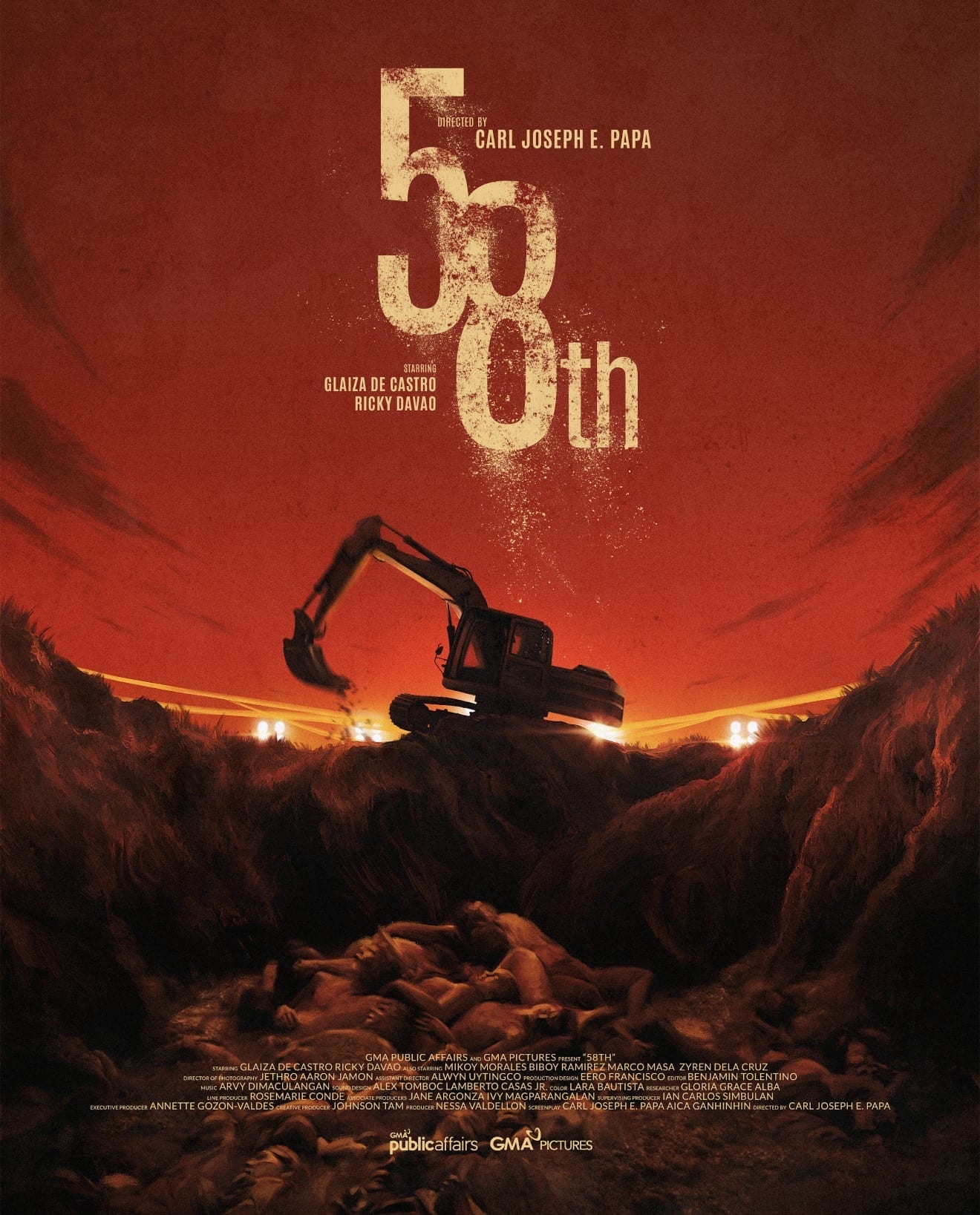
The official poster for 58th
“Si Bebot ay nakita niyo lang po sa sasakyan, never sa crime scene kasi walang nakalagay na ganoon sa desisyon, kaya nga po kino-contest ni Reynafe na mapasama siya at ma-recognize ang 58th victim ng Maguindanao Massacre,” Simbulan added.
In 58th, Glaiza de Castro dramatizes Castillo. Ricky Davao portrays a portrait of Momay from Castillo’s memories of him. Another layer of grief looms over the film as this was Davao’s last posthumous role. Mikoy Morales plays a journalist who Castillo recounts to. Reality and dramatization are blurred in the docudrama. The only moment where this is addressed is towards the end when the animated shot of De Castro morphs into the actual Castillo.
Animation is the last attribution in this docudrama’s form. “Animation might appeal to a younger audience; para maengganyo silang manuod then ma-deliver namin ‘yung message namin,” said director Carl Joseph Papa.
58th premiered in the Philippines during this year’s Cinemalaya Film Festival. For a time, the filmmakers thought it would be the film's sole screening here in the country. “Na-shock kami na it was considered sub judice pa pala,” GMA executive and the film’s producer Nessa Valdellion said. It was only granted a limited theatrical run by the MTRCB after the Film Academy of the Philippines announced it will support the film’s bid for Best Documentary in next year’s Academy Awards. “Naawa sila kasi government to government, it’s a requirement, so they let us have one cinema for seven days.”
Esquire Philippines, during the talkback, asked whether the Oscars campaign is the top priority for the team. “Mas mahalaga sa amin na mapalabas siya dito sa Pilipinas kaya ‘yun ang nilalaban talaga namin, kasi we actually started na akala namin maka-cancel pa ‘yung Cinemalaya namin,” said Papa.
There’s definitely demand for the film. Papa shared that Filipinos abroad went and flocked their screenings during the recent International Film Festival Rotterdam. This limited run they had here was also filled with people. It’s just like with GMA Pictures’ Lost Sabungeros (2024); some institutions are afraid of the truth’s wider distribution.
What 58th does best among other Maguindanao Massacre commemorations is how it transports the audience to the actual event. Its formal presentation is designed to be relatable, giving faces and names to what other outlets would only state as statistics. In the film, the relationships are palpable, the violence brutal, and the search for justice long and wearisome. Like the other commemorations, 58th does not aim to close this dark chapter. It strives to keep the conversation going and the memories fresh until full justice is attained.
Joker Manio is a freelance film critic and culture/lifestyle writer whose works have been published in various local broadsheets and magazines. His criticism is guided by the principle, "The form is the message."
View More Articles About: