'Masters of the Universe' Is as Important for Men in 2026 as 'Barbie' was for Women in 2023
The live action adaptation of the musclebound '80s fantasy hero is a surprising and deep exploration of what it means to be a man disguised in a package of action, hilarity, and high adventure.

by Zach Yonzon
Published on Jun 4, 2026
Some have said that Barbie set unrealistic expectations for young girls because the doll’s unrealistic proportions and glorification of conventional attractiveness are unattainable for most women. Barbie was an unrealistic ideal that embodied both feminism and internalized misogyny, issues tackled by Greta Gerwig in the Barbie movie, which I said was the most important film of 2023. He-Man is an action figure released in 1982, 23 years after the release of Barbie, and unlike Barbie, who has been everything from astronaut to President, has held exactly one job title since his inception: the most powerful man in the universe. Like Barbie, He-Man and the Masters of the Universe represented a largely unattainable level of exceptional physical fitness, action figures that were remarkable for their time because of the incredibly detailed and realistic sculpts of muscles. Girls played with Barbie, and boys played with He-Man. But while girls grew up with the pressure and expectation to be like Barbie, boys in the '80s were never quite expected to be anything like He-Man. Nobody ever looked at a He-Man action figure and accused it of setting an unrealistic ideal for young men. But things have changed quite a bit since then.
The Masters of the Universe toys were the hottest toys in the world in the first few years of their release, but eventually fizzled out, never recapturing the public’s imagination the same way despite several reboots and a movie with Dolph Lundgren in 1987. He-Man wasn’t as quintessential as Barbie, which has endured as a franchise for over 60 years. So when Mattel, which owns both IPs, set out to make a live-action adaptation of a property that hasn’t been in the public eye for decades despite the occasional Netflix series and smattering of action figures that show up on toy shelves every few years, it can be a little nerve-wracking for the only people who still care: old fans who grew up with He-Man. But if Barbie was the most important film of 2023 because of its existentialist exploration of identity and consumerism, Masters of the Universe is arguably the most important film of 2026 because it, in an unexpected twist, takes the exact same intellectual scalpel in deconstructing what it means to be a man in society today.
While the patriarchy is unquestionably harmful to women, there’s far less discussion about the harm it does to men. Louis Theroux: Inside the Manosphere and Adolescence on Netflix explores the dangerous side of online culture that’s quietly shaping our ideas of what it means to be a man. There’s tremendous profitability for some male influencers to spout what are not only harmful misogynist ideas, but presenting outmoded ideas of masculinity to an entire generation of lost and lonely men who will listen to anyone loud enough with a platform large enough. From looksmaxxing gurus like Clavicular to lifestyle personalities like Dan Bilzerian to former kickboxers and sex offenders like Andrew Tate, the manosphere is filled with personalities feeding young men with terrifying ideas about what it means to be a man. The United States government is overrun with such men, from Secretary of War Pete Hegseth to Secretary of Health Robert F. Kennedy, Jr., who try to make big shows of their physical prowess in embarrassing social media posts. The Philippines isn’t spared from this performative machismo, from the political families who frequently verbally challenge critics to fistfights and find excuses not to show up to them; to fugitive lawmakers who say ‘come at me, bro,’ before running away; to actor politicians who mock the younger generation for being too soft and then whine about being yelled at. These are the examples of men that young boys see.
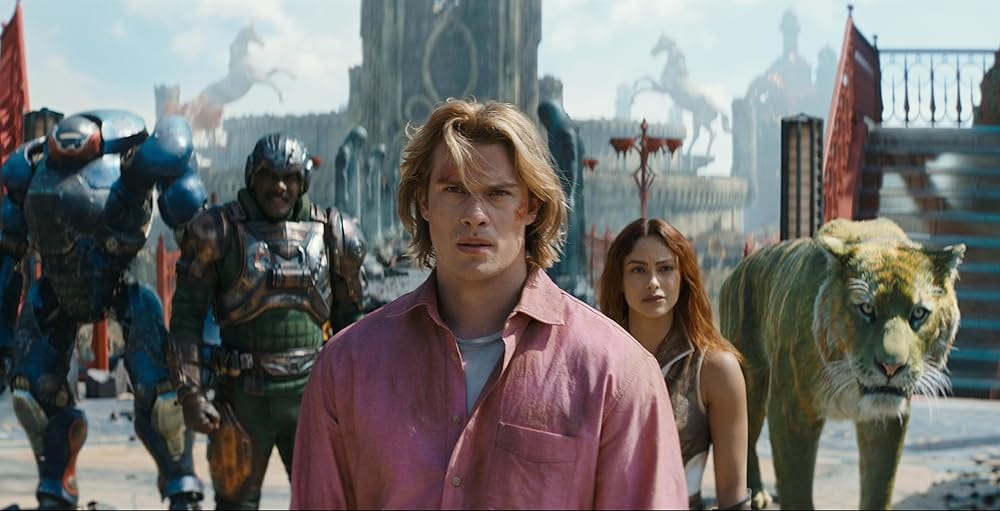
So when Masters of the Universe tells the story of Prince Adam, a pink and violet-clothed, high-voiced, cowardly soft boy who transforms into the manliest of men because of a magical Sword of Power, it has its work cut out for it because the entire concept, on the surface, serves the very same ideas of masculinity championed by the manosphere. But Masters of the Universe always understood what it truly meant to be a man, and He-Man was never a paragon of masculinity because of his muscles or his strength. From the very beginning, He-Man’s approach to conflict resolution was always through dialogue before action, and the 80’s cartoon always made it clear that the effeminate, non-confrontational Adam was always He-Man’s best and truest side. So when the film cast Nicholas Galitzine, who famously played a bisexual teen in 2020’s The Craft: Legacy and the very gay Prince Henry in Prime Video’s Red, White & Royal Blue, it wasn’t just perfect, it was subversive genius. The lean but lanky Galitzine bulked up to play the most powerful man in the universe, who also happens to be a gay icon thanks to both his love for pink and the edit that set his dance and laugh to 4 Non Blondes’ ‘What’s Up?’ in one of the Internet’s earliest memes.
This is Masters of the Universe, one of the silliest, campiest, most deliberately hilarious fantasy settings with heroes named Ram-Man (Jon Xue Zhang), who rams people with his head, and Fisto (Jóhannes Haukur Jóhannesson), who has a giant metal fist. The bad guy is a blue-skinned sorcerer with a skull for a head named Skeletor (Jared Leto). He-Man, who is canonically stronger than even Superman or the Hulk, is not the shining beacon of manosphere masculinity that some men might expect. The very same men, it should be noted, who had a meltdown when the teaser for the film showed Adam in a corporate setting with a nameplate that noted his pronouns: he/him. He-Man, despite all appearances to the contrary, has always embraced his softer side and defines masculinity in a way that’s belied by his imposing muscularity. Adam’s roommate Hussein (Christian Vunipola) hides the fact that he watches and cries at The Notebook, an indictment of performative masculinity and how men’s forced stoicism and obsession with physical fitness is more about impressing other men than being their authentic selves, not realizing that being true to oneself without fear or regard of being judged is peak masculinity.
There was no better director for the project than Travis Knight, who directed Bumblebee, arguably the best film in the Transformers franchise, and the stop-motion Kubo and the Two Strings from Laika. Knight also just happens to be the CEO of Laika, an animation studio renowned for its integrity and devotion to storytelling over profit. He’s a better director than a movie about a silly toy line from the '80s deserves, and that’s what makes Masters of the Universe such a revelation. Knight is to He-Man as Gerwig was to Barbie, and the film is as important to understanding masculinity as Barbie was to defining women.
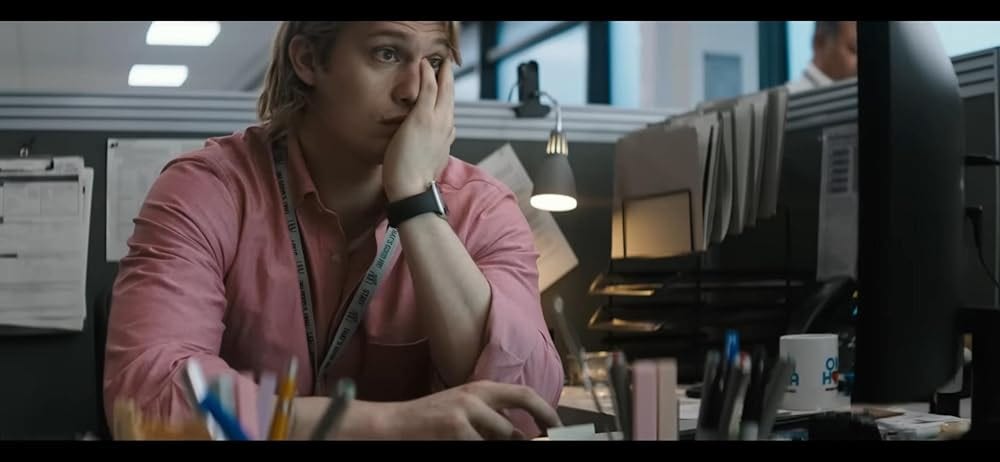
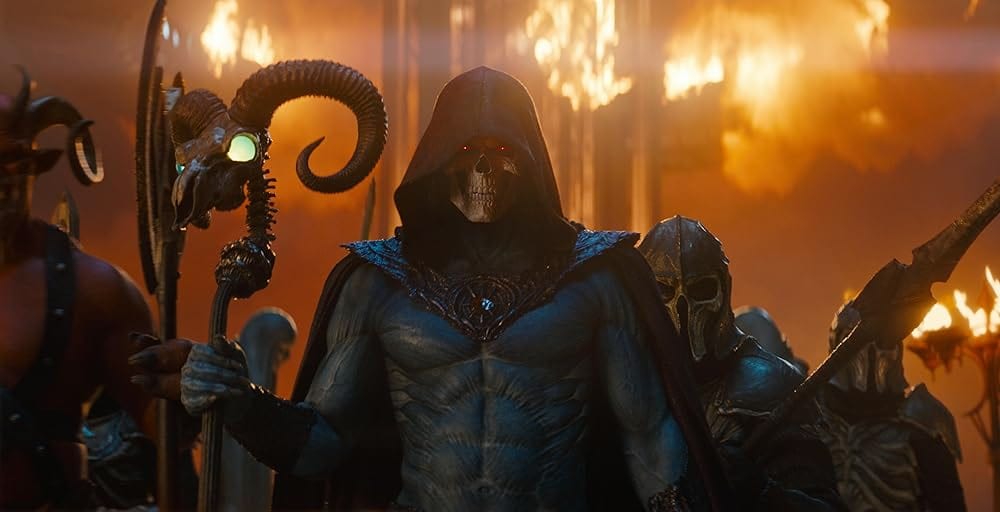
The film opens to Adam’s youth in Eternia, where we see him constantly failing to meet everyone’s expectations — from his father, King Randor (James Purefoy), to his teacher, Duncan (Idris Elba), the kingdom’s Man-at-Arms. Adam is shaped by and burdened by the expectations of manhood: strength, responsibility, and the ability to protect and provide for the ones we love. His identity is tied to his Sword of Power, an unsubtle representation of phallic potency — and if the metaphor is lost on the audience, it is referenced numerous times in the most side-splitting, hilarious ways, especially by Skeletor. The film’s marketing deliberately avoided mentioning Leto, who isn’t present in the press tour or any promotional appearances. Leto, rightly or wrongly, is blamed for the failures of the films he’s headlined, such as Morbius and Tron: Ares. But Morbius was actually a fairly decent superhero film, and Tron: Ares was the best Tron movie yet. It’s a shame that Leto doesn’t get the credit he deserves because Skeletor in Masters of the Universe is an absolute riot.
Skeletor in the '80s animation is iconic because he was funny. The disconnect between his menacing visage and his squeaky voice elevated him from a generic bad guy to one of the greatest cartoon villains of all time. He was deliberately cruel and, yes, his power was terrifying, but you could never take him seriously because he had the funniest voice. So when Leto granted his Skeletor a deep baritone with an English accent, there was the danger of losing the best part about Skeletor’s character. But Leto absolutely nails it. Masters of the Universe’s Skeletor is the funniest movie villain in decades, all while retaining his menace and cruelty. When Skeletor enters Adam’s mind in what is arguably the film’s ‘I am Kenough’ moment, it is some of the absolute best and funniest moments in cinema and guaranteed to be a gold mine of memes for years to come. Nobody else should ever play Skeletor, and should he return in a future film, Jared Leto absolutely must reprise the role.
Masters of the Universe embraces everything that is silly and camp about the franchise and runs with it. The 4 Non Blondes’ ‘What’s Up?’ edit is so iconic that it makes its way to the film. All the dumb fantasy names? There’s an explanation for all of that. The script by Chris Butler, Aaron and Adam Nee, and David Callaham is a pastiche of jokes that understands full well what it satirizes. Adam’s sweatshirt at the gym with a kitty saying ‘alpha male’ needs to go on sale the same way ‘I am Kenough’ got plastered on various merchandise. Masters of the Universe is a thoughtful and carefully constructed exploration of society’s expectations of masculinity through Adam’s journey and how his identity is closely tied to his sword.
Just like Barbie, viewers will take away from Masters of the Universe as much as they put in. It can be a fun, brainless adventure that is enjoyed by the whole family, or it can be a pause for reflection on the oppressive role of the patriarchy in shaping our ideas of masculinity and how men have been taught not to talk about our feelings or punch first and ask questions later. The women of the film are powerhouse figures themselves — Adam’s best friend Teela (Camila Mendes) and Skeletor’s right-hand woman Evil-Lyn (Alison Brie) are two sides of the same coin: both are highly competent, intelligent women, but Teela isn’t afraid to show her abilities while Evil-Lyn reduces herself in order to protect Skeletor’s male ego.
Masters of the Universe just might be the most important film of 2026 because He-Man is the antidote to toxic masculinity in a world that’s governed by it. When men are brainwashed with the idea that muscles define manhood and that conflict is what defines strength, it’s important to have a hero who embraces gentleness and dialogue. Masters of the Universe is clever, hilarious, action-packed, and pays so much respect and homage to a franchise that has only existed for almost two generations through memes. It’s one of the best movies of the year and should be mandatory viewing for fathers and their sons this June. And just in case you care about such things, there are two mid-credit scenes and one post-credit scene that should get fans fired up for even more exciting things ahead.
ALSO READ:
Barbie Is the Most Important Film of 2023
First Reviews of Barbie Are In, and They're Fantastic
Zach really, really, really loves films.
View More Articles About: