Men of Willow, Women of Thorn: How 'Wicker' Unravels the Inherently Misogynistic Nature of Marriage
When Wicker Husband says, "I was made to be with you," it’s just as much a declaration of love as it is a pro tip for men that the happiest marriages are equal partnerships, not hierarchies.

by Zach Yonzon
Published on Nov 5, 2026
Young girls used to dream about their weddings. Many still do. The dream wedding is a beautiful lie sold to women from a young age to condition them for marriage, which is another beast entirely. The life ambition of very nearly every fairy tale princess up until recent years was to become someone’s wife. Anyone’s wife, really. The most egregious might’ve been 1937’s Snow White, who sang that someday, her prince would come, but in the meantime interned for seven unkempt men as a housekeeper as if to practice for a life of eternal servitude. Sure, the film ends with Snow White being taken to the prince’s castle, but what it really sold was the idea that women are at their best cleaning up after men. And so it is with The Wicker Husband, retitled Wicker to better associate with the film, that Ursula Wills crafts an anti-fairy tale about a Fisherwoman (Olivia Colman), literally called ‘ugly girl’ in the short story, who marries a man fashioned out of wicker (Alexander Skarsgård) to put the kibosh on little girls’ dreams of white lace and flowers and happily ever afters. Or maybe not the happily ever after since that’s not a feature exclusive to weddings and marriages.
Co-directors Alex Huston Fischer and Eleanor Wilson adapt Wills’ nine-page short story into a 105-minute tale, with minor embellishments and tweaks for visual clarity and driving home the message that the institution of marriage has always been a patriarchal construct aimed at keeping women in a life of indentured servitude packaged as their life’s purpose. It’s not always the case, certainly, but if marriage were truly good for women, men would’ve found a way to criminalize it by now. In Wicker’s small, unnamed village, weddings are performed with an intentionally BDSM-coded, heirloom, ceremonial collar placed on the woman in lieu of a wedding ring. The bride takes great joy in achieving her lifelong dream of becoming someone’s wife and earning a new name. In Wicker, all the women, save for the Fisherwoman, are referred to in terms of their relationship with men, such as the town’s resident Regina George, the Tailor’s Wife (Elizabeth Debicki), formerly known as the Doctor’s Daughter.
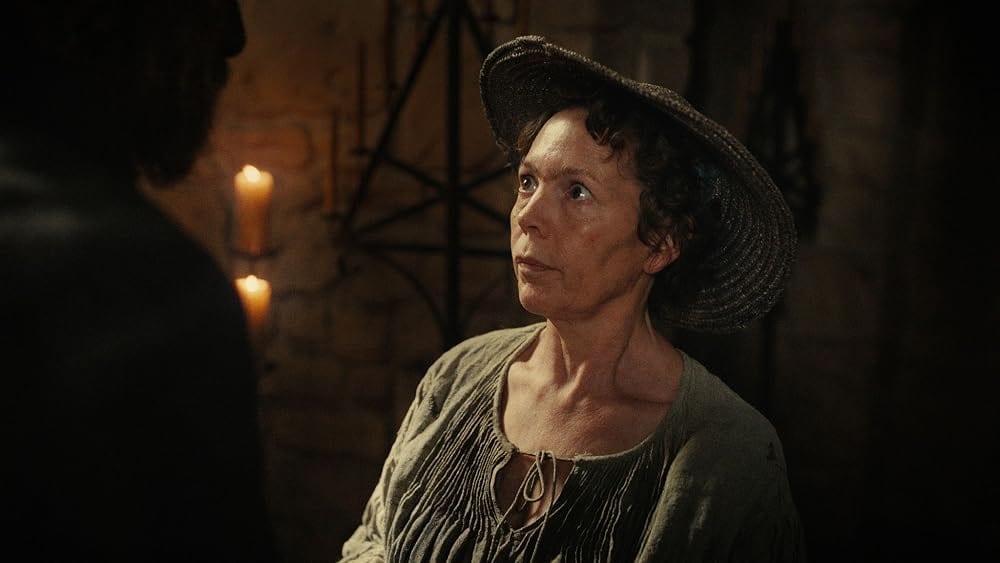
The Doctor (Richard E. Grant) is a wonderful cinematic addition to Wicker because it never hurts to reinforce the message that, yes, it’s the patriarchy’s fault. In one scene, the lush physician seeks assistance from the Tailor in doing a medical stitch, but blood aversion does him in, and it falls to the Tailor’s Wife to step in and complete the task. Her father praises her husband, anyway. In a later scene, the Tailor’s Wife mutters, “I’ve learned how to steal from my father,” referring to pilfering some tinctures for some ailments, but also conveys the sad, sobering reality that her misogynist father never willingly passed on to her any knowledge or skill. She had to steal it.
Wicker is marketed as an erotic comedy, a bed-breaking, sexually-charged fantasy romp that some might mistake for Wicked porn starring Elphaba and post-curse Fiyero. It certainly has some of that, but it’s so much more than Fifty Shades of Hay, with moments of tenderness and love that put many romance movies to shame. Which is part of the point, really, since the Wicker Husband becomes the nexus of the town’s festering discontent, driven by the jealousy of wives who want what the Fisherwoman has and the contempt of men who are upset by a husband who makes them all look bad in comparison.
This is no Cinderella story, as the Fisherwoman never really changes; she’s still the Ugly Girl and doesn’t transform into a princess with love and magic. She does, however, get her uneven gait fixed and her monobrow trimmed with the help of someone who cares. At the end of the day, that’s all one really needs from a companion. The Wicker Husband is the only man in the village not referred to by his profession, for he has none; he’s basically a househusband who simply fixes things that are broken or does household chores. Unlike the wives, he also isn’t referred to as the Fisherwoman’s Husband, only as the Wicker Husband, because the Fisherwoman doesn’t view or treat him as property.
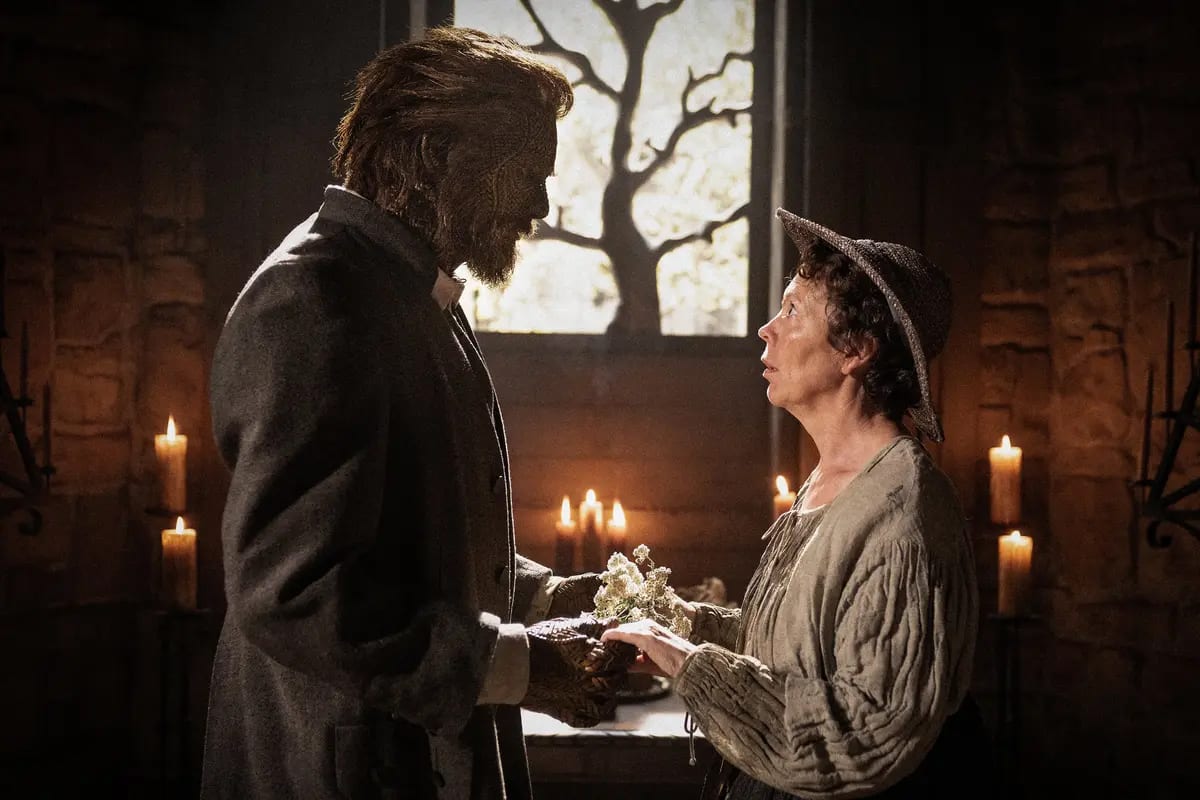
The sex is hot, wild, and extremely funny, as one would expect from a middle-aged woman being railed by furniture. It almost seems a disservice to the film to be touted as an erotic tale, as the sex is but a teeny tiny bit of a more glorious tapestry of soft and tender moments. Wicker, beyond reason, is an extremely romantic film that repudiates the institution of marriage but ironically demonstrates at the same time that some of the most beautiful and loving moments in life are the little things that happen in one. Fischer and Wilson cleverly frame the scenes of the Wicker Husband and the Fisherwoman with a soft and dreamy idyll, touched by the glow of an afternoon sun. He says, “without you, I should never have seen the sun on the water, or the clouds in the sky,” with such delicate warmth and sweetness that it’s all of a sudden perfectly normal that a man made of willow walks and talks and fucks and loves.
The Tailor’s Wife tells the women in the village to “manage their husbands,” finding that peace can be had with deft management of men with simple needs. Arguably the most powerful person in the community only manages to exercise her power within the confines of a marriage where she’s still a secondary citizen and only survives by hardening herself. Paul Dolan, a professor of behavioral science, says, “If you’re a man, you should probably get married; if you’re a woman, don’t bother.” He isn’t being glib, either. Multiple studies have found that married men are generally healthier and live longer than men who are not. Married men also tend to earn more money than single men. On the other hand, a study of over 100,000 people across Europe found that marriage tends to shorten a woman’s average lifespan by over a year.
Ephesians 5:22 states, “Wives, submit yourselves to your own husbands as you do to the Lord.” Thoughtful interpretation of Scripture describes matrimonial union as a state of mutual submission, as Paul prefaces it with, “Submit to one another out of reverence for Christ.” But many leave out this part and use God’s instruction as a blueprint for patriarchal control. Who can blame them? Paul could’ve left out the part about wives submitting to their husbands, but he didn’t. It’s not all Christianity’s fault, anyway, as various cultures and religions share the same misogynist DNA, with marriage providing the template for gendered roles and division of labor.
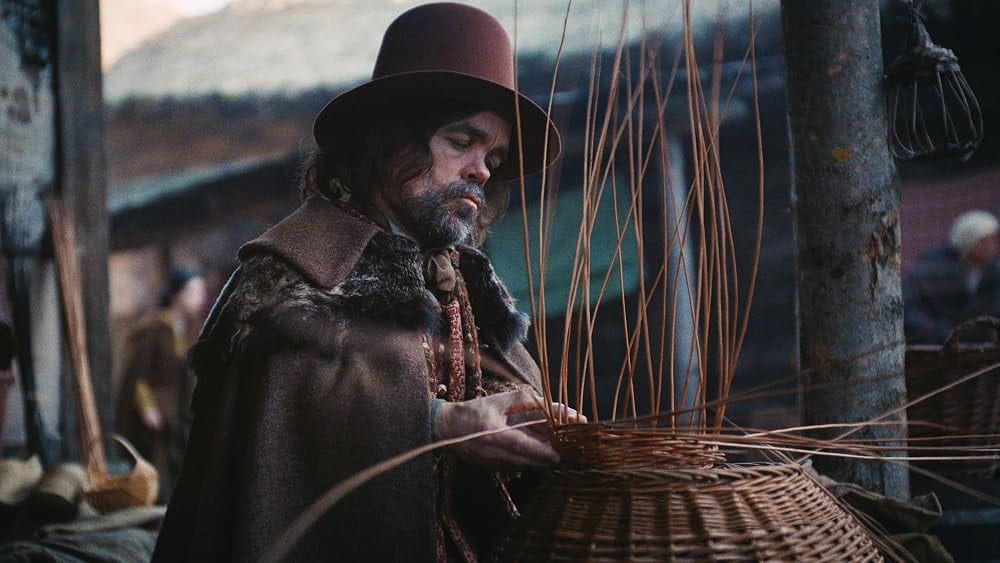
Wicker demonstrates that it doesn’t always have to be that way, and it deconstructs an inherently misogynistic institution into manageable components. Women aren’t happy because they’re married, women are happy when they’re in a happy marriage. When Wicker Husband says, “I was made to be with you,” it’s just as much a declaration of love as it is a pro tip for men that the happiest marriages are equal partnerships, not hierarchies. There’s a magic in granting Wicker Husband his own agency, and his interactions with other men feel exactly like how one would expect when a feminist joins the locker room boys’ chat. He wasn’t made for the Fisherwoman, even though he technically was; he was made to be with her. At many points in the film, the Basketweaver (Peter Dinklage) stresses that Wicker Husband’s will is his own, and that he chooses to be with the Ugly Girl out of his own volition, as only real love should. As the Basketweaver says, “I didn’t build you some fuckable furniture.”
Wicker is a wonderful feminist commentary on an ancient patriarchal construct. Fischer and Wilson even use the phases of the moon to show passage of time, and when the Basketweaver is commissioned for work, he says he'll be back in a month. For men, months are just terms to track time; for most women, months mean something vastly more, something to manage every single time. Wicker is a perfectly adapted fairy tale that women should rush to theaters to watch and drag their men with them. Marriage is fine, but it’s a far less compelling arrangement for women in 2026, and especially in the archaic Philippines, where we are the only country in the world aside from the Vatican without divorce. Wicker completes its mockery of matrimony with a simple line that upends wedding vows: as the Fisherwoman promises to never doubt Wicker Husband, he tells her, “My love doesn’t require a promise.” And he’s right.
ALSO READ:
The Case For Premarital Cohabitation, By Someone Who's Been There
Let's talk about divorce—and the lack of in the Philippines
Zach really, really, really loves films.
View More Articles About: