I Wore Rokid AI Glasses for a Month—and What in the ‘Black Mirror’ Is This?
Meanwhile, their AR Spatial are giving off serious ‘Minority Report’ energy.

Published on Jan 30, 2026
When British TV series Black Mirror first hit Netflix, I was instantly hooked on its brand of nightmare tech: sentient AI, gamified social credit, neural implants, and devices that could record, upload, and download every human memory. While the show is a near-future dystopia, the distance between the screen and reality is shrinking fast. In fact, we're already seeing prototypes of these devices hit the market—and smart glasses are leading the charge.
In late 2025, Rokid Philippines officially brought in two products from the Hangzhou-headquartered company to our shores. The first is the Rokid AI Glasses, an all-day wearable designed to replace your phone for quick tasks: taking POV photos and 4K videos, hands-free navigation, call and text, and real-time translation via an integrated AI assistant. The second is the Rokid AR Spatial (the Max 2 glasses paired with the Station 2 host), which transforms your view into an interactive workspace. It's essentially a wearable super-screen that lets you pin multiple virtual windows in mid-air for gaming, streaming, or browsing, as if you're Tom Cruise in Minority Report, minus the gloves.
I got the chance to try both and live in this parallel sci-fi world for more or less 30 days.
The Black Mirror Experience With Rokid AI Glasses
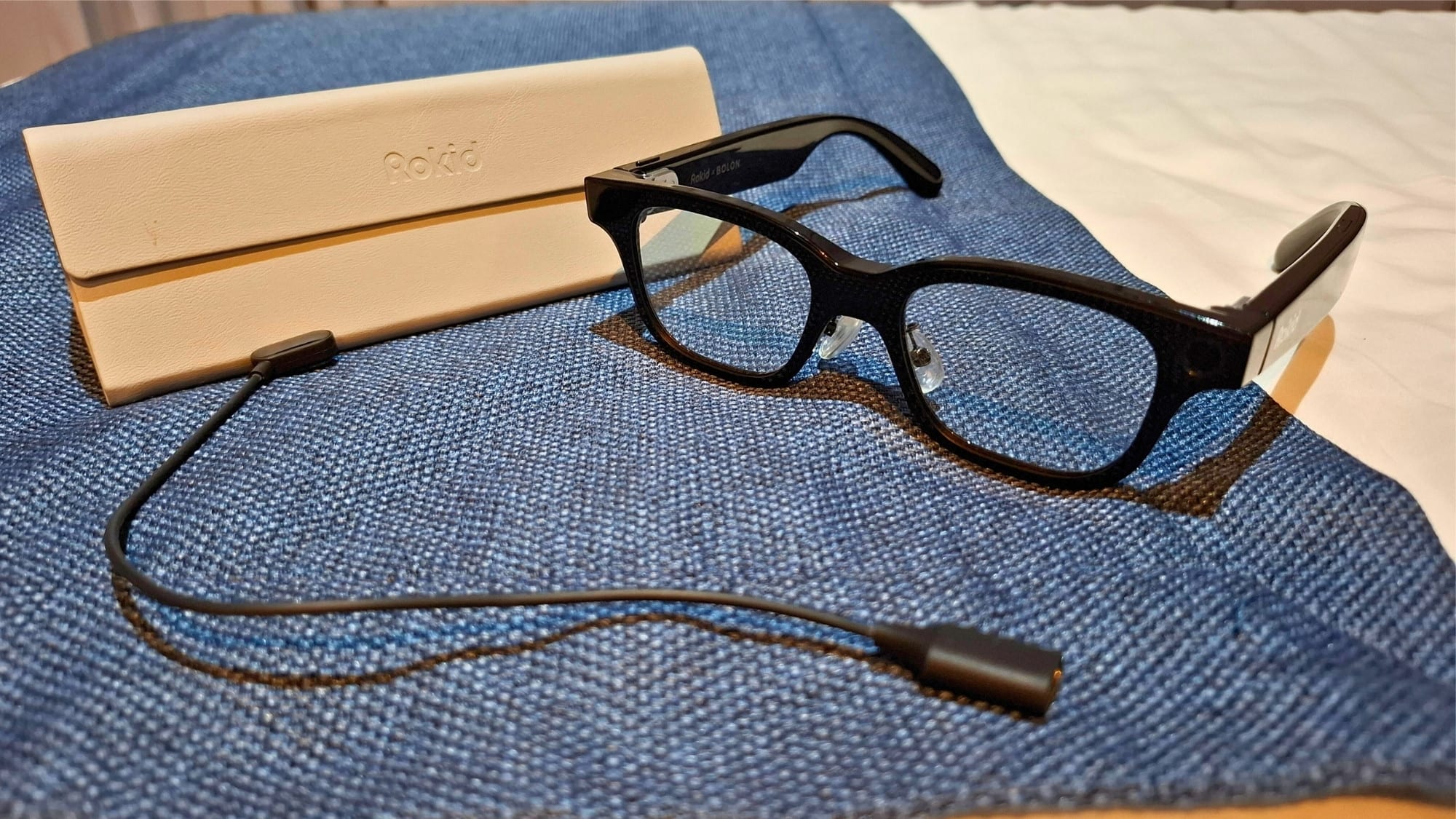
The AI Glasses look like your regular pair of black-framed eyeglasses—a design choice that is both impressive and slightly terrifying. Weighing in at only 49 grams, they are light enough that I almost forget that I have a computer sitting on the bridge of my nose all day—or at least for about six hours (while it's connected to my phone via Bluetooth) before the battery goes down to 10 percent. Charging takes about 10 minutes through USB-C (for either a wall charger or a power bank).
Rokid clearly prioritized its Asian market as the frames are scaled perfectly for smaller or narrower faces. I took them on a typical commute in a jeepney—the usual rough ride with bumps and potholes on the road included, and still the glasses never slid down. Plus, for those who need vision correction, the lenses are fully customizable with your prescription at select Ideal Vision branches.
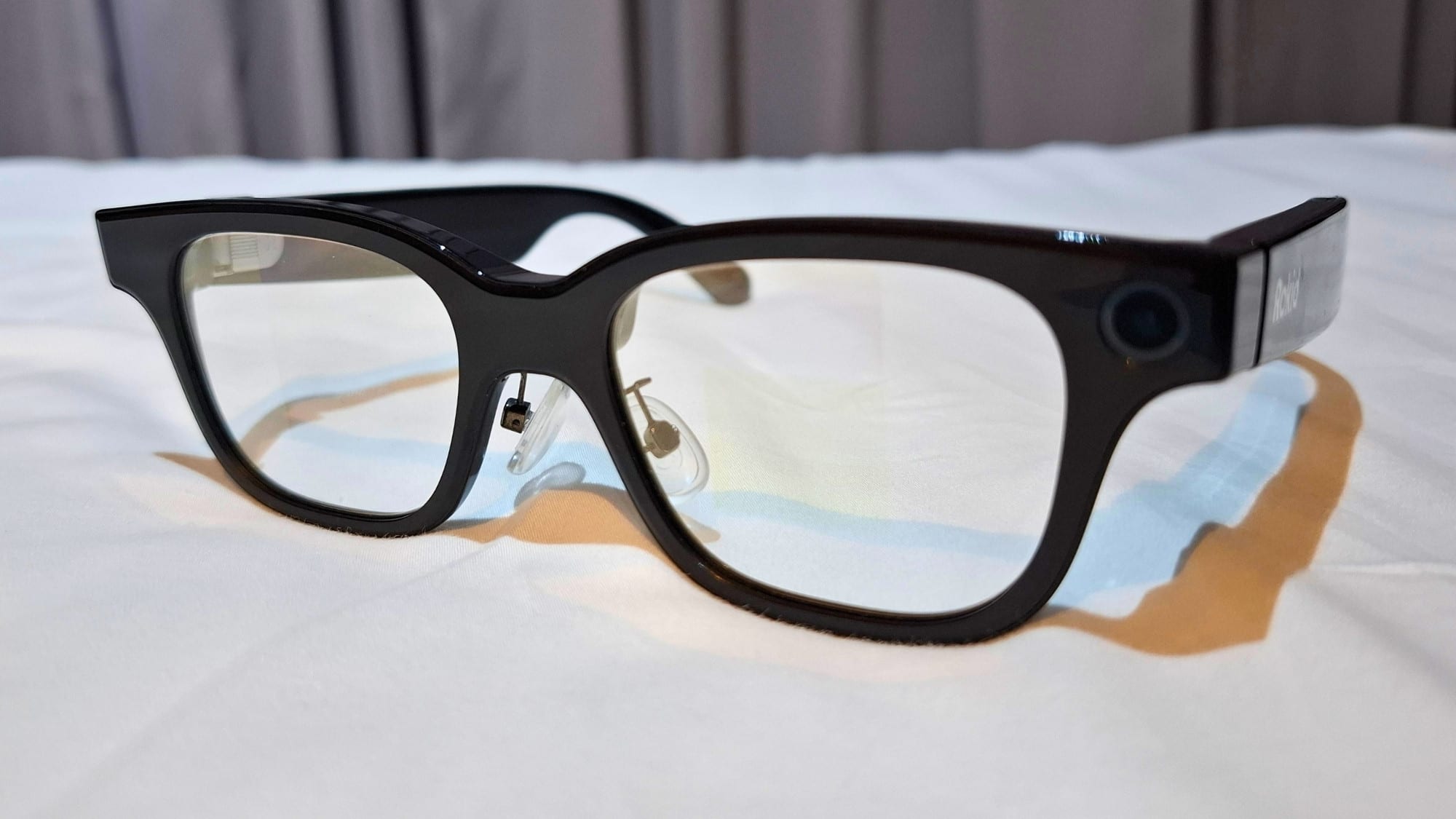
This is where the "impressive" turns "terrifying." Because the Rokid AI Glasses look so much like ordinary eyewear, they grant the wearer a level of digital stealth that we haven't quite developed a social etiquette for yet. I could sit in a crowded cafe or a business meeting and—with a single, discreet tap on the frame—capture 12MP photos or up to 10 minutes of continuous POV video. There's no need to hold up a glowing smartphone; you just look, and the glasses record.
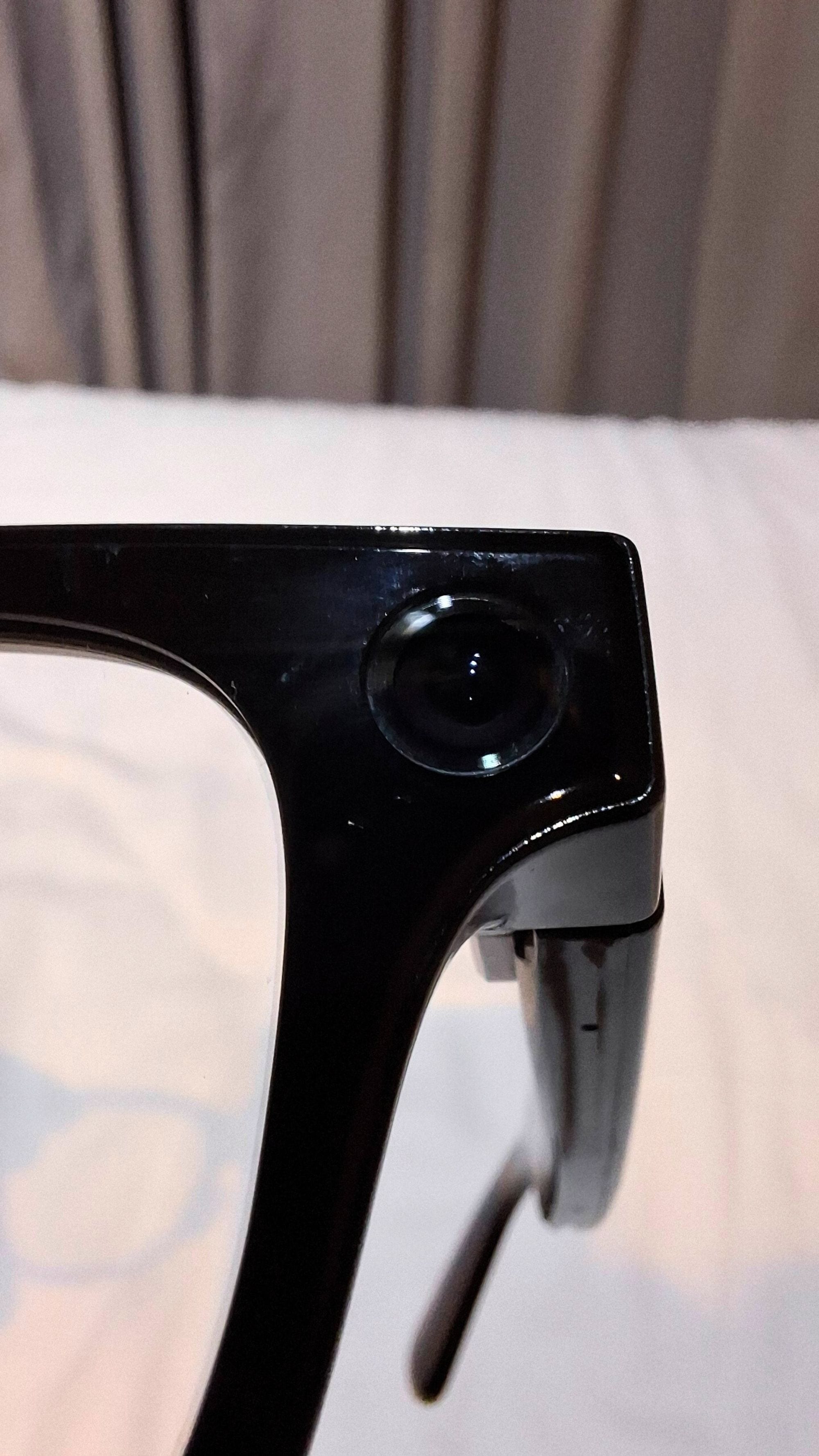
Still, Rokid included a small indicator light in the right corner of the frame that activates whenever the camera is rolling. It is a necessary workaround to privacy, but is the small LED actually noticeable and obvious enough, especially to the uninitiated? The tech-averse folks may have to catch up ASAP.
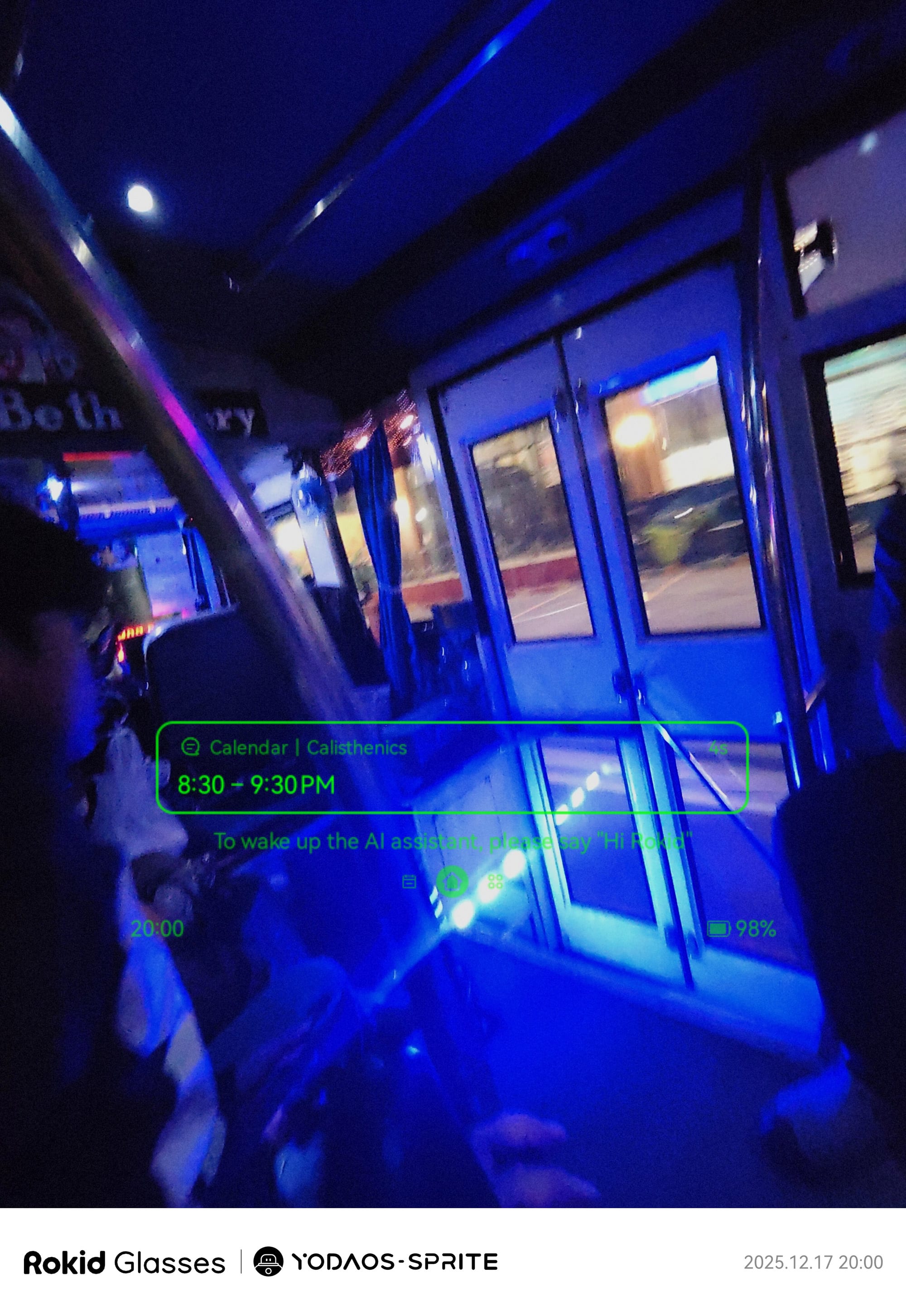
The pair’s main draw is its built-in AI assistant, a multimodal mind powered by your LLMs of choice: ChatGPT, Qwen, or DeepSeek. By simply mumbling "Hi Rokid"—the microphones are impressively sensitive, though they did struggle to hear me over a particularly loud jeepney remix—you wake up an assistant that has direct access to the sight line. Another option for AI assistant activation is to press and hold the touchpad on the right side of the frame.
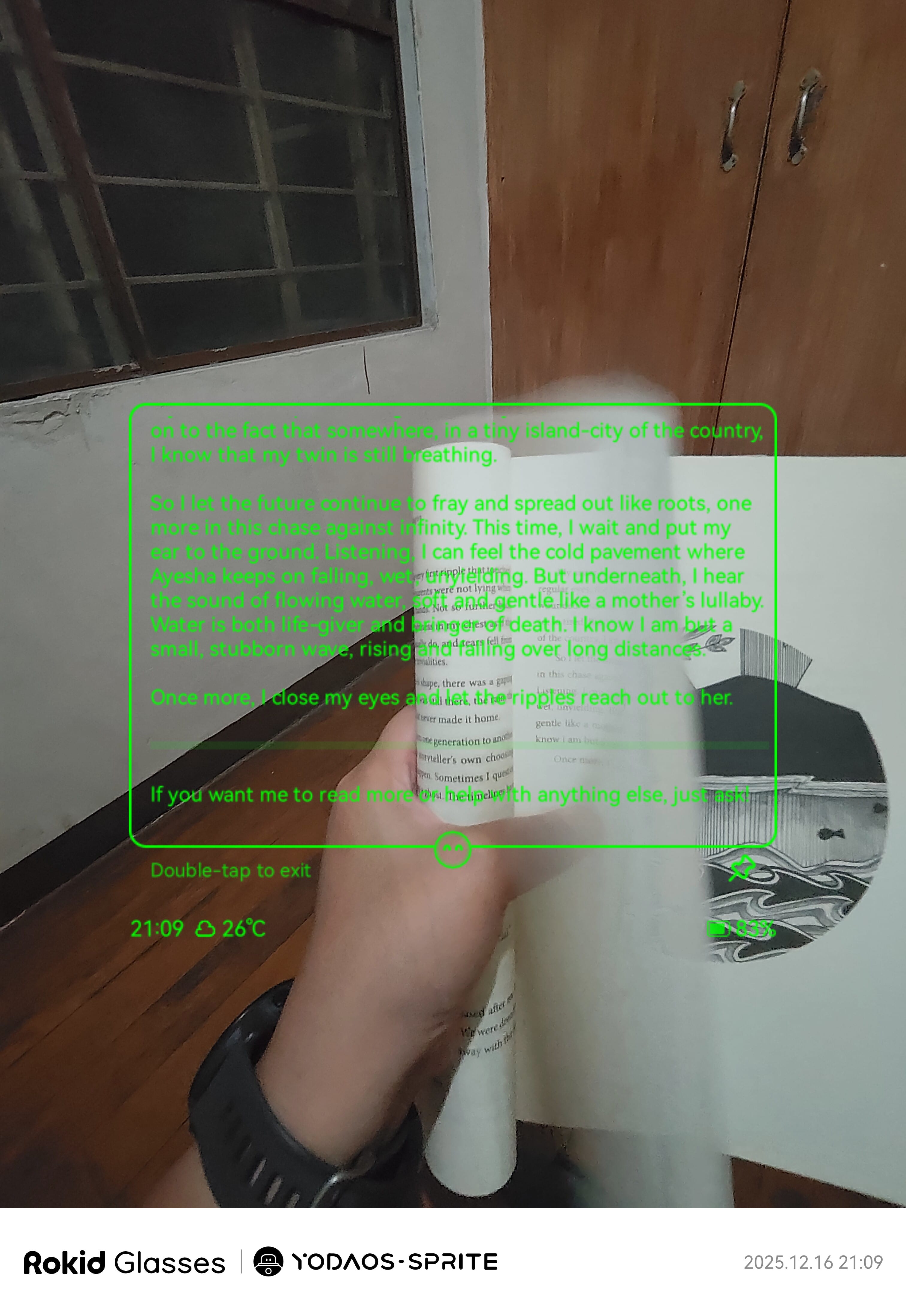
When activated, a chatbox appears as a dual-eye monochrome display in a striking neon green on a black background, reminiscent of MS-DOS screens. It took me about a day to seamlessly adjust to reading text projected directly into the lens, but the display sits comfortably at eye level and remains surprisingly sharp, even in bright sunlight. But for anyone looking at you from the front, that green chatbox is invisible.
Both the photo and video capabilities can be activated by voice: “Hi, Rokid. Take a photo.”
Rokid, the AI assistant, also "speaks" through the frames' built-in earphones. With its directional sound, I could listen to the AI's responses (with a voice of your choice) or answer a phone call with a tap on the frame. This works well if you hate audio devices sticking in your ears or sitting on your head.
A light press on the touchpad on the frame also activates Spotify, automatically playing whatever's on your queue. Asking it to play a specific track doesn't work yet as of the last system update, but there's the option of swiping on the frame to skip a song. This swiping action, however, could take some getting used to, and I would always accidentally tap on the frame and play a song.
As long as it's connected to your phone via Bluetooth, the AI assistant acts as a bridge for your digital life. It can read your messages aloud and mirror nearly any active notification from your Android or iOS device—whether it’s a calendar invite, a WhatsApp ping, or a Gmail alert. This functionality became the strongest argument for the device during my 30-day test; I could wear them for half a day and stay fully updated as notifications floated into my field of vision, all without once falling into the 'doomscroll trap' of picking up my phone.

Another reason to keep your phone in your pocket: the Rokid AI Glasses can do all the searching for you, reverse image search included. Because the AI has access to the 12MP camera, it essentially functions as a set of digital eyes. Tests included estimating the calorie count of the plate in front of me, describing the physical features of my dog, or identifying a building just by looking at it. LLMs, however, aren't always accurate, so it's still best to take the answers with a grain of salt.
Other features I explored with this wearable included having it read aloud pages from a book I was holding, translating live audio in real time, providing near-instant translations of foreign text, recording and transcribing a meeting in real time, and serving as a teleprompter as it scrolled a script for a presentation right in front of my eyes.

It also features a built-in navigation system that would be useful for drivers, complete with audio prompts and a small map projected onto the green display. However, when I tested the navigation while walking, I noticed a slight lag—probably the software is still catching up to the hardware. The glasses also acted as a live stenographer when I activated it during a conversation or when I just needed to take quick notes. It can record the audio while transcribing.
Looking back at my 30 days with the Rokid AI Glasses, I realized they represent a massive shift in how we handle information. My generation grew up opening those heavy physical encyclopedias for answers; then, we learned to adapt and "Google" every whim on a smartphone. (Google Me Gago or GMG became a catchphrase for a while.) Now, we’ve entered the next phase: we aren't just searching for information anymore—we are "ChatGPT-ing" our entire lives.
And with these smart glasses, we can do that with a simple "Hi, Rokid." Again, both impressive and terrifying.
The Minority Report Vibe With AR Spatial
At the risk of aging myself again—first with the MS-DOS green and now this—the Rokid Max 2 and Station 2 combo is the closest I've ever come to those scenes where Chief John Anderton (played by Tom Cruise) is scrolling through, minimizing or expanding, and swapping through screens and data in 3D space.
Weighing 75 grams, the pair of AR glasses is obviously more bulky than the AI glasses, but not as huge as the head-mounted VR glasses. Instead of fumbling with buttons, you use a phone-like handheld controller to point a laser-like cursor into the air. With a flick of the wrist, you can "grab" windows, swipe through menus, and throw apps across that space. The device uses YodaOS-Master, where mobile apps (like Spotify, Netflix, Candy Crush, and your browser of choice) are installed. Aside from this "Ray Mode," it also supports "Touchpad Mode," which is basically a laptop-style navigation. It can also be connected to the laptop, with the pair serving as your second screen or expanded screen.
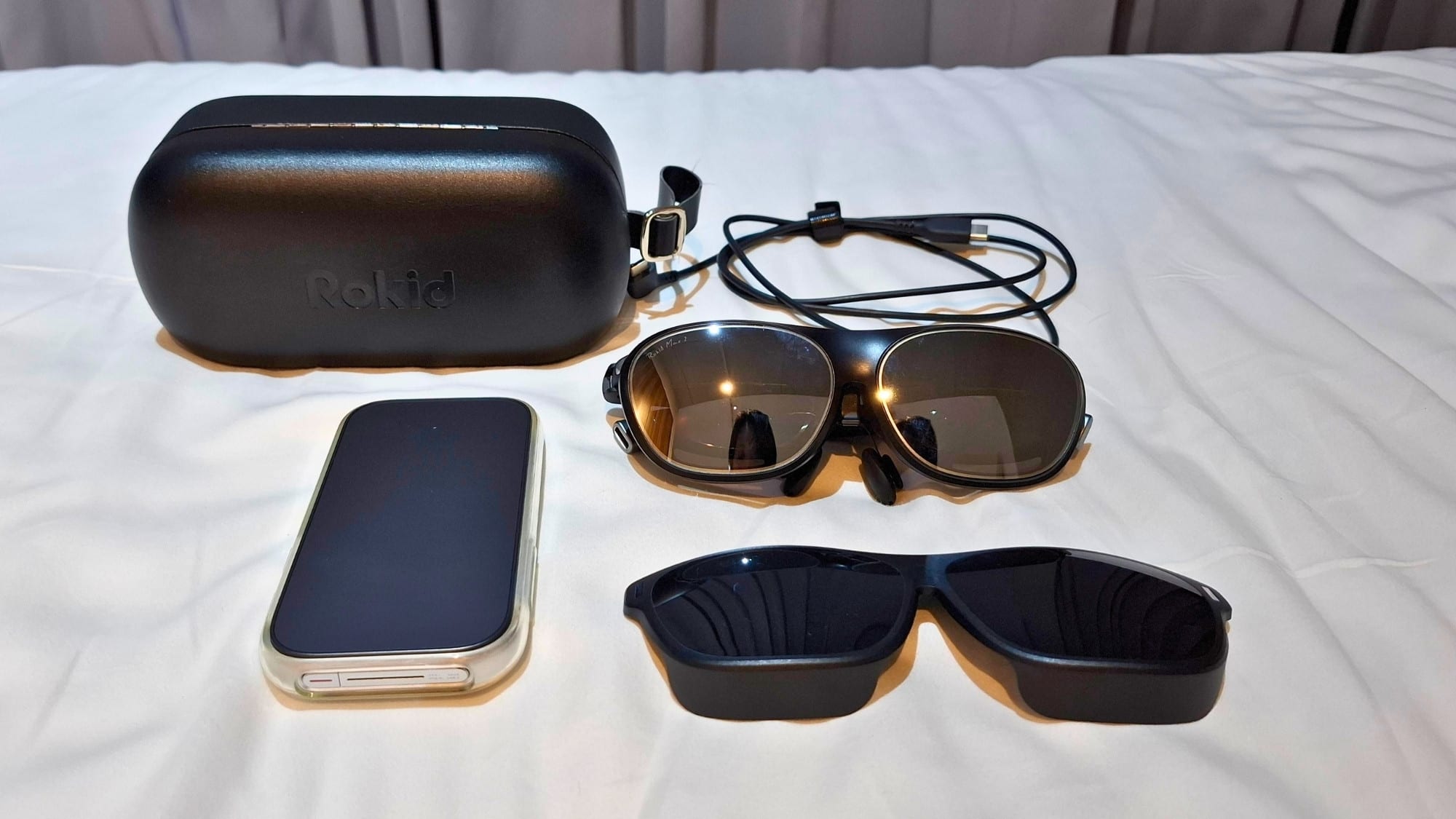
If the Rokid AI Glasses are all about productivity and AI support, the Rokid AR Spatial is mostly used for entertainment.
By just wearing it, you get to have a 300" ultra-large screen for movies or gaming, with the sound still coming from the frame. It has a built-in myopia adjustment, too, to match your eyesight. It also supports up to three screens at a time, letting you play Spotify on one screen, a browser in another, and YouTube on the third one.
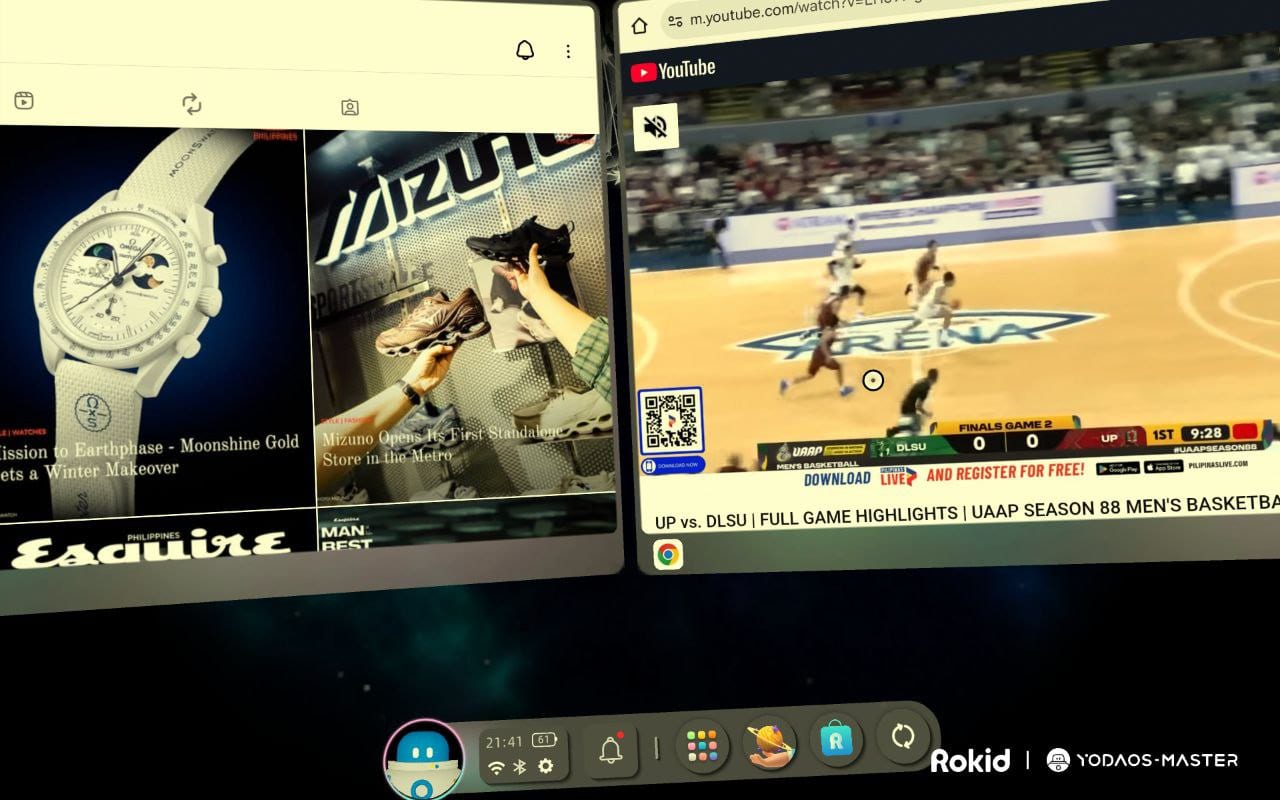
While the "wow" factor of a 300-inch screen is undeniable at first, the day-to-day usability of the Rokid AR Spatial has its challenges. Unlike the AI glasses, this AR set comes with a physical reminder of its limits: the cable and the unit. Novelty also wanes faster than I expected, especially when the initial thrill of the mid-air gestures wears off. It has its moments, though, such as watching a film while lying down in bed as if you have a built-in projector in your field of vision.
Are the Rokid Glasses Worth Buying?
The Rokid AI Glasses sell for P38,000, while the Rokid AR Spatial is at P38,890.
If you’re into wearable tech and have about P40,000 to spare, then why not? It now boils down to choosing which of the two suits your lifestyle. The pair of AI Glasses is a productivity partner, while the AR Spatial is an entertainment escape.
But if your New Year's resolution is to unplug from the matrix and live less of a Black Mirror simulation, then strapping a screen to your face is probably not the way to go.
Products are available through the Rokid Philippines website, Rokid Philippines store at SM North EDSA Cyberzone, and Hobby Dynamics. Ideal Vision Center branches (SM Mall of Asia, SM Megamall, SM North Edsa, SM Aura, SM Cebu, SM Davao) offer prescription lens customization.
Disclosure: This unit was on loan from Rokid Philippines from December 16, 2025, to January 22, 2026. No payment was received, and all editorial content remains independent and uninfluenced by the brand.
ALSO READ:
Can a Smart Watch Prolong Your Life?
Will Ray-Ban's Meta Smart Glasses Revolutionize the Way We Dress?
Christa I. De La Cruz is a Palanca Award-winning writer with over 15 years of experience in feature writing for print and digital media. She earned her Sertipiko sa Malikhaing Pagsulat sa Filipino from the University of the Philippines Diliman and holds an MFA in Creative Writing from De La Salle University.
View More Articles About: