To Penmanship
Butch was the OG prodigy, the dude who fiddled with things and made things out of them: a story, a poem, a play, a screenplay.
Published on Nov 17, 2025
Every year, Esquire Philippines presents Man at His Best, the local iteration of a global signature event where we celebrate extraordinary Filipino men and women reshaping society as we know it. These are the dreamers and doers who have made a profound impact on the Filipino's way of life, who are using their talents and skills to make something of themselves and inspire the rest of us to do better with our lives.
This year, we're honoring eight visionaries in film, politics, music, business, F&B, journalism, and literature. They are the Architects of Tomorrow: laying the groundwork for a better, more progressive country—embodying what it means to be a Man at His Best.
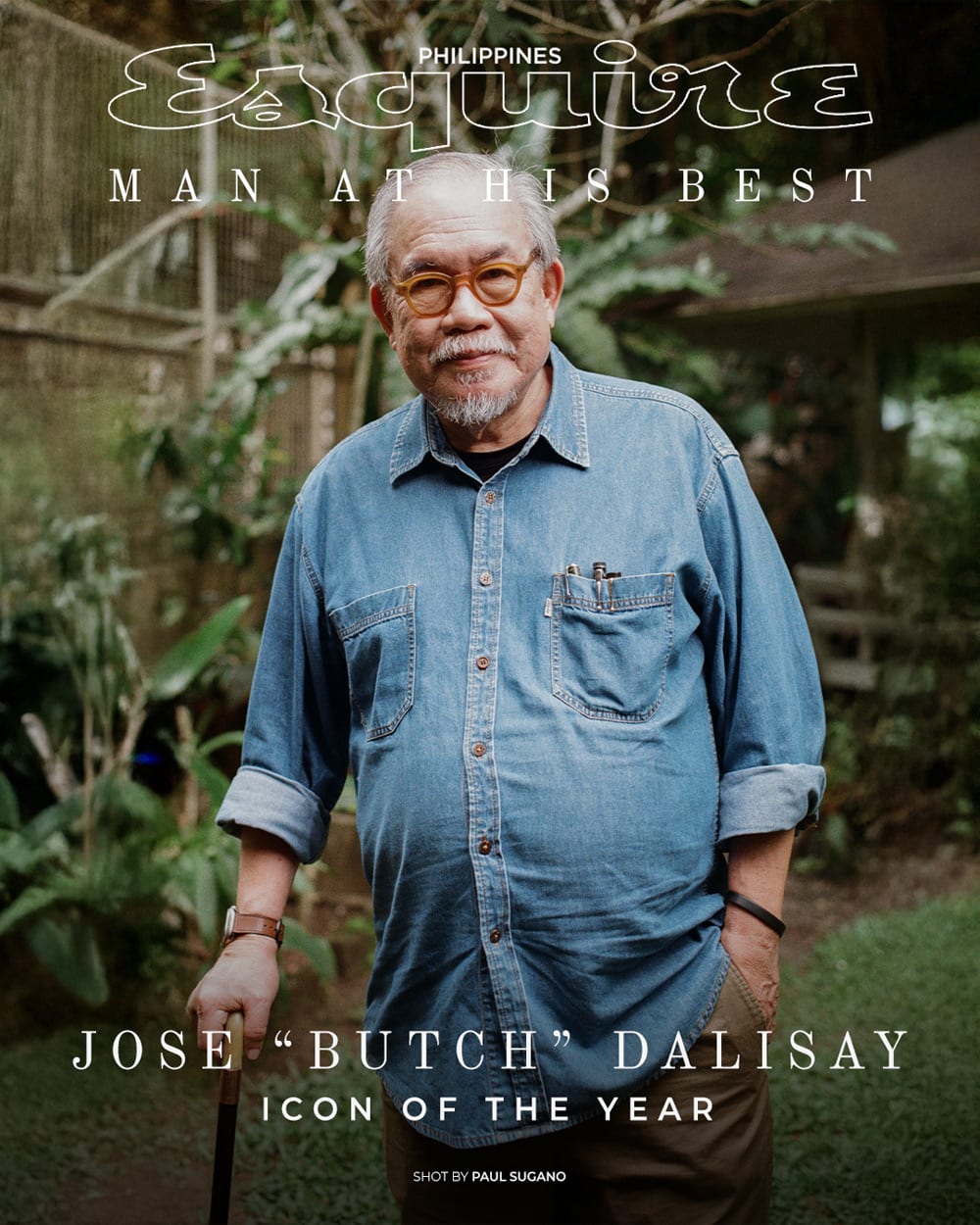
Meet Esquire Philippines' Icon of the Year, Butch Dalisay
Forgive me, editors, if there are too many words and too much love in this introduction, but I recall now what Franz Arcellana once told me when I caught him eating alone at the UP Writers’ Workshop. He said, “I only eat with people I love.” For the life of me, I can’t remember if I ended up eating with him, but I do remember thinking about it again when I delivered a lecture on Franz a year ago. I promised myself to try my best to only write, in the very same way Franz put it, about people I love.
At that same workshop, I first met Jose “Butch” Dalisay, still very much a young man at not yet forty, but who’d already gained a center of gravity. In short, Butch was the OG prodigy, the dude who fiddled with things and made things out of them: a story, a poem, a play, a screenplay. He was one of the original cross-platform dudes, too, coming about a generation after muscular multitaskers such as Alfred Yuson and Ricky Lee.
Besides his stories, novels, plays, and screenplays, Butch has written biographies of famous people, presidential speeches, annual reports, coffee table books—in other words, the stuff the business of writing is made of. I saw him do them all, and he still does it, writing damn well enough to write about anything, to make everything work, and make things work out.
It also works that Butch is an honest-to-goodness geek, the kind with a roving interest but without hesitation might scamper into the nearest rabbit hole. But, and to extend the metaphor, he’s not the kind of rabbit that is prey. He is the predator, whether he is currently nursing the nth hand of poker in his grip, or fiddling with his fountain pens, or—the true sign of an apex predator—picking them off eBay, often all at the same time.
I have seen how, in the same manner, every rabbit hole he enters opens into a rich and fertile roaming and hunting ground for the next thing to write about. This is how life that is real, and lived, has flourished in his work.
I recall Butch once saying, whether directly or through hearsay, or even through mangled attribution, that a story should be like a stranger entering a room. So the story stuck, and in the written story, a step forward happens.
The stranger that enters the room is Reality, ushered in by a man with a cane and a hat and a pen in his pocket.
Filipino writers today can now, more than ever, write inside and outside that room, and let reality shake hands or duke it out with fiction more easily. While some of us have learned to live with the phantom pain of that formalist crimp in our writing, with unexpectedly beautiful results, there are those of us who have bravely torn ourselves away, further afield, to great artistic success.
It’s an optimistic scenario, and it is to Butch that I owe my optimism. It is to him that I owe the idea of a well-traveled writer capable of writing unforgettably about the worst of things, but able to enjoy the best of life. It is in him that I continue to find a deep-seated trust in the writing community, and in the writing.
At that same UP workshop back in 1992, Butch launched "Sarcophagus and Other Stories" to a small crowd at the Faculty Center. I distinctly remember Franz, very much in his element, openly criticizing one of the stories from that book. Butch merely listened and looked at the older writer quietly, with a patient and knowing look in his eyes. I took it to mean that he stood by his story, but that he also understood that this, too, was a form of eating together.
Sarge Lacuesta: I knew you first as a short story writer.
Butch Dalisay: Yes.
SL: In fact, I still know you as a short story writer because I am a short story writer.
BD: Yes. I know me as a short story writer, too.
SL: Why do you think the Filipino is so close to the short story?
BD: Years ago, I wrote this essay titled “Novelists in Progress,” which basically talks about why it seems we Filipinos, most of us, don't get beyond two novels, like Rizal or Nick Joaquin, myself, with exceptions, like Charlson Ong, and Frank Sionil Jose, of course. In that essay, I argue that, unlike the Russians who have an Olympian view of history or whose society spans generations, I think we don't have these mountains. We don't have these perspectives. We Pinoys are basically pedestrians. Literally…
SL: We see everything from street level.
BD: Yes. We're street walkers and we're very good at that kind of close-quarters encounter. You know, what happens during the day—
SL: “I had an encounter.”
BD: Yes. And you want to tell that story right away. And we're very good at that, which I think makes it a labor for us to step back from that, and to really start looking at the big picture. I think that on a larger social and political level, it begins to be a problem, because we don't have that multi-generational or even century-long perspective. Our imperative is always to survive the day, to get by.
The short story is an ideal medium for getting by, both for the reader and for the writer, and for the subject of the story. For the writer, it delivers—not instant—but quick gratification.
SL: It's quick to read them, but a lot of short stories linger more in us than novels.
BD: Well, that's true. That's a test of the impactfulness of the story because it’s like a short jab, but it hits you hard, and you don't forget that. I teach American literature, and I don't really teach the novel because it's the short stories that really give my students a glimpse of American life in all of its variety. And I think they get a better sense of things, again, at street level, rather than in terms of the great waves of history.
SL: I recognize a lot of the characters in your short stories—some of them are very real. Because they're so real to you. Did you look at your own short story writing that way? For example, in Penmanship or your other stories, you write about mundane lives.
BD: Yes. Well, that's really what I want to do. And I tell this to my students. It's like I have nothing against speculative fiction. I enjoy reading it. I grew up on sci-fi and fantasy. But I think the challenge for me as a writer is to find the extraordinary in the ordinary. Which is why I tell my students, for example, ‘Why don't you go to Jollibee in Cubao, and sit there for like 30 minutes, and look around you. Now tell me, where's the story here? Where did this happen? Right there in that corner, behind you? Where's the story? How do you grab a story from everyday life?’
SL: For a time, short stories were the backbone of the Filipino experience, written in English.
BD: Yes. Sometime in the '90s, 2000s, thereabouts.
SL: There were three or four magazines that published stories in English every week—from the Philippine Graphic to Midweek. And we had the sense as students that the Filipino experience was now finally getting recorded. For me, as a student, as a Martial Law baby, living in the '70s, coming out of the '80s and the '90s, not knowing what to read because you felt that all your battles had been finally fought, or somebody fought them for you.
BD: Well, when I look back at it now, and I compare my short story production to those of my masters and mentors like Franz Arcellana or even someone like Manuel Arguilla, whose stories I edited for Anvil, or NVM Gonzalez—when I look at writers like that, a way of writing comes to mind, and a certain milieu, a certain period.
SL: A certain gaze? Especially for English.
BD: Yes. That's right. Well, when I came into the picture with my ragtag collection of first stories in Oldtimer, I really didn't feel like I had anything of that kind of consistency. I was dying to have consistency, but I was just too young and inexperienced to get to that point then. And I'm not even sure I've gotten there, but I think the point I'm making is that by the time we came on scene—because you followed me very shortly after—we were just telling the stories of our time and of our place in the way we knew how.
But I can't even tell how literary historians or critics will remember us. Like, what's a Dalisay or a Lacuesta story in the same way that people can say, ‘Oh, that's an Arcellana story.’ Or, ‘that's an NVM story.’
SL: Maybe also because at some point, especially in Filipino literature in English, there was a break, really, between capturing reality and sort of escaping it. The speculative fiction movement is part of that.
BD: Yes. That's very true. And I applaud it in many ways that they can do this. Myself, I'm wedded to realism because, again, as I was explaining earlier, for me it has its own intrinsic challenges.
SL: Yeah. And you lived in such a kind of reality. Martial law, you know?
BD: And there you go. Let's not forget that, having been an activist, schooling myself in what we called Marxism-Leninism, Mao Tse-Tung's thought, and that kind of materialist outlook. What we were bannering then was what we called social realism. It's very hard to get out of that box.
SL: Did you sort of see it as a political frame? Or were you just really capturing what you were going through?
BD: I don't think my fiction, a lot of which was written right after Martial Law, was intentionally Marxist to begin with. It really comes from a school of realism that I grew up with and admired. Even in high school, I was reading William Somerset Maugham and John Updike. And they became my stylistic models. I would walk into Alemar's Bookstore, and look at all those Penguin paperbacks, and I would tell myself that someday I'm going to have a book with my name on the spine. But these were, again, realist stories or novels. I remember, for example, Graham Greene. So these were the people that I wanted to write like. Especially Maugham with his emphasis on ‘clarity, clarity, clarity’. And so, I think realism was more than enough for me.
SL: I think it was not even a question of whether you would adapt realism, but really how you would write your realism.
BD: That's right. I mean, that was already a problem enough.
SL: “How do you like your eggs?” You know what I mean?
BD: Yeah, but it's gonna be eggs, right?
SL: Yeah, it's gonna be eggs, you know?
BD: It's gonna be eggs.
I mean, I did try my hand here and there at a little bit of historical fiction. In Oldtimer, there's a story there titled "The Mirror". It's kind of a tale of pre-Hispanic Philippines, which I consciously wrote for our daughter, Demi, who was then like ten years old or thereabouts. So that was meant for a very specific purpose. But having done that, I, of course, moved back again into realism.
The only other departure I think from realism for me was, in a sense that it was a historical piece, was Voyager. And I did that for a very, again, a very specific reason. Right after Ninoy Aquino was assassinated in 1983, I said, ‘What can I do as a writer to mark this moment?’
And so I said, ‘I'm going to write a story about a revolutionary against whom an assassination attempt is made on his way home from exile.’ And I was going to date this in 1883, hoping that somebody in the future would pick that up, and that became Voyager. Of course, also, at that time, you see, actually, even in my drama, I had done many historical pieces during or under Martial Law, and so this was a form of evasion. Really, now you're using fiction for avoiding the consequences of writing in the present.
SL: You're one of the few writers who grew into their confidence early on. You would do the material you wanted to do.
BD: I'm not even sure what confidence means in that sense. I mean, if you're talking about today's environment where young writers, I suppose, have to struggle for recognition or, you know, to break out of the pack—
SL: Basically, struggle to be heard or be seen.
BD: —To be heard and to be seen. We wanted to be recognized, but there were the Palancas, and then you would get published in Focus Magazine, which was almost the only thing happening in those days. I don't think recognition was such a big thing then as just getting it done and then surviving. There wasn't any money in it to begin with.
There was no such thing as being published internationally. What I'm saying is, we just wrote to make ourselves happy and hoping that in some future these would get published, and would be read and appreciated, and maybe that's happened since. But in those days without social media, where were you going to brag? So our fulfillment was in finishing the story and maybe getting it out there in the few venues open to us, and maybe winning a Palanca, and we were happy with that.
SL: I would go to a reading, for example, where there would be the usual suspects, RayVi and Danton, and there would be a small crowd. You listened to the poet and you were influenced by what you read. Influenced by people around you. And that was the thing.
BD: That's very true. And we were small enough that we could actually read what the others wrote. And we listened attentively to each other. And I remember being really fascinated by the poets. RayVi came out with Bruise, for example, which I think is still a wonderful book of poetry, and Krip came out with Dream of Knives.
I must say I've always admired the poets because I've always said that, you know, poetry is the hardest thing to do well and the easiest thing to do badly.
SL: That's why there are so many poets. But seriously, when we talk about the age of influence and we look at it from that lens, and we talk about the craft, then connect it to realism—we read Filipino writers because we wanted to learn about the world, too. However, things have changed in this attention economy. The books and the stories that are written seem to come from a different source.
BD: Well, you know, I think what I try to do is I write with feeling. Emotion is very important to me. The emotional effect and impact. I'm not reaching for your brain—I'm reaching for your gut and your heart. If I can get you there, then I think I have you as a person. And that's what I'm trying to reach.
I never thought of myself as a thinker. To begin with, I'm not a theorist. I’m a tradesman. I make things with words, things that can stand on four feet.
I write to be read, understood, and hopefully appreciated by young Filipinos in high school and college, the same way I was enthralled by my writing heroes at that age. I want them turned into movies that ordinary viewers can follow and laugh or cry at. Any writer who says he or she doesn’t want that is a hypocrite or a severely insecure and unhappy person—or just a far more serious writer than I am.
I think I’m a reasonably nice and decent person, and if you come up to me from nowhere for a chat, I’ll very likely respond with genuine warmth and sympathy. Like most Filipinos, I aim to please. Just don’t call me on the phone. I hate phone calls, which can only mean trouble. Phones were never part of my life—we never had one in the house until I was in college.
I’m actually quite shy and keep very few close friends. Sadly, one of the things my time as an activist taught me was to not trust people too much and certainly not dogmas. Maybe I even lost some faith in myself and sought to redeem that part of me through writing.
SL: Your other books before Soledad's Sister were also about intensely personal experiences, from your own gambling addiction to your experiences with the underworld. In Penmanship, I felt that they were so close to your bone. Do you think you've run out of things to write about?
BD: Oh, no. Hardly. You see, you've got to have this roving eye, which still looks around you and looks for that story. And, you know, I can see it there. Last night I was playing poker again, relatively short. I was 16 days in Europe, and I missed my poker, so as soon as I dropped off my bags, I went running off to play poker. And it was a ten-hour session.
But even during that session, I was listening around me, looking at the people I was playing with, and figuring out their backstories and listening to their language. And these instincts stay with you.
SL: Is that why you play poker?
BD: No. Well, yeah. I mean, that is my initial excuse for hanging out there. You know, I asked the playwright Paul Dumol once, ‘So Paul, what have you been up to?’ This was two decades ago. I remember me and Paul Dumol, and another playwright, Boy Noriega. And we were just catching up. And he kind of grandly said, ‘Gathering material.’ And so that stuck with me since. I mean, we're always gathering material, which again is a grand excuse to do anything.
And I suppose the poker is part of that. I have actually begun a third novel as a poker novel. I've done several chapters of it. It's still there, before shifting to yet another third novel set in the 1930s. But it's really you as the author and the writer in the room. You're living the experience of that room, but you're also soaking things up. There's that opportunist, the cannibal in us that will take advantage of anything you come across.
SL: No, did you ever dream you’d be going to Switzerland, presenting your book, reading from your book?
BD: Hell no. I mean, even as a young boy, I had always dreamt of going to these places. Again, growing up as that kind of poor kid in La Salle and a bookworm who devoured all the books. And reading all of these wonderful place names, you know. You'd read about the Netherlands and Vladivostok. I always dreamed of literally going places. I wanted to see all these places in these books. And I said, I think that's probably when I resolved that one way or the other, I was going to do well enough to be able to achieve that. And I suppose I did, but I never really thought that writing was going to be my ticket there.
SL: It must be strange to suddenly be the subject. You can't be a fly on the wall anymore.
BD: Like this interview, which is a big surprise to me. All these lights in my face. Not that this is the first time that this has happened. And, you know, I must say that I've kind of grown into this role of trying to explain to other people what we Filipinos are about. Of course, we're not all about just one thing, which makes it really complicated. But I really do see myself now as a kind of elder spokesperson, whether I like it or not. And of course, there are people who would very strongly object to that, as they have every right to.
SL: As you objected before in your youth? Or did you not?
BD: You know, I was never one of those let's-kill-our-fathers type of guy. First of all, I had a very happy relationship with my father. I didn't have any dad issues. I wanted to be like him. And I suppose in many ways I did. He was a very good writer, of letters and things. And he was the one who exposed me to reading and to books. He was also a gambler, so I picked that up too.
But I was never of this mindset where I couldn’t wait to pull Franz Arcellana down. Or say awful things about him.
SL: But neither were you trying to please him, no?
BD: Well, I was trying to please him. I mean, the fact that he even wrote that thing was big enough for me. I remember finishing a new story—I think "The Other Side,” and then slipping the draft under his door at the Faculty Center. And just kind of waiting until he would write me a short response, and that was what I was living for. So again, I don't think I ever saw myself as a literary rebel.
SL: Well, now that you're a literary father—
BD: Something like, by default, yes.
SL: By default. Now we're in a culture where there are people whose mission is almost to kill the father. A mission of their art as well. Do you think it's a mission of the art?
BD: Yes, and I mean, it's not just the angry young person doing that. I can see perfectly why they would want to do that, and why the kind of writing that I and maybe even you do is anathema to them. Yeah, that's fair enough.
I do feel that I'm writing very differently from what my students are or what even younger writers, of course, like, not that they think of themselves as young anymore, but, for example, Dean Francis Alfar would see himself in a whole other galaxy.
SL: Literally.
BD: Yes. Which is fine. I mean, he's doing great stuff.
SL: In fact, he's seen as the godfather of speculative fiction.
BD: Yeah. Now he's become a father of his own to all of these young writers. And let's not forget the literary mothers, too, and sisters. All of these writers that I've been quoting so far have been men, but let me be very clear, too, that there have been women writers who left a deep impression on me. Among my contemporaries, I very much admired, is Joy Dayrit, for example. The Walk. And of course, I read and taught Kerima Polotan.
SL: But this time, I think, there’s a different kind of edge to the idea of killing one's literary father.
BD: There's almost a shrill impatience to it. “Get out of the way.” You hear all of these charges, using words like gatekeeping. I have gotten out of that way. You know, I think about a year ago, two years ago, I announced that I wasn't going to be judging anymore competitions. Number one, because it's actually exhausting, and number two, I do wonder if these people feel that I'm standing in their way.
SL: But people who know you can never say that about you. I want to say this for the record. I mean, I have known a lot of mean-spirited writers.
BD: Oh, yes. Yes. I've known quite a few.
SL: And then I know writers like you who never really kept the gate. You never held it open for anybody or kept closed it off for anybody. You never said, ‘You're not allowed here.’ So you weren't really ever playing that role, and people who know you understand you as one of the most generous. The word is helpful, in fact. That comes to mind. It's a very peer word. Like you're helpful toward a friend, and that's all that you've been. Social media and the attention economy have flattened people into caricatures or echoes of whatever they want to be and how they want to present themselves.
BD: Yes. That comes with the times, and it's sad in a way that things have come to this pass, where we are seen as being representative of this and that rather than as persons. And even we, as persons, are defined by our social media personas. And that's unfortunate, but I suppose inevitable. And for a guy like me, I can't worry too much about that.
I have other things to worry about. I'm 71 now, and I never thought I'd get here. And Beng and I really talk a lot about how many more good years we have ahead of us, and maybe we're being generous when we say, ‘We have 10 more good years, and let's just make the best of that.’ And I really have very little time to spend on engaging in these polemics with people who don't like me or my work.
SL: But it only means that people really do see you as a father.
BD: Well, if I'm worthy—
SL: To rail against.
BD: If I'm worthy of being the guy they want to kill, then hey, you know? You're welcome to.
SL: But, you know, I can tell you about the times I wanted to kill my own father. What I'm saying is that I understand why they would treat you that way. It's not necessarily affection, but it's a kind of rebellion that one can have against one's father.
And so I want to talk about family now. Beng and Demi.
BD: Beng and I have been married 51 years now. It hasn't always been easy. There were some times we kind of drifted apart and got back together. I suppose that comes with any marriage of that length. I really see her as the greatest blessing of my life. Of course, plus the fact that we had Demi between us.
Well, we had to work hard to get there. And, of course, you have to live long enough to be able to weather every storm. And I just think that it's a tremendous privilege to be at this age with people you love and who love you back, and knowing that when it's time to go that you will be going with a smile. And that's all that I ever wished for. And Beng has been a huge part of that.
I write to impress her. I speak to impress her. I always bring her with me—like to these conferences—and not just because I feel safe with Beng being around. But I want her to be in the audience because I want her to hear me. I'm still that young man trying to impress his beloved. And I think she knows that. When I'm putting on a show, it's for her. And, you know, she gets like five, six phone calls from me every day when I'm out—just asking how she's doing. I never travel without her anymore. She is very much part of my life.
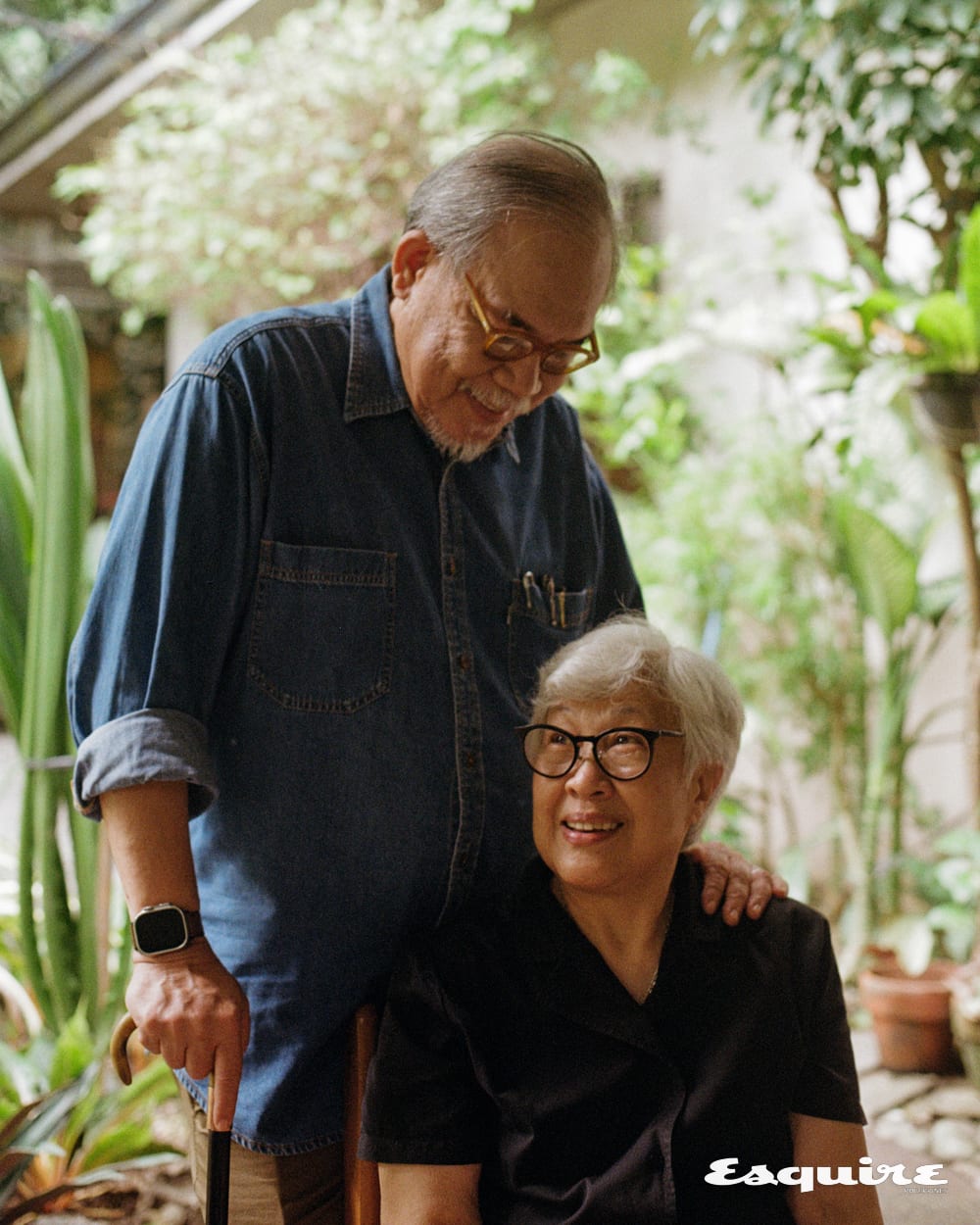
Demi, our daughter, who's now 51, has been living abroad for almost 20 years now. But again, we keep in very, very close touch. Thankfully, there's FaceTime for that. And the most recent member of our little family is Buboy, who's now nine years old. We're putting him through school. He's the son of our housekeeper. And our housekeeper and her family are our extended family.
It is my great blessing in my 70s to have these people with me. And whatever happens out there, whatever is said about me or my work, I can always come home to this environment, which I know will cherish me and protect me as much as I will do that for them. And you and I know that writers' lives or artists' lives get very complicated. And in many ways, people can very easily become unhappy or sick. And that's part of. It's on the horizon, too. So this is the cushion that I think every writer wishes for, that you don't have to worry about other things. Although worries also generate, you know, creative energy. You almost want to ask yourself, is it still possible to write with an edge when you're happy?
SL: That was my very next question. You just came from Switzerland, where everybody's interviewing you. You're on the spine of several books in translation. You're on the forefront of delegations. And I should say, of the household—no matter how unruly that is—of Philippine literature, whether or not they recognize it as a household. Aren't you dying to write?
BD: Yes, I am, actually. Yes, I am. I want to get back to my third novel as soon as I can.
SL: Get the poker out of the way. You know what I mean?
BD: Well, the poker's part of that. You see, I process a lot of stuff in my mind. I do a lot of my writing while playing poker. I've trained myself to write on my phone.
SL: You gotta play more poker, then.

Interview: Sarge Lacuesta and Butch Dalisay
Production: Esquire Philippines Team
Editor-in-Chief: Paul John Caña
Creative Direction: Igi Talao
Photography: Paul Sugano
Videography: Greeko Junio, Jo Tamesis
Grooming: Team Muriel Vega Perez
Special thanks to Beng Dalisay.
View More Articles About: