Today I Learned: Why Some Filipinos Turn to Santa Muerte, the Folk Saint of Holy Death
For some devotees, Santa Muerte is more than a symbol of death. She is a spiritual protector, a maternal figure, and a guide who helps them confront mortality.
Published on Oct 31, 2026
While the first day of November is not the official feast of the folk saint called Santa Muerte, some Filipino devotees still consider this period highly significant to their practice. According to Awo Ifatobi, a Filipino-Chinese initiate of the Ifá spiritual path, Santa Muerte reigns over the realm of the dead and lifts the veil separating the mortal and spiritual worlds from October 31 to November 2. It aligns seamlessly with the timing of Día de los Muertos (day of the dead) in Mexico, the cradle of her devotion, where the dead are honored annually during this identical late-autumn window.
“We have to consider that Santa Muerte is a Mexican folk saint, and just like the Philippines, it is predominantly Catholic. We can see here the correlation between the church’s liturgical calendar as All Saints’ Day and All Souls’ Day and the celebratory devotion to Santa Muerte. We connect with our ancestors through Santa Muerte as she lifts the veil and allows us to make any form of contact,” Ifatobi told Esquire Philippines.
Although the Vatican explicitly rejects Santa Muerte and condemns her veneration as blasphemous, Ifatobi is among the many devotees across the globe who reconcile their faith by acknowledging her as a sacred entity created by God to oversee the transition from life to death, and not as a replacement for Catholic saints.
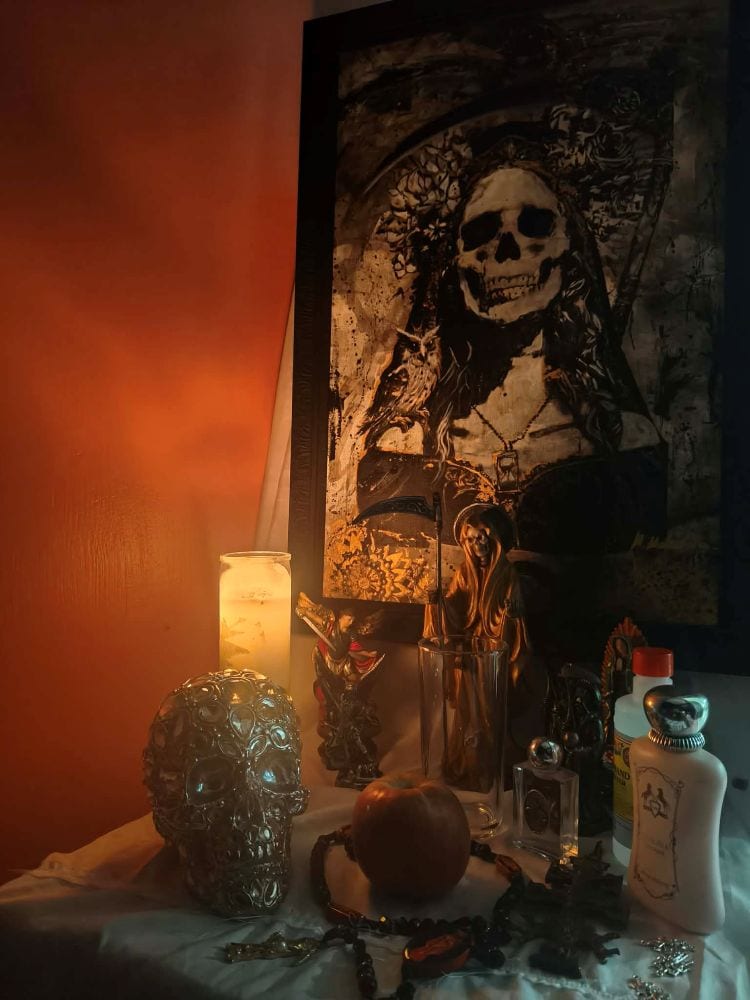
“Santa Muerte is the energy, deity, saint that guards the doorway. Everyone who has passed on is now under her protection,” he went on, referring to her as a force of nature that holds the passage of time. “People like to simplify things and think of things in pairs because it is easier to process—life and death, light and dark, good and bad, God and the devil. However, the reality is that it's never that simple. Those who do not understand Santa Muerte would think that devotees are worshipping the devil or that they are involved with some criminal organization,” he said, disagreeing on the stigma.
Ifatobi clarified that his devotion is rooted in a profound respect for mortality rather than dark magic or malevolence. “What I would love for other people to understand is that Santa Muerte—just like death—doesn't discriminate. Everyone is equal in her eyes. This is why there's a lot of marginalized people that have approached Santa Muerte because within her practice, they can escape the judging eyes of society.”
Last February, Ifatobi facilitated a month-long online retreat of Santa Muerte for Filipinos on how to begin the devotion. It covered religious practices, consecration, prayers, and meditation. “For us, Filipinos, this is also a familiar path because we already know how to light candles for our petitions, recite novenas, and pray the rosary,” he continued.
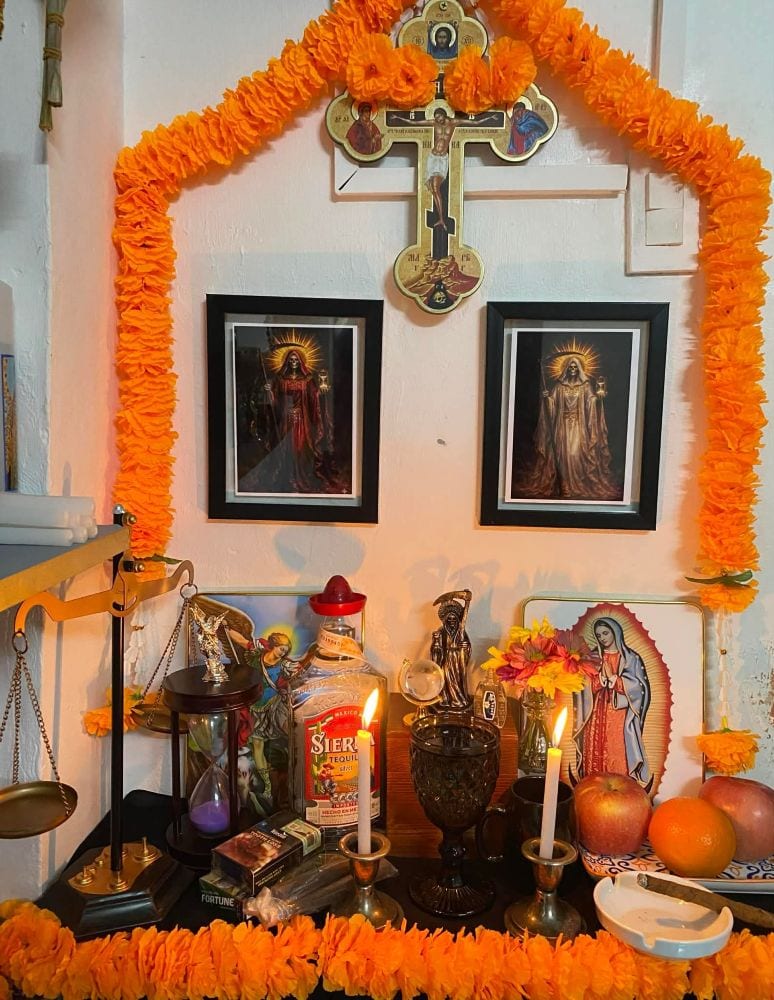
Meanwhile, architect and Esoteric Society of the Philippines co-founder Miko Abuan, who also attended the retreat, made history this year for the organization by adding a Santa Muerte vigil to their annual ritual for the departed in San Pablo, Laguna. On the night before All Saints’ Day, along with other ESP members, he would build the altar by cleansing the space, arranging fresh ofrendas like water, liquor, and bread, and lighting the candles to welcome her presence.
Once the physical space is arranged, they would then consecrate the altar by acknowledging God as the ultimate authority, followed by a formal invocation to Santa Muerte to ask for her permission and presence. Next, they’d move into the core devotional phase by reciting the initial prayers and dedication, which transitions into the traditional Santa Muerte rosary. During the specific prayers and petitions segment, each of them would take a dedicated moment to honor, remember, and invite the departed loved ones to share in the spiritual banquet.
To complete the ritual, they would present the offering of tobacco—blowing the smoke over the altar and her image as a sign of respect—before sealing the ritual with sincere closing prayers of gratitude and protection.
“Since our members practice a lot of other traditions, I wanted to introduce Santa Muerte and see if some of them will be called to her devotion. I never really petitioned with her in a strict sense. I just did the novena, and prayed for general need. I noticed that things moved fast after my initial nine-day novena with her; blockages were clearing up, so I told myself that I really resonate with her, and I'd love to continue my devotion to her,” said Abuan.
Furthermore, he will bring in hoodoo practitioner Tim Banaag for discussions about the devotion to Santa Muerte at “Takipsilim: Winter Soulstice 2026” at The Columns in Makati City on Nov. 28. It is a celebration among mystics and kindred spirits in their community, organized by ESP.
How the Altar Connects Devotees to Santa Muerte
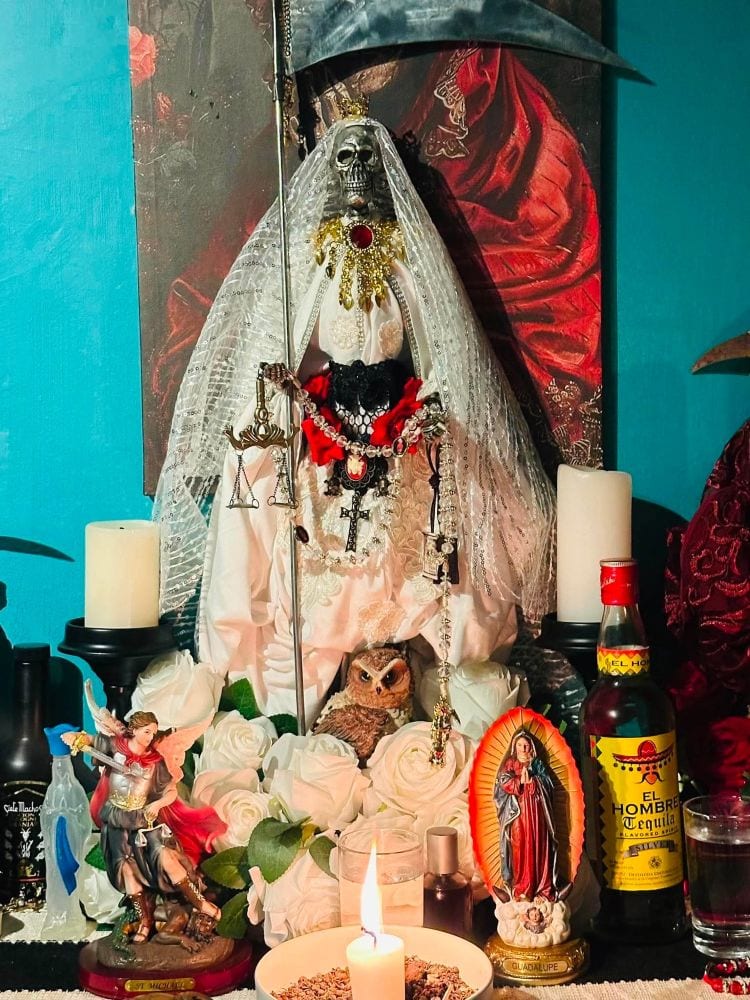
The altar serves as the ultimate focal point of Santa Muerte devotion, acting as both a sacred crossroad and a physical manifestation of the devotee's relationship with the skeletal saint. At its center stands her statue where practitioners focus their gaze and anchor their thoughts during meditation. Every component placed upon the altar—from the flickering candles to the fresh water, liquor, and curling tobacco smoke—serves to focus the devotee’s intent and channel their energy directly to her.
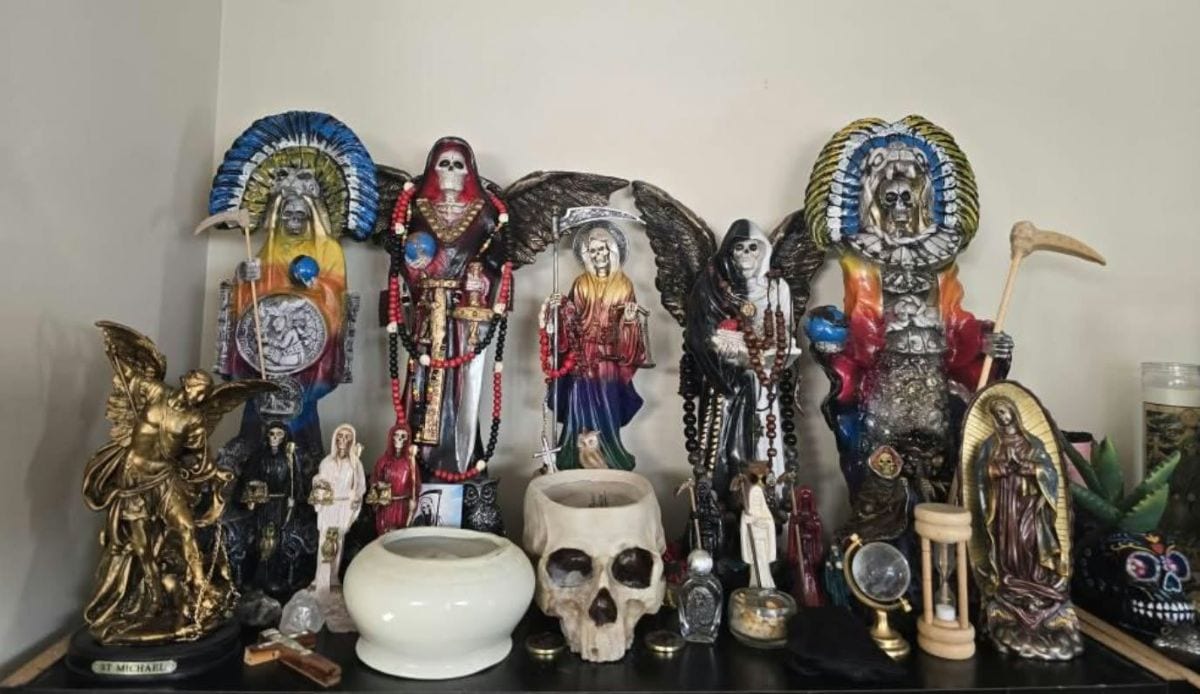
Anthropologist Cressida Stone described the saint’s iconography in her book Secrets of Santa Muerte as a “female Grim Reaper” wearing a long gown cinched with a sash around her waist. A mantle protects her bare skull while holding a scythe and scales of justice, accompanied by an owl that represents unfathomable wisdom.
“I maintain several altars and shrines at home as I like to keep my practices separate and it's also a way for me to preserve the cultural integrity and traditions associated with each practice,” said Ifatobi, who observes Ifa rites. Ifa is a Yoruba-based practice that is related to other African traditional religions such Vodou and Santeria.
Despite the limited space, he has transformed a quiet corner of his home into a sacred sanctuary for Santa Muerte. He elaborated: “I used to live in a much bigger home, and all my altars and shrines were spread out. We moved last year and we are temporarily in an apartment so I have to make do. This experience taught me that regardless of living space, you can still make it work. My shrines are smaller but they're all in my home office.”
The Personal Impact of Santa Muerte on Her Followers
Ultimately, coming to know her has reshaped their entire perspective on life, changing the idea of death as something to be feared into a protective, comforting energy that guides them through every crossroad.
In Ifatobi’s case, Santa Muerte has always been an underlying presence in his life, rooted in a childhood fascination with mortality while growing up in the Philippines. Currently residing in America, he recalled a childhood prayer asking God to spare their family from untimely deaths, but it was shattered when he was in third grade when his grandfather passed away. It reminded him that death is an inevitable part of reality. Moreso, the subsequent family losses involved traditional funerary customs, including burning incense to accompany the soul in the afterlife, further fueled his curiosity with the afterlife.
Another pivotal turning point occurred on Thanksgiving in 1999. He survived a devastating car crash without a single injury. He shared that this near-death experience has permanently forged the foundational connection to the “other side.”
Death is an essential part of our reality. Most people don’t like it because it forces them to confront their attachments and everything and everyone they aren't ready to let go of. Once you can accept that death is part of our nature and existence, you can finally let go and be liberated from your attachments,” he reflected.
Moreover, behind the glowing candles and draped altars of Santa Muerte are the deeply intimate stories of these followers who also call her mother. For Abuan, she is a fountain of comfort. “I view her as a caring mother who will sing her lullaby as you fall asleep and return to the source,” he said.
In the same light, Ilocano shaman or baglan Rein Nieva embraces Santa Muerte as a maternal figure. “Sa araw-araw kada aalis ako ng bahay at uuwi para ko siyang nanay na nagpapaalam at nagsasabi ako kung saan ako pupunta. Kapag hindi ako nakapagpaalam sa kanya, feeling ko may kulang akong ginawa. I feel guilty, na para bang hindi ako nagpaalam sa mama ko,” she said.
Her journey toward knowing Santa Muerte unexpectedly began with the movie Coco. In the movie, it beautifully demystified the spirit world and opened her eyes to Mexican traditions surrounding the afterlife. Its vibrant portrayal of Día de los Muertos shifted her perspective on death, transforming it from a frightening, taboo topic into a beautiful, celebrated transition deeply rooted in family and remembrance.
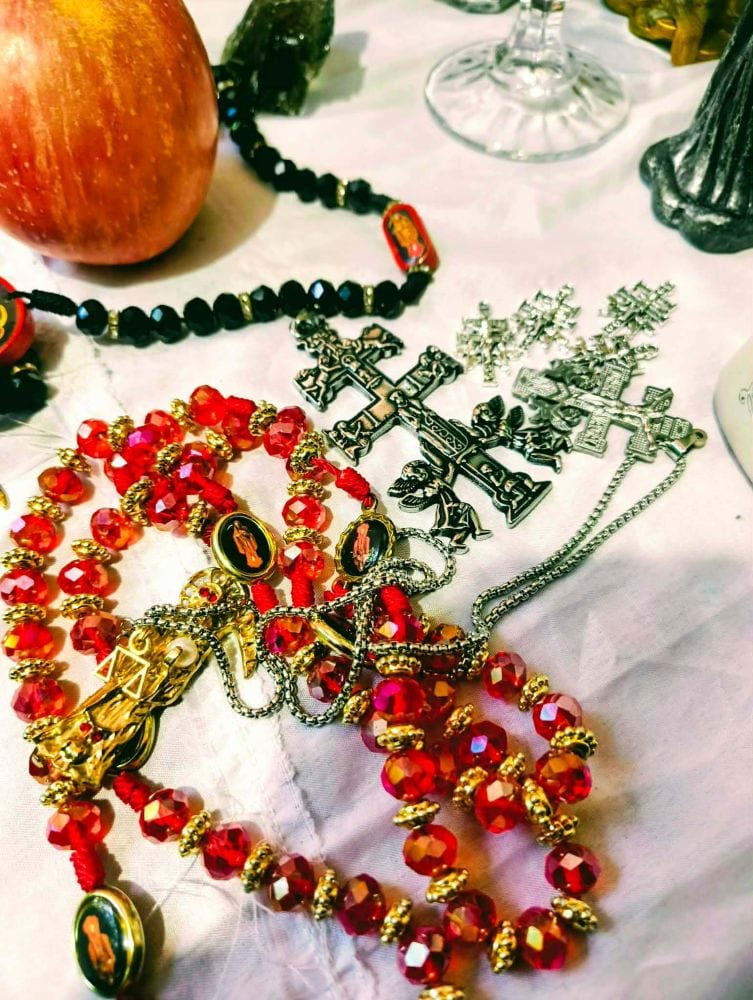
Rein added that by placing her absolute trust in Santa Muerte, she no longer walks through the world with anxiety, knowing that the most powerful force in the universe—death itself—stands as her loyal protector and watches over her every step. She added, “Isa lang hiniling ko sa kanya–protektahan ako at mga taong mahal ko at ilayo kami sa mga taong mapagsamantala, ispiritu man ‘yan o tao. Mabilis tumugon si Santa Muerte; wala akong masabi sa pagiging protective niya. Ipapakita nya sa ‘yo agad yung sagot sa dinadasal mo.
Banaag, on the other hand, approaches Santa Muerte not only for safety, but as a fierce dispenser of divine justice who rights the wrongs of a deeply flawed world. For him, she is the ultimate equalizer, an impartial force who cannot be bought, bribed, or swayed by the corrupt systems of the living.
When he lights candles for her and lays down his petitions, he does not seek malice but rather the divine intervention of a guardian who holds wrongdoers accountable. While human laws may fail, Santa Muerte's scales are perfectly balanced, ensuring that truth and fairness will always prevail under her watchful eye. “For me, there is a clear line between protection and revenge. I pray for protection, truth, and justice, but I do not believe in intentionally harming innocent people. I leave justice in the hands of the divine and trust that every action has its consequences,” Banaag said.
ALSO READ
15 Filipino Celebrities Who've Had Near-Death Experiences
View More Articles About: