Today I Learned: Sometimes, the Most Dangerous People Don’t Look Dangerous
Psychology’s “Dark Triad” explains why some of the most unsettling people can seem the most likable at first glance.
Published on May 8, 2026
So there’s someone you know, and there’s something about the way they are that gives you the heebie-jeebies. You can’t put your finger on it, but you know something is up, and you’re not into it.
There’s a vibe, there’s a feel, and there’s a thump thump in your chest that you get when you’re around them, telling you they’re bad news.
Though you might not have the words for what your internal alarm system is picking up, psychology offers one explanation. Maybe, just maybe, you’ve come face-to-face with someone possessing the Dark Triad of personality.
Nothing paranormal, but scary in a different way
The Dark Triad might evoke images of a horror sequel no one asked for, but in truth, it’s a legitimate concept that’s received a ton of attention from the world of research. It was brought to mainstream psychology by researchers Paulhus and Williams (2002), who were interested in understanding the personality traits that make some people very, very difficult to be around. They wanted to know what characteristics were likely to dominate the “personality map” of an individual we might ordinarily consider a menace to society—the kids (and adults) your parents warned you about, pretty much.
By being “menacing,” psychology doesn’t mean just mildly infuriating. This goes beyond vandals and drunkards who frequent the police precinct. We’re talking the Voldemort, Darth Vader, American Psycho Patrick Bateman, Joker, Hannibal Lecter, Adolf Hitler types—folks who have no qualms about exploiting entire civilizations and taking lives if it means achieving something “great.” (More on this later. Prep your pen and notepad at this point in the article).
In their oft-cited research, Paulhus and Williams (2002) noted the difficulty in distinguishing healthy from unhealthy personalities, normal from deviant, and clinical from subclinical. They wondered about the fairness and accuracy of labeling a person psychologically well or unwell, depending on what personality traits they had. Psychology continues to update its methods for making this distinction as new research surfaces, giving clinicians more nuanced tools to assess an individual.
To give psychology a starting point at the time, Paulhus and Williams (2002) invited 245 individuals to participate in their study. They found that out of all the personality traits in existence (there are thousands of traits to sift through, depending on the personality theory you choose to base your research on), three personality traits are likely to show up again and again in a seemingly “menacing” person.
(Now is a good time to take out that notepad).
They stated that people who possess the traits of narcissism, Machiavellianism, and psychopathy are those we can consider to have the Dark Triad personality.
Before you start lining your doorways with salt and hanging garlic by your window sills to keep these people away from your homes, here’s the tricky part. These traits may be invisible to the casual observer at first and, in some instances, even appear desirable. The Dark Triad personality doesn’t give off obvious villain energy, especially during an initial introduction or even the first few times you interact with a person who fits the profile. If only they walked around wearing bad-guy capes, but alas, they could be capable of masking these characteristics with a facade of charm and sociability, for example (Ingerson et al., 2020). This person could be an awesome party guest, telling the best jokes and showing off silky-smooth moves enough to make your grandma blush. Or they could be a work boss who exudes absolute mastery and power that makes them aspirational and respected. Maybe they’re the queen bee of the friend group who appears dominant, organized, and protective, but in reality, leans towards being insensitive and downright mean.
Essentially, the Dark Triad works to fool, then eventually, take advantage of unsuspecting people. Narcissism, Machiavellianism, and psychopathy, though all distinct from each other, can all overlap in terms of feigning likability and agreeableness at first glance.
Hang out with the Dark Triad crowd enough, and sooner than later, you’ll get a whiff of the ugly that lies beneath. Knowing what kinds of actions, beliefs, and words are associated with this trinity of traits makes them easier to spot. Hopefully, it’s knowledge that can help you protect yourself from unnecessary interactions with these types and save yourself from potentially nasty experiences.
Demystifying the Dark Triad traits
Narcissism, Machiavellianism, and psychopathy—big words, so let’s break each of these traits down for better appreciation.
We see “narcissist” and “narcissism” thrown around the Internet all the time, often incorrectly, too. (That’s a conversation for a different time). So what does it mean to be narcissistic, really?
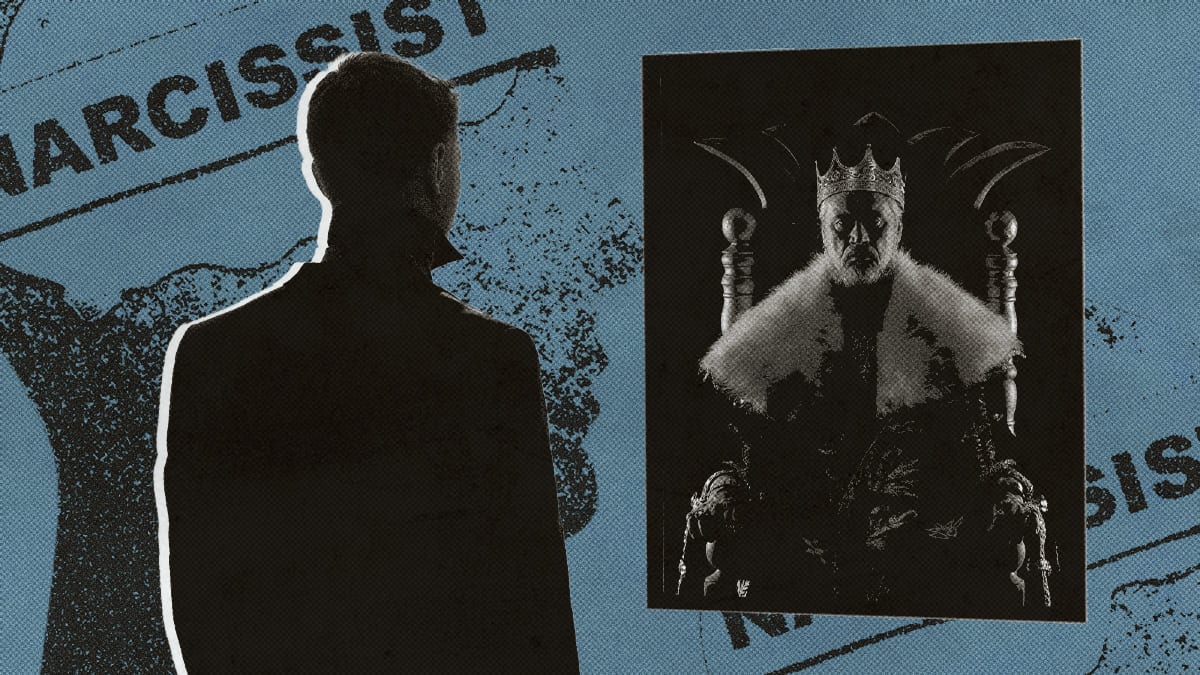
In a nutshell, these people are arrogant and entitled. Vanity and self-absorption (Richardson & Boag, 2015; Rauthmann & Kolar, 2012) are their factory setting defaults. To be more poetic about it, narcissism is self-centeredness to the maximum extreme. This person sees themselves as the main character of all main characters, and to them, everyone else exists to be in awe of their ultra-amazing, hyper-unique, unstoppable, unbeatable God-given abilities and gifts no other person could have. You are there solely to meet their deep-seated need to be admired and praised. Instead of oxygen, they require, nay, demand, a steady stream of compliments to live. To the narcissist, perhaps they are God themselves.
A true-blooded narcissist will find it incredibly hard to do things such as apologizing, acknowledging room for improvement, and sharing credit with others. They are the ideal, so, what for? You were born to help them thrive, and you should be grateful for the opportunity.
Now, moving on to Machiavellianism.
The hardcore Machiavellian believes that the end justifies the means, regardless of what it takes. This person is best described as excessively logical and cold, often relying on rationalizing behaviors and then discounting the emotional and social costs of their actions. Even if suffering and death were involved, even if ethical and moral codes were violated, even if puppies and kittens were wiped out from the planet forever, they would 100 percent be cool with it if they believed this brings them closer to achieving their goal. It would be a waste of time to expect them to consider how they affect others. They may even have no issues manipulating others to gain the upper hand. Empathy doesn’t exist in their world, as caring for others detracts from success (Ingerson et al., 2020; Jahangir et al., 2024).
The Machiavellian undercurrent is to be one step ahead of everyone else. According to this worldview, if you fall behind, then expect to be a victim of others’ schemes. (Because if I’m untrustworthy and scheming, who’s to say everyone else isn’t?). It’s either eat or be eaten. Preserving self-interest guides their life strategy. Understand that Machiavellians are not mindless brutes. They are calculated decision-makers who strategize and then strike with precision.
Finally, there is psychopathy to complete the triad.
You get a sense that someone could have psychopathic inclinations if they’re unremorseful for things they do, and most of the time, this involves hurting others with words or actions. You’ll see that the activities they pursue almost always serve a thrill-seeking desire that overrides all reasonable inhibition. They’re impulsive when it comes to engaging in pleasurable activities and fail to evaluate any long-term effects of their actions. Their absence of foresight is closely tied to violating social norms (Furnham et al., 2013).
For instance, a typical society does not condone violence in any shape or form. To a psychopathic individual, they could show some degree of okay-ness with hurting others to get what they want. Aggression is not taboo for them. What might be obviously wrong to you might not be for them. What most people acknowledge will lead to terrible consequences may not be enough to deter them, or something they even bother thinking of as they fire their engines to gain immediate gratification.
At other times, they may also just be plain mean. Psychopathy does not always manifest physically. It can come in the form of emotional callousness. Guilt is not part of their repertoire of feelings, so don’t expect them to appreciate it when you sit down with them to explain how they upset you (Furnham et al., 2013; Blasco-Beled et al., 2023).
Think of school bullies who get involved in petty crime, a parent who unscrupulously spends the family budget on a fun gambling bet, the romantic partner who refuses to acknowledge boundaries, or the friend who has trouble with self-control on a night out drinking. In short, they’re the “act now, think later” type. As long as they feel good right now, right here, consequences mean little.
Notice how there are overlaps between the three traits: there’s a disregard for other people’s well-being, the inability to empathize (i.e., put oneself in the shoes of others and feel what they feel, think what they think), a “me, myself, and I” attitude, an emphasis on personal satisfaction, and the belief that one is above the standards and laws of society.
When these three traits interact with each other to form the Dark Triad, you get a person who is willing to risk it all for a selfish, potentially harmful motive they’re convinced weighs more than the greater good. Step out of their way or risk being steamrolled.
Darkness in the workplace, family, and relationships
Beyond research and out in the real world, it’s a relief to find that about only about 8 to 10 percent of the general population has at least one of the Dark Triad personality traits (Sanz-Garcia et al., 2021). Yes, even with the state of things today, we can breathe a sigh of relief that it’s not (yet) a world of darkness we walk in. It’s not very likely for us to encounter a bona fide Dark Triad character out in the wild, and yet, your chances aren’t zero.
In the workplace, don’t be surprised if you spot one in a leadership position. Being Machiavellian and narcissistic could mean a person is more willing than others to do things that raise the company’s bottom line; ethics goalposts are adjusted to meet an agenda, listening to employee sentiment for fairness is not a priority, and being team-oriented is a joke. Self-marketing skills, even if they speak of only half-truths, needed to get ahead of the competition for that promotion come naturally to them. Passive-aggressive workplace bullying that leads to a high turnover rate—what’s that? In their eyes, they’re just verbalizing honest and objective observations of others and weeding out the weakest links from the team.
In romantic relationships, keep your eyes peeled for things like difficulty in committing to long-term arrangements and a preference for fleeting encounters. Remember their lack of empathy, manipulative tendencies, and inability to feel bad about making you feel bad? These contradict what it means to be a good long-term partner. Watch out for jealous and controlling behaviors and a disregard for boundaries, too. The saying “No is a complete sentence” is something they’ve never heard before. Sitting down to talk about improving conflict resolution is a pain. They would much rather break up and leave than work through problems and build any semblance of intimacy. If you ever find yourself dating someone with one, two, or all of the Dark Triad traits, you certainly could end up feeling drained, sidelined, and minimized.
Among family members, especially in parent-child relationships, you might notice a mom or dad who is exceptionally authoritarian. These are the parents who adhere to the “My way or the highway” style of child-rearing, where control is the measure of success in the family rather than factors like warmth, openness, and acceptance. A parent with narcissistic tendencies may also view a child as an extension of themselves; when the child ventures farther away from this as they develop a mature identity, let’s just say it doesn’t bode well for them. Among siblings, it’s worth asking if there's anyone who appears more cunning than the others. Or, is there a sibling who finds it harder to share and take turns, or to say sorry and give way? What about the black sheep cousin labeled as such because they’re known to be rebellious and delinquent?
Here’s an important caveat, though: do not diagnose individuals as narcissistic, Machiavellian, or psychopathic without a professional assessment.
While research has found evidence showing that these traits have observable manifestations in many kinds of contexts, it’s totally uncalled for and incorrect to say someone has the Dark Triad traits simply because they said this and that, or behaved in one way or another. In reality, these traits can exist in a person, but may not meet the threshold needed to be considered a genuine personality problem. The existence of these traits may also signal a different kind of mental health struggle, and not necessarily the Dark Triad personality, automatically. Not everyone who has the potential to become a murderous dictator goes down this road.
A comprehensive psychological assessment is needed to determine if a person indeed has these traits, and secondly, if their presence is serious enough to be a destructive force in their lives and the lives of others.
The talisman of protection from the Dark Triad
As a closing note to this long FYI on the Dark Triad, here’s some advice on what can be done to minimize the harmful impact these kinds of people might have on you (especially when interactions are unavoidable).
(Use the last pages of that notepad wisely).
First, be as boring as drywall. Seriously, the more bland you are, the less likely you are to invite further interactions. Don’t engage; say what needs to be said to them, and nothing more. Hope that they will leave you alone the same way a shark leaves swimmers who choose calmness over flailing around in open water alone. There is no need to outwit them, no need to challenge them, and no need to out-maneuver them. Leave it be. It’s a contest that will name no winners.
Second, be a closed book. If there is no need to share personal and vulnerable information with them, it’s totally okay to leave it at that. This is especially true in the workplace and around people who do not need to know the inner workings of your life (that includes potential partners if you are still just getting to know them and relatives whom you might feel pressured to be polite to). If they have no ammo from you, then they cannot wield any weapons against you. Keep their barrel empty.
Third, never forget to remind yourself that it’s not a you problem. This is a them problem. If they ever belittle you, invalidate you, or outright bully you, remember that it’s on them. None of it is a measure of your personhood. Don’t let them get to you, especially when you know you’re in the right.
Fourth, set boundaries and stand your ground. No caving, no saying “just this one time.” Step up for yourself by drawing a firm line in indelible ink. This returns control to you in these situations when manipulation is involved. When you realize you cannot change these people, but have full control over how you feel and behave when dealing with them, that can help take some of the edge off.
Fifth, and perhaps this may be the most challenging, don’t be too quick to think of someone who fits this profile as a garbage dump of a human being. Don’t be a hater from the get-go. Personality traits can be genetically-based, shaped by early childhood experiences as a way to survive adversities, reinforced by difficult ongoing life situations, or a mix of all. In other words, society’s “most menacing” may not have always had a choice in their personality development. They may not know any other way to be, except this. Sadly, sometimes people sometimes get dealt a bad set of cards, and all they can do is work with what they have.
And who knows? Underneath all the dysfunction, they might also be feeling that something isn’t right with them, but don’t know how to handle that. They themselves may also have noticed something isn’t okay, yet don’t know where to go from there, so they trudge onwards, albeit in the wrong direction.
In the end, the best thing to do is not to fight darkness with darkness. Psychology asserts that, in many cases, there is good that can be unearthed even in the darkest of corners. With the right support and professional help, it’s possible to turn things around and invite the light in.
REFERENCES
Blasco‐Belled, A., Tejada‐Gallardo, C., Alsinet, C., & Rogoza, R. (2023). The links of subjective and psychological well‐being with the Dark Triad traits: A meta‐analysis. Journal of Personality, 92(2), 584–600. https://doi.org/10.1111/jopy.12853
Furnham, A., Richards, S. C., & Paulhus, D. L. (2013). The Dark Triad of Personality: A 10 year review. Social and Personality Psychology Compass, 7(3), 199–216. https://doi.org/10.1111/spc3.12018
Ingerson, M., DeTienne, K. B., Hooley, J. M., & Black, N. A. (2020). Dealing with Dysfunction: Negotiating with Difficult Individuals. Negotiation Journal, 36(3), 287–307. https://doi.org/10.1111/nejo.12331
Jahangir, M., Shah, S. M., Zhou, J., Lang, B., & Wang, X. (2024). Machiavellianism: psychological, clinical, and neural correlations. The Journal of Psychology, 159(3), 155–168. https://doi.org/10.1080/00223980.2024.2382243
Paulhus, D. L., & Williams, K. M. (2002). The Dark Triad of personality: Narcissism, Machiavellianism, and psychopathy. Journal of Research in Personality, 36(6), 556–563. https://doi.org/10.1016/s0092-6566(02)00505-6
Rauthmann, J. F., & Kolar, G. P. (2012). How “dark” are the Dark Triad traits? Examining the perceived darkness of narcissism, Machiavellianism, and psychopathy. Personality and Individual Differences, 53(7), 884–889. https://doi.org/10.1016/j.paid.2012.06.020
Richardson, E. N., & Boag, S. (2016). Offensive defenses: The mind beneath the mask of the dark triad traits. Personality and Individual Differences, 92, 148–152. https://doi.org/10.1016/j.paid.2015.12.039
Sanz-García, A., Gesteira, C., Sanz, J., & García-Vera, M. P. (2021). Prevalence of Psychopathy in the General Adult Population: A Systematic Review and Meta-Analysis. Frontiers in Psychology, 12, 661044. https://doi.org/10.3389/fpsyg.2021.661044
View More Articles About: