Report: Up to 100,000 Philippine BPO Jobs Could Become Obsolete as AI Reskilling Runs Six Years Behind
VC firm Gobi Partners’ latest report finds up to 100,000 Philippine BPO jobs could become obsolete as AI reskilling lags, though 86 percent of Filipino knowledge workers already use AI at work

by JV Ordoñez
Published on Nov 11, 2026
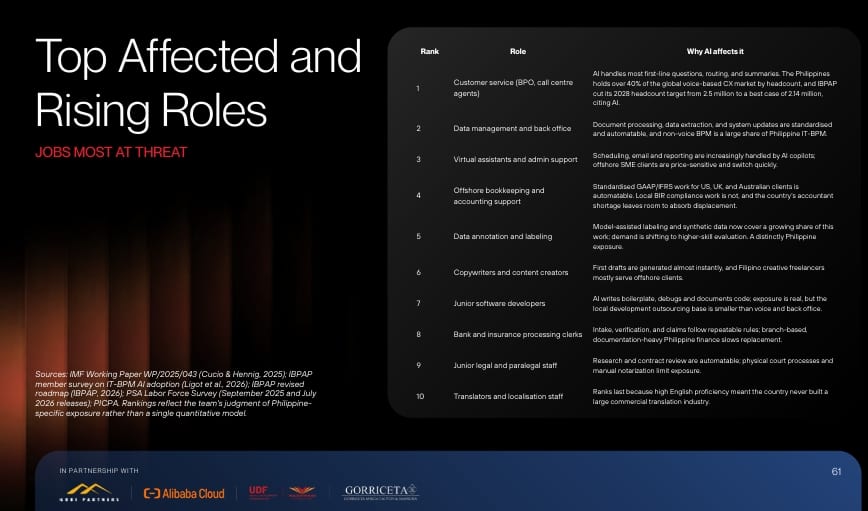
Manila is under pressure to speed up AI reskilling, as a report from venture capital firm Gobi Partners projects that up to 100,000 jobs in the local IT-BPM sector could become obsolete as AI tools spread through the industry, with retraining programs running roughly six years behind schedule.
According to its Solo Horizons: Redefining Scale for the Philippine AI Economy 2026 report, 86 percent of Filipino knowledge workers admitted to using AI at work compared to 75 percent worldwide, ranking the country first among 193 countries on the 2026 Ataraxis Global Outsourcing Talent Index. The VC firm had cited Microsoft and LinkedIn data for the numbers on AI usage among knowledge workers
The industry employed about 1.89 million people last year and earned $40.3 billion (P2.32 trillion), based on figures from the IT & Business Process Association of the Philippines.
It's no secret that the Philippines has always been glued to their phones and computers since it is consistently one of the world's top users on most social media platforms like Facebook.
We are at a point where AI platforms, tools, and assistants are transitioning from emerging platforms to now inevitable aspects of modern workflows and even bureaucracies.
“Filipino knowledge workers use AI at rates well above the global average,” according to Jason Gaisano, Gobi’s managing partner for the Philippines, who lists English proficiency, familiarity with AI, and strong service skills among the workforce’s advantages.
Going back to the IBPAP numbers, a July forecast from the organization projects a 2028 target for the industry standing at a best case of 2.14 million workers and up to $50.5 billion (P3.19 trillion), down from the current 2.5 million workers and revenue of $59 billion (P3.73 trillion) as it cited AI and global competition from the downslide.
“Empowering Filipino entrepreneurs is essential to driving inclusive and sustainable growth,” according to Senator Bam Aquino, the principal author of the Innovative Startup Act, said in a statement supporting the Gobi Partners report.
"Collaborations with organizations that support the startup community help strengthen the bridge between policy and practice—ensuring that founders receive not just capital but also mentorship and opportunities to scale regionally."
The report also showed a wide gap between how much Filipinos use AI and how ready the country is for its full-fledged adoption. Citing a 2025 estimate from the Philippine Institute for Development Studies that only 14.9 percent of Philippine firms use AI tools.
The country has a national AI strategy in NAISR 2.0 but no AI law, and 26 House bills are waiting to be consolidated, while Vietnam and South Korea already have laws in force. Among the general working population, 53 percent used generative AI in the past month and 14 percent used it daily, the lowest of Southeast Asia’s six largest economies. On readiness of the education pipeline, the report places the Philippines last among its peers.
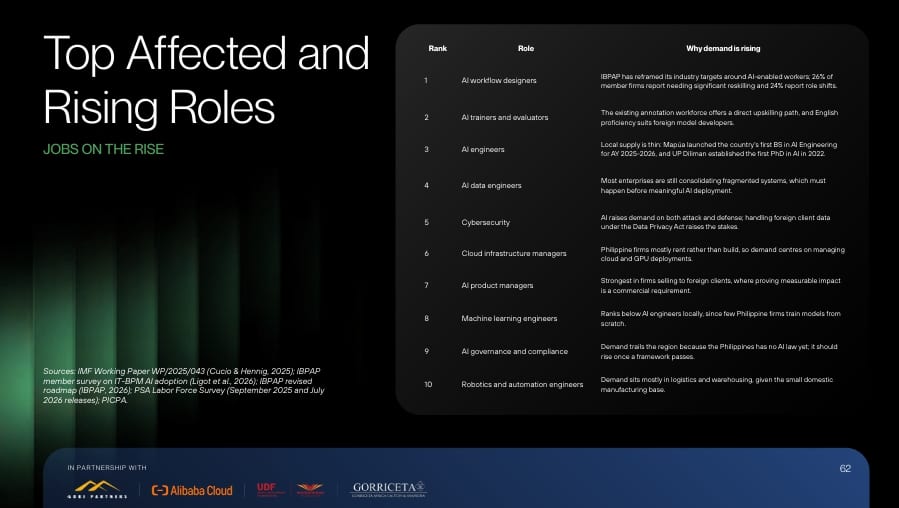
Gobi Partners' Solo Horizons Report's findings on roles at risk due to AI
A Labor Market Already Under Strain
A perennial hurdle for the Philippine government has been the persistent strain on the labor market and a challenging prospect of boosting the quality of jobs and addressing joblessness.
According to the latest data from the local statistics agency, the Philippine Statistics Authority, September joblessness inched up to 5.4 percent from 5.3 percent a month earlier.
In basic terms, this puts 2.86 million Filipinos out of work, which is up from 2.77 million a month earlier and 1.96 million or 3.8 percent in September last year. Employment rose to 50.32 million that same month, but analysts have said that the labor force is expanding faster than hiring.
When we look at underemployment, which represents employed Filipinos looking for more work or for more hours, this eased to 11.0 percent from 11.9 percent in August, though it still covers 5.56 million people. The PSA report also showed that employment among Filipinos aged 15 to 24 years old dropped to 84 percent from 88.4 percent a year earlier.
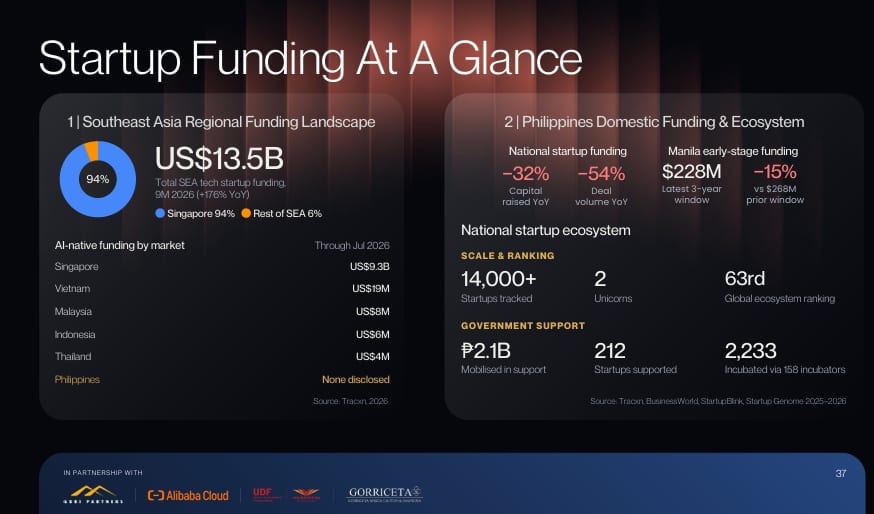
It is also essential to look at the startup ecosystem today since many see the local scene as one burgeoning with compelling and innovative players. Though in the report, the Philippine startup deal value fell 64.5 percent in the first nine months of this year against the same period last year. Gobi Partners emphasized that part of the drop reflects large 2025 deals such as the investment in GCash.
AI startups raised less than 1 percent of the 2026 total, while fintech took about 78 percent. Singapore captured 94 percent of Southeast Asia’s startup funding, startups in Taguig raised less than US$130 million, and the Philippines did not appear among markets with disclosed AI-native funding, according to Tracxn data cited in the report.
Despite this, Gobi sees an opening in small companies built around AI tools. Mynt’s October listing of GCash was the largest IPO on record in the Philippines; the country climbed to 63rd in StartupBlink’s 2026 ranking, and the report argues that one-person companies selling to foreign clients could carry the next stage of growth. One Person Corporation registrations with the Securities and Exchange Commission rose 27 percent to 8,640 in 2024.
Startup Incentives Favor Companies That Already Turn a Profit
One crucial thing Gobi also emphasized is that the existing incentives for startups mostly only favor companies that already earn money. The CREATE MORE Act, the Philippine Innovation Act, and the Innovative Startup Act all provide enhanced deductions for research, development, and training, which the report says suit established companies with taxable income better than early-stage startups. Enterprises registered under CREATE MORE pay a 20 percent corporate income tax rate and can claim an additional 100 percent deduction on power expenses, and the report says a clear route for qualifying startups would help them as they reach profitability.
If you really look closely at the current startup landscape, particularly for the early-stage startups, there is a need to "strengthen support for emerging ventures,” according to DICT Undersecretary for Strategic Initiatives and Industry and Competency Development Leandro Angelo Aguirre.
The VC capital firm's closing recommendations start with a private-led fund of funds in which private managers commit capital first and the government takes minority stakes, a model drawn from Israel’s Yozma program. It also calls for tax relief for individuals and funds that invest in qualified startups, a longer loss carry-over period for companies that run at a loss in their early years, and incentives specific to AI and other emerging technologies.
“The future belongs to economies that can transform knowledge and technology into solutions,” according to DOST Undersecretary for Research and Development Leah Buendia.
You can read the full Gobi Partner's Philippine AI Economy report here.
Esquire PH's resident music scribe, wristwatch disciple, and essayist fluent in niche internet subcultures and Philippine politics.
View More Articles About: