Girard-Perregaux Marks a Golden Milestone in Manila with the Laureato Fifty
The original Laureato, launched in 1975, was Girard-Perregaux's bold answer to a rapidly changing watchmaking landscape

by Alvin Uy
Published on Dec 6, 2025
Wine Story at Shangri-La Plaza became the backdrop for an invitation-only crowd—a mix of collectors, tastemakers, and VIP clients of the Lucerne Group. Surrounded by glass walls lined with Bordeaux and Burgundy, Girard-Perregaux chose a setting of quiet refinement to unveil the Laureato FIFTY in the Philippines, marking 50 years since the original Laureato redefined what a luxury sports watch could be.
For many in the room, the night was more than a product launch. It was a celebration of one of Switzerland's most quietly influential creations—a watch that, long before the age of waitlists and social media hype, helped set the blueprint for the integrated-bracelet luxury sports watch genre. A blueprint that the rest of the industry would follow.
The original Laureato, launched in 1975, was Girard-Perregaux's bold answer to a rapidly changing watchmaking landscape, and it landed ahead of its time. One year before Patek Philippe introduced the Nautilus (1976) and two years before Vacheron Constantin released the 222 (1977)—the watch that would eventually evolve into the modern Overseas—GP had already created its first integrated-bracelet sports watch.
Even more surprising: it wasn't mechanical.
The 1975 Laureato was equipped with an in-house quartz chronometer movement at a time when Swiss brands were still scrambling to understand the power of quartz. Girard-Perregaux wasn't scrambling. At the time, they were leading. As early as 1966, the manufacturer had established a dedicated R&D department for quartz. By 1971, they unveiled the calibre GP350, operating at 32,768 Hz—the frequency that later became the universal global standard. By 1977, 83 percent of quartz patents filed with COSC came from GP.
The Laureato's design was equally forward-thinking: an octagonal bezel set on a circular plinth, flowing into a tonneau case and integrated bracelet, all drawn by GP's in-house designers, not an external celebrity designer. Compared to Gérald Genta's sharper, screw-visible Royal Oak (1972) or the porthole-inspired curves of the Nautilus, the Laureato offered a subtler take—refined, architectural, precise. It didn't chase the era's trends. It helped create them.
The new Laureto 50
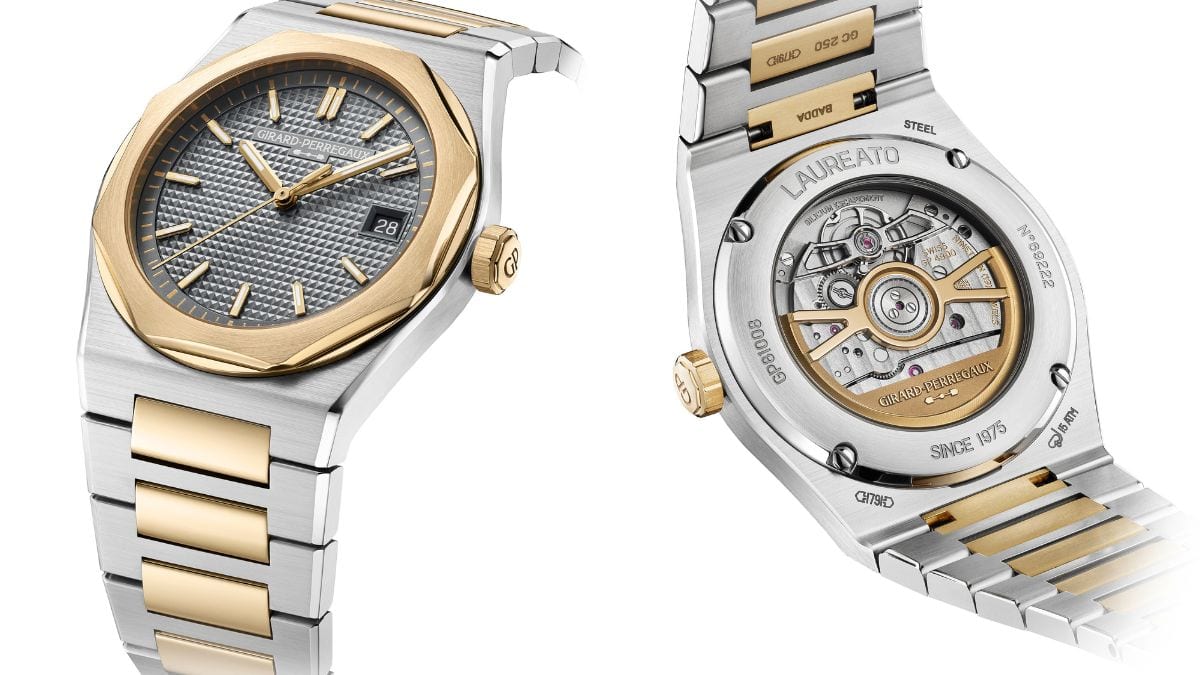
That spirit of subtle confidence carried into the Philippine launch event. The Laureato FIFTY was unveiled with quiet gravitas. No dramatics, just the quiet assurance of a model with 50 years of legitimacy behind it. Limited to only 200 pieces worldwide, the Laureato FIFTY is not a reissue but a reinvention—a modernized homage to the 1975 original, designed to acknowledge the past without being beholden to it. GP even brought in a couple of its Laureato museum pieces it has kept for half a century, for the event.
Sized at 39mm with a slim 9.8mm profile, the Laureato FIFTY immediately captures the essence of the early bicolor models, but with a fresh perspective. The combination of stainless steel and 3N yellow gold recalls the original 1975 two-tone Laureato, but the execution is sharper, more architectural, more attuned to contemporary expectations.
The iconic octagonal bezel features alternating polished and satin finishes that catch the light like facets of a gem. The case geometry has been refined as well: crisper bevels, smoother integration of the bracelet, and flatter sapphire crystals on both sides. In a world where luxury sports watches often compromise water resistance for aesthetics, the Laureato FIFTY asserts itself with 150 meters of resistance—a reminder that elegance and tool-like performance need not be mutually exclusive.
The dial is classic Laureato: a deep sunray grey base overlaid with Clous de Paris hobnail guilloché. The indexes and hands echo the warm gold of the bracelet's central links, while the GP double-arrow counterweight on the seconds hand offers a subtle flourish. Even the date disc is color-matched—a tiny detail to most, but a quiet nod to haute horlogerie for those who notice.
In integrated-bracelet watches, the bracelet isn't an accessory—it is the design. GP honors that legacy with a beautifully tapered steel-and-gold bracelet whose "H" links gradually slim toward the clasp. For the Laureato FIFTY, those links have been shortened slightly, making the bracelet more fluid and comfortable on the wrist. The clasp features an ingenious fine-adjustment system allowing a 4mm micro-extension—ideal for Manila's humidity and those warm days when wrists subtly expand.
Through the exhibition caseback, the new calibre GP4800 comes into view, showcasing Girard-Perregaux's latest automatic movement—a milestone in its own right. Slim, efficient, and built with a silicon escapement and variable inertia balance, it reflects GP's forward-leaning engineering philosophy.
The GP4800 is the first simple three-hand-plus-date movement whose architecture is inspired by GP's iconic Three Bridges—GP's signature in its haute complications. With ten finishing techniques across its components, the result is a movement that bridges GP's historic achievements with its contemporary ambitions.
Half a century after its debut, the Laureato remains one of the few luxury sports watches that has never strayed far from its DNA. It has evolved but never pandered; refined itself but never abandoned its architectural clarity. In an era where hype can overshadow heritage, the Laureato FIFTY stands as a reminder that design integrity, executed consistently over fifty years, is a trend of its own.
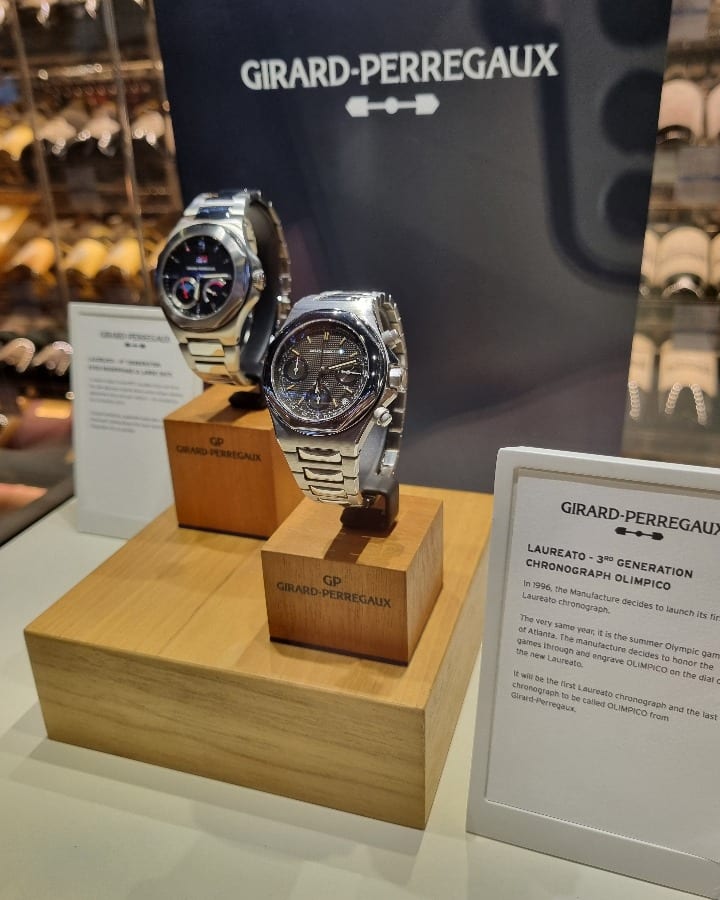
The GP Laureto Third Generation Chronograph
READ MORE:
Should You Buy an Expensive Watch?
View More Articles About: