How Blancpain’s Fifty Fathoms Became a Legend
The pioneering dive watch's enduring legacy is why mechanical watchmaking transcends luxury and utility.

by Alvin Uy
Published on Aug 30, 2026
There are dive watches, and then there are watches that helped define what a dive watch should be. Few have a claim to the latter quite like Blancpain’s Fifty Fathoms. Born in 1953 from a collaboration between Blancpain CEO and passionate diver Jean-Jacques Fiecahter and French combat divers Captain Robert “Bob” Maloubier and Lieutenant Claude Riffaud, the Fifty Fathoms established many of the features that remain fundamental to professional dive watches today: a highly legible dial, luminous markers, a secure rotating bezel, robust water resistance, and protection against magnetism.
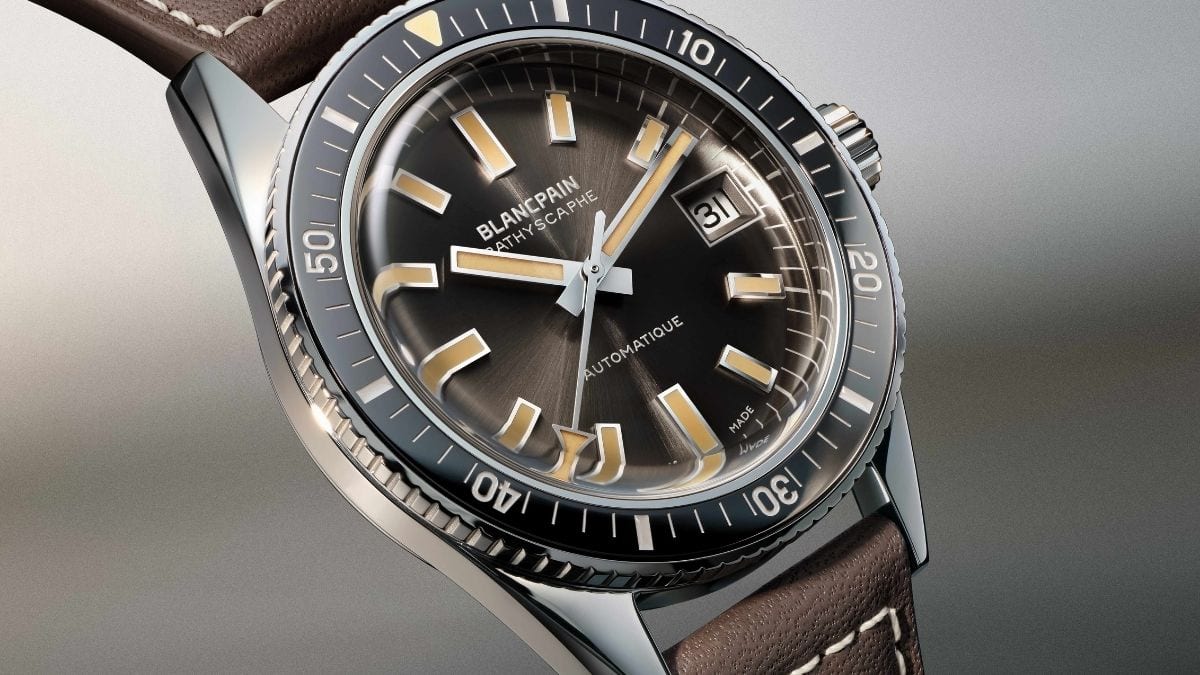
This year, Blancpain is celebrating another chapter of that story: the 70th anniversary of the Bathyscaphe, the more compact, civilian expression of the Fifty Fathoms that arrived in 1956. To mark the occasion, Blancpain has recreated the spirit of a particularly evocative 1968 Bathyscaphe in a 300-piece limited edition, reference 5903 1110 63A.
A vintage Blancpain Fifty Fathoms Bathyscaphe 37 mm, dated 1968
.jpg)
Even if you aren't really a stickler for details or a pedantic horology nerd, the distinction between the two models is an intriguing study.
The original Fifty Fathoms, at slightly more than 41 mm, was conceived first and foremost as a professional instrument for military divers and underwater specialists. The Bathyscaphe, measuring around 35 mm when it first appeared, translated that same diving philosophy into something smaller, slimmer, and more suitable for everyday civilian wear. Its name was borrowed from the deep-sea exploration vessel conceived by Swiss scientist Auguste Piccard, an appropriate reference for a watch born during the golden age of underwater exploration.
The new anniversary model looks backward without being a museum piece. Its 37.40 mm stainless-steel case reproduces the proportions of the 1968 reference, while the sunburst meteor-grey dial, mid-century Blancpain logo, baton hands, and geometric indexes deliberately recreate the period aesthetic. Vintage-colored Super-LumiNova evokes the warmth of aged luminous material, while the original hesalite bezel has been replaced by a more durable ceramic insert with lacquered numerals.
The new anniversary Blancpain Fifty Fathoms Bathyscape comes with a chocolate leather strap, which is faithful to its original vision and design.
A look at the Fifty Fathoms' open caseback design
.jpg)
The watch's crown
.jpg)
Underneath is distinctly 21st-century Blancpain. The Manufacture Calibre 1150 is an automatic movement running at 3Hz and offering an impressive 100-hour power reserve. A silicon hairspring provides enhanced resistance to magnetic fields, while the sapphire caseback reveals the movement’s Haute Horlogerie finishing and an openworked 18K-gold rotor inspired by the original Fifty Fathoms. Water resistance remains a serious 30 bar, or approximately 300 meters, and is limited to 300 individually numbered pieces.
But to understand why a bathyscaphe anniversary matters, it helps to go back to the Fifty Fathoms itself.
From Combat Tool to Cultural Icon
The Fifty Fathoms was not originally designed to be a luxury object. It was a solution to a problem. Maloubier and Riffaud were building France’s postwar combat-diving capability and needed a watch that could survive underwater operations. Fiechter, himself an enthusiastic diver, understood the requirement and worked with them to create the watch that emerged in 1953.
Its military credentials soon extended far beyond France. The Fifty Fathoms was adopted or commissioned for military use by the United States, Germany, Norway, Pakistan, Israel, and other nations. One of the most fascinating chapters was its relationship with the U.S. Navy.
Because American procurement rules required an American supplier, Blancpain could not sell directly to the Navy. Its U.S. distributor, Allen Tornek, established a testing laboratory in America, allowing the watches to be tested and certified domestically. The resulting Tornek-Rayville Fifty Fathoms became the U.S. Navy’s MIL-SPEC dive watch. The first order was for 611 watches.
The subsequent TR-900 was even more specialized. Designed to minimize magnetic materials so the watch would not interfere with magnetically triggered explosives such as mines and torpedoes, with 780 watches delivered in 1964, followed by approximately 300 more in 1966. These watches have since become some of the most coveted military dive watches among collectors.
There were also civilian-facing versions. Blancpain worked with Aqua-Lung, the diving equipment company associated with Jacques-Yves Cousteau and the development of modern scuba diving, producing Fifty Fathoms watches bearing Aqua-Lung on their dials. The watch was becoming not simply military equipment but an emblem of the emerging culture of recreational diving.
That evolution eventually led to the Bathyscaphe.
After Fiechter left Blancpain in 1980, the Fifty Fathoms effectively entered a long hiatus. It resurfaced in 1999 as part of the Trilogy collection, but its true modern renaissance came in 2003, when Blancpain President/CEO Marc A. Hayek introduced the Fifty Fathoms Anniversary in limited editions.
Four years later, in 2007, the modern Fifty Fathoms collection returned in earnest, with new movements and a range of increasingly sophisticated interpretations.
The Bathyscaphe was brought back into the collection in 2013, marking another expansion of the Fifty Fathoms family. Over time it evolved from its compact vintage origins into models incorporating ceramic, titanium, flyback chronographs, and even complete calendar and moon-phase complications. Yet the fundamental idea remained intact: a diver designed to be more versatile and wearable beyond the water.
The 2026 anniversary edition therefore feels less like a nostalgic reissue than a reminder of why the Bathyscaphe existed in the first place. Its 37.40mm case is unusually restrained by contemporary dive-watch standards, and its leather strap reinforces its civilian, everyday character.
A Swatch That Changed the Conversation
The Swatch x Blancpain Bioceramic Scuba Fifty Fathoms
.jpg)
There is another fascinating chapter in the Fifty Fathoms story: its unlikely partnership with Swatch.
In 2023, for the Fifty Fathoms' own 70th anniversary, Blancpain and Swatch introduced the Bioceramic Scuba Fifty Fathoms. Rather than simply placing Blancpain's name on an inexpensive watch, the collaboration recreated recognizable Fifty Fathoms design cues in colorful bioceramic cases and, crucially, used Swatch's automatic SISTEM51 mechanical movement.
The significance went beyond the watches themselves. Blancpain was taking one of haute horlogerie's most historically important dive watches and introducing its visual language to an audience that might never encounter a traditional Blancpain boutique. It also reinforced the Fifty Fathoms as a cultural object rather than merely an expensive instrument.
For Blancpain, there was an additional philosophical symmetry. Despite being part of the Swatch Group, the manufacture has maintained its long-standing commitment to mechanical watchmaking. Blancpain itself states that it continues to create exclusively mechanical watches, while its current collections are built around automatic and hand-wound movements.
That commitment is particularly meaningful given Blancpain's history. During the quartz crisis of the 1970s and 1980s, when much of the Swiss industry was struggling against inexpensive and extraordinarily accurate electronic watches, Blancpain chose not to compete on quartz's terms. Instead, its revival in the 1980s emphasized mechanical craftsmanship and complications. The introduction of its moon-phase watch in 1983 became an important statement that mechanical watchmaking represented something fundamentally different from electronics.
It is a philosophy that makes the Fifty Fathoms particularly compelling today. The original watch was created because a diver needed a mechanical instrument that could be trusted in an environment where failure had consequences. Seventy-plus years later, the technology has become vastly more sophisticated, but the principle remains remarkably unchanged.
The new Bathyscaphe is therefore more than a 300-piece exercise in vintage styling. It connects a 1968 skin diver to the 1953 professional instrument, the military watches that followed, the recreational diving boom of the 1960s, the quartz crisis, the Fifty Fathoms' 21st-century resurrection, and even its unexpected encounter with Swatch.
For a watch born to measure time beneath the surface, the Fifty Fathoms has demonstrated an unusual ability to survive above it. And in the new Bathyscaphe, Blancpain seems to be making the point once again: the best heritage is not something preserved in the past. It is something that continues to move.
READ MORE:
Swatch and Blancpain Tease Their Collab
View More Articles About: