IWC Just Debuted the First Watch Engineered from Scratch for Human Spaceflight
Meet the Pilot's Venturer Vertical Drive, redefining the astronaut’s tool watch in partnership with Vast.
Published on Apr 19, 2026
Every watch that's ever gone to space has been, in some sense, a compromise—a terrestrial tool sent somewhere it was never designed to be. IWChas had timepieces aboard Inspiration4 and Polaris Dawn, but until now, every one of them was essentially a modified aviation watch. The Pilot's Venturer Vertical Drive ($28,200) is the first wristwatch built with space as its only design brief.
This design feat was developed in partnership with Vast, the five-year-old company building Haven-1—the proposed successor to the International Space Station and, when it launches, the world's first commercial space station. Vast is designing Haven-1 as a human-centric innovation lab serving both private astronauts and government missions. IWC signed on as official timekeeper last year, a natural extension of its 90-year aviation heritage, and immediately put its engineering to the test. It began with a blank sheet of paper and a simple question: What does a tool watch for an astronaut actually need to do?

The most radical departure: there is no crown. All functions are controlled through a patent-pending rotating bezel system—the eponymous "Vertical Drive"—toggled by a rocker switch on the case side. It’s a technical solution to an obvious challenge: during spacewalks, a crown is rendered useless to an astronaut’s thick, Teflon-gloved hands. Inside, the movement is IWC's new caliber 32722, automatic with a 120-hour power reserve and integrated GMT.
The matte black dial is deliberately simple for legibility, showing mission reference time via central hands, plus a dedicated 24-hour hand. This is essential in orbit, where astronauts witness up to 16 sunrises a day and live by Greenwich Mean Time (the time zone chosen as a neutral compromise between U.S. and Russian mission control centers). Keeping a natural rhythm to earth time in 24-hour periods helps anchor a consistent routine of sleep and work amid the rapid churn of orbital cycles.
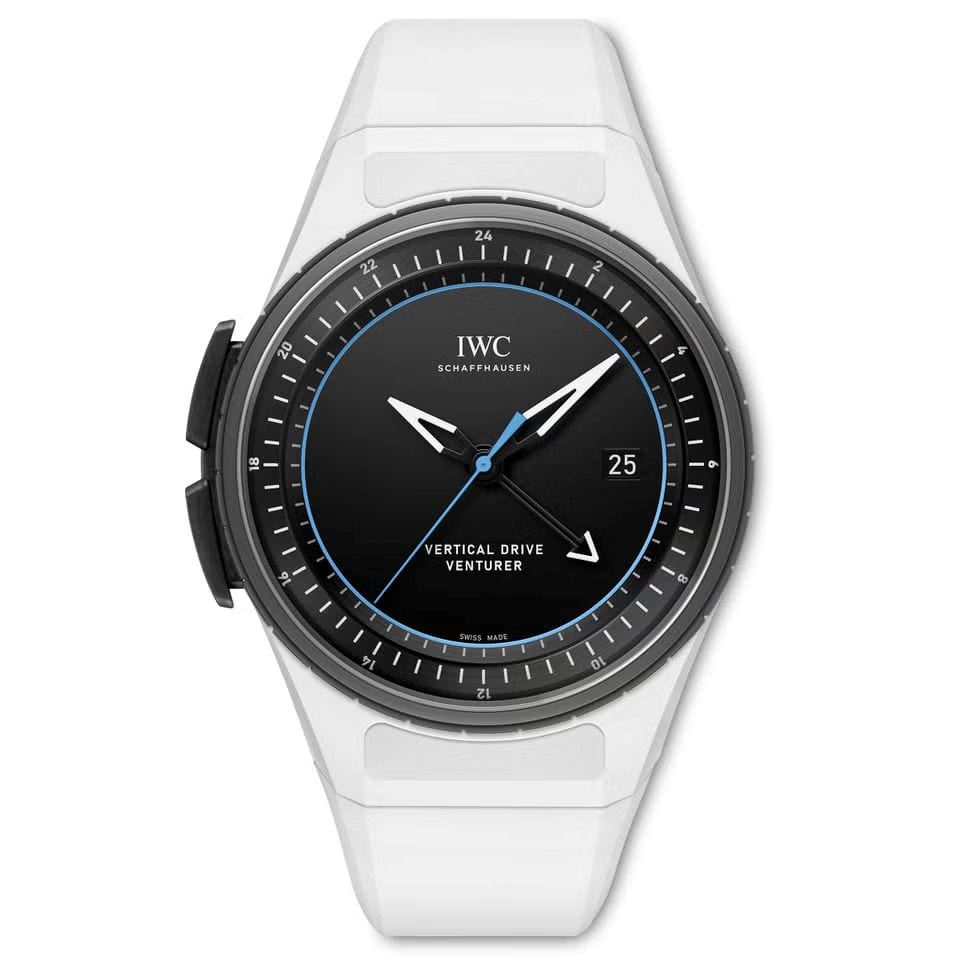
The case is white zirconium oxide ceramic, with a Ceratanium bezel and case back—IWC's proprietary alloy that combines titanium's lightness with ceramic's scratch resistance. The watch has to survive rocket ascent forces of 4g, temperature extremes from +100°C to -150°C, vacuum, and radiation. To prove it, partner Vast subjected the watch to 10g vibration tests at its Long Beach facility, alongside simulations of the research modules astronauts will run aboard the station, ensuring it can hold up in a delicate, precision-driven environment. It passed, under supervision of the organization’s senior mission manager Kelton Temby, earning official spaceflight certification for flight on Haven-1.
As humans push deeper into space, the instruments built for it are being engineered to match. And if you're not planning on raising your hand for a spot on Haven-1 any time soon, sporting the Venturer Vertical Drive can give you at least a taste of the thrill of braving the final frontier.
This story originally appeared on Esquire.com.