Nissan Bets on Electrification with Latest Crossover
Nissan's second local e-Power model arrives with more power, more tech, and a bigger role in the brand's electrification push in the Philippines.

by Alvin Uy
Published on Sep 4, 2026
Nissan Philippines launched the all-new Kicks e-Power on Friday, August 28, giving one of its most recognizable nameplates a full generational overhaul and, more importantly, adding fresh momentum to the brand’s electrification push in the country.
The timing works in Nissan's favor. Battery electric vehicles, hybrids, and other electrified drivetrains have moved past the early-adopter phase in the Philippines and are edging into the mainstream, with more brands competing for buyers who once wouldn't have considered anything without a conventional engine under the hood.
Nissan has been part of that conversation longer than most. In 2010, it launched the Leaf, the first mass-market electric vehicle, putting a production EV in the hands of ordinary buyers years before most automakers had settled on whether electric cars would ever go mainstream. The company built on that with e-Power, introduced in Japan in 2016 with the Note. The system took a different route to electrification: instead of plugging into a charger, a gasoline engine generates electricity that an electric motor then uses to drive the wheels, delivering an electric driving feel without asking owners to rethink how they refuel. The Kicks eventually inherited that technology too, launching as an e-Power model in Japan and other Asian markets in 2020.
That history now loops back to the Philippines. The first-generation Kicks arrived here in 2022, giving Filipino drivers their first taste of Nissan's e-Power approach. Four years on, the new Kicks returns with more power, more tech, and a considerably bigger job to do.
.jpg)
Under the hood, or more accurately under the electric motor, sits Nissan's e-Power system, good for 136 PS and 280 Nm of torque. A 1.2-liter three-cylinder gasoline engine handles generator duty, supplying the battery with electricity rather than turning the wheels directly, and that distinction shapes everything about how the Kicks drives. It doesn't try to pass itself off as a conventional hybrid: what stands out is the electric motor's instant response, its smooth acceleration, and how quiet the cabin stays at a stoplight. Owners still get the convenience of a gasoline-powered generator, so road trips don't require mapping out charging stations along the way.
For a market where charging infrastructure is still catching up, e-Power reads less like a compromise and more like a bridge; one Nissan is clearly betting can carry it toward something bigger.
A look under the Nissan e-Power's hood
.jpg)
A Familiar Face, Grown Up
The new Kicks looks considerably more mature than the model it replaces. Its exterior leans into Nissan's current design language: the V-Motion grille, sharper lighting, and the brand's signature triple-arrow daytime running lights up front, with hexagonal taillamps giving the rear its own identity.
Inside, the emphasis shifts from entry-level crossover to something closer to a daily companion built for comfort. Zero Gravity seats, anti-heat leather upholstery, an optimized rear seatback angle, and a rear armrest all aim to make longer drives less tiring, while the driver's six-way power-adjustable seat adds another layer of convenience.
The tech list runs deep too. A 12.3-inch Display Audio system comes standard with wireless Apple CarPlay and Android Auto, and NissanConnect Services ships with a three-year subscription built in.
The 12.3-inch display audio system with Apple CarPlay and Android Auto and NissanConnect Services
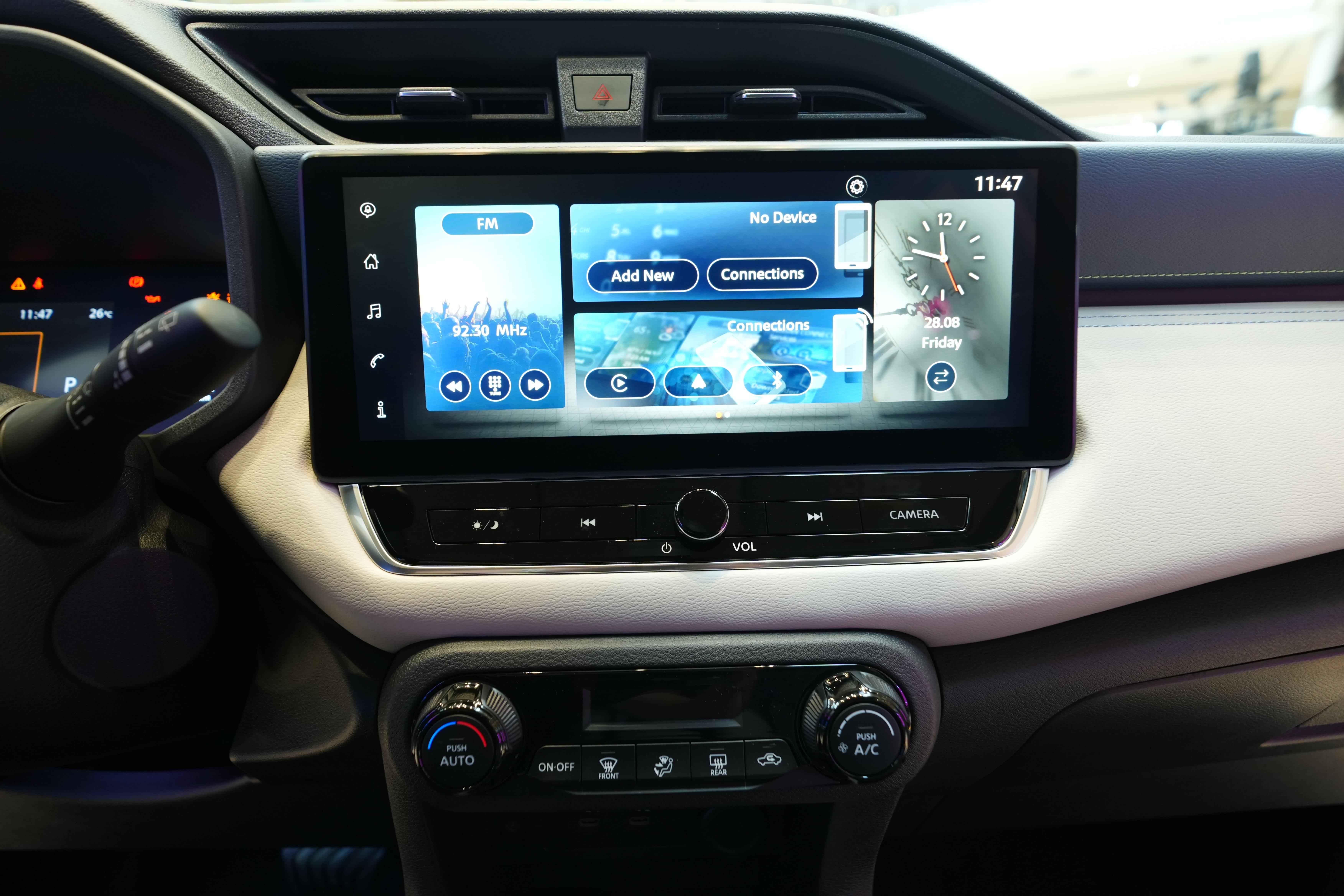
Then there's ProPilot. Nissan's advanced driver-assistance suite can manage steering, acceleration, and braking on its own, backed by Intelligent Lane Keep Assist and Intelligent Cruise Control, and its Traffic Jam Assist function can bring the Kicks to a full stop in slow traffic and get it moving again once things clear. Add Blind Spot Warning and Intervention, Intelligent Forward Emergency Braking with pedestrian detection, Rear Automatic Emergency Braking, Rear Cross Traffic Alert, and an Intelligent Around View Monitor, and the safety package alone makes a case for the new Kicks well before anyone talks about the powertrain.
The Bigger Picture
This launch carries weight beyond the vehicle itself, in what it signals about where Nissan Philippines is headed next.
With this release, Nissan Philippines now runs two e-Power models locally, joining the X-Trail e-Power already on sale. That gives the Kicks a job beyond selling units: it's another marker in Nissan's attempt to reestablish itself as a serious player in a Philippine EV market that's moving faster than it used to.
Nissan's history makes that attempt worth taking seriously. The company was among the first global automakers to commit to EVs at scale, launching the Leaf in 2010, years before the current explosion of electric-car options.
Nissan Philippines was already talking about bringing the Leaf to the country as early as 2019 and by 2020 had gone as far as using the car's vehicle-to-everything technology to power the Ortigas Center Christmas tree, a demonstration that doubled as proof of concept.
Nissan built a good chunk of that category itself and now finds itself working to reclaim ground in a market that's caught up to an idea it helped popularize back in 2010.
The Kicks may just be the opening move. Nissan's global strategy remains built around electrification: under Nissan Ambition 2030, the company has committed to 27 new electrified models, including 19 EVs, by fiscal year 2030, with a target electrification mix of 55 percent globally across Nissan and Infiniti. That pipeline is already showing up in the company's product plans, with e-Power technology expanding into more models and markets, including the Rogue e-Power and other next-generation EV and hybrid products still to come.
The open question for Filipino buyers is how much of that global lineup eventually makes it here. The Kicks and X-Trail suggest Nissan Philippines is willing to localize its global electrification technology. What's less clear is how far that willingness extends.
What It'll Cost You
The new Kicks come in three variants: the VE at P1.499 million, the VL at P1.649 million, and the range-topping LE Plus at P1.749 million. Buyers who sign on before September 30 get a complimentary one-year Nissan Protect+ package that covers prepaid maintenance using genuine Nissan oil and parts.
Exterior colors run to four options: Aquamarine Metallic, Gun Metallic, Pearl White, and Moon Pearl Gray, with the LE Plus adding a black roof on top of those.
The Philippine automotive market looks nothing like it did when the first Kicks launched in 2022. Electrification has gone from a niche talking point to a central part of where the industry is headed, and buyers now have more electrified options to choose from than ever before.
Nissan had a hand in starting that shift globally. The Leaf proved an EV could work as a real production car, and e-Power showed that going electric didn't have to mean plugging one in. The new Kicks carries that thinking into its next generation. The launch also marked the debut of Kicks by Quiccs, putting the Filipino artist's visual language on a Nissan nameplate for the first time.
View More Articles About: