The Philippine EV Conversation is Beginning to Move Beyond Hype And How EVIDA is Helping
QSJ Motors is spreading its EV bets across the board, from a sub-P500K city runabout to delivery vans built for fleet operators counting every peso per kilometer.

by Alvin Uy
Published on Aug 2, 2026
At QSJ Motors' EV Tour at SM City Clark, running July 31 to August 9, the company laid out a full electric mobility portfolio spanning both ends of the market: compact city cars for everyday motorists and electric utility vehicles for businesses looking to modernize their operations. The venue tracks with the lineup. Clark sits inside a growing logistics and manufacturing corridor, the exact kind of ground the BAW and Lynxs commercial models are built to work on. Headlining the showcase are the Bestune Joyee 03 electric crossover and the Bestune Pony city EV, alongside the BAW Dropside, BAW Closed Van, and Lynxs Cargo Van for commercial use.
QSJ pitches these as vehicles built for the daily routines of Filipino drivers and entrepreneurs, a claim that lines up with the real drivers behind local EV interest right now: rising fuel costs, improving charging infrastructure, and the incentives under the Electric Vehicle Industry Development Act (EVIDA).
EVIDA has done real work for QSJ's expanding lineup. Exemptions from the number-coding scheme, which normally bars vehicles from Metro Manila's major roads one day a week based on plate number, along with reduced import duties on qualifying EVs and government support for charging infrastructure, have chipped away at the usual barriers to EV adoption here. For QSJ, that means introducing the Bestune Pony, the Bestune Joyee 03, and the BAW and Lynxs commercial range into a market where electric mobility increasingly reads as a financially sensible choice, not just an environmental one. QSJ Motors also carries Aito and DFSK passenger EVs in the Philippines, giving it a wide footprint across price points.
The Bestune Pony is the most approachable entry point, a compact battery-electric hatchback built for city driving. It comes in two variants: a 170-kilometer version priced at P588,000 (P488,000 promo) and a 220-kilometer version priced at P658,000 (P588,000 promo). Top speed sits around 100 km/h, with dimensions suited to tight city streets and cramped parking. It's aimed squarely at commuters looking for a cheaper alternative to a gas-powered city runabout, not a lifestyle statement.
The BAW Dropside plugged into a charging bay, with the Bestune Joyee 03 and Lynxs Cargo Van staged behind it at QSJ Motors' EV Tour in SM City Clark.
.jpg)
Buyers who want more room move up to the Bestune Joyee 03, which competes in the increasingly crowded compact crossover segment. Priced at P1.388 million (P1.188 million special cash price), it delivers up to 445 kilometers of range on a full charge. Its 122-horsepower electric motor produces 155 Nm of torque, giving it the quiet, effortless drive typical of EVs paired with the space expected of a crossover. DC fast charging takes the battery from 30 percent to 80 percent in roughly 30 minutes, a more realistic setup for longer drives than most affordable EVs manage, and one that matters for buyers still weighing range anxiety against sticker price.
Bestune carries more history than its recent arrival in the Philippines suggests. It's part of FAW Group (First Automobile Works), one of China's oldest automakers, founded in 1953, with long-standing partnerships with Volkswagen, Toyota, and Audi. FAW has poured resources into new-energy vehicle development as China became the world's largest EV market, and that scale gives Bestune access to established manufacturing and supply chains that newer Chinese EV brands don't have. For buyers still cautious about unfamiliar nameplates, that pedigree is worth more than a spec sheet.
Two colorways of the Bestune Pony, QSJ's entry-level city EV, staged under the tour's light-up marquee.
.jpg)
QSJ's decision to give real floor space to commercial EVs might matter more for Philippine electrification than the passenger lineup does. The BAW Dropside starts at P538,000, and the BAW Closed Van at P568,000, both built for small businesses, delivery operators, and fleet customers who care more about running costs than badge value. Their electric drivetrains are sized for urban delivery routes, where stop-and-go traffic plays to an EV's strengths rather than exposing its weaknesses. For a business running several vehicles a day, the gap between diesel and electricity cost per kilometer compounds fast, and that math is getting harder for fleet operators to ignore.
BAW, or Beijing Automobile Works, has been building light trucks and utility vehicles since 1958. As China's logistics and e-commerce sectors grew, BAW developed electric commercial vehicles specifically to cut fuel and maintenance costs for urban fleets. That's a genuine commercial vehicle pedigree, not a passenger brand retrofitting its tech for cargo use.
Above the BAW lineup sits the Linxys Cargo Van, priced at P1.168 million (P968,000 promo), with a payload capacity of roughly 1,300 kilograms and a range of about 300 kilometers. That combination fits last-mile delivery networks, courier services, and small distribution fleets running within Metro Manila and other metro areas, the kind of stop-heavy routes where fuel costs eat fastest into margins.
An overhead view of the full QSJ Motors lineup on the floor at SM City Clark: the Bestune Pony and Joyee 03 up front, the BAW Dropside and Lynxs Cargo Van staged behind, ahead of the tour's presentation program.
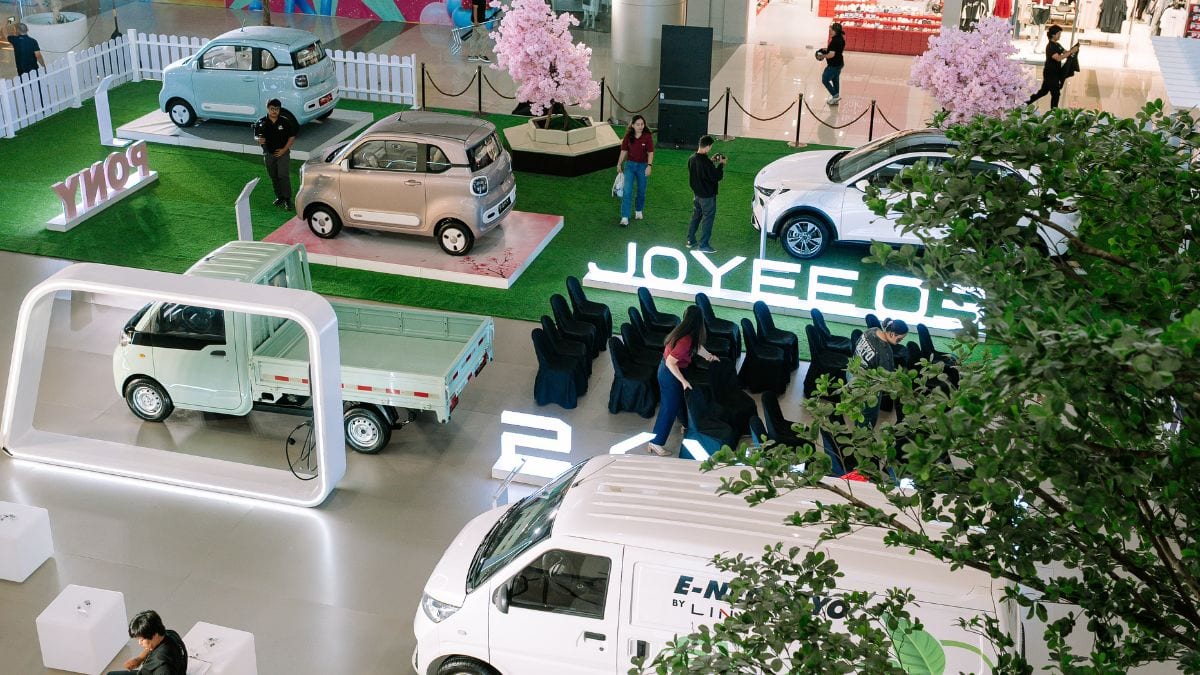
Taken together, the QSJ lineup covers three distinct EV use cases at once: affordable urban commuting through the Pony, mainstream family driving through the Joyee 03, and commercial logistics through the BAW and Lynxs range. Few brands operating in the Philippines right now are trying to cover all three simultaneously.
Angela Miranda-Asebuche, QSJ Motors' marketing manager, describes the pitch as electric mobility that's "a practical solution that is available today," meant to lower operating costs, improve efficiency, and support a cleaner transportation ecosystem for both private motorists and businesses.
The mall-based tour strategy backs that up in practice, letting shoppers inspect vehicles up close, ask about charging and ownership, and compare passenger and commercial models side by side instead of relying on a showroom appointment. After Clark, QSJ Motors moves the campaign to SM Center Urdaneta Central and SM City Cebu, where the Bestune Pony and Joyee 03 will also be on display.
A handful of new models landing in showrooms is the smallest part of what's happening here. The bigger shift is how quickly the conversation around Philippine EVs has moved past premium electric sedans and luxury crossovers into small city cars that can replace a daily gas commute, family-sized crossovers, and delivery vans that cut into a business's operating costs. FAW Bestune and BAW are bringing increasingly competitive electric products into the country, and Filipino consumers and businesses now have more real options on the table than they did a year ago.
View More Articles About: