Gardens and Mountains of Philippine Literature
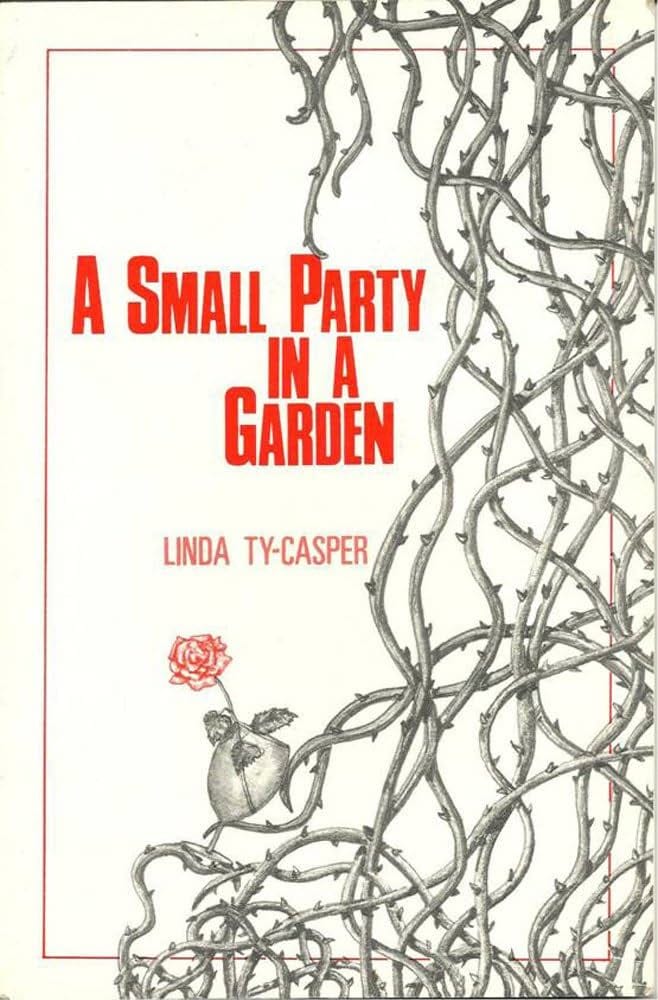
A revised and critical edition of Linda Ty-Casper's Martial Law novella, A Small Party in a Garden (1988), is slated for release this year.

Published on Jan 8, 2026
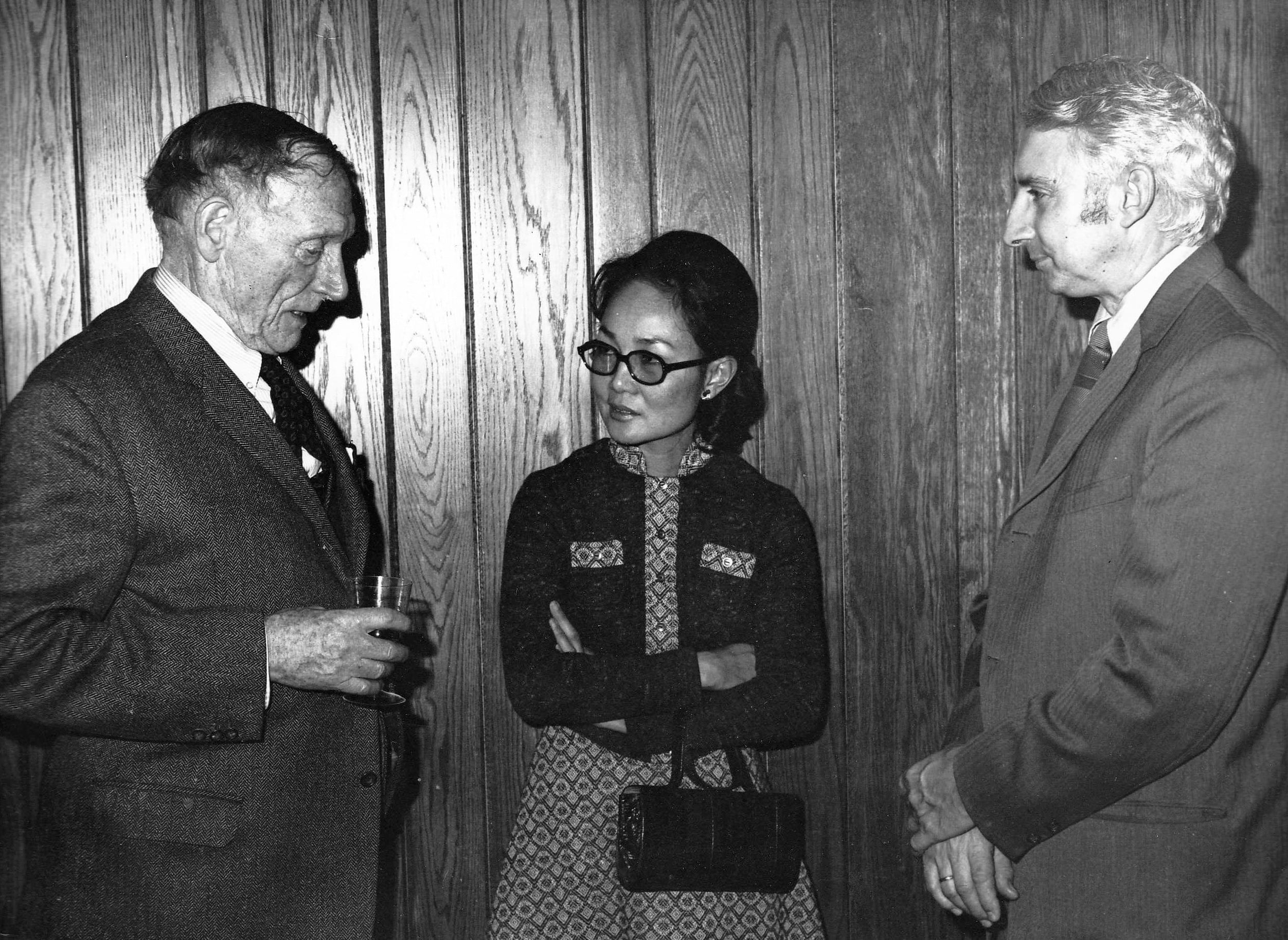
In April of 2025, I visited the novelist Linda Ty-Casper at her house in Massachusetts. Grace Talusan, a Filipina American writer at Brown, accompanied me. When we arrived, Linda was standing at the door with her walker. She looked frail, her hair tied back. It was warm and tidy in her house. A brass banana tree stood next to a bouquet of Capiz shells. Beside the fireplace lay a vintage rattan chair and a black leather lounge. There were wood carvings, a string of amulets with fake Latin spells on the wall. The living room had a long window, framed by potted plants that blended with the view of the trees outside. Behind the trees was the winding river. Linda sat Grace and me at the round table where we chatted. Every now and then, I looked out to see if the swans, about which Linda spoke tenderly, were up and about.
I listened with great fascination. Each word she uttered carried the dignity of a witness. I marveled at the fact that I was face-to-face with someone who had a direct connection to more than one hundred years of Philippine history. From her grandmother, whom she called Nanay, she learned about the Spanish colonial times. Her earliest lessons regarding the Philippine Revolution came from Nanay, who had summoned Linda at an early age to write her tales down one day. Born in 1931, when the US flag flew over the islands following the defeat of the Spaniards in 1898 and of Filipino revolutionaries in 1899, Linda was fifteen years old when the commonwealth gave way to nominal independence in 1946, much of the ruins of the Second World War still unreconstructed. She came of age in the first decades of the postcolony and studied at the University of the Philippines as the Cold War spread in the Pacific. She met her husband, the American critic Leonard Casper, who was also a war veteran, when he came to the Philippines to teach English and institutionalize Formalism at major universities in the country. At around the same time, the young postcolonial state was containing the Huk rebellion with the support of the CIA.
How lucky I am, I thought to myself, to speak to someone who has witnessed the evolution of the republic under three flags—American, Japanese, and Filipino. Her stories linked me to a vanished world that existed long before I was born in 1977, five years after the declaration of Martial Law in 1972. Through her tales steeped in history, Linda became my surrogate Nanay. My historical world expanded as the knowledge that she had gained from her Nanay and her own experience melded with mine.
I kept in touch with Linda upon returning to Manila with a trove of personal papers from her and her late husband, which represented the first donations that launched the Ateneo Archive of Philippine Literature in English, an initiative whose establishment was funded by Robby Kwan Laurel. Following our initial meeting, I sent emails to Linda with photographs that I had taken of the parts of Manila that she knew. When she wrote back to say that her uncle had owned a pharmacy on San Fernando Street in the San Nicolas District, I went looking for it, taking pictures as I retraced her steps deep into a place that was unknown to me, where a fork in the road led to a view of the Pasig River, the ancient walls of Intramuros looming on the other side. But there was no pharmacy. Instead, I came upon a historical marker that revealed the deathplace of Teodora Alonso, mother of the American-sponsored national hero, Jose Rízal. In place of the original house, there is a high-rise building on 478 San Fernando Street now.
I emailed the photographs to Linda in November of 2025, a few days after the fictionist and publisher Cecilia Manguerra Brainard invited me to write the introduction to the revised edition of Linda’s Martial Law novella, A Small Party in a Garden, whose revised and critical edition is slated for release in early 2026 by the Philippine American Literary House. As I write these words I realize that the aimless trips that I took to San Fernando Street were my preparations for Linda’s novella where B, the narrator, and her father, the retired Judge Arvisu, go on an unplanned journey back to San Filemon where the facets of B’s life and the entanglements of her relationship with her father, and the regime for which she is working, are revealed. The novella was first published in 1988 in Manila, two years after the EDSA Revolution toppled the dictatorship and sent the Marcos family to exile in Hawaii, a settlement that then U.S. President Ronald Reagan had brokered.
Divided into two parts, A Small Party in a Garden is deceptively quiet. The first part involves the charmed life of B as a speechwriter for the First Lady, who remains unnamed, although it is clear that the woman known as Madame is no other than Imelda Marcos. It unpacks the jet-setting lifestyles and the powerful networks that shape B’s work, particularly her close circle of friends who went to Cornell and came back to Manila to prop up the dictatorship and profit from it. The second part, prompted by the guilt that haunts her after witnessing the accidental death of a random pedestrian, takes her on a trip back to her childhood home after her mother’s passing and then, finally, to San Filemon where she reconnects with the old world of her father and confronts the horror of the dictatorship that brings her to her knees, her Ivy League pedigree and connection to Malacañan unable to provide her with the protection she so desperately needs. The first part consequently involves the perfumed interactions among intellectuals, industrialists, officers, and technocrats whose lives revolve around exclusive garden parties and the forbidding halls of power. The second part concerns the more personal struggles between B and her domineering yet conscientious father, and the eventual journey back to their roots that ends in tragedy in the wilderness, which represents the seething forces of unrest in mountains far from the presidential palace. The former is accordingly urban and civilized, the latter, rural and civilized otherwise, the site of forests, minerals, and revolts.
We think that gardens and mountains are opposing forces never to meet, but the novella sets them up for a brutal confrontation towards the end, where the reader is left with B’s dilemma in the beginning: How to flourish, where can the new arise, when all is rotten in Malacañan? The opening chapter’s titular party in the garden contemplates this question as it foregrounds the peak of B’s reflected power to foreshadow the great fall that awaits her. In the course of the novella, B moves from the garden of refined sensibilities in Ithaca and Manila to the mountain of historical violence that boomerangs and saves no one in San Filemon. We are all doomed citizens of San Filemon, the novella suggests, and there is no exit.
The stifling atmosphere is apropos given the dictatorship as the setting. It does not help that B’s father is also a royal pain from which B has been trying to flee. Thus, the dictatorship of father figures—Ferdinand Marcos and Clemente Arvisu—is what B installs as monuments for her to dismantle. The novella’s feminist tenor is set against its authoritarian milieu. B’s feminism, however, is personal, at least in the beginning. The unfreedom of the woman is the battle that exists for her, which explains why, despite the political repression, she can live with the contradictions for as long as her individual freedom is secured. She flies to New York, Washington, Brussels, Paris, London. She goes where the Madame goes. On the surface, she is fine with her job and its perks—a Patek inscribed to her by her boss, a VIP ticket to the best operas in the world, a Picasso drawing. More than anything, the problem for B is existential, namely, a philosophical burden. B is loveless, after all, besotted with the memory of Richard from her heydays in Ithaca, a romance that endures even if it had never come to fruition in the first place. “I want,” B says, “to run away. The lights are squirming. You’ve never had a real love affair, I tell myself. Turning on the charm is not the same. You have to open yourself to someone you’re afraid to lose, who cannot be replaced by anyone else. How does one meet such a person? Through luck or mere perseverance?” The question finds its answer in Sally, a fellow Cornellian with stakes in pharmaceuticals, who sneers, “No marriage lasts. All vows are meant to be violated.”
B’s existential angst cannot last long, however. The hand of history reaches wide and deep. It cannot be avoided, nor can owning Patek and Picasso shield anyone from it. This truth comes no less, as it should be, from the novelist among the Filipino Cornellians, Pete. Like B, Pete is single. Unlike B, he holes up in Baguio to pursue his art, away from the contaminations of social class and literary coterie. The monkish life grants him the clarity of conscience as a critic. His diagnosis is sharp. “We’re, the whole lot of us, Sisyphus. Instead of rolling stones up a hill and down again, hoping, on the way up or the way down, it will catch and stay in place and end the ceaselessness—we juggle the hours, running here and running there, hoping they will somehow connect into full and satisfying lives which we see as always just beyond reach. There. Out there. We’re not far from it but we’re not there, might never get there.” “Filipinos are existentialist by birth,” Pete concludes. But we are existentialist, too, by dint of history.
In the second half of the novella, Pete disappears, but his moral voice is replaced by B’s father, Judge Arvisu. But there is a key difference. In place of Camus and Freud, who serve as the fodder for Pete and B’s appreciation of the world, Judge Arvisu draws instead on his own experience as a guerrilla fighter who resisted the Japanese occupiers and now criticizes the Marcos dictatorship. A contrarian through and through, Judge Arvisu is not only a father to B but also becomes the voice of history, one that enables self-understanding. Seen this way, the road trip to the countryside is a form of self-reflection, occasioning B’s immersion in the social realities that heretofore she has carefully avoided, intentionally ran away from, or totally ignored. That is, the trip to San Filemon is a spiritual, philosophical, and historical journey that the father and daughter undertake to trace the roots of their personal conflicts back to collective predicaments. They immerse themselves, B in particular, in the ways of common folks. Before this trip, B’s exposure to ordinary lives was limited to Viring, B’s trusty maid, who represents everything the former is not, but one who foretells the tragic ending: One is utterly naked and violable in the face of unreasoning might.
More than the father who leads the way, B molts into a different character—in the car and on the road. The trip to San Filemon transforms B, compelling her to shed her titles from Cornell and Radcliffe as her father introduces her to Panyang, maker of the best kanduli in all of Calamba. “He is trying to shock me,” B says, “by offering to treat me to a place which has no tablecloth, where the spoons are stacked beside the toothpicks, for flies and idle hands to pick on.” She accepts her father’s invitation to see things from his perspective, appreciate his version of the past, and be one with the common people. “Now that there are just the two of us—two stubborn and irreducible, one to the other—I am learning to keep the peace,” she says. It is nothing short of B’s renativization, wherein she begins to see life under the dictatorship not through rose-tinted glasses that she herself helps to manufacture as a speechwriter but, rather, from the combined perspective of history and the common people. By assuming this new perspective, B leaves Ithaca behind and enters the lay of San Filemon, moving from gardens to mountains where the people reside, their discontent simmering just below the surface. Judge Arvisu and the folks on the way to San Filemon serve as B’s guide in her journey of renativization. The close encounter between B and Judge Arvisu brings to mind the conversations between Don Lorenzo Marasigan and his daughters, Candida and Paula, in Nick Joaquin’s A Portrait of the Artist as Filipino, wherein conflict occasions an indispensable self-knowledge. The journey of self-knowledge is the quest for redemption. In the novella, the metaphors for this redemption are gardens and mountains that act as ciphers for the social rifts that mar the local community. The destiny of the Filipino nation, the novella seems to say, is to turn mountains into gardens: To transform the wilderness into a society that works for all, especially the least. The task is to make the party open to all.
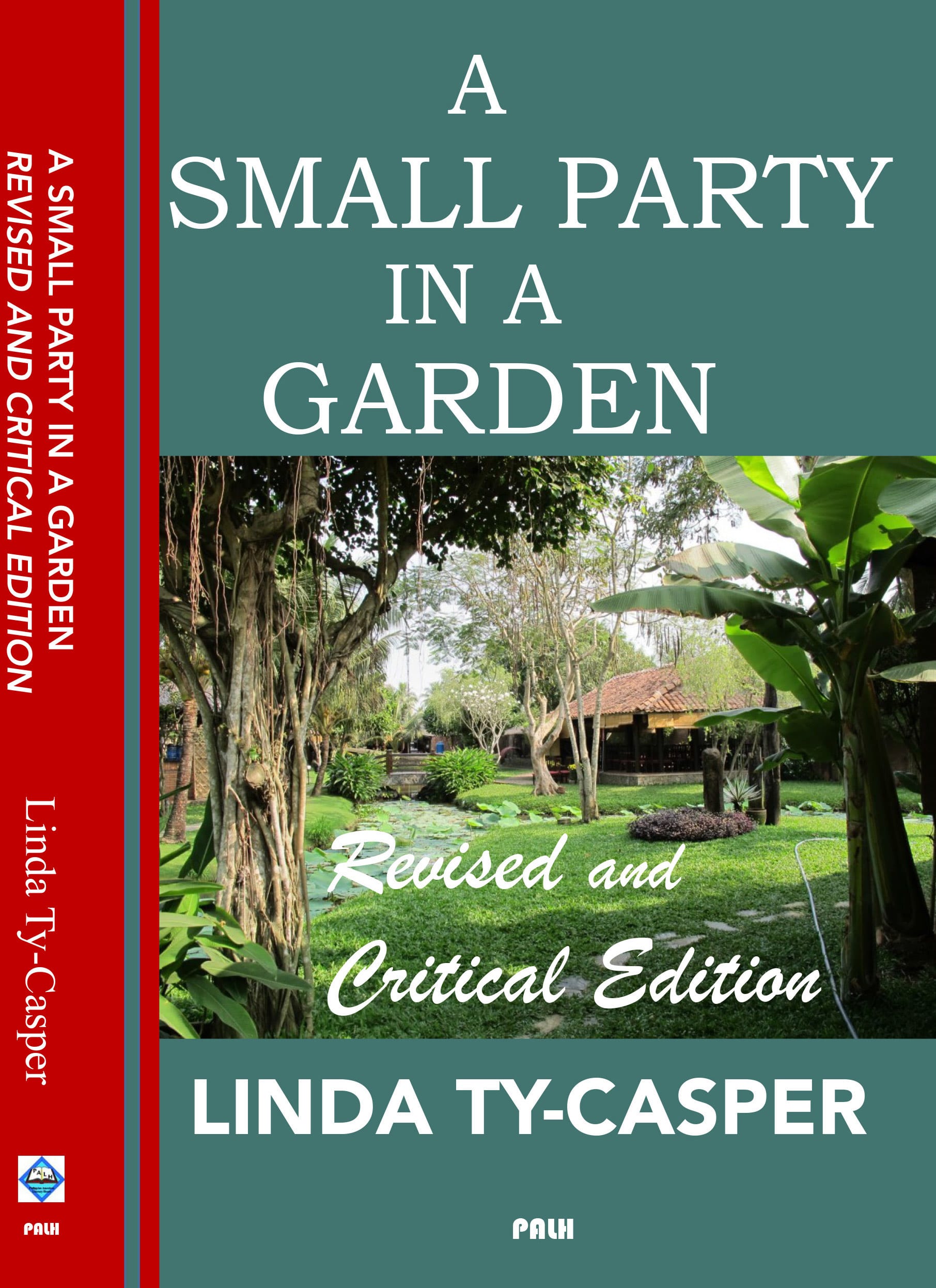
But as the ending of A Small Party in a Garden and the ascension of Ferdinand Marcos, Jr. to the presidency in 2022 show, Filipino historical self-knowledge remains unfinished and is never more urgent than it is today. The republication of the novella is, thus, both timely and necessary. Three interrelated contexts enhance its timeliness: First, the resurgence of studies on Martial Law following the victory of Marcos Jr., for which the bloody rule of Rodrigo Duterte paved the way; second, the transpacific revival of interest in the literary work of Linda; and, finally, the impact of U.S.-educated Filipino technocrats and intellectuals on postcolonial knowledge production since 1946. Taken together, these interrelated contexts help us not only to see the value of A Small Party in a Garden and why it continues to matter, but also to understand how the postcolonial novel of justice might be conceived more fully.
Indeed, the republication of the novella marks a historical conjuncture, coming on the heels of the election of Marcos Jr., whose family’s return to power was clinched by the Dutertes. Shortly after Duterte swept into Malacañan in June of 2016, he ordered the burial of the remains of Marcos Sr. in the Libingan ng mga Bayani in November, a move that began the full-blown rehabilitation of the Marcos political brand. The remains of the dictator had been frozen in Batac, Ilocos Norte, for twenty-three years before they were given a hero’s burial. On Duterte’s watch, Martial Law was declared in Mindanao that led to the flattening of Marawi City, as his fake drug war terrorized the whole nation. According to one estimate in 2018, midway through Duterte’s reign, about 20,000 victims were summarily executed, including the teenager Kian de los Santos, which were enough to pack the Araneta Coliseum to the rafters with corpses. Duterte’s strongman rule reinforced warlordism, toxic masculinity, military adventurism, and impunity, all of which are present in uncanny ways in the novella. Later, the Dutertes and Marcoses campaigned on a platform of unity, propped up by massive online disinformation, and installed the dictator’s son as the new president almost forty years after the family was forced out of Malacañan in 1986. As a response to the rehabilitation of the Marcoses and the rise of disinformation, civil society, universities in particular, ramped up the publication of studies that countered the Marcos lies. Reissuing A Small Party in a Garden is of a piece with this development, and what is special about it, and also historically consistent, is the fact that it comes from the efforts of progressive Filipinos in the diaspora who had participated in anti-Martial Law campaigns in North America in the 1980s. Linda herself was part of this movement.
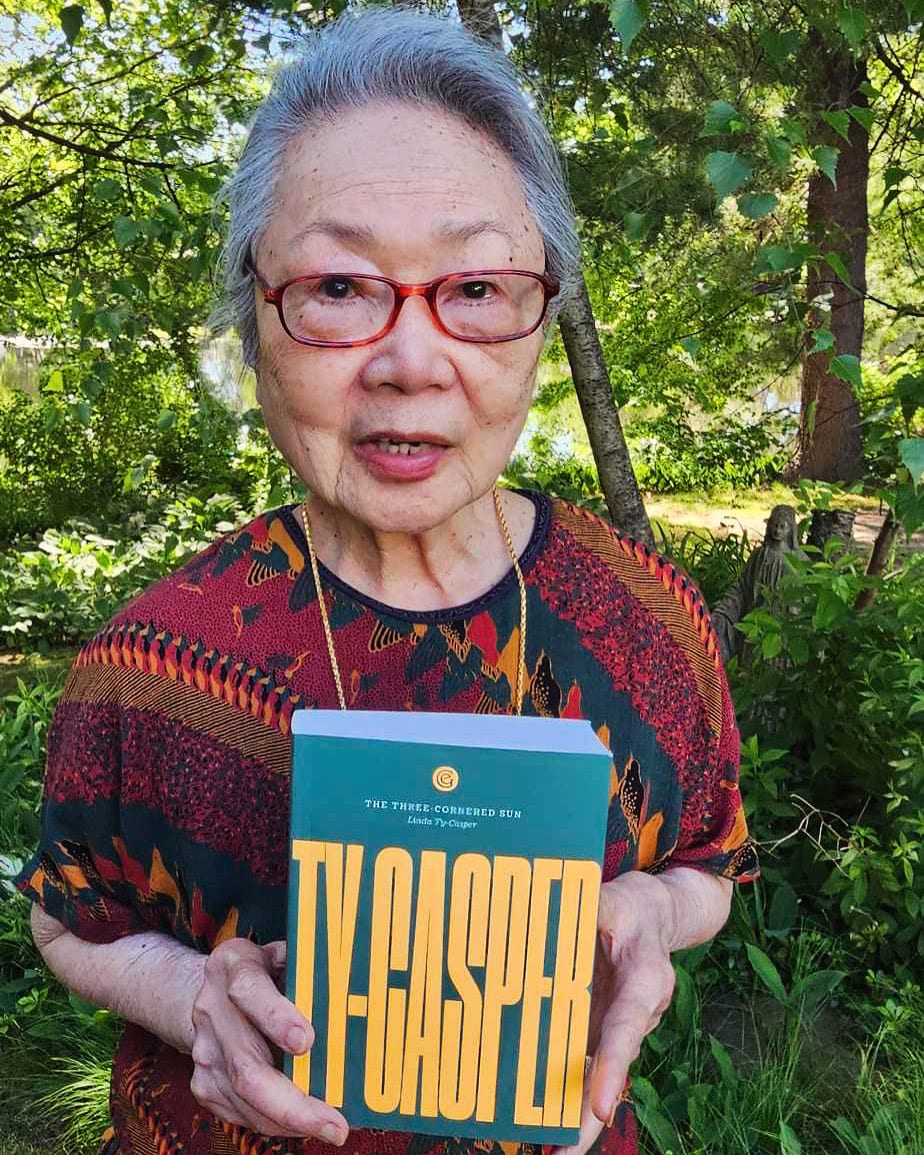
The reissue also comes in light of recent attempts to rediscover lost classics in Philippine Literature in English and introduce them to a new generation of Filipino readers. Founded by Mara Coson, Exploding Galaxies leads one such initiative with the republication of Wilfredo D. Nolledo’s But for the Lovers in 2023, followed by Linda’s The Three-Cornered Sun in 2024. Meanwhile, the Philippine American Literary House published Linda’s memoir, Lives Remembered, in 2025. That the revival is happening simultaneously on a transpacific scale is significant in that it demonstrates the deeper collaboration among Filipino writers in the homeland and the diaspora. Equally significant, the initiatives strengthen the Filipino literary tradition on all fronts and create a wider readership for our authors in ways that complement, and also go beyond, university and trade presses.
Finally, the novella’s reissue clarifies the impact of U.S.-educated Filipino intellectuals on knowledge production since the grant of independence in 1946. By fictionalizing the inner conflicts and moral obligations of B, A Small Party in a Garden puts a human face to the corruption, alienation, and awakening of the postcolonial intellectual who is torn between her American training that ensures power and the need to change a moribund system that stifles creativity, erases history, and perpetuates division. As the novella makes clear, such a condition thrives on the social death of the majority, prevents the development of a truly Filipino culture and identity, and creates political dead ends that foreclose the future. Equally important, the novella presents a tangible—and therefore edifying—study that draws on the symbolic importance of what may be termed the Cornell Cabal and its problematic effects on postindependence national culture. It is possibly the first Filipino novella to grapple with Cornell-educated intellectuals with care and sensitivity. Since the founding of the Southeast Asia Program at the height of the Cold War, generations of specialists in Southeast Asian Studies were trained at Cornell which produced historians, anthropologists, and sociologists whose works came to define contemporary postcolonial historiography from the 1960s to the present, including Reynaldo Ileto, Vicente Rafael, Patricio Abinales, and Caroline Hau, among others. The program was established at Cornell as a U.S. Cold War instrument to contain communism and promote liberal values in the region. The novella touches partly on this theme, but its remarkable value lies in the fact that it toggles between historicity and fictionality—namely, between truth and imagination. As a work of historical fiction, its foundation consists of facts, yet one that extends the reach of truth to include human conflicts, contradictions, vulnerabilities, and uncertainties that only literature can plumb to great effect.
In other words, the novella provides creative reconstructions of history where we come to terms with lofty questions rooted in structures of feeling. What does it mean that our best minds are educated at the best universities in the most powerful nation that colonized us? How can our intellectuals overcome Western bias and connect in authentic ways to our people’s dreams? What intellectual alternatives can there be that will help us to realize our flourishing? A Small Party in a Garden hints at these questions, but it will be a mistake to think that the novella is uncontaminated, providing an unsullied critique. For the novella, too, is complicit given how its storytelling is reminiscent of U.S. Cold War formalist aesthetics. The trope of the garden, for example, recurs throughout the novella to tie up the narrative and keep the plot moving forward. The technique makes the novella tightly woven, a perfect little story from beginning to end whose strategy makes it no different from the best specimens of Southern fiction by Flannery O’Connor or Eudora Welty. Formalism was entrenched as an American import in the Philippines, one that took off in the post-war period and was cemented with the establishment of the National Summer Writers Workshop at Silliman University in 1962. In short, the novella’s tenor is critical, yet its storytelling is steeped in Formalism whose connections to the Cold War dispensation cannot be ignored. If Cornell is complicit in propagating containment policies in the Philippines and the wider Asia Pacific region during the Cold War, so is Formalism in window dressing the colonial and neocolonial relations between the US and the Philippines.
This, then, is the novella’s dilemma: How to reckon with complicity, and resolve it finally? The novella’s redemption lies in the direction that it takes. It starts with Ithaca and continues in San Miguel, where Malacañan sits by the Pasig River. From Makati, where B lives, it moves back to Malabon to capture the reunification with the father and the remembrance of the dead mother, an unplanned itinerary that continues with a road trip with the father and daughter. From Malabon, off they go, passing by Cubao, then Parañaque, before exiting at South Superhighway on the way to San Filemon, where B’s father owns a farm with a sentimental value. Everything goes well before the trip takes a wrong turn. Entailing a movement from gardens to mountains, the pursuit of a destination is a descent into the nightmare of the historical present and the injury of the past. In taking us on this trip, the novella does not spare us from the pain. In fact, it plops us in the front seat and plays before us, like a movie, the fraught story of our postcolonial lives. By telling us the story the way it is—complicities and complexities included—we begin to understand ourselves and mark a point in our evolution as a people in search of a better country.
Although formalist in style, the novella constructs a decidedly Filipino reader. If other nationalities come upon it, they have to deal with the novella’s idiosyncratic language on their own. For the author makes no room for a translation or a guided tour. It is curious that this Filipino readership, which assumes familiarity with native history and language, is realized more fully in the second part, where B’s journey of renativization occurs. Halfway into their trip to San Filemon, for example, B begins to observe her father’s speech. “I recall suddenly that he never used the word ‘instead,’ en vez, sa halip na. But it makes no difference to me,” she says, “whether it is en primera vez or muna, or where I spend the two days I am giving to him.” The observation denotes not only B’s heightened awareness of her father’s linguistic quirks but also reveals a particular readership for whom the novella is intended. It is written for a Filipino political community that only begins to come to terms with itself using its own language, its history, and its vision of the world.
Writing in 1993, five years after the novella was first published in 1988, NVM Gonzalez defined what he called the novel of justice. “Living in the milieu of postcolonial and neocolonial societies,” he wrote, “we tend to forget that imperialism dies hard.” Heavy is the burden of the Filipino writer, Gonzalez said, who must write the novel of justice wherein “the writer configures a world out of life and language derived from colonial or postcolonial milieu.” The duty is heavy because the Filipino writer must invent “strategies of narration in order to bring off the theme of oppression, the territory provided by their perceptions of the workings of empire.” In A Small Party in a Garden, a milieu exists to plumb the Filipino soul, spanning the horror, nightmare, and disgrace of the choices we make on the long road to becoming free, to becoming postcolonial at last.

Poet, intellectual historian, and curator, Charlie Samuya Veric is the founding director of the Literary and Cultural Studies Program at the Ateneo de Manila University, project leader of the Ateneo Archive of Philippine Literature in English, vice chair of the Humanities Division of the National Research Council of the Philippines, and former fellow of the Stellenbosch and Johannesburg Institutes for Advanced Study. He is the author of Children of the Postcolony: Filipino Intellectuals and Decolonization, and, most recently, of Regarding the Face of Others: Social Difference and Inhuman Sympathy. His fifth book of poetry, Songs from Manunggul, was published in 2025.
READ MORE:
Lives Remembered, Histories Regained
The Firewalker
View More Articles About: