
The Firewalker

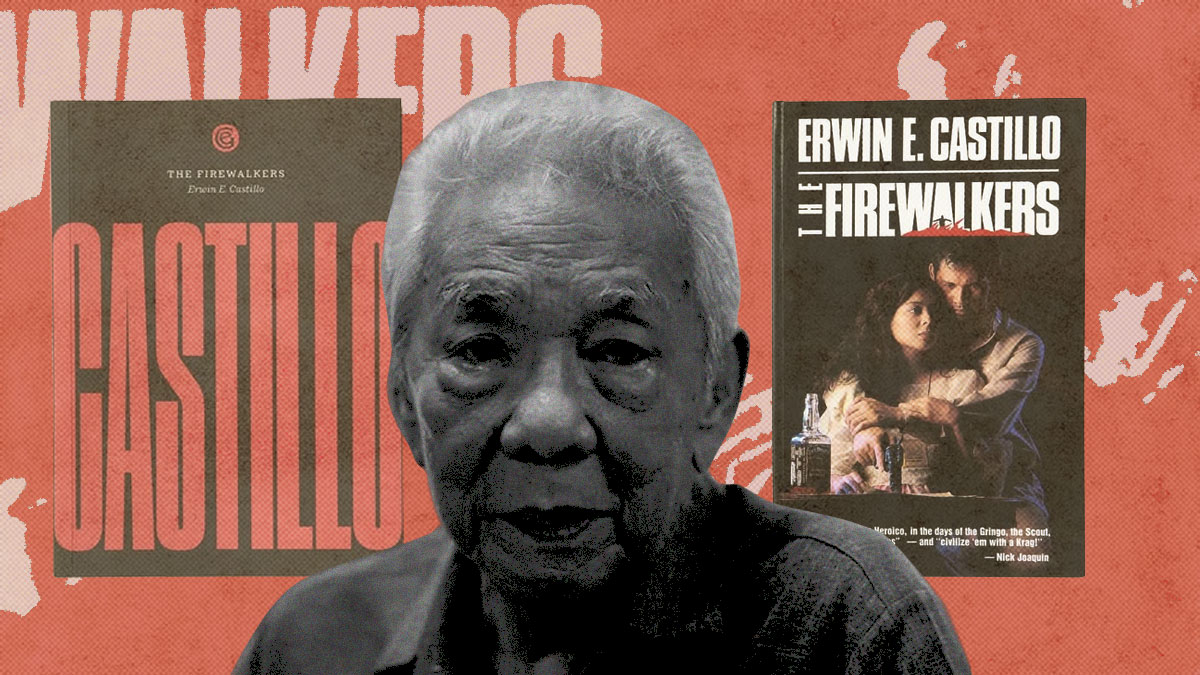
ILLUSTRATION: Igi Talao
This story was originally published in the October 2013 issue of Esquire Philippines.
It is getting dark in the walled pavilion. The batteries in our digital recorders are running low, and the sounds of the crickets have risen. From time to time, we hear small hard things tumbling on the roof. “Those are mangoes,” he explains.
I don’t know for sure if Erwin Castillo, novelist, poet, painter, musician, advertising man, pugilist, martial artist, and sport shooter, looks like the man I met some twenty years ago at the Silliman University writer’s workshop in Dumaguete City. He had blown into town in the middle of the workshop and promptly set up nightly headquarters at a bar on Rizal Boulevard, gathering old friends among natives and fellow visitors. He had also just finished his novel The Firewalkers, which begins thus:
ONCE UPON A TIME, IN THE YEAR of 19 hundred and 13, there lived in the mountain town of Lakambaga, the province of Cavite, a man named Gabriel Diego who was sergeant of police. He was a widower and childless, and because this town fairly overbrimmed with blood relations and old acquaintances, he was conspicuously apart, patrolling the streets in his sevastopol cap, his faded khaki uniform with creases sharp as blades, hair and mustaches close-cropt. In the night of peace, the people turning in their sleep had learned to expect his quiet, formal coughing — as if he threatened to orate or to sing — to hear the drop of his cane punctuating his retreating footfalls every once and again.
His friends would bear the brunt of his—and his novel’s—resultant energy; Dumaguete native and fellow poet Cesar Aquino would end up hospitalized for exhaustion. I suppose it was darkly funny, but to beginning writers, it was no cause for laughter. Castillo was an especially burly presence. We knew him to be tremendously gifted and extraordinarily wealthy, and we had been warned of his temper. Therefore, we all hoped one day to be like him.
ALSO READ:
Lives Remembered, Histories Regained
How I Wrote It: The Age of Umbrage
Like us at that time, Erwin Castillo was dirt poor when he arrived in Manila from his hometown of Cavite to attend high school at UP Prep.
“It was a strange city to me,” he says. “People would say ‘your mother is a whore’ and smile. Those things weren’t done in our mountains. You don’t say that to a Cavite boy.”
Cavite in the 1950s was a quiet and old-fashioned world quite removed from Manila, and UP Prep was the center of a stellar public school system to which it was notoriously difficult to gain admission. Castillo found himself a talented young scholar surrounded by snobs. “I started hitting people,” he says. “I developed an anger.”
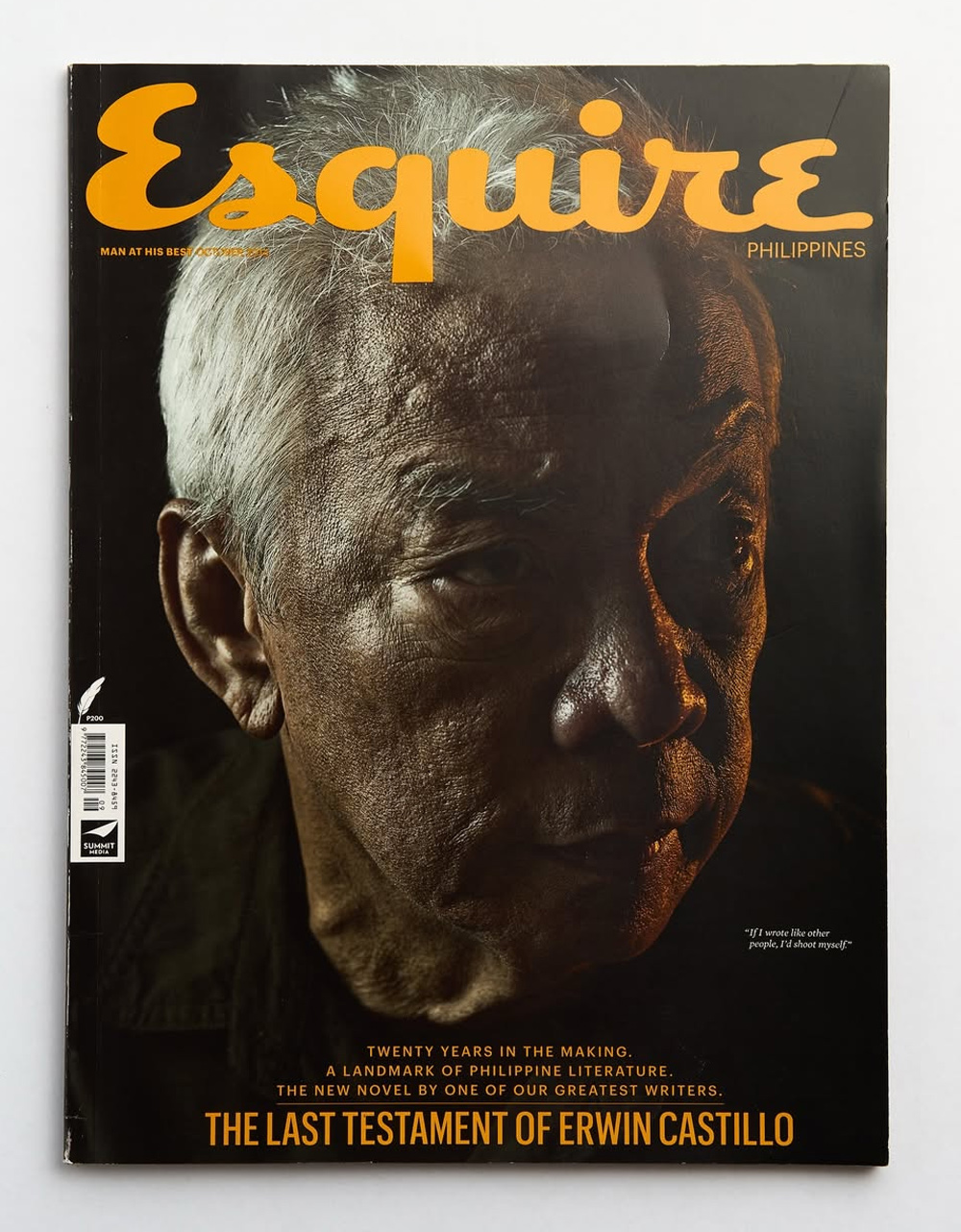
Erwin Castillo on the cover of Esquire Philippines' October 2013 issue. Photographed by Tim Serrano.
Castillo’s story begins—literally—as a prizefighter’s tale, starting as an unknown in the city streets, a fresh, wide-eyed recruit from the boondocks. “The first time I saw a jab was in Manila,” he says. “In those days, children fought at fiestas.”
He verbalizes the punches, his delivery startling the air: “Boom! Boog! Putangina, gan’un pala ‘yun. There’s a science. They taught me!”
Castillo’s first proper competition was an amateur boxing conference called the Diamond Gloves. It was a version of America’s Golden Gloves. He emerged a silver medalist in the bantamweight division. It was one of many prizes he would fight for. At the University, Castillo fought for gin—and the occasional shower stall. For the latter prize, he came up against Fernando Afable, a student of Jose Garcia Villa, who himself had come from the Diamond Gloves. “We would hit each other full power—blood and everything. Pow! Pow! Pow!”
For Castillo, friendships would be formed out of such violence. He recalls poet-critic Jolico Cuadra, who died in May 2013, as someone he feared back in college. He recalls Anthony Villanueva and Flash Elorde. He remembers brawling buddies, drinking buddies, shooting buddies.
“Let me talk to you about FPJ,” he says. “That’s a person I love very much.”
“To this day, I weep when I remember him. But I was not an admirer in the beginning. He assumed that I was like everybody else (in advertising) and therefore beholden to him for a living. He was an artist. We’re both storytellers.”
He tells me an FPJ story, the first of many. “He gets drunk. We’re in his studio. We don’t know each other yet. I never called him by his first name. Someone makes the mistake of calling him ‘Mr. Poe.’”
“’Ronnie,’” Castillo recalls him berating the other guy, flawlessly imitating his trademark drawl. “’sinabi ko na sa ‘yo, Ronnie.’”
It turns out that FPJ has a temper, too. To escape the situation, Castillo falls over—and he fakes an epileptic seizure. FPJ is sober immediately. Someone gives Castillo a cup of coffee. He vomits it out. The car is brought around. He jumps into the back seat. “Remember the ending of Viva Zapata? I jump into the back seat and take Marlon Brando’s fetal position!”
“In the end, we understood each other. We drank together. We are street people,” he explains, laughing large.
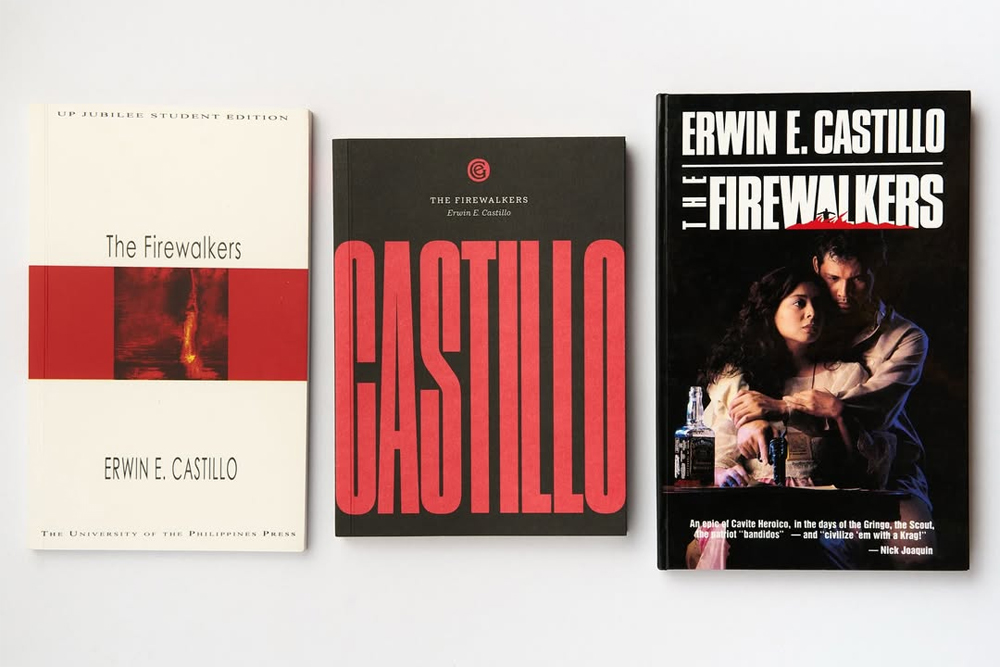
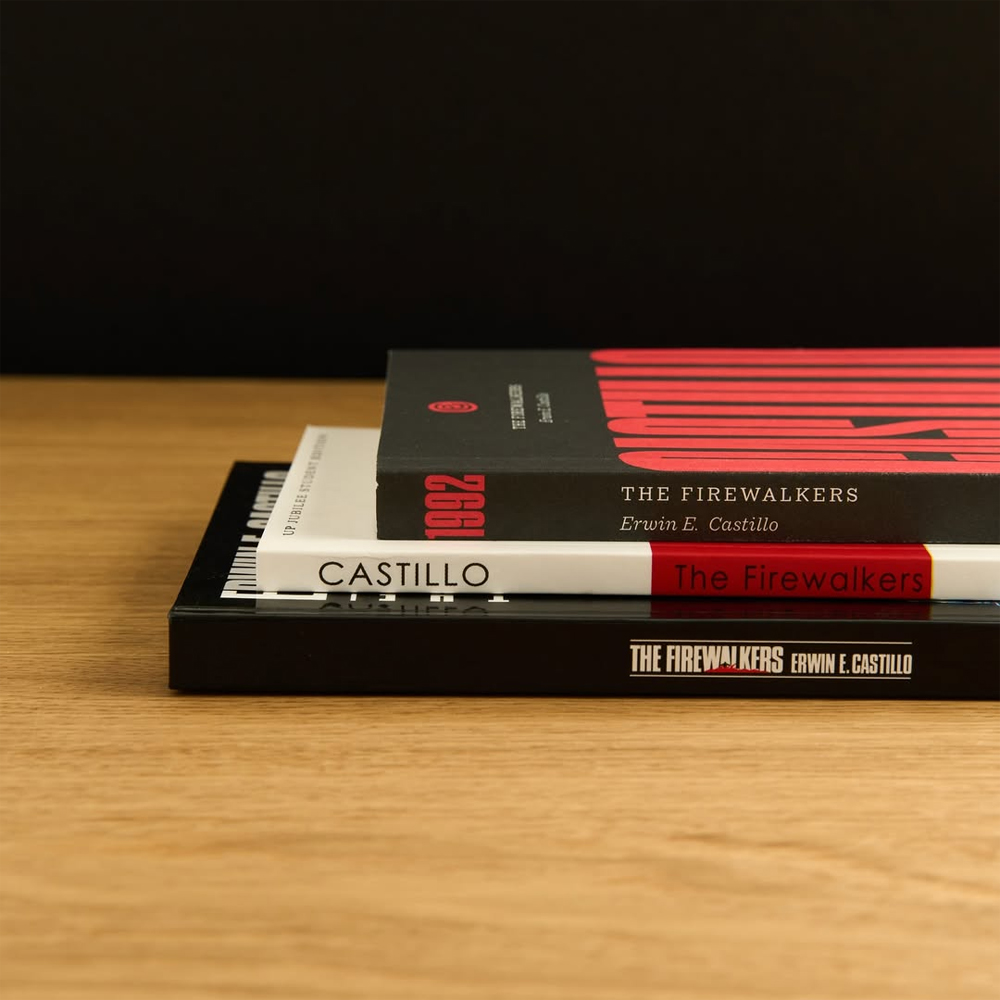
Erwin Castillo's 'The Firewalkers' was first published by Anvil Publishing in 1992 (right), then by The University of the Philippines Press in 2003 (left), and, most recently, by Exploding Galaxies (center).
In 1969, Castillo came to the US to serve a writing residency at the University of Iowa. As it happened, America was also held in an atmosphere of violence. It was the height of the Vietnam War and the Cold War. It barely was a month after the Rolling Stones concert at Altamont, where four people died, “It was the end of an era,” he recalls. “I went to America wanting to go to Haight-Ashbury. I wanted to join the hippies. I wanted to listen to Lawrence Ferlinghetti.”
At the time, he was working in the pharmaceutical industry. “I was a supervisor for Winthrop-Stearns, selling Demerol,” he says. “I wanted out of there.”
He had also already decided on being a writer. “A writer-in-exile is when the writer finds himself,” he proclaims. But he also recalls Wilfrido Nolledo, who was also at the University of Iowa as another writer-in-exile. “Ding was then beginning to raise his family, and the whole Nolledo household was dedicated to helping him write. He was dirt poor!”
Castillo didn’t want to be poor. “I didn’t want gin bulag. I refused to drink cheap wine or cheap whisky.”
“To be a hungry writer—literally?” He didn’t want to go that far. “I had a knife. I was carrying a knife. If I had to, I was going to climb up the bus and ask for money.” He describes his entrance into the corporate world of advertising in this manner. “I was a highwayman. I was going to climb up, and this is all for my family. So I went into advertising. That is what happened.”
Castillo remained in advertising for the next 40 years, making big, sprawling ads for brands like San Miguel. That was how he met FPJ and became a looming figure in the corporate world. He also built campaigns for other looming figures—political candidates running for senate, or the presidency.
Erwin Castillo made many ads for San Miguel Beer, including this one in 1987.
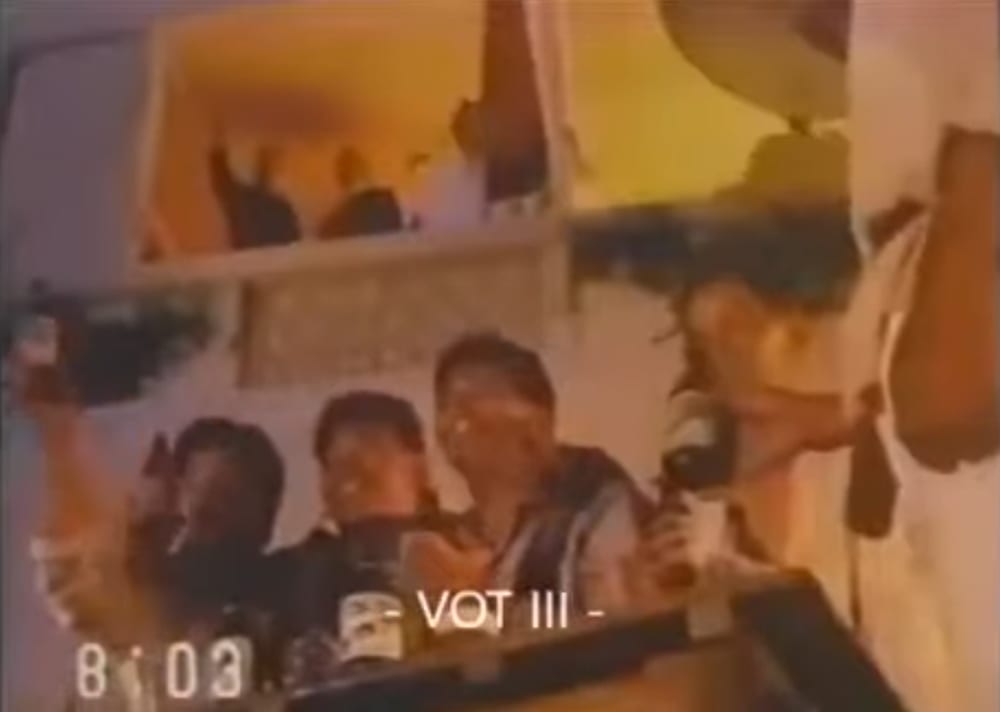
“I work in the trash heap. I work in the real world, trying to earn a living,” he says. “That may also be an excuse. Writing is absolutely difficult for me. It is heart-wrenching. NVM Gonzalez once said one should always write 100 words a day, but I cannot do that.”
At fourteen, Erwin Castillo was going to be God’s spy. This is what a writer really was, Franz Arcellana, his teacher at the UP Preparatory School, had told him. He then fell on his knees and prayed. “God, I accept. I’m going to be God’s spy.”
“This was exactly Joseph Conrad’s fate,” he recalls today. He is now 69 years old. “I was sent to be a salesman in the deep country. And while I was in the deep country trying to sell goods and watching out for my employer, God, God died. So there is no more employer. And I am alone in the back country, still doing God’s work. But there is no more God.”
Castillo’s works do tell of man’s concerns for the divine. More tellingly, they hold a love of the second language of English, much like Joseph Conrad had:
And the tide was taking me outward across the grass, to the gate, and I was fighting knowing there was even greater danger outside, perhaps even death, knowing I should root quickly, drop anchor, because the storm was blowing me outward into the darkness of reefs and sharks and thunder and I knew if I walked on my strength would fail, somewhere, now that you, and Sweet Jesus, and the Sad-Eyed Lady of the Lowlands are all withdrawn, and from where I fall would be a difficult time, what with the opened German assassin's knife still here in my hand, to be swallowed saying Hello-hello-hello! I would have to wait out many voyages, many years, and hope that everything return with health — I should run, ride the bike, box, but the boys are gone from the corner and where are they now? — and just stay. Just stay. Where are you going? I asked myself, leaning against the gate and pulling at the bolt until the gate sprang open with a rusted scream and I was outside under the street lights, saying your name, not knowing where to run, where to fuck, which friend to visit and drink with. And then find myself saying things I should say to you, only, if you were here and loved me still. I should have died, I knew. I should have drowned and died. (“The Watch of La Diane,” 1972)
“I learned language from Presbyterian missionaries,” Castillo says. “Our grandfathers in the mountains were out of the church. They were masons. The Catholic Church would not let them in. The Presbyterians came down to speak. That’s when I learned the language of King James.”
“My mother was a teacher of Tagalog. But it was English that affected me very, very much. The prayers, the benedictions. All of these wonderful things.”
It is a different language from what we are accustomed to in Philippine prose these days. Castillo also confesses to a different audience.
“We are writing only for Dunbar’s number,” he says, referring to a theorized maximum number of individual meaningful relationships a person can have, ranging from 100 to 230. It is a number far below the audience size that your average commercial for San Miguel Beer might aim for. It is below the average number of friends a given individual might have on their social media site of choice. By today’s standards, it is a number that seems inadequate and lonely.
Castillo doesn’t seem inadequate, and neither is he lonely. He is constantly surrounded by family. Our private interview is graced by the presence of a precocious grandson, an obedient son, and a doting wife, among other personalities drifting in and out of the pavilion, which is several meters from his large home.
There is a popular image of the writer as a lone figure. But writers know they cannot live alone. Today, Castillo seems truly embarrassed to make pronouncements such as “I got by because people were scared of me” and “I was a drunk.”
Castillo recalls being ashamed even to ask for blood before a bypass operation. “’That’s OK—I’ll buy blood,’ I said, pretending to be a rich person. ’No,’ they said, ‘there is no such thing as buying blood anymore. You have to have friends. It was suddenly very strange to me because I have no friends who will give blood. Cesar Aquino will not give me blood. Krip Yuson will not give me blood!”
Blood did come—in the form of contributions from 200 or so Navy men he previously trained with. It is a number that is very close to Dunbar’s number.
He recalls a recent swimming trip during which he was embarrassed to reveal the scar on his chest. The same precocious grandson who now shoots pistols with him told him, “Don’t worry, Lolo, that’s badass.”
Castillo keeps a gym in his house. There are posters of FPJ films and photographs on the wall. There are remembrances and trophies from his various sports engagements. There is a photo of him at the old Penguin Café with his old literary crowd. I recognize Greg Brillantes, Recah Trinidad, and Jolico Cuadra. In the center of the photo is Nick Joaquin.
Castillo feels that the previous generations of Filipino writers laid their hands on him—in a kind of continuity that isn’t present anymore. “Nick was a person with no jealousy, a person with complete generosity—he knew he was better than us,” he explains.
“But we could have taken him!” he adds, later on, and he explodes again with laughter.
Erwin Castillo laughs like an enemy you never want to face. His story is peopled by brawlers and killers, their broken faces thick with scar tissue and brave laughter. He talks about fistfights and encounters. He talks about being beaten up and losing part of a cheekbone during the Marcos regime. “I’m a bandit,” he proudly declares, “I was taught how to do this, how to get inside…how to go out without getting hit. “
Before the interview ends and it gets too dark to take photographs, he talks about Flash Elorde. His voice has grown thunderous against the crickets and the falling mangoes, and I recognize it as the voice I heard in Dumaguete twenty years ago.
“I sparred with Elorde. I wanted to go up against him. He had just retired. Those are the most dangerous people. I had a photographer who was a very good-looking woman, and therefore he was trying to impress the girl.”
“Pam! Pam! Isa pa!” At the end of the third round, he noticed that Elorde had never thrown a punch.
“Near the end, he just locked me with his feet, and I saw his left hand—Moooo.” Castillo produces the sound from his throat and moves his fist through the air toward his own face, in slow motion.
“Then he opens his palm. And then he laughs!” Castillo laughs, too. And we learn to laugh with him. And this is how friendships are made on the streets, in the ring, in the dark, in the back country.
The Firewalkers by Erwin Castillo (Exploding Galaxies, 2025) is available for P580 through the Exploding Galaxies website and online stores.
