Eminem, Ancient Wood, and the Buddha in a Hoodie
We talked to the artist behind the viral hooded sculptures in BGC that made waves on social media earlier this month.
by JV Ordoñez
Published on May 16, 2026
If you've recently strolled around the iconic black wall by Shangri-La and the Gentle Monster store in BGC, it is likely a hooded statue stopped you in your tracks due to how alive it feels.
The man behind this now-viral piece of street art and many other hooded characters is Beijing-based artist and overall laidback fellow Huang Yulong.
The viral Hey What's Up People by Huang Yulong sculpture in BGC
.jpg)
The prolific sculptor has held exhibitions in cosmopolitan cities such as Hong Kong, Paris, Miami, New York, and Art Basel.
The highly talked-about sculpture, simply named "Hey, What's Up, People," is an invitation to his current gallery debut in Manila, filled at Art Plus in Fort Shang, which runs until the end of May.
Esquire Philippines got to sit down and walk around the streets of BGC with the artist obsessed with committing to an urban flair and his undying love for the 1990s and the early 2000s.
When we asked him why he decided to reconcile his love for hip-hop and sculpting, he gave an initial straightforward and endearing answer. He just loves Eminem and his highly transformative rap semi-biopic, 8 Mile.
"I'm really from that generation: 90s-style hip-hop. But I keep learning the new trends," he said, referencing Central Cee and contemporary UK drill rap as among his current fascinations.
These hoodie-donning figures in his art draw heavily from Confucian, Buddhist, and Taoist iconography. Yulong doesn't want to say some grand philosophical thesis with his pieces.
"I want to use a very simple language. I don't want to make something and have people not understand," the artist told Esquire Philippines.
Party by Huang Yulong
.jpg)
Top Dog by Huang Yulong crafted from Golden Nanmu wood
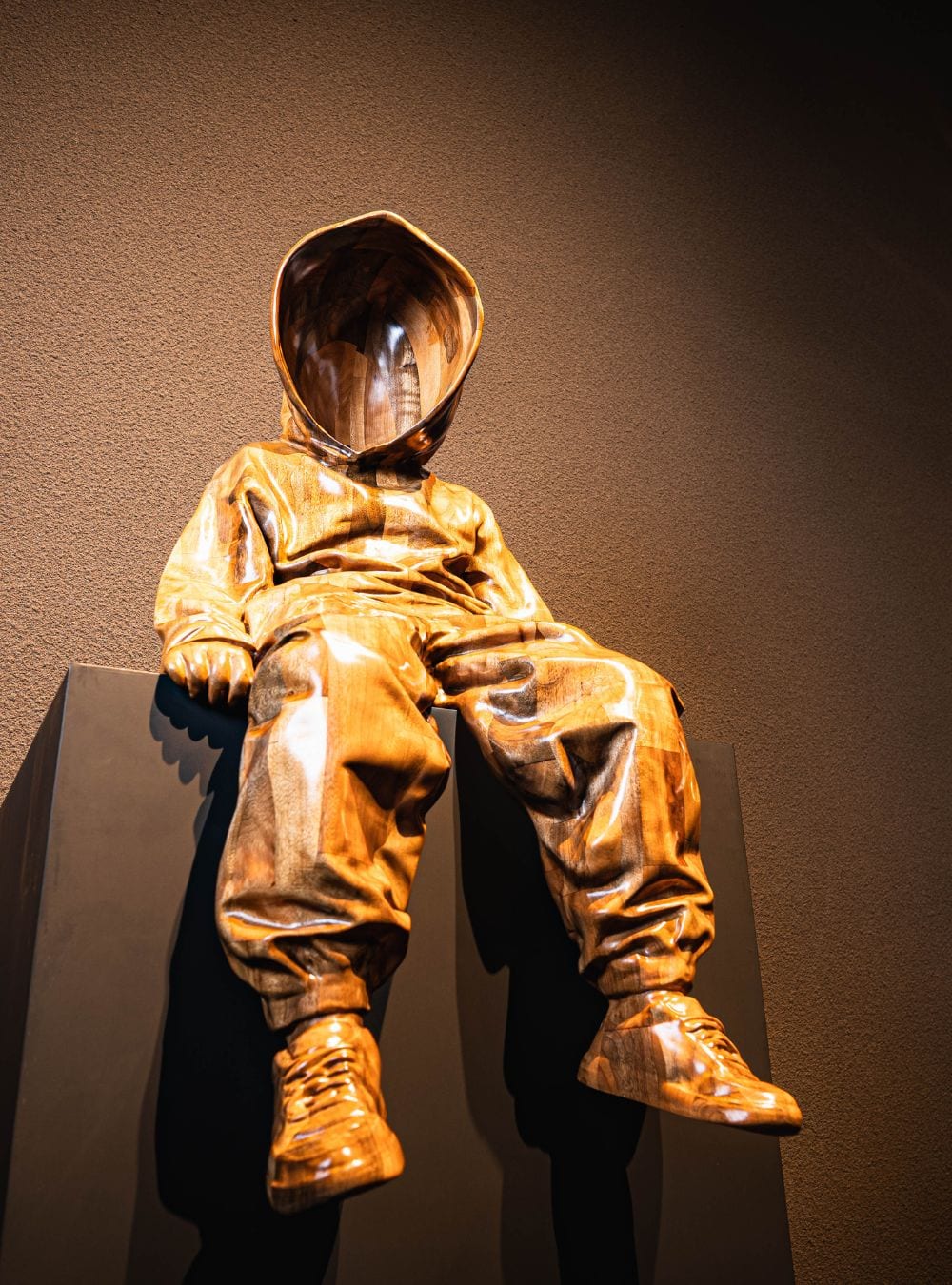
One of his first hip-hop-inspired sculptures is called "Party" and shows the anonymous character posing in a traditional Kung Fu gesture: the left hand covering the right.
"Our right hand is more powerful," Huang explains. "So we use the left hand to cover it. That means I won't hurt you." He calls it a peaceful battle or pride without aggression.
The Manila exhibition also features a rather peculiar piece crafted from an extremely rare Chinese wood named Golden Nanmu, which used to be reserved exclusively for Chinese emperors and temple construction. "Top Dog" harnesses the wood's unique light refraction quality, resulting in a golden hue that drapes the figure in an otherworldly glow.
Yulong noted that golden nanmu took up to a thousand years to form in the mountain provinces in China where it's found.
"Different materials have different languages. We can use this special language to finish our work," he said.
Yulong's free-flowing and almost freestyle-leaning design could also be attributed to his time as a seasoned hip-hop dancer who was obsessed with the legendary Jabbawockeez.
Yulong's tried to sculpt out of everything: ice, glass, and the aforementioned royalty-grade wood.
"Manila is a very international city; the Philippines is a very international country," the Chinese artist reflected on why Manila is a prime destination for all kinds of art.
Huang Yulong’s Manila debut runs through the end of May at Art+ Gallery, Shangri-La The Fort, BGC. For inquiries, contact [email protected]
Tian Di Gold by Huang Yulong
.jpg)
.jpg)
Esquire PH's resident music scribe, wristwatch disciple, and essayist fluent in niche internet subcultures and Philippine politics.
View More Articles About: