

Make Room for Prints: The Changing Landscape of Philippine Printmaking

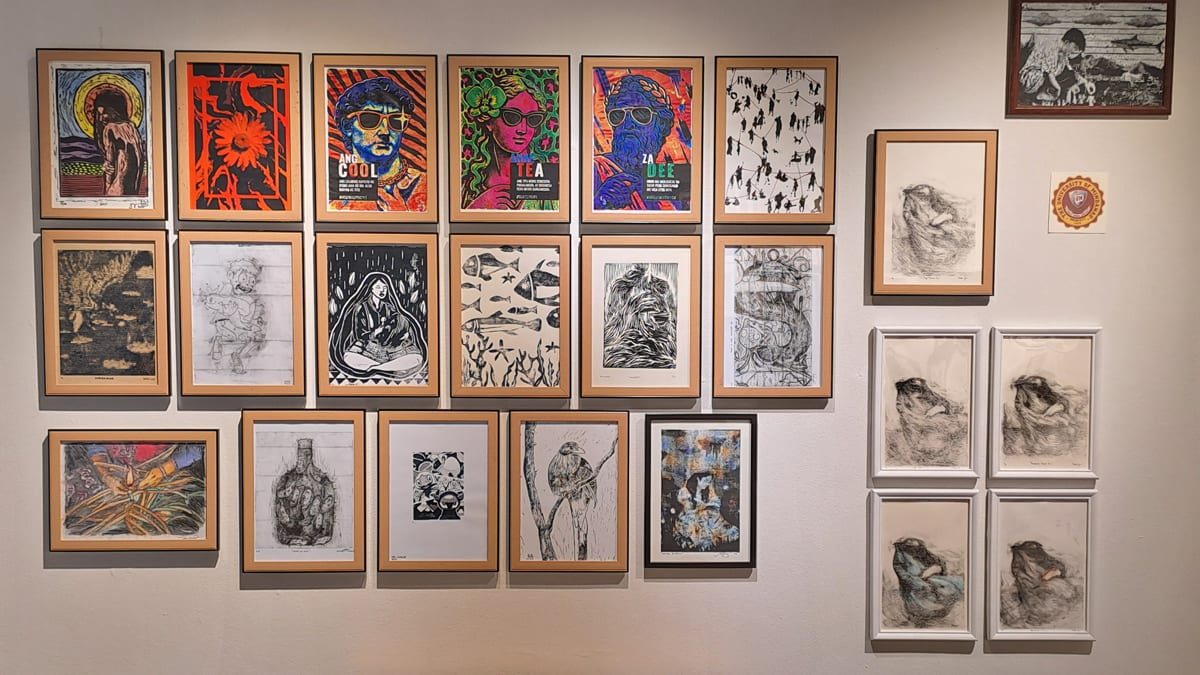
(Main photo: Prints and print portfolios by students of the University of Mindanao.)
Hosting a print fair in a gallery space is rare. Prints—especially on paper—are often overlooked in local art scenes, seen as fragile or less collectible. I've heard these concerns echoed over the years, but lately, there’s been a shift: new interest, fresh advocates, and a growing curiosity about the medium.
In 2023, Proven and Printed at the Iloilo Museum of Contemporary Art came close to a full-scale print festival. That same trip, I visited Adoro Gallery, where collector Ed Valencia’s carefully preserved works by Chagall, Rauschenberg, Nune Alvarado, and BenCab reminded me that collecting prints is not about compromise, but commitment.
Print Fair+@GAS, a month-long printmaking festival at Gravity Art Space in Quezon City, reflects that same spirit. Featuring eight exhibitions, it opened in tandem with Printopia in New Zealand, where works by 28 Filipino printmakers—some also showing at Print Fair+@GAS—were on view. The timing feels right, as printmaking gains ground in major institutions through shows like Perspectives in Philippine Printmaking (College of St. Benilde - Design + Arts Campus), Finding Zóbel Prints (Ayala Museum), and The Power of Pressed Images (Metropolitan Museum of Manila).
In this context, Print Fair+@GAS serves not as a definitive survey, but as a working cross-section. It’s meant to show where printmaking is right now—across practices, regions, and generations. The first wave of exhibitions looked at prints beyond paper, political graphics, serigraphy, and formal print exchanges. The second wave brought in a wider lens.
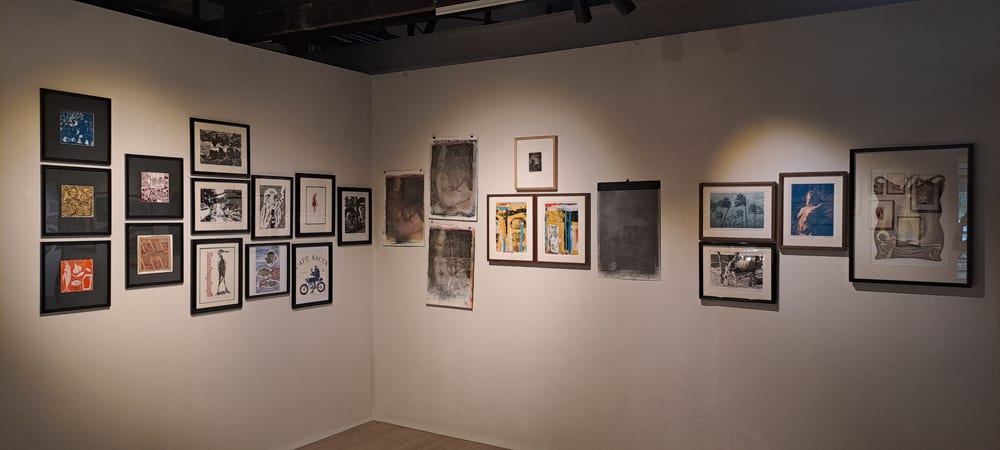
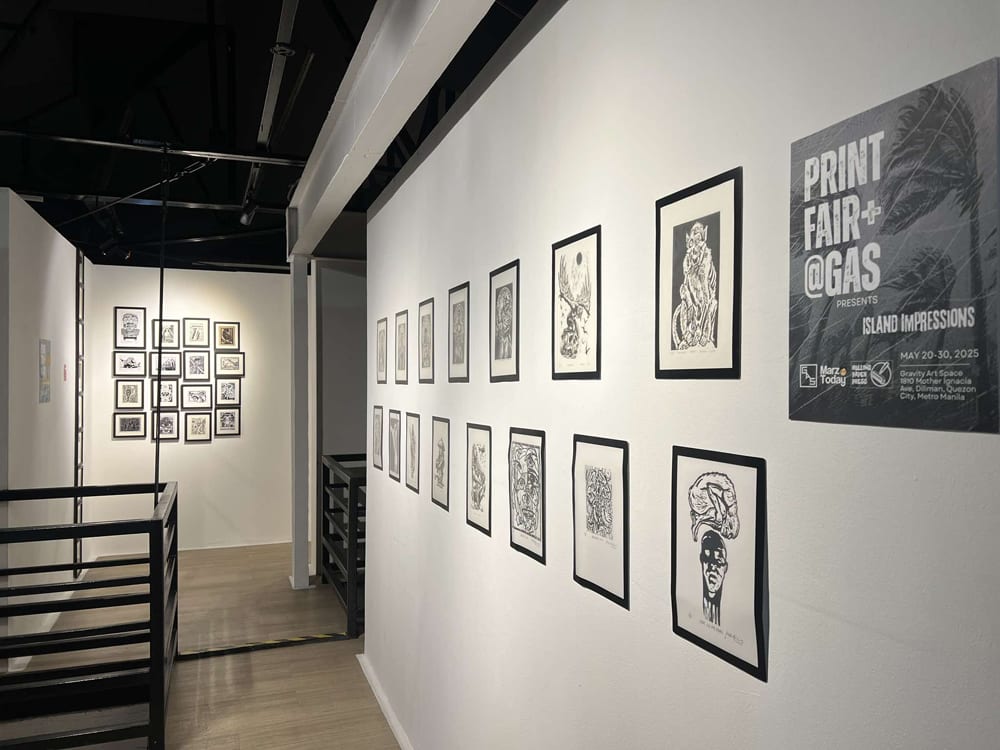
Island Impressions, which ran from May 20 as part of Print Fair+@GAS, opened with a salon-style display of works from print collectives across the Philippines: Tarlac, Bacolod, Iloilo, Cagayan de Oro, Davao, Dumaguete, and Zambales.
Works from printmakers from ILCP Art Space (Dumaguete), BIE (Tarlac), Bohol, and Kikik Kollektive (Iloilo)
ALSO READ: Quiet Identities in the Printmaking Practice of Imelda Cajipe Endaya
Regional Printmaking Talents Take the Spotlight
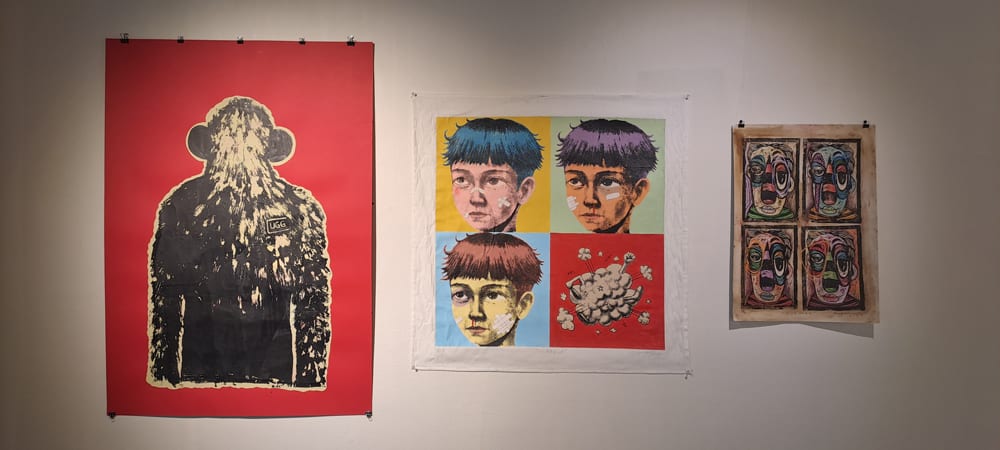
For many visitors, Print Fair+@GAS offered a rare opportunity to engage with emerging printmakers from outside the capital. The fair brought together artists and collectives from Luzon, Visayas, and Mindanao, creating a space where regional voices and practices could be seen—and heard—on equal footing. A key highlight was Kilometer 1476, a focused presentation of artists rooted in or based in Davao. The show offered an in-depth look at the city’s developing printmaking scene. For many of these artists, it was also their first time exhibiting in Manila.
(L-R) Sut’s "Good morning UGG," Ivan Sepelago’s "Scuffle," and Reagan Deiparine’s "HUEman" from Kilometer 1476
“There are few printmakers in our region—we’re still introducing it to the local art community,” says Rey Gallardo Bollozos, a Cagayan de Oro-based printmaker and member of PLELEMUDA. “I’ve been promoting printmaking by holding workshops. We’re preparing for our first group print show here in CDO.”
Leah Divino Samson, a member of Grupo Balhag from Bacolod, shares how Print Fair+@GAS became a milestone for their group: “To be included in a platform like this means a great deal for people like us who are relatively new to printmaking. It wasn’t a medium we expected to explore until we met Angela Silva, and ever since then, it’s been a transformative experience,” She adds, “As regional printmakers, we’ve had limited access to exhibition opportunities outside Negros Occidental. Angela’s mentorship and her efforts to connect us with wider printmaking communities—especially through social media—have made a huge difference. The challenges we used to face in terms of visibility and access are now being addressed.”
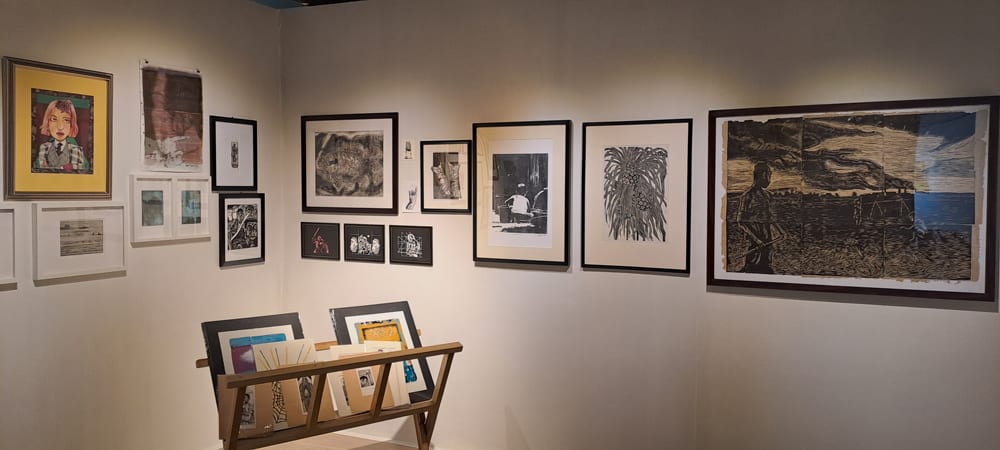
An assortment of prints from Pasilyo Press (Zambales), Bohol, BIE (Tarlac), and Grupo Balhag (Bacolod)
For Davao-based artist Emmanuel Marx, who participated in Island Impressions, the fair offered a moment of recognition for perspectives that are too often overlooked:
“What once were abstract subjects—our stories, our voices—are now on display for the public to see. Being represented at Print Fair+@GAS affirms our efforts to engage on a broader level. This platform gives us a space where our works are not just seen but also understood and appreciated.”
When asked about the challenges regional printmakers still face, Marx is candid:
“There’s still limited awareness of printmaking—not just among artists, but also among audiences. The process can seem technical and intimidating, which makes it harder for new practitioners to get started. But we’re seeing hopeful signs: there are now flourishing workshops in Mindanao, and art spaces in Davao are stepping up to support these efforts. These developments make it easier to reach wider audiences and help demystify the medium.”
Prints by students of the University of the Philippines Baguio (background) and PLELEMUDA from Cagayan De Oro, Maguindanao, and Davao (foreground)
Printmaking in the Classroom
Another key component of the fair was Prints: Language and Interpretation, which featured works by students from institutions with active printmaking programs—including the College of Saint Benilde, Philippine Women’s University, University of Mindanao, and the University of the Philippines campuses in Baguio, Cebu, and Diliman. It was a rare opportunity to see these schools exhibit together, offering a glimpse into how academic programs are shaping the next generation of printmakers.
Guests at Prints: Language and Interpretation
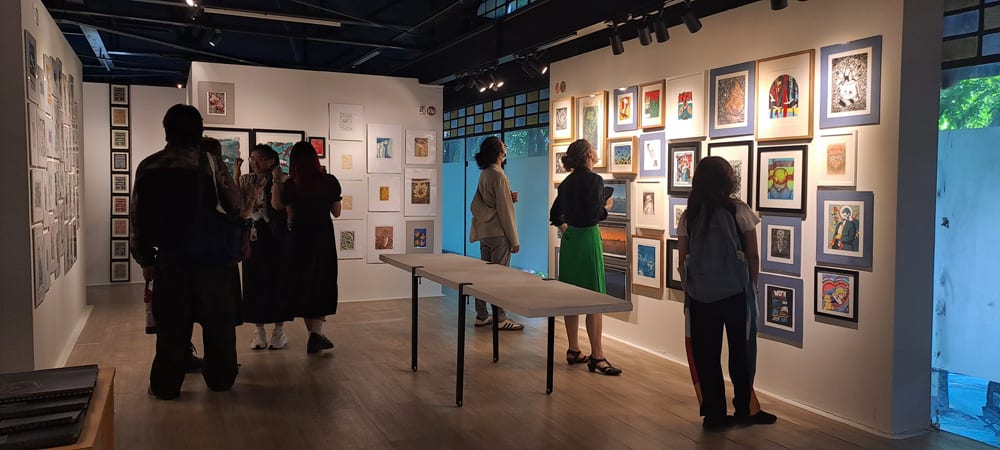
In the case of the UP College of Fine Arts in Diliman, where a minor in Printmaking is offered, structured and outcome-based curricula play a critical role in developing both the technical skills and the professional disposition of aspiring printmakers. “Students are not only taught the rudimentary principles and techniques of printmaking,” says Professor Rey Concepcion, “but also mentored to develop the necessary attitude, temperament, and sense of appreciation for the medium.” This approach prepares students for various roles in the field—as assistants to master printmakers, facilitators of workshops, museum and gallery professionals, and even future educators.
On how students engage with the medium, Concepcion emphasizes the importance of foundational knowledge. “Printmaking techniques are unique and require focused instruction,” he explains. “Once students have mastered the basics, they are free to explore—whether through subject matter, materials, or hybrid techniques. Whether they lean toward tradition or innovation, it’s their choice—and both paths are valid.”
A guest browses through UP Diliman Professor Rey Concepcion’s print portfolios—collections of student works compiled over the years, thoughtfully organized by printmaking technique. While not for sale, the books offer a glimpse into the evolving practices of his classes.
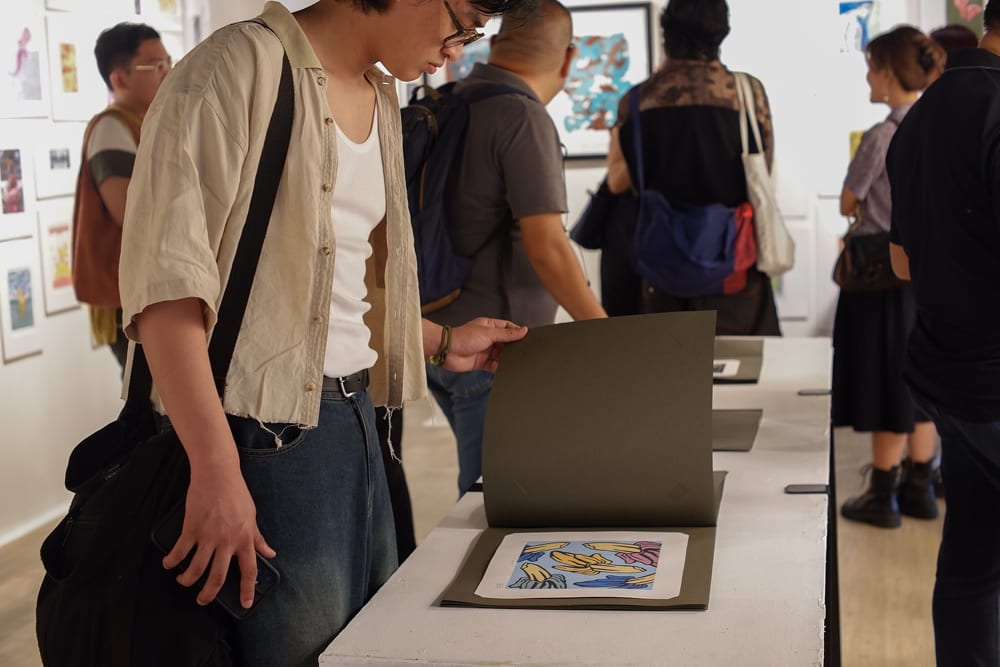
At UP Baguio, printmaking is currently integrated into foundational courses, such as Materials II, where first-year students are introduced to rubbercut techniques. Professor Jandy Carvajal notes: “We’ve yet to offer it again as a full Art Workshop course, but this introduction helps sustain printmaking traditions early on.”
Reflecting on the value of bringing different printmaking communities together, Carvajal adds, “Though we’re geographically apart, we realize we’re not alone in this pursuit. That’s both reassuring and a challenge—it pushes us to ask how we can make our work more distinct, even when engaging with shared or national themes. These encounters allow us to learn from one another, which helps the community grow.”
As both an educator and a member of the Association of Pinoyprintmakers, Carvajal remains optimistic. “Philippine printmaking is thriving. Recent exhibitions at the CCP and GAS show a wide range of expressions—from traditional to experimental—all of which keep the form alive. While some artists are now incorporating digital tools and even AI, I believe human handiwork remains central to the medium. There’s still immense value in the hand-done, the deliberate, and the deeply felt.”
(L-R) Printmakers Melai Arguzon, Angela Silva, and Elmer Borlongan share a laugh.
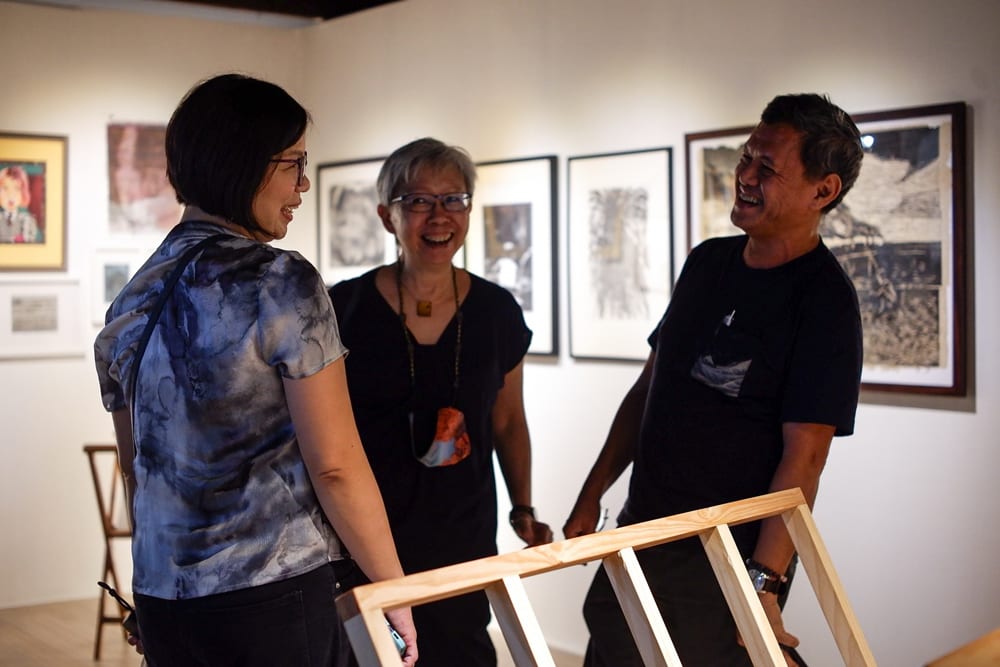
As organizers, we were clear from the start that this fair wouldn’t—and couldn’t—represent everything. But we hoped it could offer a meaningful slice of the present: that it could reflect a medium alive in many forms, in many places, practiced by many hands. And maybe, in the process, we’d stop thinking of print as a footnote.
Print Fair+@GAS runs until May 30, 2025, at Gravity Art Space, 1810 Mother Ignacia Avenue, Quezon City.
Disclaimer: The writer is one of the organizers of Print Fair+@GAS. This article considers the position of the fair against the recent developments in the local printmaking scene.
