How a Bunch of YouTube Guys Took Over Horror
This new wave of YouTuber-turned-director movies asks what we owe each other, and what that says about modern masculinity.
Published on Jul 1, 2026
The latest wave of American horror features comes from a crop of YouTuber-turned-directors proving that the online video platform is a viable pipeline to the mainstream. It started with Danny and Michael Philippou's Talk to Me (2022) and continues through the present with Chris Stuckmann's Shelby Oaks (2024), Michael Shanks' Together (2025), the Philippous' Bring Her Back (2025), and Mark Fischbach's Iron Lung (2026).
It reached a high point recently when Kane Parsons' Backrooms (2026) and Curry Barker's Obsession (2026) released concurrently with high fanfare. Popular conversation claims this wave of filmmakers brings a new, exciting energy to horror, and rightly so. But there are those who say they're here to save the genre.
Equally populating the online ecosystem with "elevation" subscribers are its detractors. As a horror fan myself, I am of the latter camp. "Elevated horror" disregards history, as if the 2010s batch and the 2020s batch were exceptional groups existing in a vacuum, rather than in a continuum of influences. But don't take my word for it. Barbarian (2022) and Weapons (2025) director Zach Cregger, in an interview with DiscussingFilm, rejected the label, saying, "I feel like the term 'elevated horror' is for people who don't know much about horror. It's for people who see horror as some inferior genre." In the same interview, Cregger named Sam Raimi's films, especially the schlocky yet iconic Evil Dead series, as an inspiration.
Whether it's the anti-establishment transgressions of splatters like The Last House on the Left (1972) and Saw (2004); political allegories like Invasion of the Body Snatchers (1978) and They Live (1988); conservative critiques like Rosemary's Baby (1968) and The Exorcist (1973); slashers with feminist undertones like The Texas Chainsaw Massacre (1974) and Halloween (1978); critically acclaimed darlings like The Silence of the Lambs (1991) and The Others (2001); turn-of-the-century found footage experiments like The Blair Witch Project (1999) and Paranormal Activity (2007); and even self-reflexive genre satires like Scream (1996) and The Cabin in the Woods (2011), horror ALWAYS has something to say.
Which begs the question: what is it with this current wave—that I call "YouTuber horror"—and what makes it unique from past generations? I suspect that our endearment partly comes from positionality, that the mere idea of content creators hitting it big in Hollywood is exciting enough to propel the trend. If anyone could easily be a content creator, anyone could be a director. Internet culture plays a huge part in the sensibilities of YouTuber horror. After all, the web is where its creators were incubated. And it is also where its audience was raised. Another viable explanation for this boom is that the future is here, now. And the now is Gen Z.
Chris Stuckmann has been a poster boy of YouTube film reviews for years. So why isn't Shelby Oaks as popular to the current generation? Could it be simply because Stuckmann doesn't target the Gen Z audience? While the film is technically polished, it is burdened by an overreliance on its inspirations. It simply does not know what it wants to be as it jumps from textbook found-footage horror to textbook supernatural cult horror. And while Zach Cregger's films are also guilty of genre switching, his films go to novel and uncharted territory rather than retreading the course of past masters.
Mark Fischbach (Markiplier) gained fame streaming video games, popularizing Five Nights at Freddy's, which now has two Hollywood films. His Iron Lung is the most video-gamey film here, considering its source was also a video game. The film evokes a close emotional response one would get from a video game and makes a case for how video games could properly be adapted into film. Markiplier was supposed to play a cameo role in the Five Nights at Freddy's films as a nod to him, but he turned it down to work on Iron Lung. In a twist of fate, Markiplier's film adaptation of Iron Lung would become a more faithful adaptation of Five Nights at Freddy's since the two sources have very similar game mechanics. To me, Markiplier understood how to properly adapt active game design into passive film viewing.
FOMO plays a huge role in the Philippou's Talk to Me. A group of friends take turns letting themselves be possessed by random spirits for thrills and clicks. Mia goes a little too far from the prescribed possession dosage, and she describes the experience as euphoric. Her friend Riley insists on trying it for himself, but he's not allowed by his older sister Jade. Behind Jade's back, Mia lets Riley be possessed and then pushes him too far when Mia's dead mother Rhea takes over. This leads Riley to be susceptible to spirits and be hospitalized after serious physical injuries. Mia then continually puts Riley in danger in successive instances just for the chance of closure with her mom.
Bring Her Back, the Philippous’ sophomore film, takes a similar theme of reliving the dead. Andy and Piper are orphaned stepsiblings adopted by an eccentric Laura. Laura is grieving her child Cathy; Andy is suspicious of Laura, and a visually impaired Piper is oblivious of malintent. It turns out Andy is right, as Laura intends to use Piper as a vessel to resurrect her daughter. Laura manipulated Piper using the virtuous image Piper has of her stepfather, a lie that Andy has been telling her to maintain her bliss.
In Together, couple Tim and Millie move to a small town as friction between them becomes more apparent. Millie wants to settle down while Tim, frustrated he feels dependent on Millie, still wants to pursue a career in music. Soon after, they encounter a cult harboring a strange intangible entity that forces them to physically merge into a singular creature. They figured it was futile to resist and embraced the fusion.
What these latter 3 films share, and what the next 2 films will best illustrate further, is the underlying question of what we owe to each other. Whether it's Mia’s disregard for Riley’s well-being to communicate with her mother, Andy’s genuine care towards his dear sister Piper as his reason for lying, Tim and Millie’s straining relationship as the foundation of their mutual union, they answer the question head on. Even in Iron Lung, the convict Simon acquiesced to impossible demands asked of him after he unintentionally caused harm to others. And in Shelby Oaks, whose main core lies in Mia finding her sister Riley (not to be confused with the characters with the same name in Talk to Me) who has gone missing after investigating an abandoned prison in the titular ghost town.
A Mirror on Modern Masculinity and Relationships
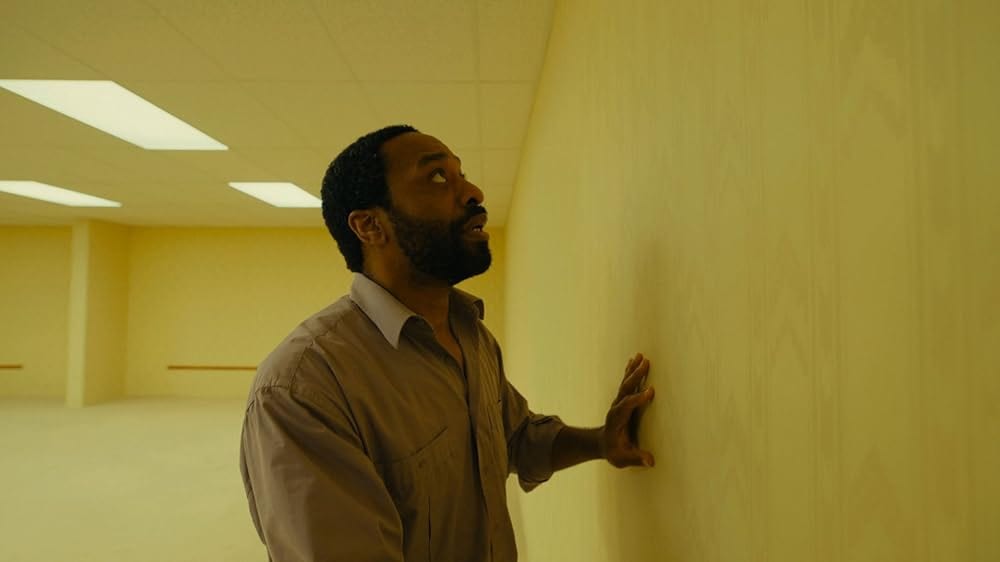
Backrooms has its origins as an anonymous post in 4chan and is a feature-length expansion of Kane Parsons’ YouTube short film The Backrooms. To call it an expansion is to note its runtime, but really, the film really is an enhancement of the idea and mood the original photo evokes. The Backrooms is in the foreground, and in the background are its protagonists, which, while wholly inconsequential to the unknowable, provides a backdrop of how humans’ limited grasp constructs explanations serviceable to their ego. In the film, Clark is a frustrated furniture store owner seeking therapy for his collapsed marriage. When he finds the Backrooms, he feels no fear, for he is enthralled by it and the possibility that the world holds. Clark’s therapist Dr. Mary Kline searches for Clark after he goes missing for some time and enters the Backrooms. She soon finds a crazed and delusional Clark there who’s been eaten up by the false reality he found there. Unable to directly confront his flaws, Clark moved to the Backrooms, where he convinced himself he’s the victim in his marriage, a perspective that the real world and his therapist have not been affording him.
A delusional Clark sets up shop in the backrooms, where he finds solace from his demons.
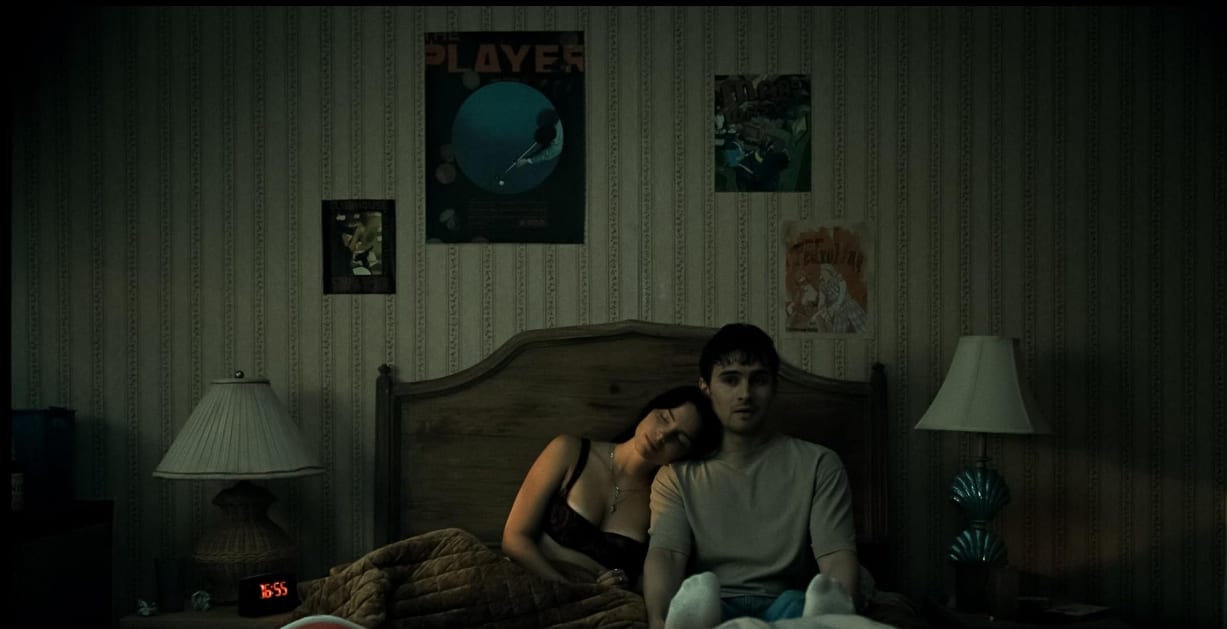
In Obsession, Bear also chooses to live in pretense over reality after his wish that his friend Nikki loves him comes true. Throughout the film, increasingly intense situations come up, but Bear continues to prioritize serving his wants over Nikki's and his friends' well-being. What can be seen as a movie about female obsession is easily dwarfed by the more monstrous story of a man abusing power over the agency of others. Or it’s a film about the horrors of crossing consent in a world that is hypervigilant of your actions or being infantilized from a male perspective. Like a Rorschach test, the film asks the audience their position in the conflict and inspects where their perspective lies
Bear choosing to live in this reality he's created for himself via the One Wish Willow
Obsession’s director Curry Barker said, “I wish they understood that we’re [Gen Z audiences] tired of slop,” as per The Hollywood Reporter. “We want good movies back. People are still hungry for movies that are original without some big IP, as long as the story is good.” While what Barker said is true, I believe it's more accurate to say that Gen Zs will show up in films depicting their truth. Newness will not suffice. Relatable is the key ingredient. What Gen Zs crave, and what YouTuber horror has been providing (as horror has been providing for past generations), is a mirror to their cultural zeitgeist. The more successful films discussed here fill this need. And Obsession, as a date film showing why a generation has been dating less, did it best.
We’ll still have to see whether YouTuber horror maintains its momentum. It’s still too early to call it more than a trend and harder yet to call it a movement. In the same interview, even Barker disclaims the label, saying, “I never thought of myself as a YouTuber… It’s just a buzzy thing to say, 'This is a YouTube thing.'" But one thing is undeniable: Gen Z grows to be the primary audience. Even Hollywood is reportedly looking at Reddit for more IP to mine. Let’s just hope it didn’t take the wrong lessons from YouTuber horror’s boom.
View More Articles About: