
Is There Really a Male Loneliness Epidemic?


Two years ago, The New York Times published the cheekily titled “Is the Cure to Male Loneliness Out on the Pickleball Court?” by Michelle Cottle, a piece contending that indeed, men–especially those of the cishet persuasion–struggle with loneliness on a systemic level, and that the partial solution to this is for male friend groups to bond through a shared hobby. It doesn’t have to be pickleball; it could be fishing, Magic the Gathering, or virtually any group activity that isn’t just cracking open a cold one with the boys.
Upon release, the article’s headline and header art were memed to high heavens. Variants such as “Is the Cure to Male Loneliness thugging that sh*t out?” and “Is the Cure to Male Loneliness 14 Beers at Chili’s?” sprung up in the ever-flippant X-sphere. Clearly, the sentiment struck a nerve among those who question the legitimacy of male loneliness as an actual issue. Either it doesn’t exist (it does, kind of), or the cure is more obscure than we think (it is).
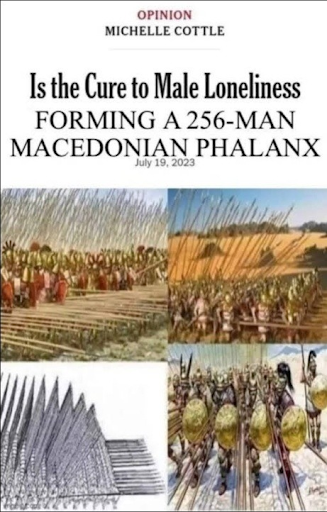
In Cottle’s defense, she points out right away that “no gender has a lock on loneliness,” while citing surveys that evince men’s lack of emotional support for other men. For example: over the past three decades, the amount of men who report having zero close friends has quintupled. But she doesn’t really get into why exactly this is. Are men naturally stoic, lone wolves allergic to hugging other dudes? Is there some property to testosterone that repels other people with the hormone, like two alike magnetic fields? Obviously not. There must be other non-biological, non-magnetic forces at work.
***
In a milieu where the full spectrum of gender fluidity seems positioned front and center in culture and media, and our day-to-day speech is sternly influenced by political correctness, tension between the sexes seems more heated than ever. The terminology of self-hating incel culture (e.g. “blackpilled,” “chad,” “mogging”), which used to thrive in the fringes of obscure Reddit forums, has bled into our lexicon. Men Going Their Own Way (often shortened to MGTOW), a movement associated with the political far-right, encourages men to avoid romantic relationships with women altogether, and live against the grain of a world allegedly “corrupted” by feminism. You might have seen on your TikTok and IG reels those random clips of podcasts where men ask OnlyFans creators deliberately inflammatory questions, or conduct street interviews with women about their body count. Barstool Sports type-sh*t.
ALSO READ
It's Time We Addressed the Epidemic of Male Loneliness
People Who Base Their Self-Worth on Financial Success Feel Lonelier and More Isolated—Study
In these points of tension, there is an obsession with how exactly men must play the role of potential suitor, and how they expect to be rewarded for following these arbitrary rules of masculinity. Where is my obedient tradwife, my faithful sex object? To such men, their loneliness is a punishment they don’t deserve for behavior they leave unexamined. “I think the male loneliness epidemic conversation [...] spread because it became a conversation kind of about dating,” remarked Harris Sockel for NPR on It’s Been a Minute. “That's how I first heard about it. [...] And I think they were conflating a conversation about singleness with a conversation about being lonely when, actually, they're kind of two different things.”
“On Heteropessimism” by Asa Seresin presents a rather prescient diagnosis of gender trouble, defining “heteropessimism” as a kind of attitude that expresses “regret, embarrassment, or hopelessness about straight experience,” and a desire to swear off heterosexuality altogether. While vogue usage of the term places the blame squarely on men, women aren’t the only ones who see being straight as a kind of prison. Seresin writes:
“From the indignant fury of the incel to the married man complaining about his ‘old ball and chain,’ men clearly subscribe to heteropessimism even if, like all feelings, they are not exactly encouraged to express it. To be clear, men’s heteropessimist claims tend to be neither ethically nor logically equivalent to those made by women. Instead, they are a kind of funhouse distortion of feminist complaint[s].”
The heteropessimism of women is a reasonable response to a whole history of patriarchal violence and abuse. South Korea’s 4B movement, which calls upon advocates to stop dating, marrying, having sex with, or having children with men, is an example of heteropessimism grounded in a palpable social reality (look up the “Nth Room case”). Heteropessimistic men however insist that women’s rights movements, gay rights, and #MeToo evince an Illuminati-level, female supremacist world order, hell-bent on making men’s lives miserable on purpose. So great is these men’s bitterness for society at large that they willfully turn to the tepid succor of self-isolation. Either that or they turn to women as their only sources of emotional support, exasperating them while simultaneously resenting their alleged privilege in a girl’s world. Failing those pseudo-comforts, they bond with other men over their mutual disdain for women. (It’s chilling to watch the latter up close. Have you ever been to a PUA Academy seminar where multiple lonely men in the same space learn negging techniques?)
No wonder the “male loneliness epidemic” is perceived as some kind of joke–this is the “funhouse distortion” Seresin spoke of, where valid feelings and grievances are warped into some pity-mongering neologism.
***
So much of modern culture seems to venerate a solitary existence. The adage of “protect your peace” may be an antidote for toxic relationships, but is prone to misuse, both by archetypal girlbosses and self-proclaimed alpha males. Forsake the friction of community, self-improve, optimize your existence, get your money. To live this way is to hide a sad existence under the thin veil of control. Never mind that the heart is locked inside a cage–it’s guarded.
It behooves the sharpest of us to acknowledge, though, that there is a distinctly bro-y version of this otherwise widespread leave-me-alone attitude. The men who inhabit this mode talk a lot of game about “The 48 Laws of Power;” they resent powerful women and self-loathe their inability to connect with them; they leave inane comments like “onlyfans detected, opinion rejected” under IG reels they watch. It is a subjugation-focused mindset that is fluent in belittling others, but doesn’t know how to open up.
One is led to believe that much of this fabled male loneliness epidemic is self-inflicted. If men really wish to kill the flu-like loneliness that plagues them so, they must flush out the bitterness, resentment, and hatefulness that the patriarchy has conditioned them to embody. This is the cure, or at least one of them.
And if that doesn’t work, well… there’s always pickleball.
