Manila's Finest: Where Have all the Good Men Gone?
Sometimes the most heroic thing to do is to stand one's ground and survive even in corrupt institutions.
Published on Dec 24, 2025
There is a palpable hunger for justice currently simmering in Philippine society. Corruption scandals are flooding our news. Criminality pushed voters to justify a drug war.
Interestingly, Criminology is among the most popular undergraduate courses. The saturation came to a point where some of my own students in a local pamantasan entered political science only because criminology was full. Most people see it as another job opportunity. Many still want to become policemen to uphold justice and catch criminals. Some to avenge personal encounters with criminals. Some even want to catch their own family at odds with the law.
The police portrayed in the media is even more polarizing. When he is loved, he is a symbol of justice and defender of the poor and the weak. Politicians like Joseph Estrada, Bong Revilla, and Fernando Poe Jr. have converted their fame playing policemen in movies and television to political capital. Most famously, Cardo Dalisay from FPJ's Ang Probinsyano remains one of the most popular characters in recent television history. Then there are other media where they are henchmen of the oppressive state and corrupt elite.
Manila's Finest is an official entry to the 2025 Metro Manila Film Festival
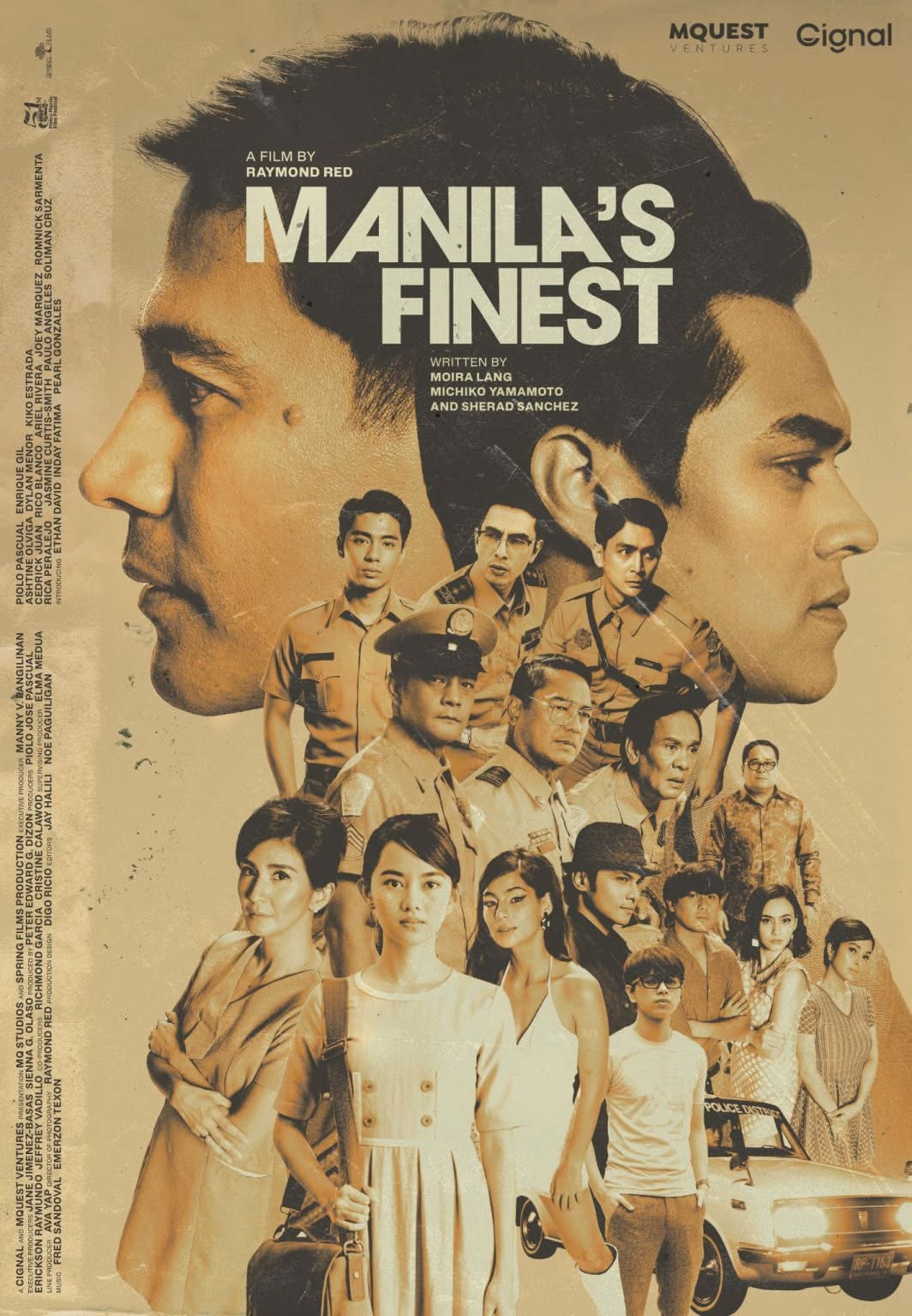
Enter Manila's Finest. It's 1969, Manila. A different time.
The title itself reminds us that the police represent the best and morally upright of our society. They are role models, public servants. Defenders.
The title becomes sarcastic as the plot unfolds. The film follows Officer Homer Magtibay, played by Piolo Pascual, with his squad: the young but hot-headed Billy Ojeda (Enrique Gil), the cranky Severino Meneses (Romnick Sarmienta), and the witty, Rogelio Liwanag (Joey Marquez).
The main squad embodies the traditional standard of masculine morality. In early scenes, they keep their uniforms clean, collars starched. Shoes shined. Even when dealing with gang leaders, they treat them with respect and honor. They respect the authority of the law. They follow hierarchy. This virtue of obedience is tested when they butt heads with their rival institution, Metrocom, led by Danilo Abad, played menacingly by Cedrick Juan.
The villains exist as byproducts of an unseen enemy. They are given license to overrule the "good cops" as they investigate a series of violent murders and arsons across Manila. As much as the audience wants to root for the good cops, they are undermined by institutional power and procedure.
The story overall is an assemblage of familiar tropes from police procedural dramas: the clash between traditional senior and overzealous junior beat cops, grand gang fights, jaded street yet colorful characters, outdated roles of women simply as either damsels or housewives.
The movie's production transports the audience back in time with classical songs through vinyl records, filming on preserved streets of Escolta and Binondo's Chinatown, driving classical cars of the period. Raymond Red and his team made painstaking efforts to situate it in a different but familiar time, back when "Manila's Finest" meant something.
This leads us to ask: Did Manila's Finest ever exist?
To answer this empirically may be a longer research project. What the film gives us cinematically is just as essential: moral imagination. One can critique the casting of Piolo Pascual and Enrique Gil as strange choices for their movie star looks being distracting despite playing regular Manila policemen. Perhaps Homer Magtibay is not meant to represent a historically accurate Filipino policeman, but a mythical figure of a good man; more specifically, a hypothetical good Filipino policeman: smart, principled, and kind.
G.K. Chesterton once said that stories of dragons are needed not to tell children that they exist but to show dragons can be beaten. In the same way, stories like Manila's Finest show not only that good men exist but that it is possible to become them.
Many previous police films merely created idolatry for their actors rather than providing good actionable examples. However, more works of contemporary cinema have overcorrected in criticizing this excessive idolatry of strong men, from Jerrold Tarog's Bayaniverse trilogy to Antoinette Jadaone's Fangirl, to Mikhail Red's Birdshot, to the policemen in Kip Oebanda's Balota. As a result, today's men and boys lack clear references to good Filipino men in our stories. Though the police force has been progressive in including women, it is a masculine social role aspired to by young boys today.
The movie shows that goodness can be found not only in individual characters but is defined by their actions even in the face of institutional pressure and oppression. It begins with small practices like keeping one's uniform clean, looking respectable, to more difficult actions like respecting your enemies, even criminals, and risking oneself to defend the defenseless.
One notable scene has a junior officer, Efren Taguyunon, played by Dylan Menor, affirming his duty despite the corruption, saying, "Di naman sa labas ang kalaban, may kalaban din sa loob." (There aren't just enemies outside, there are enemies in here, too.)
Sometimes the most heroic thing to do is to stand one's ground and survive even in corrupt institutions. While it is tempting to assume the worst of the police, as many already do, the police still play a crucial role in promoting good and fighting corruption. Just a few days prior to this film’s release, the Supreme Court affirmed the conviction of the policemen responsible for the death of the 17-year-old Kian Delos Santos. Justice is possible but arrived several years late compared to the still urgent need of reform.
Men are not born good. They become good and die heroes or live long enough to learn to be good and to have done good for society. The movie doesn’t provide easy solutions or contrive heroic victories. Instead, it shows embers of good struggling in an impossible system much like many of us Filipinos are experiencing today. By producing a familiar Manila, the script demonstrates goodness can still be realistically found in a broken city even in unseen and silent displays of heroism.
We must imagine good men can exist even in tragic times, especially in tragic times in this tragic country.
Matthew Ordoñez is a university lecturer at De LA Salle University-Manila. He teaches courses in Citizenship and Governance, Development Economics, and Cinema and Politics. He is a member of the Society of Filipino Film Reviewers and writes film reviews for Asian Movie Pulse.
View More Articles About: