
The Bayaniverse Has Ended. What Now?

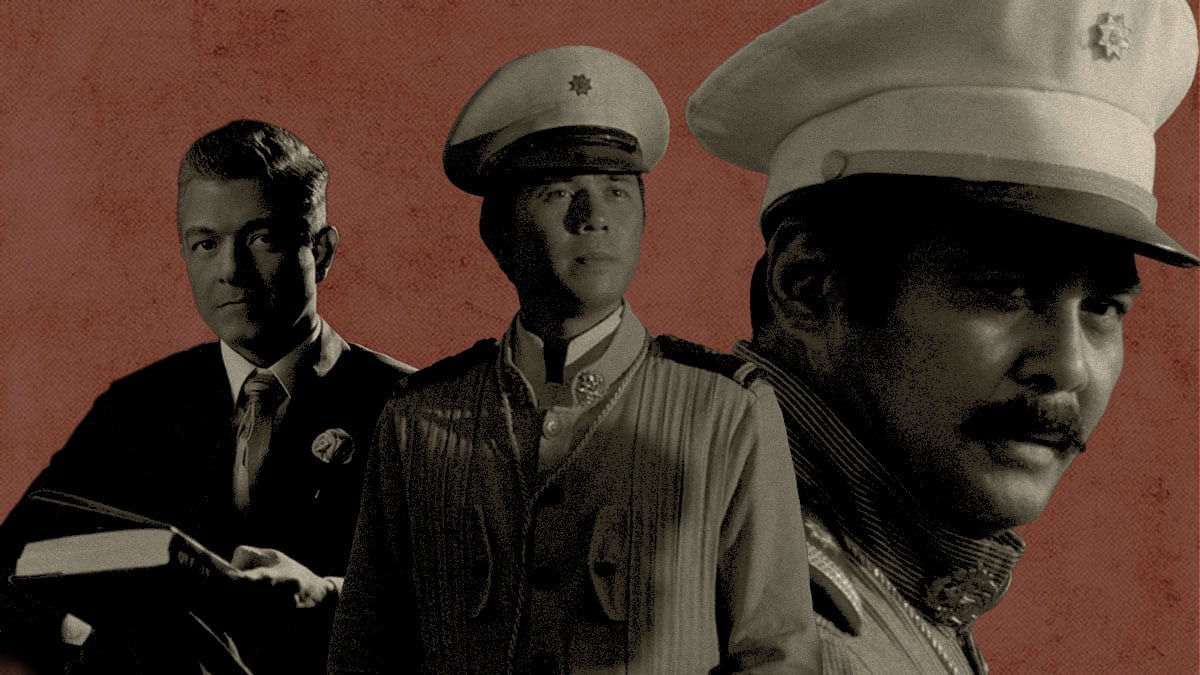
Ten years ago, diector Jerrold Tarrog's historical trilogy known as the Bayaniverse debuted with Heneral Luna, one of the most expensive cinematic productions in the country's history. At the time, I was a first-year social studies lecturer and used it as one of my first teaching materials.
When I watched the third film, Quezon, I did not feel the same enthusiasm. While Luna and volume two of the Bayanieverse, Goyo: Ang Batang Heneral, have birthed thousands of reaction papers and Facebook essays, and Quezon continues to do the same, I struggled to compose my own. It had nothing to do with technical craft, as it exhibited Tarrog's growth as a filmmaker. Perhaps it had more to do with how much I have changed as an audience member and how this country has changed since the first movie.
Tarrog's Bayaniverse entered and ended in two vastly different versions of the Philippines. While Luna arrived with the advantage of novelty and the momentum of the Marvel Cinematic Universe, Quezon emerged after multiple political crises and corruption scandals. The resemblance of Quezon's political games in the 1935 Commonwealth era with contemporary politics is a double-edged sword. Audiences who can pick up on the satire will be engaged, yet recognizing it can also bring fatigue, as it can feel like more of the same.
I wondered if the film had much to say about the present beyond replicating and satirizing it. What should Filipinos take away from this project now that it has concluded?
ALSO READ:
Quezon Is a Triumphant Blend of Fact, Fiction, and a Whole Lot of Exposition
'Goyo' is a Somber Sequel That is a Spectacular Indictment of Idolatry
Bayan o Sarili
The scripts across the Bayaniverse contain many quotable lines that have evolved into viral memes. I argue there are two lines that express Tarrog's thesis statement within the trilogy.
First: "Bayan o Sarili, Pumili ka?" This is unmistakably the most recognizable line in Heneral Luna. It was first delivered by the titular character toward Aguinaldo's cabinet, accusing them of placing profit above country. The trilogy's core can be seen as a dialectic between Bayan (Nation) and Sarili (Self). What must one do for the country? Luna enforces his principle through his "Articulo Uno," declaring that those who disobey him and die for it have only themselves to blame. His harsh leadership leads his own soldiers to assassinate him.
The second film, Goyo: Ang Batang Heneral, shows the immediate fallout of Luna's assassination. The surviving troops are left undisciplined and unmotivated as they rally toward their boy-general, Gregorio "Goyo" del Pilar, who is defined by loyalty to Aguinaldo rather than competence. Arguably, the foil for both Goyo and Aguinaldo is the "Sublime Paralytic," Apolinario Mabini. He is the story's truth-teller but remains sidelined.
The Battle of Tirad Pass highlights the failure of Aguinaldo's army despite having the advantage of terrain. While many historical accounts call it our "Thermopylae," Tarrog shows the consequences of building an army and a nation out of loyalty to a leader rather than merit or discipline. Their semblance of unity at the final battle is a false unity.
Quezon seems to merge Bayan with Sarili when the former president proclaims, "I am the Philippines." Out of the three protagonists, Quezon is arguably the most successful due to his capacity to compromise and deceive. He gains power by working with the Americans and using their tools of patronage and corruption. The film, Quezon himself, and even the journalist Joven Hernando, the fictional journalist in the films acting as the audience surrogate, constantly remind us that all his actions are motivated by the eventual independence of the nation.
Ironically, compared to the other two films, the regular Filipino is more passive and understated. They are present but divided, swayed by the campaigns of Quezon and Aguinaldo. They are merely audience members in political rallies and Quezon’s propaganda films. When asked what they wanted, independence, they relate it to food. The main political actors are the politicians, not the citizens. The "Bayan" has disappeared and become singular under Quezon.
Clearly, Tarrog's harsh critique is for the Filipino people as much as for the Bayani. Each titular hero has a distinct relationship with his countrymen while highlighting a facet of their society. Each film shows a different version of how the individual relates to bayan, and each ends in failure. Luna tries to command the nation through discipline. Goyo dissolves himself into loyalty to another’s vision. Quezon merges entirely with the nation, proclaiming "I am the Philippines." Three variations of bayani, three versions of failure.
Filipino against Filipino
This leads to the second thesis of the Bayaniverse: "Ang kalaban ng Pilipino ay ang kanyang sarili." ("The Filipino’s enemy is himself.")
Tarrog openly admits using Nick Joaquin's A Question of Heroes as the foundation of his Bayaniverse. Joaquin’s book was Tarrog's precursor in puncturing the popular tendency to valorize historical figures as flawless saints. Since the book did not cover Quezon, the latest movie is Tarrog's best attempt at continuing Joaquin's iconoclasm. However, Joaquin did not tear them down for the sake of tearing them down. He expanded our view of history. These individuals are part of a continuous chain of figures and events that connect with our origins, leading to the present. His point was not to fixate on individuals but to understand how they all contribute our history as a nation.
The Bayaniverse can be read as the history of the elite, the Ilustrado-soldier, America’s brown brothers. To a point, it is satisfying to see these flawed men fall. It is tempting to project the flaws of our current politicians onto them. Yet because they are human and not gods, they have more in common with us and therefore more to teach us. They are still us. We dislike those who disagree with us like Luna. We follow idols like Goyo. We are swayed by Quezon’s theatrics.
For all his political skill, Quezon could not succeed. He was a self-fulfilling prophecy, a Filipino who ran the Philippines like hell. As the camera fixates on its titular protagonists, we should ask: what about the rest of the nation off-screen?
Bayan Beyond Bayani
Tarrog’s tearing down of historical idols through cinema is the necessary first step to the real work. It is a critique of the idea that history is the story of great men. There is an old saying that a "BAYANI" puts the "Bayan" or nation before "I." Tarrog’s characters either put a chasm between themselves and their nation, or they conflate the two entirely. Quezon concluded it with a man putting himself above the nation so that he could save it. But the BAYANI as a concept can be salvaged by applying it to ourselves. Rather than searching for a BAYANI who will save the Filipino people, we must imagine a Philippines where the people can save themselves.
Cinema is largely a language of singular protagonists. It does not always give tribute to more modest actors who already build the nation beyond the “great men” framework. A few exceptions are recent Cinemalaya Documentaries that focus on activists like Alipato at Muog and Bloom Where You Are Planted. But beyond cinema, rather than waiting for elections and our next batch of saviors, we must begin taking charge of our country while learning the lessons of history. After the Bayaniverse, we can hope audiences become actors. Not for the screen, but for the political stage.
