'Teach You a Lesson': The Show That Punches Bullies—and Still Gets It Wrong
It's deeply satisfying television. It is also, as a teacher, a little bit troubling.

by Kimberly Nicole P. Quilantang
Published on Jun 16, 2026
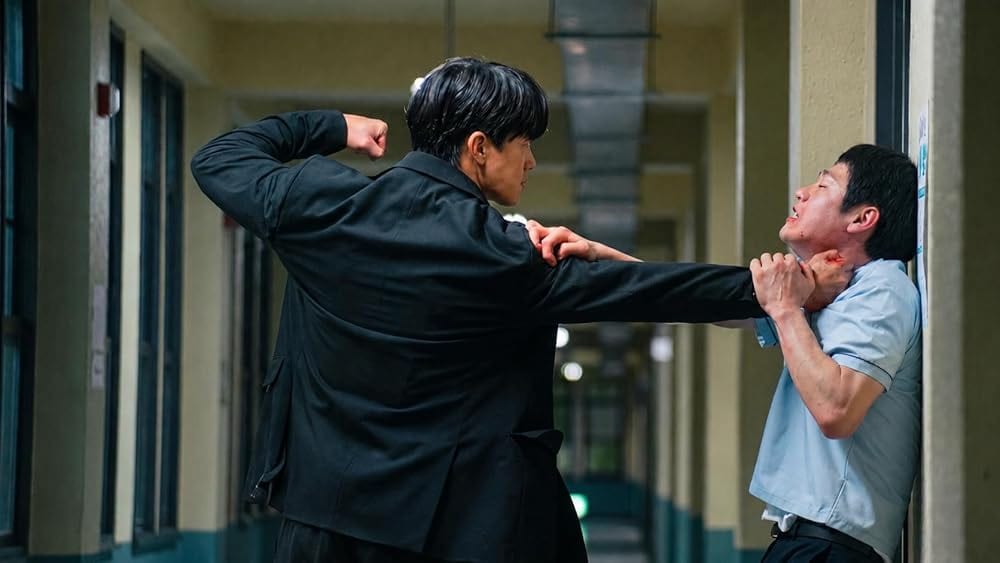
There is a moment in the second episode of Teach You a Lesson where Na Hwa-jin (Kim Mu-yeol), the Educational Rights Protection Bureau (ERPB) lead inspector, corners a teenage bully in a school corridor and proceeds to physically dismantle him. Not metaphorically. The kid ends up on the floor. And the audience cheers.
I know because I cheered too.
I’m a university instructor. I’ve spent nearly a decade in classrooms. I have sat across students with tears in their eyes because of what was done to them inside the classroom, by what was done to them by their classmates, and sometimes even by faculty members. I have filed incident reports. I have coordinated with guidance offices and sought guidance from our chairperson, watched the slow churn of institutional process, and seen how often that process protects no one. So yes, when Inspector Na Hwa-jin dropped that kid, some part of me felt it. That’s how good this show is at its job.
That’s also exactly what makes it worth interrogating.
What the Show Is
Released on Netflix in June 2026, Teach You a Lesson is a South Korean action-drama adapted from the webtoon Get Schooled by Chae Yong-taek and Han Ga-ram. It runs 10 episodes, each roughly an hour, and operates on a case-per-episode structure: a different school, a different crisis, the same team sweeping in to restore order through force.
The premise is a kind of policy fantasy. South Korea’s National Assembly, alarmed by rising school violence and the complete erosion of teacher authority, passes legislation creating the ERPB, a government-sanctioned intervention unit staffed by former special forces operatives and one very nervous computer genius. Their mandate is to protect victims. Their methods are not found in any curriculum guide.
The team is anchored by Na Hwa-jin (Kim Mu-yeol), a former elite soldier whose personal stakes in the mission run deep, and Choi Gang-seok (Lee Sung-min), the Bureau’s founder and Minister of Education, a man whose grief has curdled into something harder and more purposeful. Im Han-rim (Jin Ki-joo) is a former military operative who takes genuine, barely-concealed pleasure in intimidation. And then there is Bong Geun-dae (Pyo Ji-hoon), the deputy director with a nervous, endearing quality that the show weaponizes for comedy and, quietly, for something more uncomfortable.
The series is slick, well-acted, and paced like a thriller that knows exactly how long you’re willing to wait before something explodes. It covers, in 10 episodes, a wide range of school-based violence: physical assault, substance abuse, cyberbullying, stalking, extortion, and the particularly ugly phenomenon of bystander culture—the students who watch and say nothing, and the parents whose money and connections ensure that nothing is ever done.
It is, on its own terms, excellent television.
The Catharsis Is Real. And That’s the Problem.
Korean education is one of the most pressure-saturated systems in the world. The cultural weight of academic performance, the terror of the CSAT, the social stratification that begins in elementary school and calcifies by high school—the show knows all of this, and uses it as fuel. The bullies in Teach You a Lesson are not cartoons. They are products of a system that rewards dominance and punishes vulnerability, backed by parents who have learned that wealth and influence absorb consequences. The show understands the structural rot it’s depicting.
And then it punches it in the face.
That punch is the show’s great dramatic satisfaction and its central intellectual failure. Because what Na Hwa-jin and Team Bureau offer is not a solution. It is a fantasy of instant consequence—the idea that the right amount of physical force, applied by the right person, can do what institutions cannot. The bully gets hit. The victim feels safe. Order is restored. Credits roll.
Except that’s not how it works. Not in Korea. Not in the Philippines. Not anywhere.
In classrooms I have taught in, the students who became aggressors were almost never simply bad people. They were kids who had absorbed cruelty somewhere upstream—at home, in an earlier school, in a social ecosystem that taught them that being the one who inflicts pain is safer than being the one who receives it. Hitting them harder does not interrupt that logic. It confirms it. What the show calls justice, a psychologist would call a replication of the original trauma, delivered by a better-dressed authority figure.
The Bureau doesn’t fix systems. It wins fights.
Corporal Punishment Is Just Bullying With Better Credentials
Here is where I have to be direct, because the show invites a reading that I think deserves more resistance than it usually gets: the ERPB’s methodology is, structurally, corporal punishment. Dressed up in tactical gear and framed through the aesthetics of a superhero procedural, but corporal punishment nonetheless.
Corporal punishment in schools—the physical disciplining of students as a corrective measure—has been prohibited in South Korea since 2011. The Philippines outlawed it under the Child Protection Policy as well. Both countries moved away from it for the same reason: decades of research and lived testimony established that it does not reduce bad behavior long-term, that it escalates aggression, and that it teaches children that whoever is physically stronger gets to define what is right. It produces compliance through fear, not understanding through consequence.
The ERPB does not use a paddle. But when Na Hwa-jin corners a 17-year-old and beats him into submission to demonstrate that his behavior was unacceptable, the underlying logic is identical to a teacher who slaps a student across the knuckles for talking back. The message is: someone bigger than you will hurt you if you do this. That is not a lesson. That is a threat. The fact that the target deserved it—and in this show, they always, clearly, visibly deserve it—is a narrative convenience that real life does not typically provide.
What the show cannot quite reckon with is that the most dangerous bullies are rarely the ones who can be cornered in a hallway. They are the ones with parents in the PTA, the ones whose fathers are on the school board, the ones whose connections make every formal complaint disappear before it reaches a desk. Force doesn’t reach those students. Force is exactly what they’ve always had on their side.

And Then There Is Bong Geun-dae
I want to talk about Bong Geun-dae, because I think the show almost knows something important and then keeps walking past it.
Bong is the Bureau’s deputy director, a KAIST-trained computer genius who is, by any professional measure, the most technically competent person in the room. He is also the one who gets sent undercover as a student because, in the words of his colleagues, he is small and non-threatening. He is routinely talked over, dispatched into dangerous situations with minimal backup, and subjected to Han-rim’s near-constant intimidation with a nervous laugh and a kind of exhausted acceptance that the show plays mostly for comedy.
The first time Bong goes undercover, he gets bullied. By actual students. In a school that the Bureau was deployed to fix.
There is something the show is gesturing at here but never quite says out loud: that the same hierarchies the ERPB is supposedly dismantling exist inside the ERPB itself. Bong is the team’s least physically imposing member, and the show treats that as a source of humor rather than as a structural critique. He gets ordered around, dismissed, and placed in harm’s way with a frequency that, if you squint at it from the right angle, looks a lot like institutional bullying. The fact that he also has a deputy director title doesn’t change the dynamic—in most organizations, the person everyone finds it acceptable to laugh at and push around is experiencing something that deserves a name.
The show is too in love with its own power fantasy to sit with that irony for long. But it’s there. And a sharper version of Teach You a Lesson would have made it the center of the story rather than its background texture.
What the Classroom Actually Needs
I am not naive enough to think that restorative justice programs and trauma-informed pedagogy make for compelling television. I understand that Teach You a Lesson is not a policy paper. It is a show, and it earns its genre satisfaction.
But I teach Humanities. Part of what I teach is how messages shape belief—how the stories we tell about problems determine what solutions we find imaginable. A generation of students watching this show will absorb, however lightly, the proposition that the right response to systematic cruelty is a better-armed authority figure willing to meet it with force. That is a proposition worth pushing back on, even while enjoying the episodes.
The schools I have taught in needed more counselors, not more enforcement. They needed parents who could be reached before situations escalated, not after. They needed administrators who understood that a student who terrorizes peers is usually a student in profound distress, and that suspending or expelling them simply moves the problem downstream rather than addressing it. They needed, above all, a culture in which bystanders felt safe enough to speak—because almost every instance of sustained bullying I have encountered in my teaching life persisted because twenty other people knew and decided it was safer to look away.
None of that makes for a satisfying beat in a 10-episode action drama. I know that.
But I also know that the fantasy of the ERPB is seductive precisely because the real alternatives feel so slow, so uncertain, so dependent on institutions that have already failed. The show is brilliant at naming that frustration. It just mistakes the feeling of revenge for the work of repair.
The Verdict
Watch Teach You a Lesson. It is genuinely compelling television—well-directed, superbly acted, and built around social problems that are real and urgent. The scenes of school violence are difficult precisely because they are not exaggerated. The performances are grounded. The pacing is relentless.
Just don’t confuse watching it with understanding the problem it depicts.
The best thing this show does is make you angry. The anger is correct. The schools it portrays—and the schools I have taught in, in a different country, in a different context, with different names for the same hierarchies—deserve that anger. What they don’t deserve is to have that anger spent on a power fantasy that leaves the underlying architecture untouched.
Na Hwa-jin cannot save our classrooms. And neither, for that matter, can a government bureau staffed by former commandos who believe that the problem with school violence is that nobody has hit back hard enough yet.
The problem is more boring than that. And harder to solve. And the solution doesn’t punch anyone.
Teach You a Lesson is currently streaming on Netflix. All 10 episodes are available now.
ALSO READ:
I Was Looking for a Chinese Series. I Found Taiwan Instead.
Why We Should Watch in Filipino Dubbed—and Demand More of It
Kimberly Nicole P. Quilantang is a Literature and Arts faculty member at the University of Santo Tomas. She has written several academic international publications about Film and emerging literature. Outside the academic responsibilities, she loves playing music and creating art
View More Articles About: