Report: Philippines Among the World's Biggest ChatGPT Markets with One in Four Filipinos Using the Platform
The Southeast Asian nation is 9th in the world in ChatGPT markets, tied with Italy with 30 million users.

by JV Ordoñez
Published on Mar 31, 2026
The Philippines is 9th in the world among countries with the most users of OpenAI's automated service and platform ChatGPT, ahead of markets like Germany, Australia, South Korea, and the Netherlands, according to a report by personal finance platform BestBrokers.com.
Manila also accounts for about 2.5 percent of all ChatGPT traffic worldwide, with about 30 million of the 115 million people in the Southeast Asian country actively using the AI service. That's almost one in four Filipinos using the service.
BestBrokers extracted the data by cross-referencing OpenAI's 900 million weekly active users with SEO agency First Page Sage's March 2026 traffic estimates.
An overview of the biggest ChatGPT markets in the world
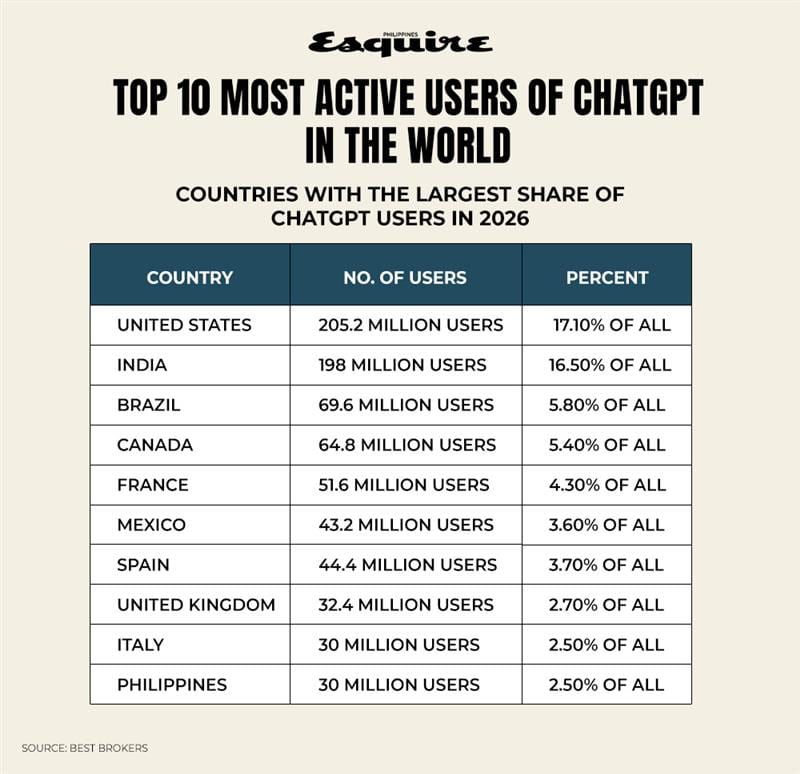
Manila is accompanied by G7 economies such as Germany (28.8 million users) and the United Kingdom (32.4 million), which isn't surprising considering the ASEAN nation's reputation for English proficiency. The list is topped by the US (205.2 million users or 17.1 percent of all traffic), India (198 million, 16.5 percent), Brazil (69.6 million, 5.8 percent), Canada (64.8 million, 5.4 percent), and France (51.6 million) rounding out the five biggest markets.
Ottawa is an interesting case with 64.8 million estimated users even against a population of just 41.7 million, showing repeat heavy usage or an average of 130 messages per citizen yearly.
This tracks to about 63.3 billion prompts. The Netherlands also has a peculiar usage rate with 13.2 million users of its relatively small population of 17 million clocking to a 72 percent adoption rate and about 58 AI questions per resident monthly.
ChatGPT commands about 60.4 percent of the generative AI chatbot space as of March this year. But BestBrokers analyst Alan Goldberg noted a shift in a surge in personal use cases instead of work-forward usage.
"While millions have already built the chatbot and other AI tools into their daily workflows, the usage is apparently changing: people seem to rely more on rival AI apps and tools for work and prefer ChatGPT for their personal use," he said.
"OpenAI's move to discontinue Sora might be a response to that, a signal that the company is focusing more on enterprise coding tools and a larger, unified AI assistant... and less on consumer-facing, media-heavy apps."
BestBrokers also ranked the most popular generative AI chatbots by market share as follows: 1. ChatGPT (60.40 percent) 2. Google Gemini (15.20 percent) 3. Microsoft Copilot (12.90 percent) 4. Perplexity (5.80 percent) 5. Claude AI (4.50 percent), and Elon Musk's Grok AI (0.60 percent) at 6th.
Should We Worry About The Clanker Takeover?
Digesting all these stats means there's probably an alarming takeaway ala Al Gore's An Inconvenient Truth with this AI takeover. Well, let us give you a brief idiot's guide to what you might have to worry about with the rise of these clankers and automatic poindexters.
Coming straight from the report, ChatGPT gets asked about 3.2 billion questions daily, which requires OpenAI's servers to burn about 60.7 gigawatt-hours of electricity every day just to respond to these prompts. That's about $3 billion in just electricity bills. Yearly, that could run about 2.1 million American homes annually, charge every electric car in the US 36 times, or keep the entire US powered for 44 hours straight.
One ChatGPT prompt on the latest GPT-5 model uses about 18.9 watt-hours of electricity, which is about 50 times more energy than Googling a question.
According to Yale University's Environment 360 magazine, every 20 to 50 queries to ChatGPT uses about half a liter of water to cool the hardware responsible for processing automated responses. Because of this, protests have erupted in countries like Chile and Uruguay over planned data centers that would eat into drinking water reservoirs.
Earthday.org reported that AI's water consumption could possibly exceed the total volume of bottled water sold globally each year. Electricity consumption from these AI data centers is expected to near 1,050 terawatt-hours around the world.
To put these into perspective, a single ChatGPT query has a relatively low water footprint at around 30ml compared to the 250ml used to stream music, the 430ml for an hour on social media, or the 1,720ml needed for an hour on Zoom. The thing is, there are about 3.2 billion prompts being entered each day.
The Death of Critical Thinking?
A society overly reliant on AI does beg the question if our brains will rot away, degrading our capacity to think for ourselves. The Massachusetts Institute of Technology Media Lab conducted a study that divided 54 subjects into three groups and asked them to write SAT-level essays using just ChatGPT, Google Search, or without the help of each tool. MIT researchers recorded activity across 32 brain regions and found that those who employed the use of ChatGPT had the lowest neural engagement and consistently underperformed cognitively, linguistically, and behaviorally.
Thinking generally degraded over time during the study, with ChatGPT users devolving their writing methods into only copy-pasting entire essays by the final session, after starting off with actual structural questions. Researchers call this phenomenon "cognitive debt," which reduces long-term independent thinking, leaving people more vulnerable to manipulation and a harder time with creative reasoning.
A Harvard University study showed that AI is not inherently bad for thinking as long as you use it as a partner for analyzing, inferring, and problem-solving. Faculty conducted a study in May last year and found that generative AI made people more productive, but less motivated. They also found that many use AI without really knowing how these platforms work and make for more than a few students who are unreasonably confident with their AI-generated output.
So, this means preserving skills of discernment, evaluation, judgment, and reflection have never been more crucial. And there hasn't been a shortage of calls to action to stop them robots from eroding our capacity to generate original thoughts how nature intended.
Esquire PH's resident music scribe, loafer disciple, and essayist fluent in niche internet subcultures and Philippine politics.
View More Articles About: