The Closing of the CMFR is Another Blow to Free and Responsible Journalism
After nearly four decades, the Center for Media Freedom and Responsibility, a non-profit organization established to protect and promote journalistic excellence and integrity, will cease to exist.

Published on Sep 18, 2026
The Center for Media Freedom and Responsibility (CMFR) has announced that it will close its operations on September 30, 2026, ending 37 years of work devoted to press freedom, journalism ethics, and the development of the Philippine news media.
In a statement posted on its social media channels on Friday (September 18), the CMFR said the decision was brought about by funding issues. “Philippine and international funding support has sustained the work of CMFR; but multiple factors have affected the funding environment, making it difficult for CMFR to secure the necessary funds for its operations,” it said.
ALSO READ
Opinion: The Case for Shared Responsibility on Disinformation
Summit Media, PlayTime Entertainment Set to Elevate Modern Filipino Publishing with PT Summit
The CMFR
Established in 1989, three years after the People Power revolution ended the dictatorship of Ferdinand Marcos Sr., the CMFR was founded by journalist Melinda Quintos De Jesus, who would remain its executive director for its entire 37-year existence. Before CMFR, De Jesus had written critically about the Marcos regime as a columnist for Bulletin Today and later became editor in chief of Veritas Newsweekly, one of the publications that made up the country’s alternative press during the dictatorship. At CMFR, she developed its core programs around media monitoring, press freedom, professional standards and journalism education.
The CMFR then grew into one of the Philippines’ most recognized media organizations, helping protect and promote the practice of responsible and ethical journalism. Its work spanned a period in which the country’s press went from rebuilding after years of state control to navigating political upheaval, the rise of digital media, attacks on journalists, disinformation, and the economic pressures reshaping the news industry.
Another central figure of the CMFR was Luis V. Teodoro, the veteran journalist and former dean of the University of the Philippines College of Mass Communications. He joined the organization soon after its launch and became deputy executive director and editor of Philippine Journalism Review. When Teodoro died in 2023, De Jesus recalled that the two shared a conviction that press freedom also required responsibility, and that news should serve the public rather than simply function as a commodity.
CMFR’s work
What made the CMFR's work unusual and relevant was that it defended journalists against attacks while also scrutinizing journalism itself. It monitored news coverage, raised questions about accuracy, fairness, context and sourcing, documented attacks against journalists, and pushed news organizations to examine the standards by which they operated.
For example, CMFR documented the press's experience under Martial Law and revisited those lessons decades later. In 2012, for the 40th anniversary of the declaration of Martial Law, it brought together the recollections of De Jesus, Teodoro and Santos and assembled a timeline and archive examining the relationship between the dictatorship and the Philippine press.
The organization monitored the media's coverage of major political controversies, including the 2009 Ampatuan massacre, one of the deadliest attacks on journalists anywhere in the world. It also followed the threats against media organizations during the Duterte administration, including the cases involving Rappler and ABS-CBN. The organization frequently found itself defending press freedom while simultaneously holding journalists and news organizations accountable for the quality of their work.
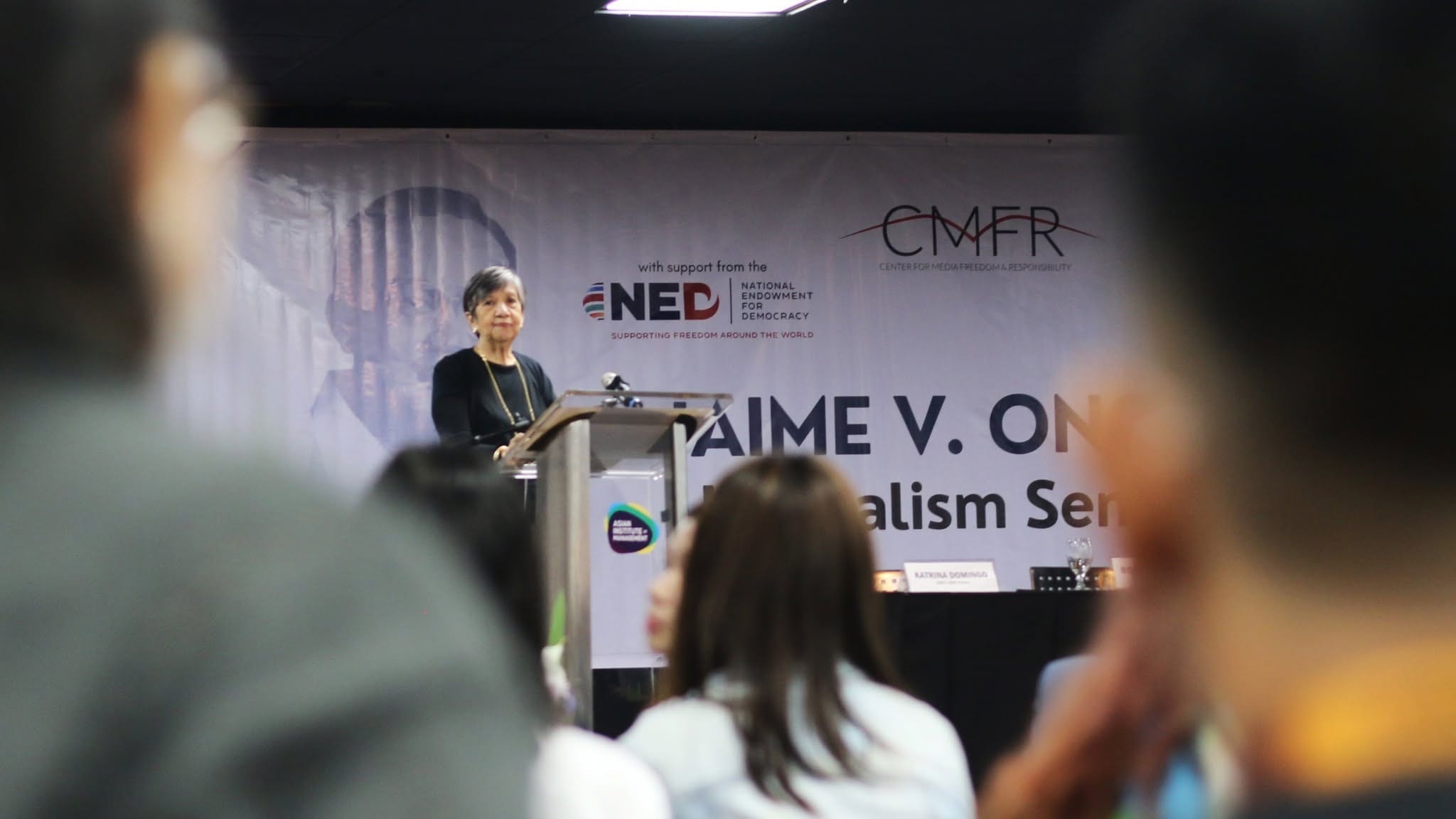
CMFR's journalism programs also helped shape generations of reporters, especially through the Jaime V. Ongpin Journalism Seminar, which was named after the late journalist and businessman. It became an annual gathering for journalists and journalism students and a venue for recognizing work that demonstrated strong reporting and journalistic values.
The organization’s final leadership roster reflects the range of people who carried that work in its later years. As listed by CMFR, the board comprised De Jesus, Tina Monzon-Palma, Vergel O. Santos, Lisa O. Periquet, Ed Lingao, Francis Estrada, Lorna Kalaw-Tirol and Carlos H. Conde. Its officers were De Jesus as president and CEO, Monzon-Palma as chairperson, Periquet as treasurer and Kalaw-Tirol as corporate secretary.
The closing of CMFR comes at a time when the global media landscape is markedly different from the one it entered in 1989. News has largely moved online, social media has become a news source for a vast majority of online users, and misinformation and attacks on journalists are at an all-time high. For nearly four decades, CMFR was there to document those changes and, when necessary, to question the people responsible for producing the news, including journalists themselves. It is a huge blow to journalism itself that the watchdog of watchdogs will now cease to exist.
“CMFR would like to thank all who have been part of the journey—our past and present staff, the community of journalists and news organizations in the Philippines and abroad, various embassies in Manila, the schools and students, and civil society organizations—who appreciated and understood the value of our work and supported our efforts,” it said. “We are truly grateful. Please accept our best wishes.”
View More Articles About: