Opinion: Shahed Kamikaze Drones Are the Future of Warfare—Should the Philippines Consider Them?
In the coming years, a Shahed-like blanket could protect the Philippines while strengthening its leverage in the West Philippine Sea dispute.

Published on Apr 11, 2026
Regardless if the truce between Washington and Tehran holds out or not, one thing is certain to all observers. Throughout the 38 days of fire, Iran has demonstrated its prowess in asymmetric combat. One weapon system continues to stand out, sowing uncertainty, fear, and elation depending on which side you’re on: the HESA-136 Shahed, translated in English as the “Witness” one-way attack drone. Yet before diving into why the HESA-136 Shahed is integral to understanding the ongoing Iran war, some technical jargon must first be clarified.
Asymmetric Warfare: What’s in the Name?
Asymmetric warfare, as it says on the tin, is a type of fighting that involves an adversary that depends on unconventional means to defeat, subdue, or cripple an opponent, which is assumed to be operating along conventional lines. Conventional war involves clear combatants, rules of engagement, and the corresponding strategies and tactics associated with it. The ‘shock and awe’ doctrine, so common in many NATO armies since the Gulf War of 1991, is one example, where the massive use of tanks, infantry fighting vehicles, aircraft, and advanced military technology is essential to pummel an enemy into the ground and force them to withdraw, which was the case with Saddam Hussein’s Iraq, whose forces retreated from Kuwait, which they had invaded, after massive losses in the thousands.
Asymmetric warfare, on the other hand, includes guerrilla warfare, espionage, psychological operations or psyops, both online and offline, and other means to defeat an opponent in ways that they will least expect. An asymmetric force will never confront the enemy directly. The goal is not to outfight, but to outwit your opponent and still achieve the goal of victory.
Throughout history, both conventional and asymmetric warfare have dotted the landscape and simultaneously existed side by side, whether in the campaigns of Alexander, the Three Kingdoms Period, the Reconquista, the French Revolution, or in the insurgency of the partisans of Kosovo and the Taliban.
Certain countries are able to acquire a reputation based on the effectiveness of their armed forces. Russia is known for its deep operations, which are multiple attacks across a wide front to deliver a killing blow, with the objective of breaking all of them in a synchronous fashion, as happened to Germany during the Battle of Stalingrad in 1942 to 1943 and Operation Bagration in 1944. On the other hand, Britain’s Royal Navy dominated the seas in much of the 1700s, the 1800s following Trafalgar, and until the 1956 Suez Crisis, as it was indispensable to her interests in finance and trade. Vietnam is able to etch itself as having one of the most formidable guerrilla militaries on the planet, responsible for defeating the French, the Americans, and even the Chinese in the 1900s, through a combination of foreign support from the USSR and its allied nations, and Vietnam’s own officer corps, who are known for their adaptability, ruthlessness, and commitment, which are shared by its rank and file up to this day.
In layman’s terms, asymmetric combat is akin to fighting shadows. The opponent chooses the time and place where they attack. All they have to do is wait and unleash havoc. And this fighting style suits Iran.
A Crash Course on Iran’s Geostrategic Outlook
The civilian and military leadership of Tehran are cognizant that they can never defeat America and its allies in direct combat. Sanctions, in place since 1979, meant that they can never field a huge conventional military that can equal or even exceed NATO standards. Thus, over the years, which is also shaped by their experience of fighting a bitter eight-year war with Iraq that involved trench warfare and chemical attacks from 1980 to 1988, Iran sought to counter these deficiencies by adopting an expansive security architecture.
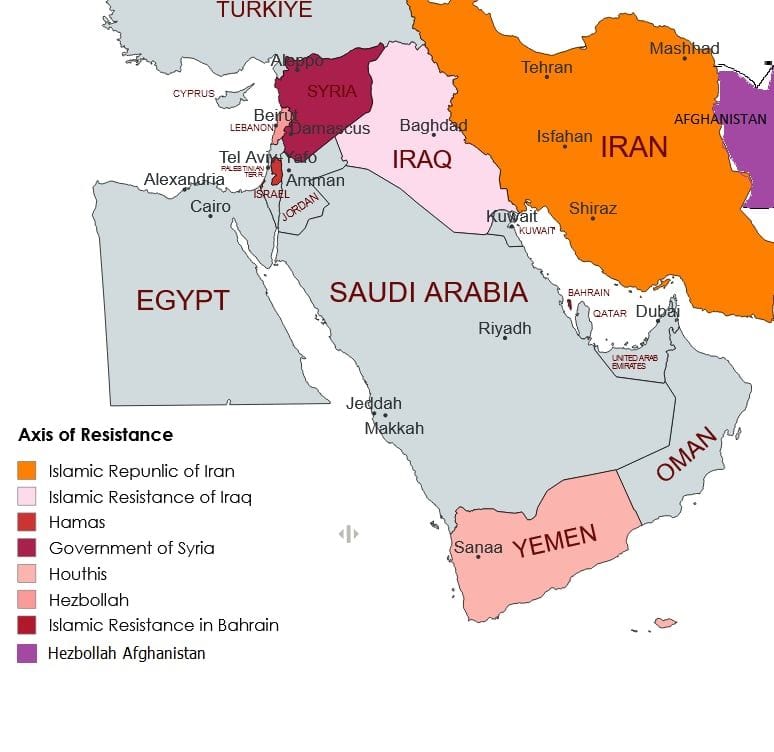
In foreign affairs, Iran has meticulously cultivated a set of armed militants and proxies in the Middle East known as the Axis of Resistance. This includes Hezbollah in Lebanon, the Popular Mobilization Forces in Iraq, the Houthis of Yemen, Hamas in Gaza, and, until 2024, the nation of Syria under Bashar al-Assad. The purpose of this Axis of Resistance is to give Tehran the means to project power in the region, counter America and Israel’s technological superiority, and keep the Gulf countries, already leaning towards the West, in check.
In domestic affairs, this has meant that the civilian government in Iran, and even its clerics, have been overshadowed by paramilitary factions within, of which the Iran Revolutionary Guard Corps (IRGC) takes hold. Distinct from the regular army, navy, and air force, the IRGC not only has its own army, navy, and air force, but it is also mandated to take command of Iran’s missiles and drones. It also has massive influence in Tehran’s economy through its shares in numerous enterprises and the existence of charities such as bonyads, which are noted to comprise a quarter of Iran’s GDP. Last but not least, it has a commanding presence in militias either fully or partially aligned to the mullahs. These capabilities have earned the IRGC both renown and notoriety, depending on whether you are Tehran’s friend or enemy.
Where Do the Shahed Drones Fit Into This Equation?
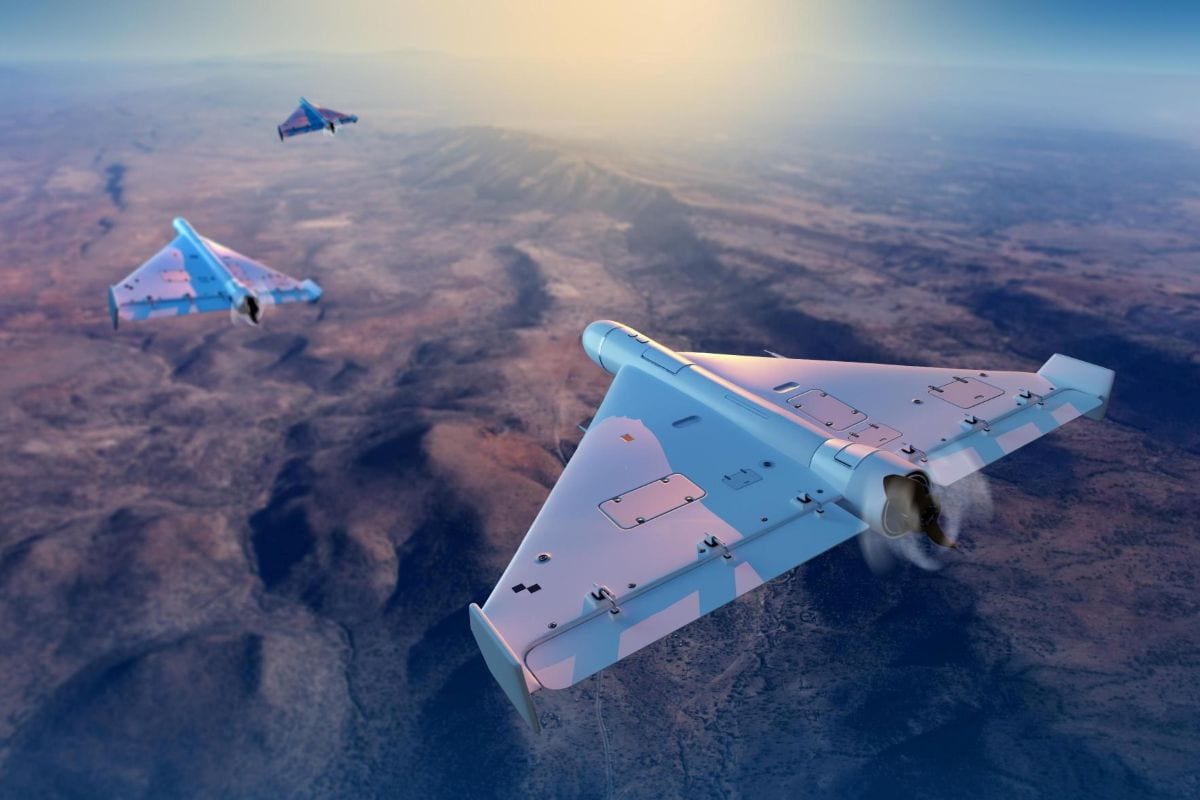
The Shahed kamikaze drone plays an integral role in the fortunes of Iran’s warmaking and survival, especially the HESA-136 variant, as there are many types of Shaheds since the late 2010s. First unveiled in 2021, with its design and role influenced by preceding platforms such as the Dornier DAR and IAI Harpy, which by themselves are part and parcel of the increasing prevalence of unmanned aerial vehicles (UAVs), of which the larger American MQ-9 Reaper drones once predominated, the Shahed drone first saw its major combat use in the Russo-Ukrainian War in late 2022 in the form of Moscow’s Geran-2. Made from civilian parts, which technically are able to evade commercial restrictions, Geran-2s are the bane of the Ukrainian armed forces, after their initial strong showing in the opening months of 2022 with their widespread use of the Javelin anti-tank guided missiles against Russian T-72s, T-80s, and T-90s during the ill-fated assault on Kyiv.
Russia’s massive deployment of the Geran-2 is noted as one of the factors that contributed to the current stalemate on the battlefield between Kyiv and Moscow. For, unlike other UAVs, kamikaze drones are designed not to return and are fielded in quantity, which produces a quality of its own. Alongside other types of drones, Geran-2s tend to have a price tag running into tens of thousands of dollars, as opposed to tanks, vehicles, and aircraft, which cost millions to procure, repair, and replace. Likewise, a fleet of such drones is enough to repel a massive offensive, leading to horrific losses on the front in the first few weeks of its debut.
Yet, it is in 2026, with the ongoing Iran War, that HESA-136 Shaheds have been noted for their lethality. Since the 28th of February, Iran has been dispatching these units across the Middle East, specifically against the Gulf countries, where they either function as bait for the million-dollar interceptor missiles that the Gulf countries have to offer or, in many cases, as swarms that hit and destroy American radar, logistics facilities, oil depots, pipelines, and data centers. The arithmetic here is sound.
A Shahed drone costs $20,000, or the price of a used pickup truck, while Patriot interceptors are estimated to cost $2,000,000 or more, and before they can even reach the target, four or five other Shaheds are already on the way. As of this writing, Tehran has unleashed roughly 5,156 drones, 2,181 ballistic missiles, and 59 cruise missiles since February 28, and this is regarded as the entire arsenal of several nations, and it will take time to recover. In addition, Iran’s diplomats, whether bluffing or genuine, claim that they still have 45,000 drones and 15,000 ballistic missiles that can be dispatched at a moment’s notice.
Iran’s use of the HESA-136 is seen as cost-effective and often as a convenient buffer that it tends to apply before it deploys its ballistic missiles such as the Fattah. The missiles that Iran reserves thus complete the kill chain of the operation. And in Lebanon, the Hezbollah militia, long thought to have been defeated in 2024, came back with a vengeance against the Israeli Defense Forces, where numerous Merkava tanks were either hit or incapacitated by this same munition.
Why the focus on the Gulf monarchies? Simple. This is the Achilles’ heel in the Middle East.
If Iran puts all its eggs in one basket over Israel, aka Option 1, it is not as effective. If Iran single-handedly targets the U.S. fleet, aka Option 2, it will waste its ammunition. Therefore, Option 3—to force the Gulf monarchies to choose where their bread is buttered, since they host numerous U.S. bases in their countries—is the most rational option for Tehran’s planners.
Instead of a one-trick pony, Iran’s fleet of Shaheds is estimated to be in the thousands. Drone production averages 500 to 600 per month. Much of this weaponry, alongside the more formidable yet limited number of ballistic missiles, is located deep in the Zagros Mountains, where it is noted that tunnel cities, or underground facilities operated by the IRGC, are where they launch these drones and missiles in swift succession. Despite attempts by America and Israel to destroy these sites, they can simply be dug up, rebuilt, and restocked. At this juncture, one can say that Iran, instead of the expectation that it would fall apart so easily after the decapitation strike that killed Ayatollah Ali Khamenei, instead stood, absorbed the shock, and mercilessly fought back.
Shaheds for the Philippines?
While some may see this proposal as still far-fetched, even outrageous, this is not that fanciful. In 2025, American search teams were able to capture a Shahed drone, and they reverse-engineered it. This resulted in the introduction of the Low-cost Uncrewed Combat Attack System, or LUCAS drones, in October 2025. The U.S. Defense Department or the War Department candidly admitted that they simply copied and deployed an improved version of the drone. By doing so, parity is believed to have been reached.
But here is the reality check. Despite the ongoing wars in Europe and the Middle East, Western armies continue to be relatively unprotected and unguarded against drone swarms. They also continue to use doctrines from the shock-and-awe era, despite recent exercises, in which Ukraine took part, demonstrating the obsolescence of relying on traditional combat. We must therefore expect that this will be the same hurdle that Manila will face if it is to seriously consider the Shahed.
Why so? For one, the implementation of new techniques and styles will take time. First will be bureaucratic resistance, each with its own entrenched reasons on why they will or will not consider it. Second is hesitation to learn even from the enemy’s effectiveness, as many in charge still have paradigms clocking back between the 1960s and 1980s. Third are the ethical repercussions and consequences, since Shaheds and kamikaze drones, by their nature, do not distinguish between civilian and military targets.
In addition, the introduction of a weapon system will not necessarily shift doctrine unless initiatives are taken to do so. It will likewise affect many of the processes and supply chains along the way. As old dogs are reluctant to learn new tricks, the initiative of assessing equipment such as the Shahed will likely fall into the hands of younger officers and the rank and file. Yet, as tensions in the Asia-Pacific continue to rise, studying the Shahed weapons system is not only necessary but urgent. Perhaps, in the next few years, we can cover this nation with a Shahed blanket or its local equivalent, thus protecting not only our archipelago but offering direct leverage and a bargaining chip in the West Philippine Sea dispute since its flare-up in 2012?
To be complacent is the easiest path to ruin. In this vein, the Shahed, or Witness in English, is the literal witness for a new kind of warfare, of the fifth-generation variety, where memes are as lethal as armies, where supply chains are king, and where there is no longer certainty in the old binaries and logics that were gobbled up by contemporary orthodoxy since 1950. Either we take this as an opportunity to melt these paradigms, or remain stuck out of fear that it will jeopardize what we took for granted is none of this author’s business. But the HESA-136 Shahed, as we speak, whether it is too early to say or not, is this present century’s Maxim gun, which was developed in the 1800s, a weapon that literally ended the cavalry charge of the colorful and aristocratic hussars and dragoons as a viable heuristic in WWI, and forced the rest of the world to adapt or perish in the general direction of its frontal and rear-end sights.
For fortune always favors those who are bold, the adventurous, the mad innovators, and the pioneers, with the rest simply playing catch-up.
Further Reading and Viewing:
Britzky, Haley (2025). US sets up one-way attack drone squadron in the Middle East after reverse-engineering Iranian drone. CNN Politics.
https://militarnyi.com/en/news/u-s-presents-low-cost-lucas-strike-drone-inspired-by-shahed/
Gordon, Chris (2023). Cheap UAVs Exact High Costs. Air & Space Forces Magazine.
https://www.airandspaceforces.com/article/cheap-uavs-exact-high-costs/
HistoryLegends Flashpoint (2025). Iran Strikes All US Bases in Middle East. Youtube.
https://www.youtube.com/watch?v=jzAxWRvA1L8
Reuters (2024). What is Iran's 'Axis of Resistance'? Special Features.
View More Articles About: