How a Belgian Designer Pays Homage to His Filipino Roots
Maxime Edward’s menswear spotlights traditional Philippine craftmanship.
Published on Jun 17, 2026
Fashion designer Maxime Edward debuted his collection Roots and Weaves to a standing ovation from an audience of diplomatic dignitaries, cultural workers, industry practitioners, and activists at the grand La Bellone showroom in Brussels, Belgium, last June 6, 2026. Without sacrificing artistry, style, and straight-up coolness, Maxime was able to spotlight traditional Philippine craftsmanship, fashion sustainability, and 80 years of diplomatic ties between the Philippines and Belgium through a sweeping collection of stunning pieces that straddled men’s, women’s, and androgynous wear.
As the crowd, decked out in barong and terno, was welcomed with award-winning baritone Cipriano De Guzman Jr.’s operatic renditions of beloved Tagalog, Bisaya, and European songs, they munched on lumpia and barbecue hors d'oeuvres by Ceres Kusina, a Belgian-based Filipino food caterer. Around the room, you could hear Tagalog chatter piercing through the hum of French and Flemish. Even the Philippine ambassador to Belgium and Luxembourg, Jamie Ledda, made opening remarks.
Undeniably, this moment—held just a few days before the nation’s 128th Independence Day—was a celebration of the Philippines and its culture in the heart of Europe’s capital. But in a way, it was also a homecoming for the designer who, until recently, had no connection to the Philippines at all.
Weaving Together Native Philippines and Adoptive Belgium
Having been adopted by a white Belgian family at nine months old, Maxime grew up identifying as conventionally European. He did not experience the marshmallow hotdog birthday parties, karaoke sessions, and meeting so many titos and titas (related or otherwise) that even children of the diaspora get to be a part of when growing up abroad. As such, he is—as evidenced by his collection’s nod to the Antwerp Six’s sleek and unconventionally cool legacy—fully Belgian.
And yet, questions of identity began to echo in his creative process as he approached his mid-30s. Was he more than just Belgian? What parts of him and his work, if any, were Filipino?
In May 2025, Maxime returned to the Philippines for the first time since his adoption. Filled with apprehension about whether or not he would feel a sense of belonging in the country—or worse, feel anything at all—he partnered with Philippine Art and Culture Exchange (PACE) to build a connection rather than to wait for one.
During the trip, he and PACE president Louise Baterna-Hubert visited artisans producing textiles using traditional methods. In Luzon, he met and watched the work of master weaver Irene Bauer Bimuyag in the town of Lubuagan, Kalinga. He shared coffee with Mabilong weavers as they discussed their community and traditions. In the Visayas, he learned the grueling process of turning pineapple fibers into the coveted piña cloth. He watched the artisans of Miag-ao, Iloilo, craft gilded fabrics. In Mindanao, he explored local artisans' kiosks and spoke with them about how weaving holds both history and identity. In every region he visited, he hand-selected fabrics to bring back to Belgium and incorporate into his collection.
Two Roots, One Story
As the pieces came down the runway, it became clear that Maxime’s collection—and Maxime himself—was able to embrace both his Belgian identity and his Filipino heritage fully and at once.
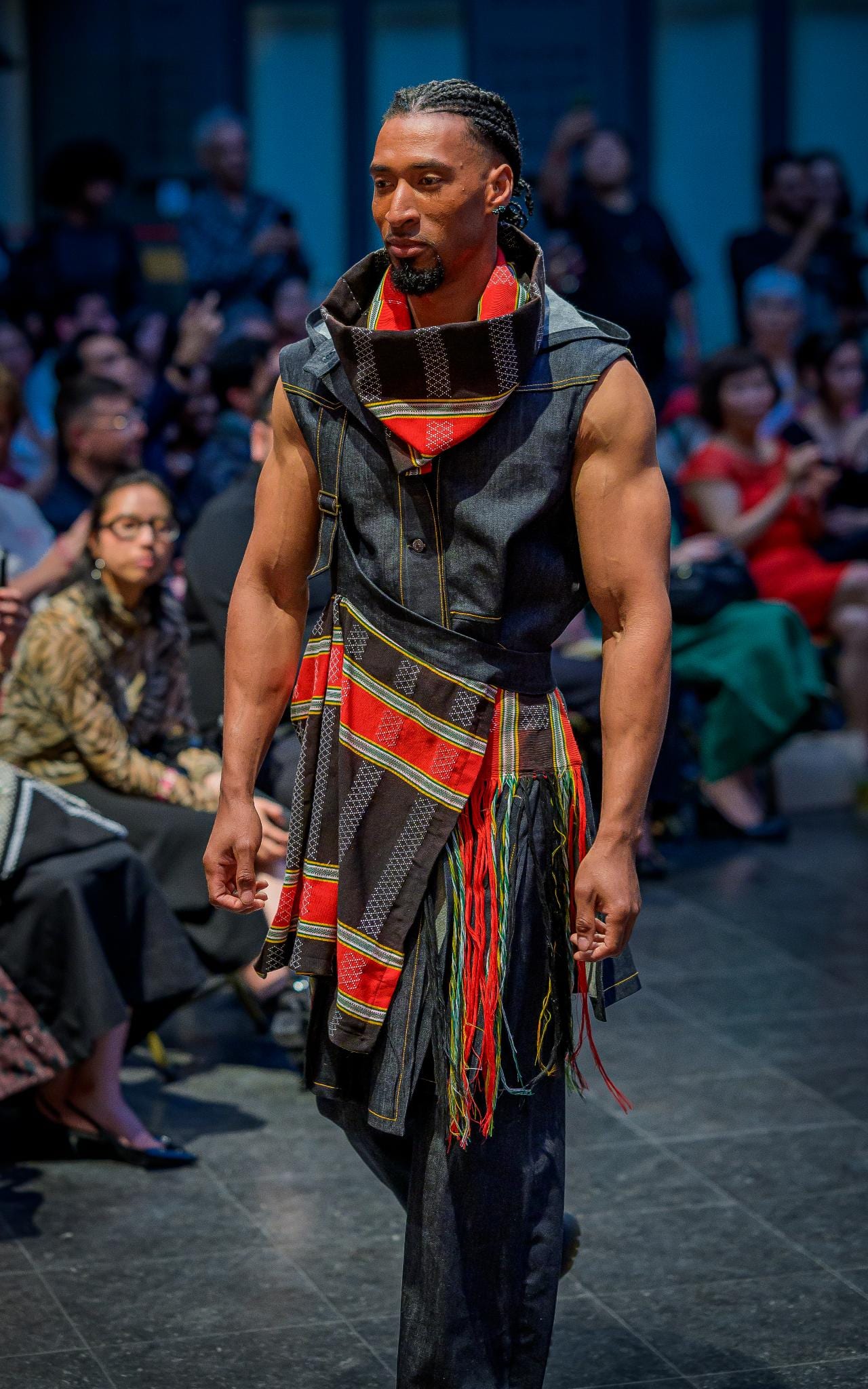
The references to Belgian subculture were apparent in the cowl-hoods and erogenous zone-baring cropped tops of his menswear. These are looks you could see fitting into (or rather, standing out) at any electronic music rave. Likewise, the bomber jackets and trousers with ribbed cuffs alluded to Europe’s football tradition. While the use of canvas and denim nodded towards workwear, and thus, contemporary streetwear.
Still, Filipino fabrics took center stage. The designs were executed using the textiles Maxime collected during his trip to the Philippines. And their presence produced emotionally evocative garments that were at once stunning, wearable, and culturally weighted.
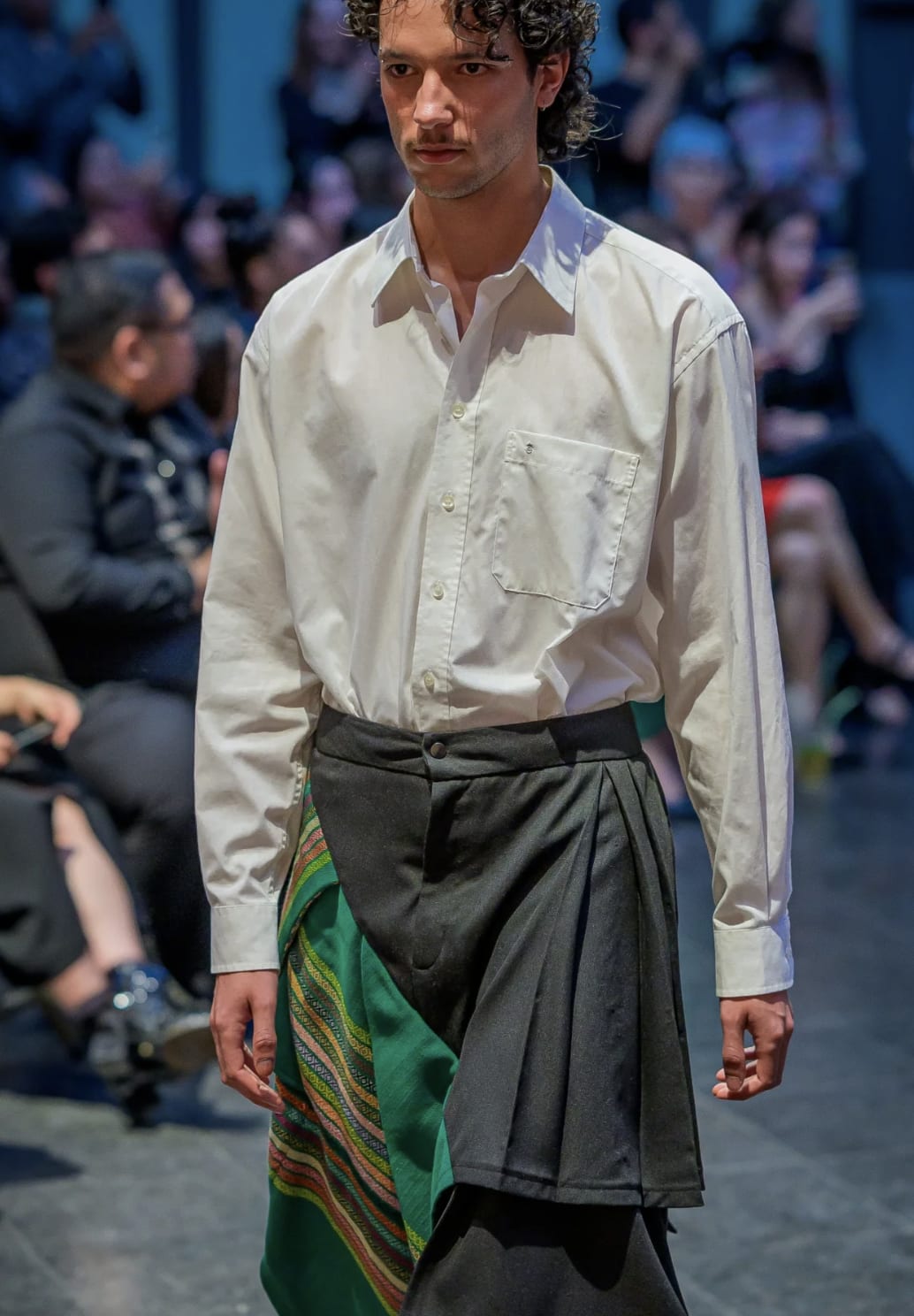
The genderfluid kilts, for instance, modeled by men, toed various lines: between male and female, between playful and serious, between Belgian and Filipino. While the levity of men-in-skirts celebrated queerness, the draping and layering of indigenous Filipino textiles grounded the look with precolonial gravitas. Similarly, the reimagining of the piña as a rouche-sleeved men’s blouse instead of the traditional barong injected newfound possibilities into the Filipino fabric.
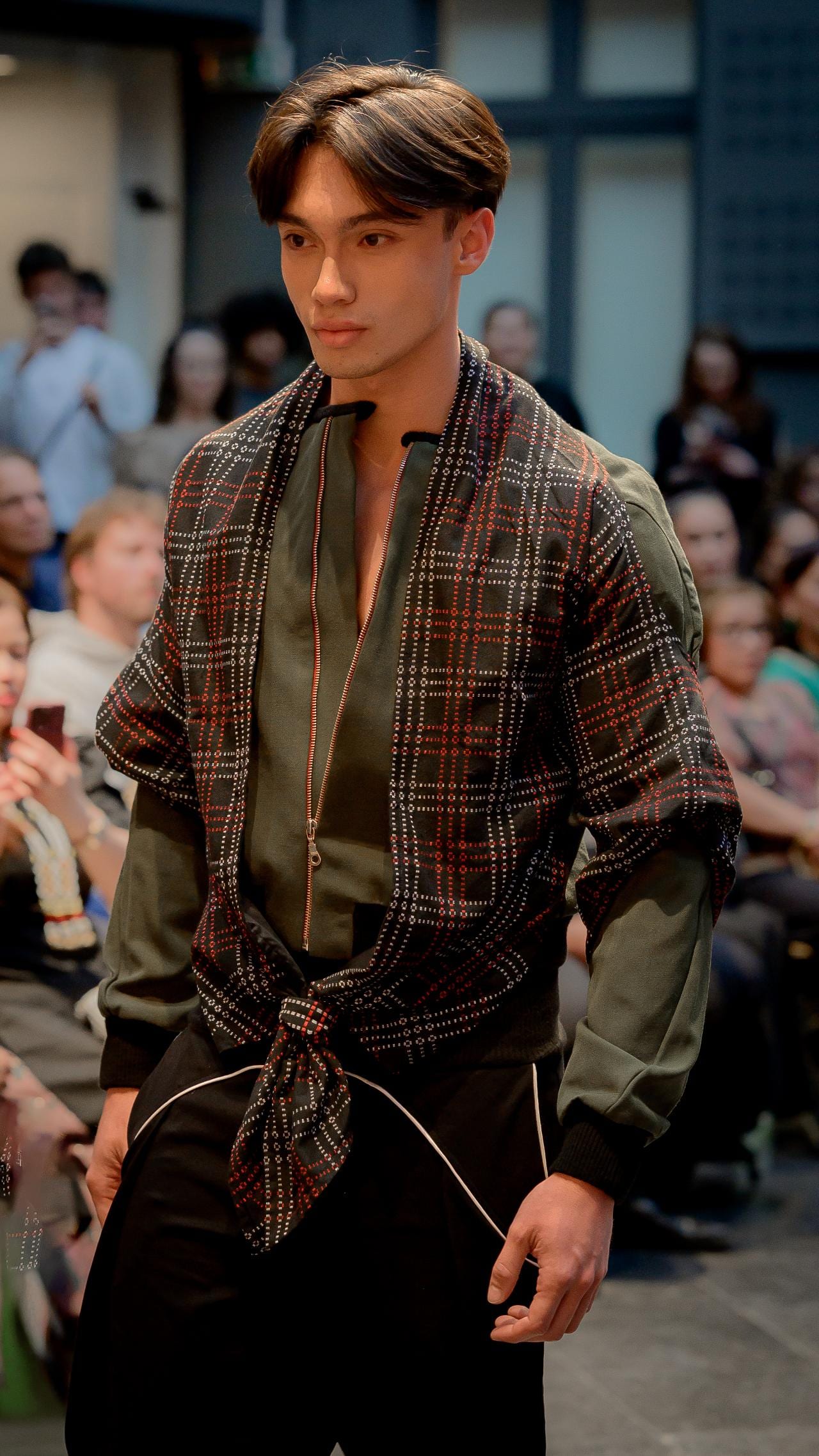
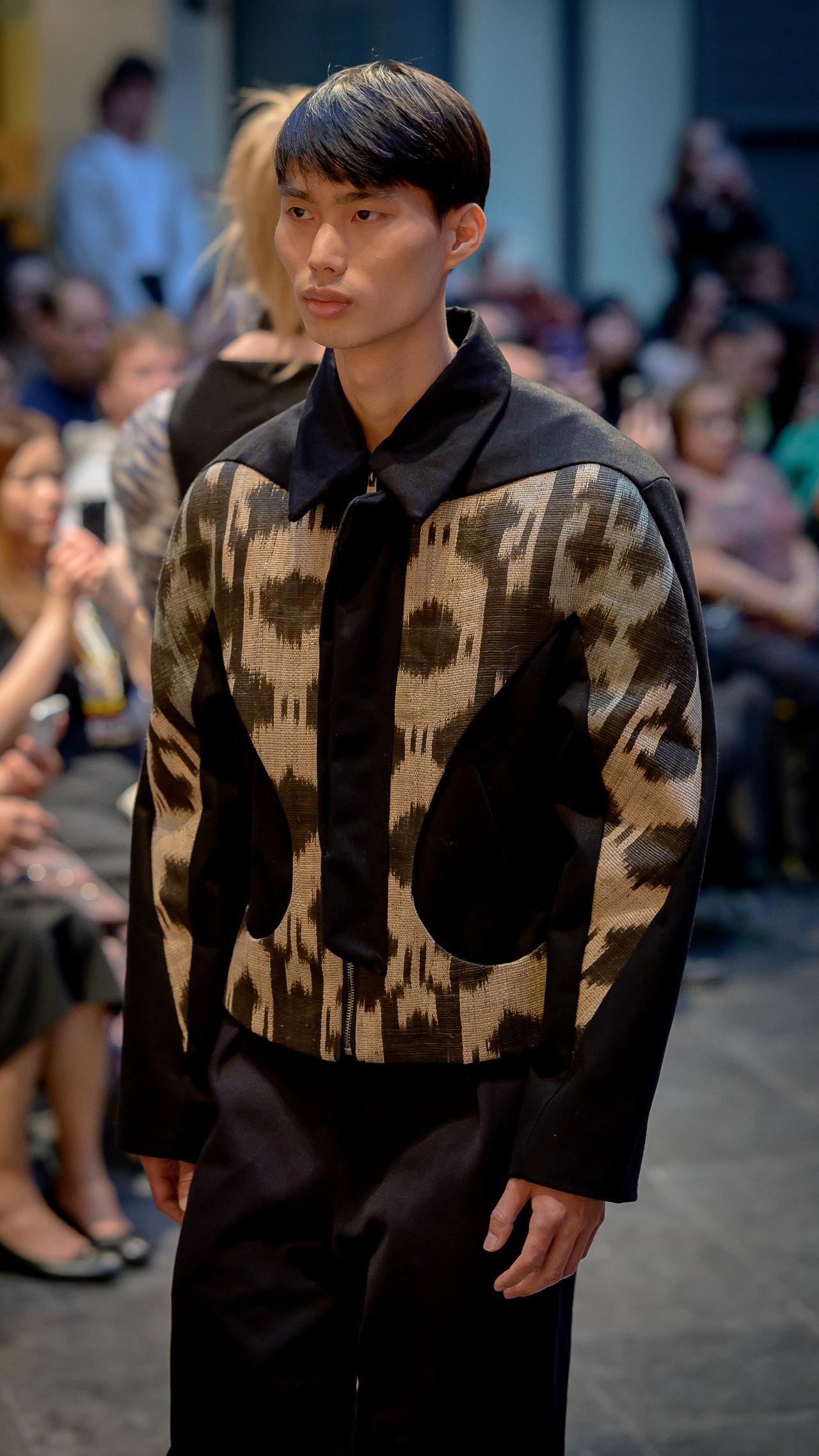
Perhaps the most impressive looks were the most deceptively simple. The ikat zip-up, a haute couture take on the classic Carhartt Detroit Jacket, was a showstopper. Impressive in its versatility—it would look as good on a red carpet as it would at the airport; on a feminine look as on a masculine one—it was its unapologetic, yet unexoticizing incorporation of the Filipino textile that made this piece indicative of traditional craftsmanship’s contemporary global potential.
A Designer To Watch
There’s a lot to commend Maxime Edward for based on his Roots and Weaves show. One is how he champions the women who created the textiles he used, the regions they represented, and their essentialness to fashion’s sustainability. Another is how he dovetailed two distinct cultures into a cohesive collection. And another is his own detailed craftsmanship: he designed and sewed every garment with the rigorous discipline and precision of his own two hands.
Maxime is a designer to watch—not just because he’s “one of us” but because he is earning his place on the world’s stage with quality work that matters. Lucky for us, his story is just getting started.
ALSO READ:
Meet Keith Brown, the Under-the-Radar Fashion Designer You Should Know
Remembering Ramon Valera Who Turned the Baro't Saya Into the Modern Terno
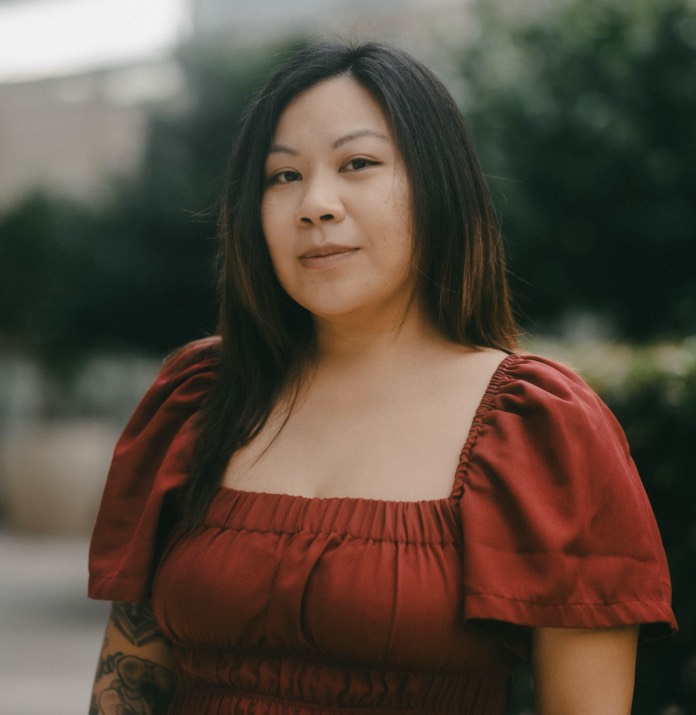
Pauline is a contributing writer preoccupied with decolonization, conceptual art, counterculture, and long conversations over flaky pastries. Follow her on IG: @pauline_arnould
View More Articles About: