Patek Philippe's Philippe Stern: Remembering the Man Who Looked After Time
The watch world lost one of its quiet giants: the third-generation patriarch of the family that owns Patek Philippe died at the age of 88.

by Alvin Uy
Published on Jun 16, 2026
Philippe Stern, honorary president of Patek Philippe and the third-generation patriarch of the family that owns the storied Swiss manufacture, passed away on June 14, 2026, at the age of 88.
To the general public, his name may never have carried the celebrity of fashion designers, industrialists, or luxury moguls. Yet among collectors and watch enthusiasts, Philippe Stern was something far more significant: the man who ensured that mechanical watchmaking survived long enough to become relevant again.
In the 1970s, Swiss watchmaking was in the middle of its greatest existential crisis. Quartz technology from Japan had disrupted centuries of tradition. Battery-powered watches were more accurate, less expensive, and easier to manufacture.
Many of Switzerland's most respected watchmakers either disappeared, merged into larger groups, or abandoned mechanical watchmaking altogether.
The prevailing wisdom of the era was simple: the future belonged to electronics.
Philippe Stern disagreed.
Philippe Stern navigated through the 1970s era plagued with the quartz crisis and transformed the brand to the powerhouse that it is today
.jpg)
He believed a mechanical watch was never just an instrument for telling time. While others chased the future, Stern preserved craftsmanship. He continued investing in complicated mechanical movements, retained traditional watchmaking skills, and doubled down on the very things the industry was being told were obsolete.
History would eventually vindicate him.
Today, collectors wait years for certain references. Vintage complications sell for millions at auction. Mechanical watches have become objects of culture and connoisseurship rather than necessity. The renaissance of traditional Swiss watchmaking owes much to the conviction of leaders like Philippe Stern, who refused to surrender to short-term thinking.
Contrary to what many assume, the Sterns were not descendants of founders Antoni Patek and Adrien Philippe.
The family's connection to the manufacture began in 1932, when Charles and Jean Stern acquired Patek Philippe during the depths of the Great Depression. The Sterns already owned a successful dial-making company and had been supplying components to Patek Philippe for years. They understood the value of the manufacturer at a time when others saw only financial risk.
Philippe and his son Thierry
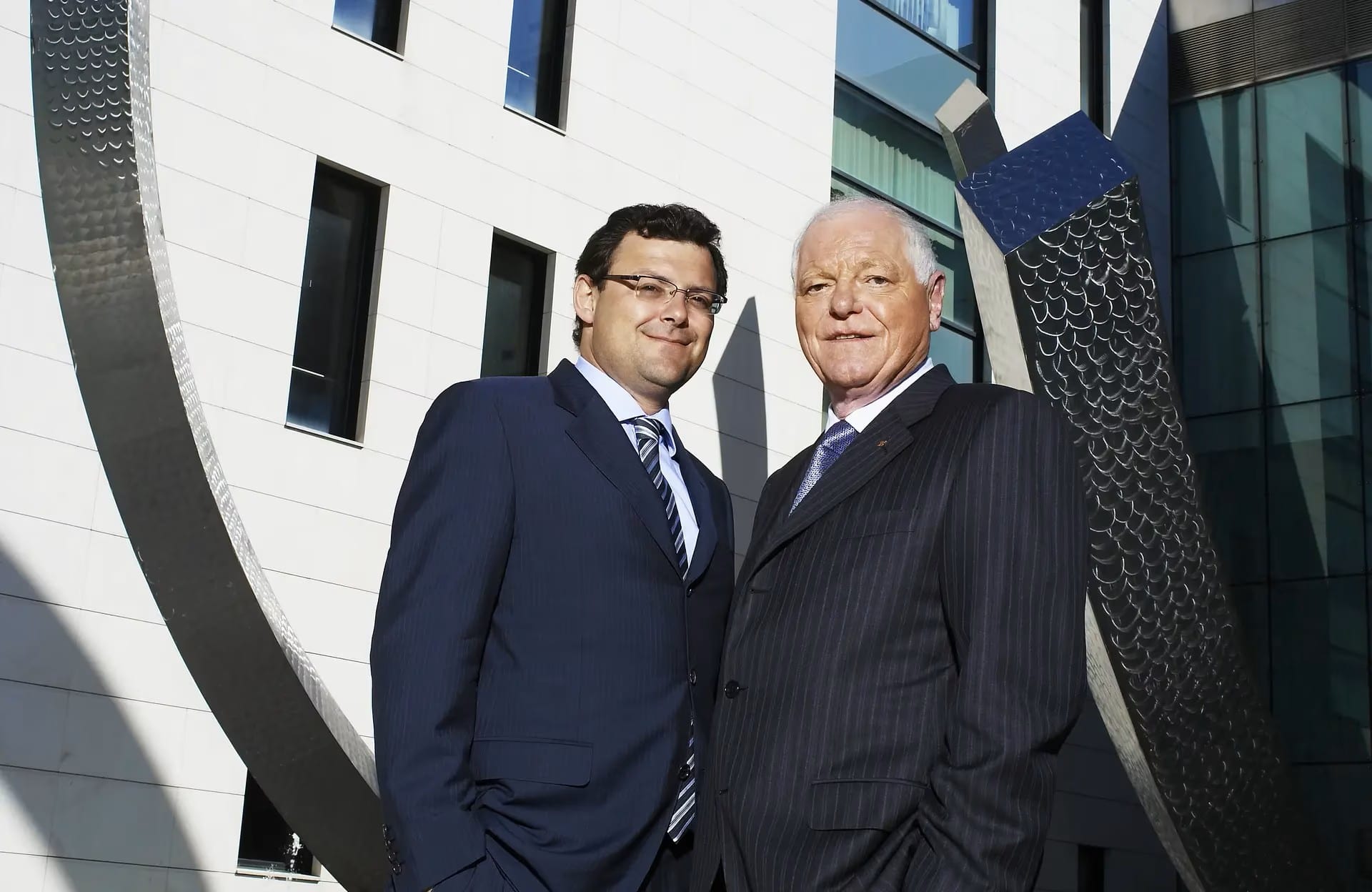
What began as a rescue would become one of the most consequential acquisitions in luxury history.
Charles Stern's son, Henri Stern, expanded the company's international presence and established its American operations. By the time Philippe Stern assumed leadership, the foundations had already been laid. His challenge was not merely preserving the family legacy but elevating it.
Under his stewardship, Patek Philippe evolved from a respected Swiss watchmaker into what many regard as the gold standard of haute horlogerie.
He championed grand complications, supported the development of legendary creations such as the Calibre 89, strengthened the manufacture's independence, established the Patek Philippe Museum in Geneva, and later helped introduce the Patek Philippe Seal, an uncompromising standard of quality that extended beyond movements to the entire watch.
He also oversaw an era that transformed watches such as the Nautilus from bold experiments into icons of modern luxury.
Henri Stern was the president of the family-owned enterprise, with his son Philippe eventually succeeding him
.jpg)
His greatest product legacy may have been having the vision to embrace the Nautilus at a moment when doing so seemed almost heretical for Patek Philippe. In the mid-1970s, as the Quartz Crisis threatened the Swiss watch industry, Stern recognized that a new generation of affluent buyers wanted something different from the slim gold dress watches that had long defined the brand. He became a key champion of a daring concept: a high-end sports watch crafted in stainless steel.
To bring that vision to life, Patek Philippe turned to the legendary Swiss designer Gérald Genta, who created what would become the Nautilus. According to watchmaking lore, Genta famously sketched the design in just a few minutes while observing Patek executives during the Basel Fair, drawing inspiration from the portholes of transatlantic ocean liners. Stern himself initially admitted to having reservations about the watch's radical 42mm size, integrated bracelet, and steel construction, features that ran counter to everything Patek Philippe traditionally represented.
Yet he also understood that the brand needed to evolve without abandoning its values. The resulting Ref. 3700 Nautilus, launched in 1976, became one of the boldest decisions in the company's history. Today's waiting lists, auction records, and collector obsession surrounding the Nautilus are a testament not only to Genta's design genius but also to Philippe Stern's willingness to bet on an idea that few others could see at the time.
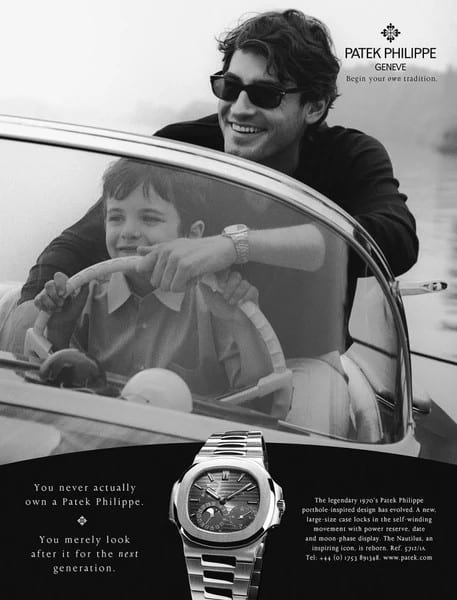
The iconic Patek Philippe campaign about "never really owning a Patek Philippe"
But his greatest contribution wasn't a watch.
In 1996, during Stern's presidency, Patek Philippe launched what would become arguably the most famous advertising campaign in the history of luxury goods. The line was deceptively simple:
"You never actually own a Patek Philippe. You merely look after it for the next generation."
Thirty years later, it remains one of the most recognizable slogans ever written.
The brilliance of the campaign was that it refused to sell a product. The advertisements often focused less on the watch itself and more on the relationships surrounding it, a father and son, a mother and daughter, or a shared moment between generations. The watch was almost secondary.
What mattered was the idea that certain possessions become repositories of memories, stories, and family history.
What made the campaign so powerful was that it reflected Philippe Stern's own philosophy. At a time when many luxury brands pursued growth at any cost, Patek Philippe remained fiercely independent and family-owned. Stern often behaved less like a corporate executive and more like a steward.
He viewed the company as something entrusted to him by previous generations and destined to be handed to future ones.
The famous slogan was not merely a marketing message. It was a mission statement.
The irony is that the line describes the Stern family just as accurately as it describes Patek Philippe owners. Since acquiring the manufacture in 1932, three generations of Sterns have acted not as owners in the conventional sense but as caretakers of an institution larger than themselves.
As someone who has spent years admiring the brand and writing about the world of fine watches, one of my regrets is never having had the opportunity to meet Philippe Stern personally.
By all accounts, he was a deeply private man whose influence was felt more through the culture he built than through public appearances. Yet I have had the pleasure of meeting his son, Thierry Stern, on several occasions over the years. In those encounters, one gets a sense that the values Philippe championed remain firmly intact.
Thierry carries the same belief in independence, long-term thinking, and respect for tradition that defined his father's stewardship. In an industry increasingly driven by quarterly results, hype cycles, and social media trends, that continuity feels reassuring.
"You never actually own a Patek Philippe. You merely look after it for the next generation."
For decades, collectors interpreted those words as advice about a watch. This week, they feel like an epitaph.
But behind every modern Patek Philippe lies the legacy of a man who understood that true luxury is not ownership. It is stewardship. And few stewards have ever served time more faithfully than Philippe Stern.
View More Articles About: