The Ulysse Nardin Museum Just Got Robbed
This is the second museum heist in the quiet Swiss watchmaking town of Le Locle.

by Alvin Uy
Published on Sep 16, 2026
There is something almost cinematic about a crime committed at three in the morning in Le Locle, Switzerland, a quiet town whose name is virtually synonymous with Swiss watchmaking.
But this was no scene from a heist movie.
In the early hours of September 14, several intruders broke into the private museum of Ulysse Nardin, the historic Swiss watchmaker founded in Le Locle in 1846. They forced their way into the building, smashed open display cases, and escaped with several rare and historic timepieces from the Manufacture's collection, according to Ulysses Nardin
What makes the story even more remarkable is where the robbery took place.
The Ulysse Nardin museum is located at the brand's historic home on Rue du Jardin in Le Locle, the same site that has been associated with the Manufacture since 1865. Ulysse Nardin itself describes the historic Rue du Jardin building as its headquarters and the "historical heart" of the independent Manufacture. Today, the building houses the company's museum and archives, as well as restoration and customer-service operations.
In other words, the thieves did not simply break into a museum somewhere in Switzerland. They broke into Ulysse Nardin's own historic house. The manufacturer's current listing gives the Le Locle address as Rue du Jardin 3, 2400 Le Locle, Switzerland.
It is a remarkable setting for a mystery. This is the same Rue du Jardin where Ulysse Nardin established itself in the 19th century, transforming what began as a family workshop into one of Switzerland's most respected names in precision timekeeping. The building has remained connected to the company for more than 160 years.
And sometime around 3 a.m., someone decided that a piece of that history was worth stealing.
The alarm went off. The thieves still got away.
According to the Neuchâtel cantonal authorities, the break-in occurred at around 3 a.m. on September 14. The perpetrators forced their way into the Ulysse Nardin museum and broke into display cases. An alarm system was triggered, prompting a private security company to respond.
But there was a crucial delay.
The initial inspection did not identify the point of entry, and the theft itself was discovered only about an hour later. By then, the perpetrators had already disappeared with the watches. Police were subsequently notified, and a criminal investigation was launched.
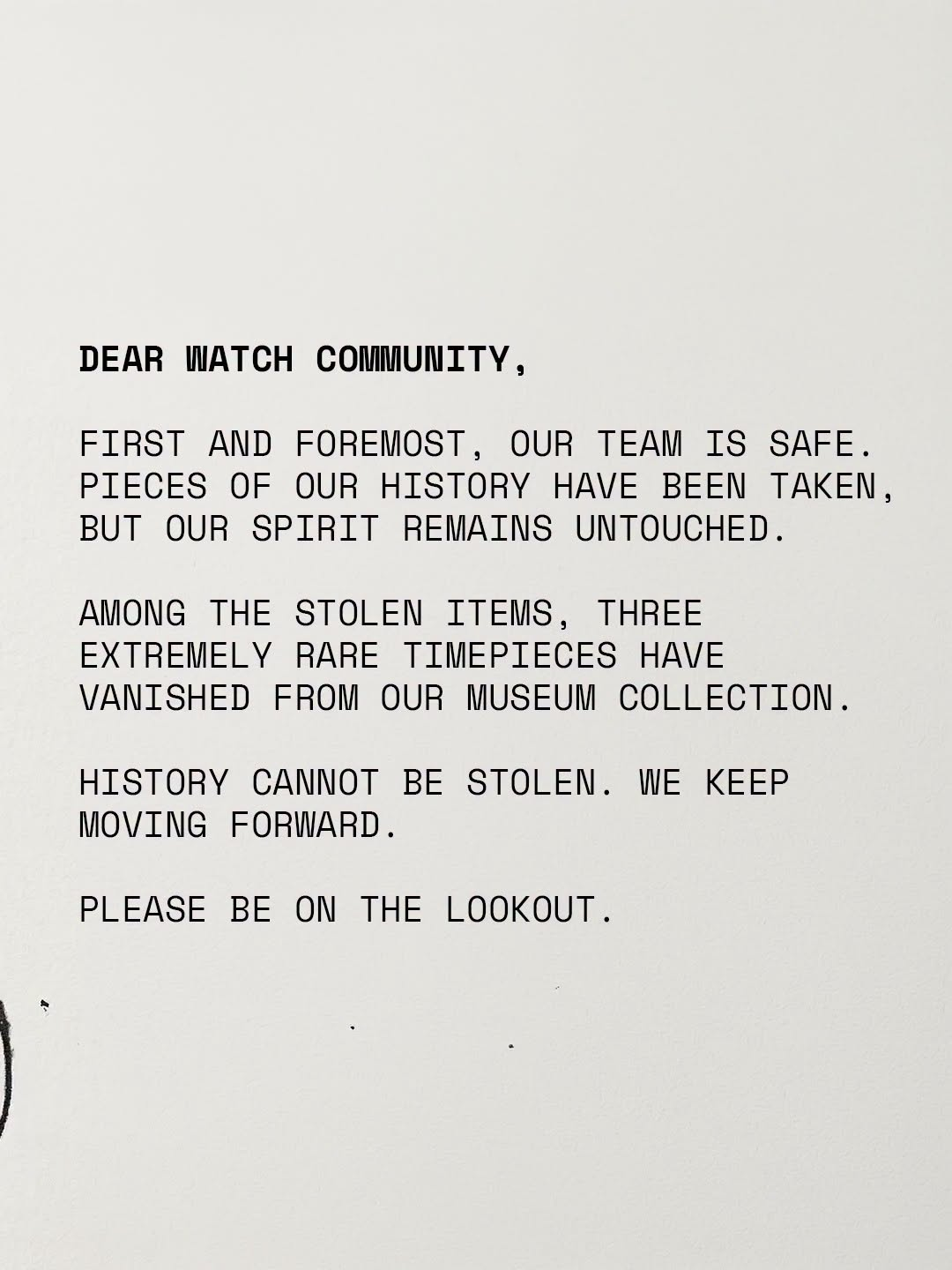
Authorities are asking anyone who may have seen suspicious people, vehicles, or activity in Le Locle between approximately 2 a.m. and 4 a.m. that morning to come forward. For now, the unanswered questions are almost as intriguing as the stolen watches themselves. How did the perpetrators know what was inside? Were they collectors' targets, or was the museum selected simply because of what it contained? And how did they manage to leave the premises after the alarm had already been triggered?
Those questions remain for investigators. There is currently no public evidence establishing who was behind the burglary or whether it was commissioned.
A Museum Hidden Inside a Watchmaking legacy
The location makes the theft particularly poignant.
Ulysse Nardin has been rooted in Le Locle since 1846 and on Rue du Jardin since 1865. The company's own historical account describes the site as evolving from a family workshop into a fully integrated manufacturer, with engineering, regulation, and production functions developing around its pursuit of precision. Today, the historic building serves another purpose: preserving that history.
The museum and archives occupy the same historic headquarters, effectively placing the physical memory of Ulysse Nardin alongside the continuing activities of the Manufacture. The company's restoration workshop is also capable of working on watches produced throughout Ulysse Nardin's history, according to the brand.
Three Pieces of History Disappear
Ulysse Nardin Pieces: Pocket Watch Grande Complication, 1927, minute repeater, chronograph, perpetual calendar, and moon phase. Movement No. 16778 Case No. 5535
Pocket watch, 1860, eight-day power reserve, Grand Feu enamel dial. Movement & Case No. 16778 Case No. 2987
Genghis Khan - 2002, Tourbillon Minute Repeater Jacquemarts Westminster Carillon Case No. 08/30

The exact number of stolen watches and their total value has not yet been established. The museum was still compiling its inventory following the burglary when the theft was reported.
But reports have identified several particularly important pieces.
Among them is an 1860 Ulysse Nardin pocket watch, fitted with a twin-barrel movement offering an eight-day power reserve and retaining its original Grand Feu enamel dial.
Another is believed to be the last pocket watch produced by the Manufacture in 1927; it was a grand complication with an 18-karat gold hunter-cased watch incorporating an extraordinary combination of a minute repeater, chronograph, perpetual calendar, and moon-phase indication.
Then there is Genghis Khan, produced in 2002.
Only 30 examples were made, and the stolen example is reported to be the final piece in that limited series. It combines a tourbillon, minute repeater, Westminster carillon, and animated Jaquemarts—an extravagant expression of the complicated watchmaking for which Ulysse Nardin became known.
These are not watches that simply have a retail price. They have provenance and historical significance. And, perhaps most importantly, they have an identity that makes them difficult to erase from the horological record.
The Genghis Khan is particularly fascinating because it embodies the more audacious side of Ulysse Nardin's modern identity. The Manufacture has never been content merely to reproduce traditional watchmaking. Its history is filled with complicated instruments that combined precision with astronomy, marine navigation, music, and mechanical animation. It is the kind of watch that makes the boundary between timepiece and mechanical sculpture disappear. And now one of the rarest examples has vanished from the very museum that preserved it.
Two Museum Thefts in One Watchmaking Town
There is another detail that makes the story even more curious.
In August, the Musée d'Horlogerie du Locle-Château des Monts, another important horological collection in the same town, was also targeted. Several historic objects were stolen in that incident. Reports of the Ulysse Nardin burglary have noted the proximity in time between the two cases.
There is, however, no confirmed connection between the two thefts, and investigators have not publicly established that they are related. Still, the coincidence is difficult to ignore.
Le Locle is not an enormous city. It is a place whose identity has been shaped by watchmaking for generations and is part of the UNESCO-listed urban landscape of the Neuchâtel region. And within this town devoted to preserving time, two collections of horological history have recently been targeted.
For now, the clock is still ticking. But nobody yet knows where the watches are.
View More Articles About: