Grieve: On Julie Lluch’s 'Lamentations, a Prelude' at ALT ART 2026
The sculpture stood quietly, but powerfully, in one of the corners of the exhibition hall at SMX Convention Center.
Published on Feb 18, 2026
“I am innocent of this man’s blood; see to it yourselves.”
—Matthew 27:24
There is a woman kneeling low to the ground. The folds of her chiton gather around her knees. Her bare feet emerge from beneath the folds. Her body leans backward with her head tilted upward. Her left hand presses firmly against her chest as if trying to hold together something that is breaking inside, while her right hand extends forward, palm open. Restrained. Her eyes are closed. The lids feel heavy. Her lips are parted just enough to suggest that she is still breathing. She is Mary, the Blessed Mother, in surrender and appeal.
On the Blessed Mother’s left is a woman standing. Her body leans slightly forward with her weight shifting and her left foot grounded. She seems to be stepping forward, or about to collapse. The drapery of her chiton clings to her body as both of her arms are raised. Her fingers spread and tensed and curved inward as if they were searching the air for, or trying to hold on to, something that is no longer there. The gesture feels almost instinctive. Animalistic. Her brows are pulled upward in the center, carving anguish into her forehead. Her eyes are wide in shock. Her lips are caught in the middle of wailing. Words must have failed her. This woman is Mary Magdalene in disbelief.
There is another woman—she’s on Mary Magdalene’s left. She’s kneeling with her left knee to the ground and her right foot steadying her weight. Both of her arms extend with the palms of her hands open as if she is inviting someone who is not there to be carried. There is a sense of immediacy from her gesture. It feels maternal. Her head inclines downward, toward that someone she is about to comfort. Her face carries the weight—the gaze lowered, the creases at the brow, the deep laugh lines around her mouth, her lips pressed together. If sculptures can cry, her tears must be falling down her face by now. Fatigued. The woman who has witnessed is Mary Cleophas.
There are traces of Niccolò dell’Arca’s "Lamentation over the Dead Christ" in three out of four women in Julie Lluch’s "Lamentations, a Prelude" (2026). Both works portray Mary, Blessed Mother, as contained, Mary Magdalene as explosive, and Mary Cleophas as supportive. Both Lluch’s and dell’Arca’s sculptural works do something that the Bible does not do—the sculptural works allow the women in the Passion of Christ to process the complexity of grief as if they are actual persons, their own selves, not just followers of Christ to His death. These are embodiments of grief.
Lamentations, a Prelude is presented by Galleria Duemila for ALT Project Spaces in ALT ART 2026. It stands quietly, but powerfully, in one of the corners of the exhibition hall in SMX Convention Center. The works exhibited in the fair are diverse and experimental—from jellyfishkisses’ "To Remember is to Love you hard" to Carlo Ortiga’s "Unstable waters" to Ben Brix and Kiri Dalena’s "Birds of Prey"—but Lluch decides to return to religious art despite having lost its appeal in contemporary art spaces. Religious art has found a niche in churches and pontifical universities. Lluch writes in her artist’s statement that she thinks “it still holds tremendous power and relevance today.” The Passion of Christ, for example, is not just about Christ’s suffering and death—from the last supper to the crucifixion. It is also a story of state power and innocence, revealing institutional complicity and civilian experience of violence—a recurring narrative centuries after.
And more than being religious art on the literal level, Lluch adds a Mary who is not in the Bible—the fourth woman.
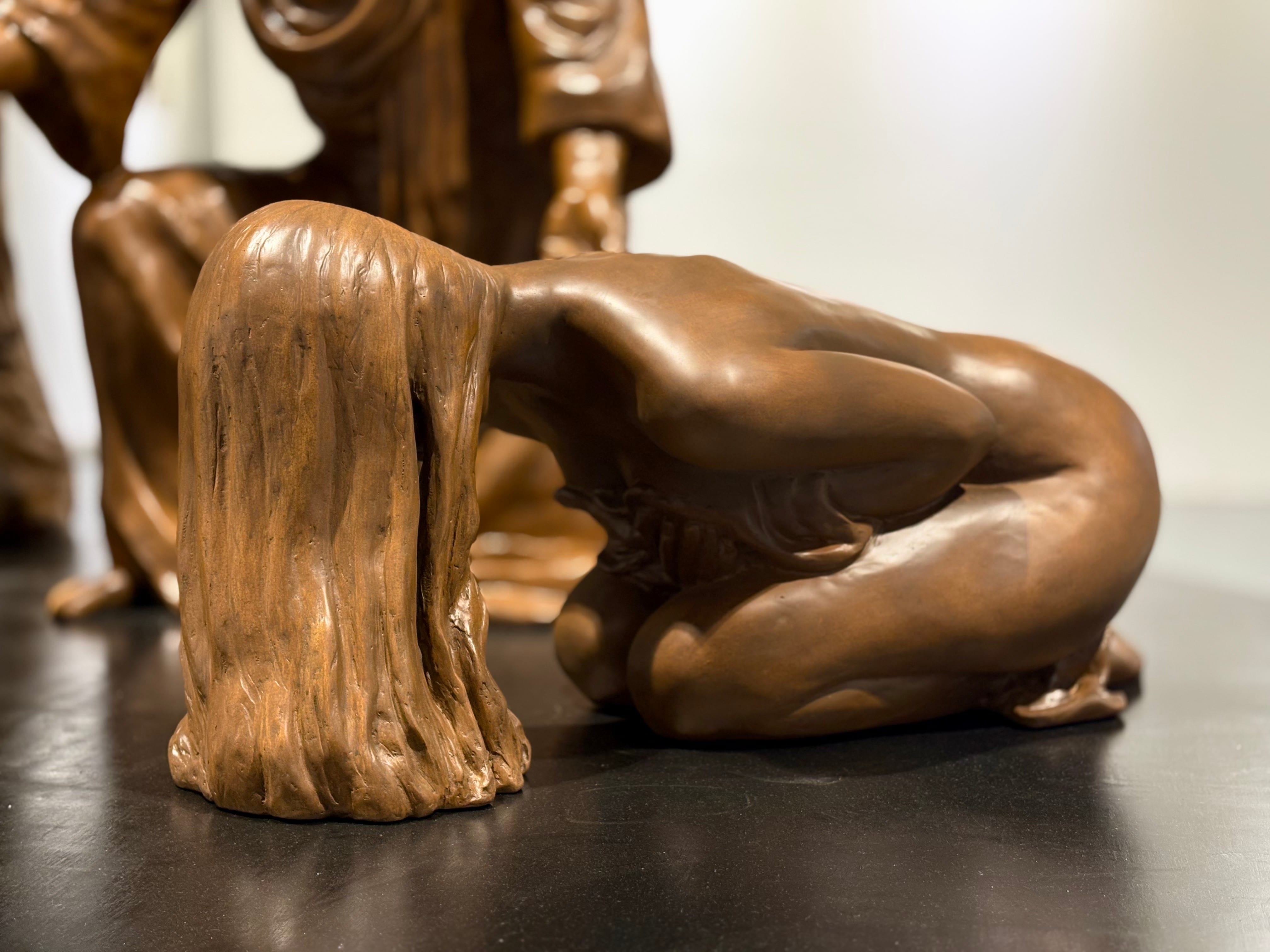
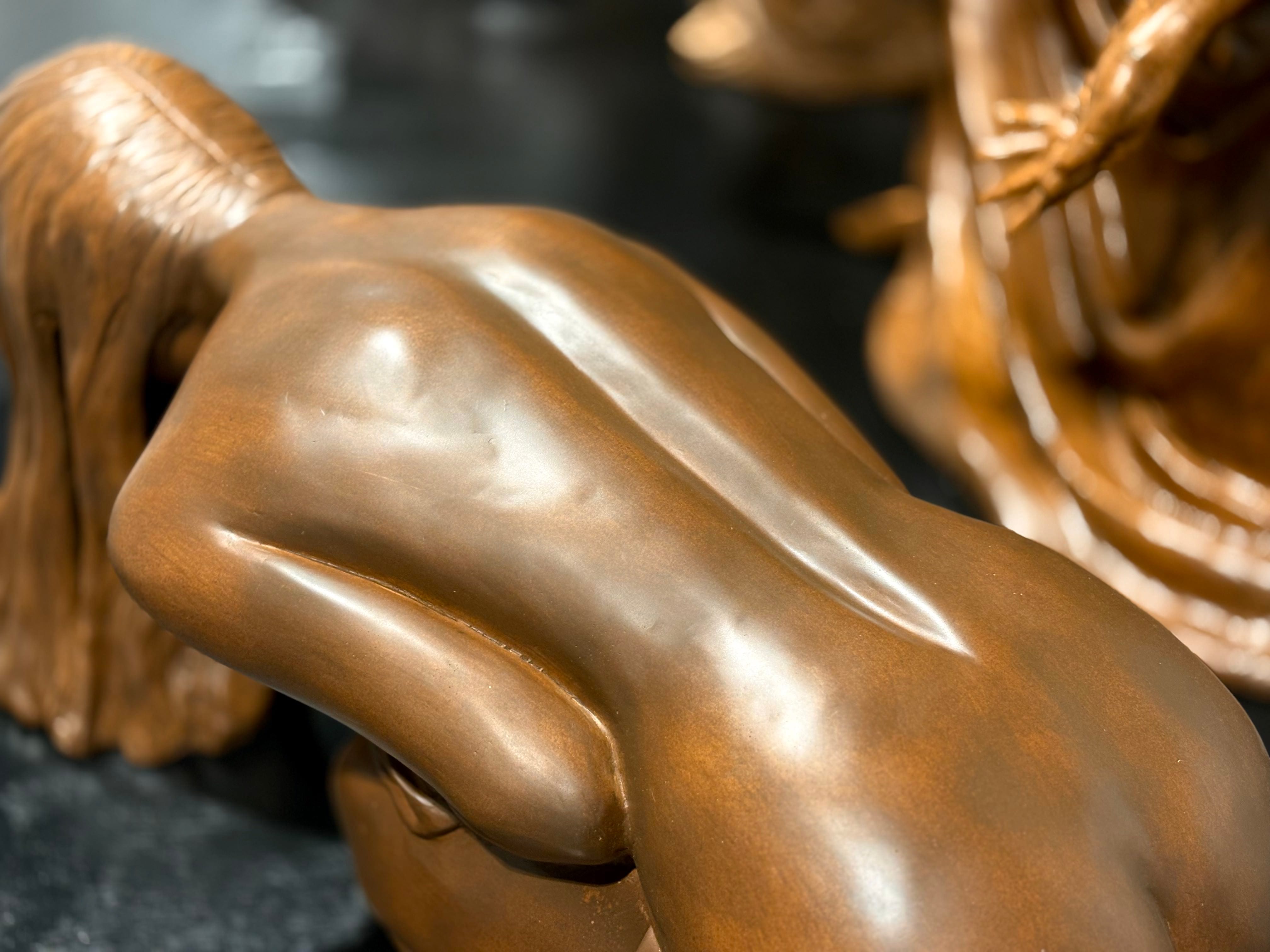
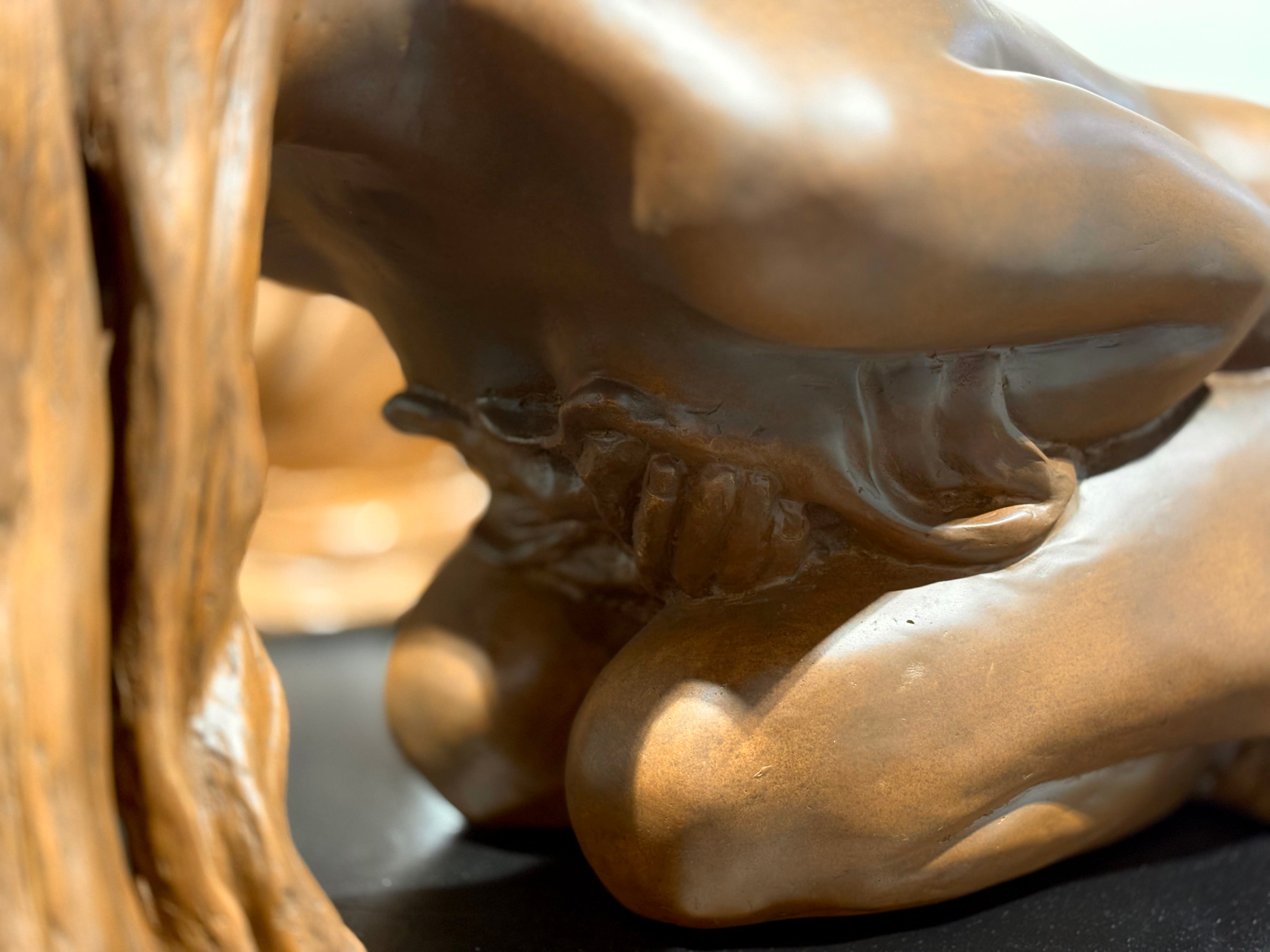
She is folded down to the ground. Her body is curled tightly inward—spine arched, knees drawn up, feet tucked, and torso collapsed over itself. Her forehead leans toward the ground as her hair spills like a curtain covering her face. Unlike the other women, we cannot see her grief. But her body, naked, becomes the very site of lament. Her hands clutch beneath her body, gripping something only she knows what it is. She looks protective of it. Self-containment.
This Mary cuts across history and culture—from the past to the present, from the local to the global. Her existence is not bound by time and space. She transcends. The fourth Mary is every grieving body. Lluch’s artistic practice has always been rooted in her activism, which she has cultivated since her younger years in the 70s. The erratic inclusion of this Mary hints that her latest work, Lamentations, a Prelude, touches on our socio-political reality today—our moral degradation. Her work is an attempt to articulate her own grief and sorrow. Is it also an attempt to share with ours?
I remember a series of photographs taken by Raffy Lerma. They are photographs of what happened before the image that resembled Michelangelo’s "Pietà" made it to the front page of the Philippine Daily Inquirer on July 24, 2016. In the series, the camera looks down from above:
The first photograph shows Michael Siaron sprawled on the asphalt. His limbs are loose, body angled diagonally across the frame. Near him is a cardboard sign, a common vigilante marker in these killings. Jennilyn Olaires approaches from the right side of the frame. Her body is upright but about to collapse. One arm reaches down toward him. Her face shows a combination of disbelief and urgency.
The second photograph shows Olaires now crouching beside Siaron. Her hands are grasping her hair. Her elbows point outward. Her torso folds inward. I remember Gustave Courbet’s "The Desperate Man" and "The Man Made Mad with Fear." Siaron’s body remains motionless. He’s dead.
The third photograph shows Olaires cradling Siaron. Her arms encircle his torso. Her body curls around his. It was the preparation for the "Pietà"-like image.
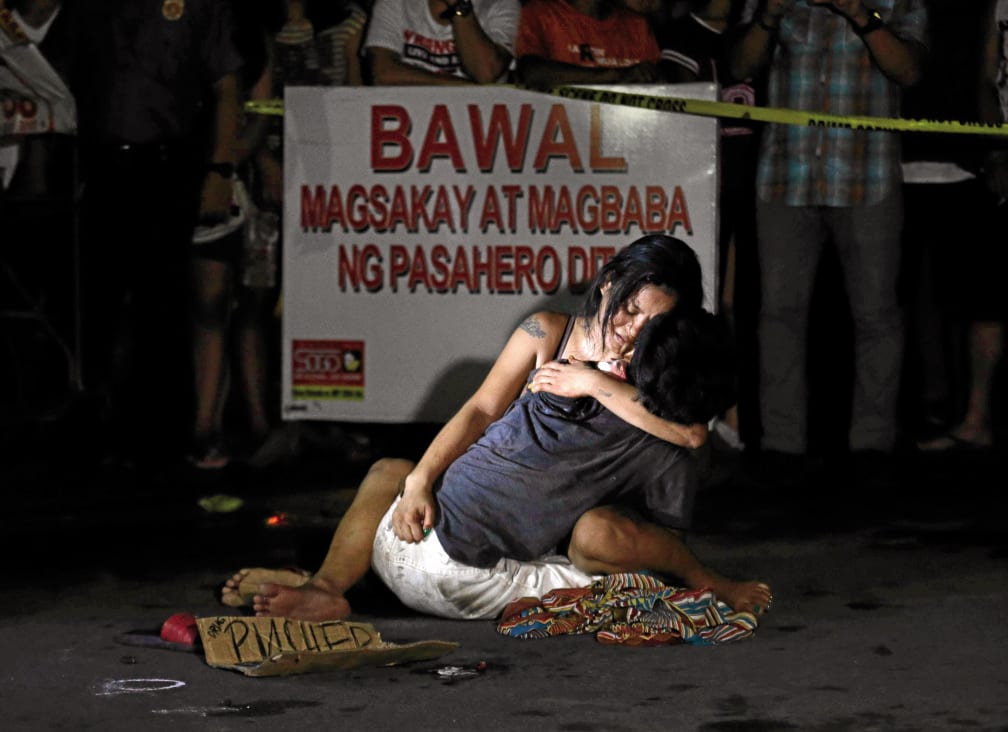
There’s a fourth photograph. The camera is now positioned high above an intersection. The city continues as usual in the upper half of the frame. Buses, taxis, and cars move through the lit streets. Traffic flows. In the lower half, there is a sharply defined spotlight. Inside that circle of light are Siaron and Olaires. Around them, police tape forms a perimeter. Officers and onlookers gather in a ring. Media photographers lean inward with cameras raised. It feels theatrical—the street becomes the stage, the crowd becomes the audience, the grieving woman and the dead man become the spectacles, all while the world beyond remains indifferent.
“…you are portrayed in a broadsheet na parang Mother Mary cradling the dead cadaver of Jesus Christ. E ‘yan ‘yang mga ‘yan, magda-dramahan tayo dito,” former President Rodrigo Duterte said in his SONA in response to Lerma’s photograph. Rosa Cordillera A. Castillo, in her essay "A Politics and Ethics of Viewing Photographs of Duterte’s Drug War," says that Duterte’s drug war was built partly on the perpetuation of a culture of impunity, which is fueled by our anxieties for our everyday security, an attitude that others the poor, and decades of demonization of drug users by influential sectors of the society like the media and the Church.
Through Lluch’s "Lamentations, a Prelude," I also remembered the photographs of many more women grieving for—because of—the indifference of the world—Mohammed Salem’s photograph of Inas Abu Maamar embracing the body of her five-year-old niece at a morgue in Gaza on October 17, 2023; Tyrone Siu’s photograph of a screaming woman detained by a police officer during a protest in Hong Kong on September 2, 2019; and Kim Kyung-hoon’s photograph of Maria Meza and her five-year-old twins running away from tear gas near the border between Mexico and the United States on November 25, 2018. These are only some of the women whose photographs filled my Facebook newsfeed.
Pontius Pilate washes his hands off the decision to crucify Jesus. “Crucify Him! Crucify Him!” the crowd demands, to which Pilate succumbs. It was the women—Mother Mary, Mary Magdalene, Mary Cleophas, and the many unnamed women—who grieved, empathized, and reached out to Jesus, to the innocent, the victims of injustice. While the Passion of Christ is about Jesus’ final moments and institutional complicity, let us not forget that it is also about those who stayed to gather the bodies left behind.
ALT ART 2026 ran from February 12 to 15 at SMX Convention Center, Mall of Asia, Pasay City.
ALSO READ:
ALT Philippines Marks Its Largest Edition Yet
Gold Leaf and Pink Fur: The Layers of a Woman’s Gaze
Amanda Juico Dela Cruz teaches in the Fine Arts Department of Ateneo de Manila University and the Literature Department of University of Santo Tomas. She was a fellow at the 20th Ateneo National Writers Workshop and the 8th Cordillera Creative Writing Workshop. She graduated with an MFA in Creative Writing and an AB in Philosophy from De La Salle University. She has published in Art+ Magazine, Beyond the Ghetto, Plural Art Mag, and Philosophia: International Journal of Philosophy. Her oeuvre of creative and scholarly works inquires from theories to write on and from the female body in the context of post-sexual revolution narratives.
View More Articles About: